CodeMark+



Lightweight annotations, contextual navigation, and developer workflows for Visual Studio Code.
CodeMark+ helps developers keep implementation context visible directly inside the editor using annotations, workspace navigation, contextual links, and Markdown-friendly workflows.
Instead of moving technical context into external systems, CodeMark+ keeps it close to the code.
Why Developers Use CodeMark+
Most projects already contain annotations like:
// TODO: remove legacy auth flow
// FIXME: websocket reconnect race condition
// NOTE: aligned with API v2
// HACK: temporary compatibility layer
The problem is that these annotations often become:
- scattered across files
- difficult to revisit later
- disconnected from implementation notes
- easy to ignore during development
CodeMark+ helps turn those annotations into visible, navigable development context without forcing heavyweight workflows or external systems.
Core Features
| Feature |
Description |
| Annotation Highlighting |
Highlight TODO, FIXME, NOTE, HACK, and custom tags directly in the editor |
| Workspace Tag Browser |
Navigate annotations across the workspace |
| Contextual Navigation |
Open files, anchors, and ranges directly from Markdown or plaintext |
| Markdown Navigation |
Navigate between notes and source code |
| Highlight Directives |
Highlight lines, ranges, or blocks using inline directives |
| Comment Templates |
Generate reusable annotation or documentation structures |
| Annotation Cleanup |
Remove annotation comments safely |
| Multi-Language Support |
Supports multiple programming languages |
| Filesystem-Native Workflows |
References and notes remain local and versionable |
Annotation Highlighting
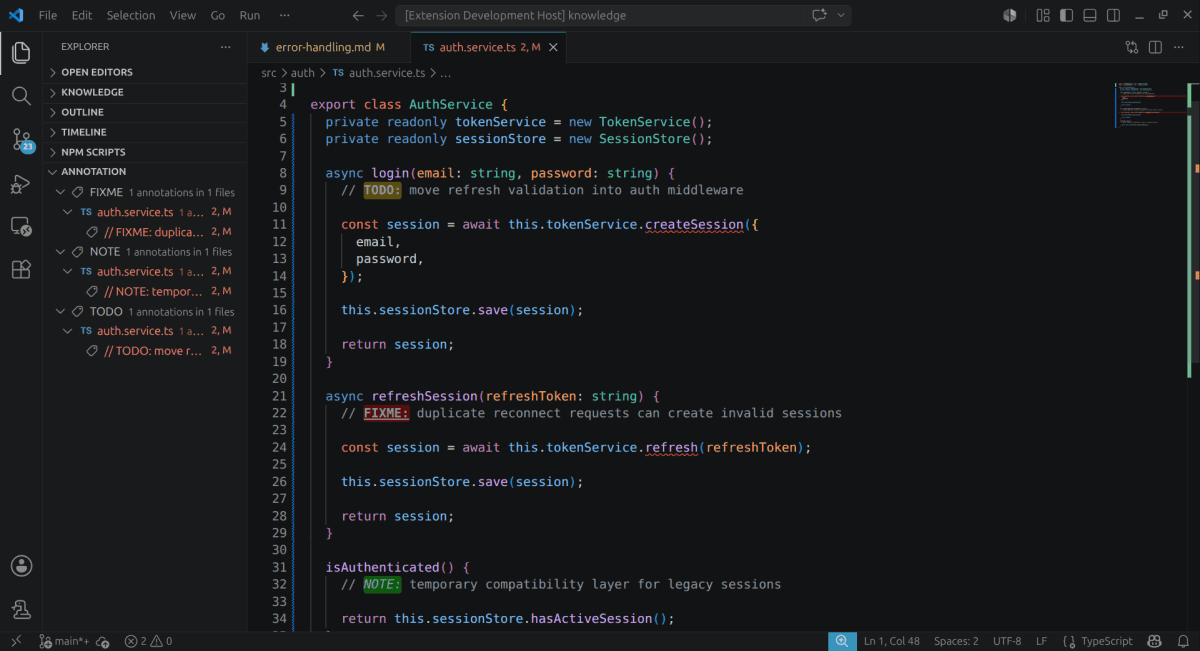
CodeMark+ highlights annotations directly inside the editor while you work.
// TODO: refactor retry strategy
// FIXME: websocket reconnect race condition
// NOTE: remove after migration
// HACK: temporary compatibility patch
Highlights update dynamically as files change and can be customized using flexible highlight rules.
Supported workflows include:
- technical debt tracking
- migration reminders
- debugging sessions
- review flows
- temporary implementation notes
- custom annotation systems
Workspace Tag Browser
The Tag Browser provides a workspace-wide view of annotations grouped by tag.
Example:
TODO
 ├── auth.service.ts
 │    └── remove retry duplication
 │
 └── cache.manager.ts
      └── optimize invalidation flow

FIXME
 └── websocket.ts
      └── reconnect race condition
The browser supports:
- click-to-open navigation
- grouped annotation visibility
- technical debt discovery
- implementation tracking
- lightweight workspace coordination
Contextual Navigation
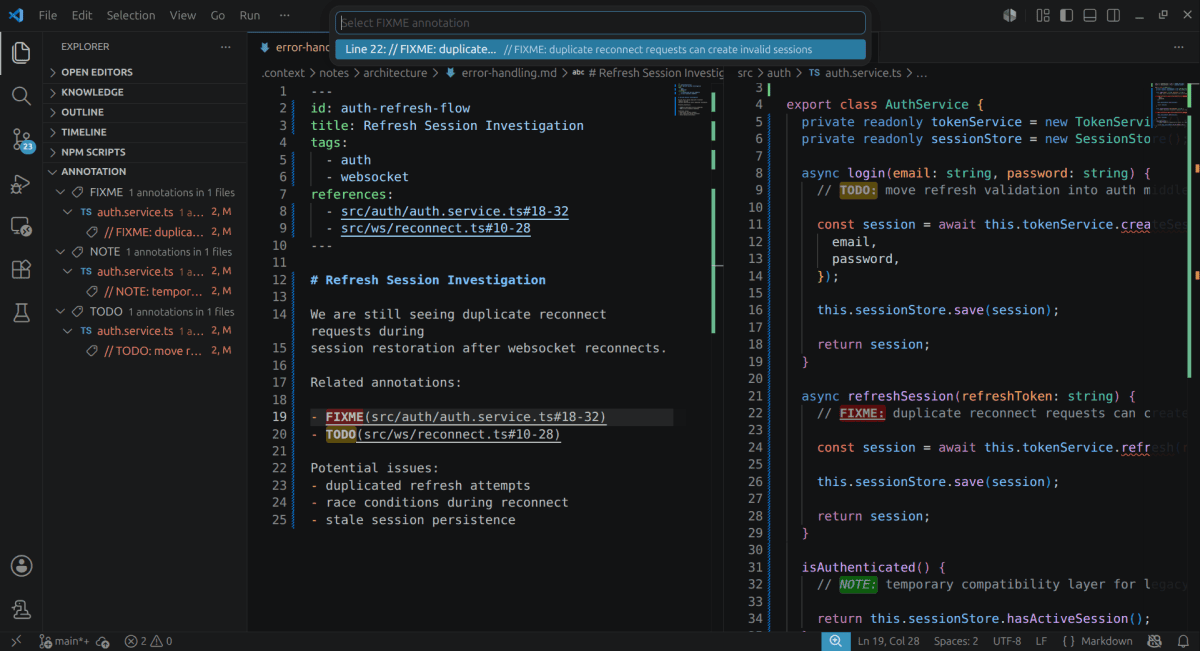
CodeMark+ supports navigation between Markdown and source code using plain-text references.
References remain portable, versionable, and editor-friendly.
Supported References
File References
src/auth/auth.service.ts
Line Anchors
src/auth/auth.service.ts#20
Explicit Ranges
src/auth/auth.service.ts#20-40
Single line anchors navigate directly to the target line, while ranges can trigger contextual annotation discovery when annotations exist within the selected range.
Annotation References
TODO(src/auth/auth.service.ts)
FIXME(src/auth/auth.service.ts#20)
NOTE(src/auth/auth.service.ts#20-40)
CodeMark+ can also discover annotations near referenced files or ranges, making it easier to reconnect notes with implementation details.
Markdown Navigation
CodeMark+ allows Markdown notes and operational documents to reference implementation context directly.
### Websocket Migration

See:
backend/ws/reconnect.ts#20

TODO(backend/ws/reconnect.ts#20-40)
Supported sources include:
- Markdown documents
- plaintext files
- task lists
- frontmatter references
- investigation notes
- implementation notes
Navigation works using:
- Ctrl+Click
- command links
- editor-native navigation behavior
References remain navigable even as files evolve over time.
Multi-Root Workspace Context
When working with multi-root workspaces, Markdown documents can optionally define a project context using frontmatter:
---
project: backend
---
This allows contextual references such as:
src/auth/auth.service.ts#20
to resolve relative to a specific workspace folder without changing the reference format itself.
If no project is specified, CodeMark+ falls back to the currently selected workspace behavior.
Highlight Directives
CodeMark+ supports inline highlight directives for visually emphasizing nearby code.
Example:
// HIGHLIGHT: line 42

// HIGHLIGHT: range 10-20

// HIGHLIGHT-BEGIN
reconnectWebsocket();
syncSubscriptions();
// HIGHLIGHT-END
Supported directives include:
| Directive |
Behavior |
line 10 |
Highlight a specific line |
range 5-10 |
Highlight a line range |
HIGHLIGHT-BEGIN / HIGHLIGHT-END |
Highlight an explicit block |
These directives are useful for:
- debugging sessions
- code walkthroughs
- onboarding
- temporary reviews
- implementation visibility
CodeMark+ supports reusable Mustache-based templates for generating annotations and documentation blocks.
Templates are customizable per language and workflow.
Example:
"codeMarkPlus.templates.customTemplates": [
  {
    "language": "typescript",
    "template": [
      "/**",
      " * {{functionName}}",
      " *",
      " * @description {{description}}",
      " */"
    ]
  }
]
Generated output:
/**
 * fetchUserProfile
 *
 * @description Retrieves the active user profile
 */
Templates can be used for:
- reusable comments
- structured documentation
- shared team conventions
- lightweight annotation workflows
- service documentation
Annotation Cleanup
CodeMark+ includes cleanup utilities for removing annotation comments safely.
Supported cleanup scopes include:
| Scope |
Description |
| All Comments |
Remove all detected single-line comments |
| Annotation Comments |
Remove annotation comments only |
| Specific Tags |
Remove comments matching specific tags |
Example workflows:
Remove all TODO annotations
Remove all FIXME annotations
Clean temporary review comments
Cleanup operations remain language-aware and respect each language's comment syntax.
Configuration
CodeMark+ is intentionally configurable while remaining lightweight by default.
The extension supports:
- custom annotation tags
- custom highlight rules
- contextual navigation behavior
- annotation templates
- Tag Browser workflows
- cleanup operations
- Markdown navigation
- multi-language behavior
Open:
Preferences → Settings → CodeMark+
to explore available settings.
Highlight Rules
Highlight behavior can be customized using annotation rules.
Example:
"codeMarkPlus.highlight.highlightRules": [
  {
    "tag": "TODO",
    "color": "#FFCC00",
    "fontWeight": "bold"
  },
  {
    "tag": "FIXME",
    "color": "#FF5555",
    "underline": true
  },
  {
    "tag": "NOTE",
    "color": "#4FC1FF",
    "italic": true
  }
]
Supported capabilities include:
- keyword matching
- regex matching
- substring matching
- per-language scoping
- priorities
- decoration styling
- overlap resolution
Special Highlight Decorations
Highlight directive decorations can also be customized.
Example:
"codeMarkPlus.highlight.specialHighlightDecoration": {
  "backgroundColor": "rgba(0,128,255,0.3)",
  "border": "1px solid blue",
  "isWholeLine": true
}
This allows teams to create visual annotation systems adapted to their workflows.
Commands
| Command |
Description |
codeMarkPlus.insertComment |
Insert annotation or template comment |
codeMarkPlus.removeSingleLineComments |
Remove annotation comments |
codeMarkPlus.replaceAnnotationTag |
Replace annotation tags in selection or file |
codeMarkPlus.openAddress |
Open contextual file references |
codeMarkPlus.tags.refresh |
Refresh Tag Browser indexing |
Example workflows:
Insert TODO annotation
Replace NOTE → FIXME
Navigate to src/auth/auth.service.ts#20
Refresh workspace annotations
Multi-Language Support
CodeMark+ supports annotation workflows across multiple languages.
Examples include:
- JavaScript
- TypeScript
- Python
- Java
- PHP
- Dart
- Go
- Ruby
- C#
- C++
- additional languages supported through configurable comment parsing
Language-aware behavior includes:
- comment syntax detection
- annotation extraction
- cleanup operations
- template generation
- contextual parsing
CodeMark+ is designed to remain lightweight during normal development workflows.
The extension focuses on:
- responsive highlighting
- bounded workspace scanning
- lightweight indexing
- deterministic behavior
- minimal workflow interruption
The runtime includes:
- file size limits
- lazy initialization
- caching strategies
- bounded indexing
- concurrency control
to avoid slowing down the editor during large workspace operations.
Typical Workflows
Technical Debt Tracking
// TODO: remove deprecated auth adapter
// FIXME: retry flow duplicates requests
Use highlighting and the Tag Browser to keep debt visible while coding.
Migration Tracking
### API Migration

backend/ws/reconnect.ts#20-40

TODO(backend/ws/reconnect.ts#20-40)
Navigate directly between notes and implementation ranges.
Temporary Debugging Sessions
// HIGHLIGHT-BEGIN
if (shouldReconnect) {
  reconnectWebsocket();
}
// HIGHLIGHT-END
Use temporary visual emphasis during investigations or reviews.
Shared Documentation Conventions
Use templates to standardize lightweight documentation across teams and repositories.
Especially useful for:
- APIs
- services
- SDKs
- reusable modules
- large codebases
Troubleshooting
If highlighting or navigation is not working as expected:
| Check |
Description |
| Highlighting Enabled |
Ensure annotation highlighting is enabled |
| Reload VS Code |
Use Developer: Reload Window |
| Output Logs |
Check Log (Extension Host) |
| Workspace References |
Verify referenced paths exist |
| Highlight Rules |
Ensure tags match configured rules |
You can also test behavior using a small file with known annotations and references.
Design Principles
CodeMark+ is designed around a few core ideas:
- annotations should stay lightweight
- references should remain plain text
- workflows should remain editor-native
- files should remain portable and versionable
- navigation should be deterministic
- integrations should remain optional
The extension intentionally avoids becoming:
- a knowledge graph
- a PKM platform
- an AI orchestration system
- a centralized documentation engine
- a mandatory synchronization framework
The goal is simple:
Keep implementation context visible, navigable, and close to the code.
Requirements
- Visual Studio Code
^1.102.0
Contributing
CodeMark+ is open-source and welcomes community contributions:
Fork the GitHub repository.
Create a new branch:
git checkout -b feature/your-feature
Make your changes, commit them, and push to your fork.
Submit a Pull Request against the main branch.
Before contributing, please review the Contribution Guidelines for coding standards, testing, and commit message conventions. Open an Issue if you find a bug or want to request a new feature.
Code of Conduct
We are committed to providing a friendly, safe, and welcoming environment for all, regardless of gender, sexual orientation, disability, ethnicity, religion, or other personal characteristic. Please review our Code of Conduct before participating in our community.
Changelog
For a complete list of changes, see the CHANGELOG.md.
Authors
See also the list of contributors who participated in this project.
Follow Me
- GitHub:

- X (formerly Twitter):

Other Extensions
Auto Barrel
Automatically generates and maintains barrel (index.ts) files for your TypeScript projects.
Angular File Generator
Generates boilerplate and navigates your Angular (9→20+) project from within the editor, with commands for components, services, directives, modules, pipes, guards, reactive snippets, and JSON2TS transformations.
NestJS File Generator
Simplifies creation of controllers, services, modules, and more for NestJS projects, with custom commands and Swagger snippets.
NestJS Snippets
Ready-to-use code patterns for creating controllers, services, modules, DTOs, filters, interceptors, and more in NestJS.
T3 Stack / NextJS / ReactJS File Generator
Automates file creation (components, pages, hooks, API routes, etc.) in T3 Stack (Next.js, React) projects and can start your dev server from VSCode.
Drizzle ORM Snippets
Collection of code snippets to speed up Drizzle ORM usage, defines schemas, migrations, and common database operations in TypeScript/JavaScript.
CodeIgniter 4 Spark
Scaffolds controllers, models, migrations, libraries, and CLI commands in CodeIgniter 4 projects using Spark, directly from the editor.
CodeIgniter 4 Snippets
Snippets for accelerating development with CodeIgniter 4, including controllers, models, validations, and more.
CodeIgniter 4 Shield Snippets
Snippets tailored to CodeIgniter 4 Shield for faster authentication and security-related code.
Mustache Template Engine - Snippets & Autocomplete
Snippets and autocomplete support for Mustache templates, making HTML templating faster and more reliable.
Recommended Browser Extension
For developers who work with .vsix files for offline installations or distribution, the complementary One-Click VSIX extension is recommended, available for both Chrome and Firefox.
One-Click VSIX integrates a direct "Download Extension" button into each VSCode Marketplace page, ensuring the file is saved with the .vsix extension, even if the server provides a .zip archive. This simplifies the process of installing or sharing extensions offline by eliminating the need for manual file renaming.
License
This project is licensed under the MIT License. See the LICENSE file for details.

