Skip to content
| Marketplace
Sign in
Visual Studio Code>Data Science>DBF Viewer — DBConvertNew to Visual Studio Code? Get it now.
DBF Viewer — DBConvert

DBF Viewer — DBConvert

DBConvert

|
2 installs
| (0) | Free
Open dBase and FoxPro .dbf tables and .dbc databases in the editor, with their memo files: long names, relations as an ER diagram, read-only SQL. No FoxPro, no ODBC, no Windows.
Installation
Launch VS Code Quick Open (Ctrl+P), paste the following command, and press enter.
Copied to clipboard
More Info

DBF Viewer — DBConvert

Open dBase and FoxPro .dbf tables and .dbc databases in the editor, with their memo files: long names, relations as an ER diagram, read-only SQL. No FoxPro, no ODBC, no Windows.

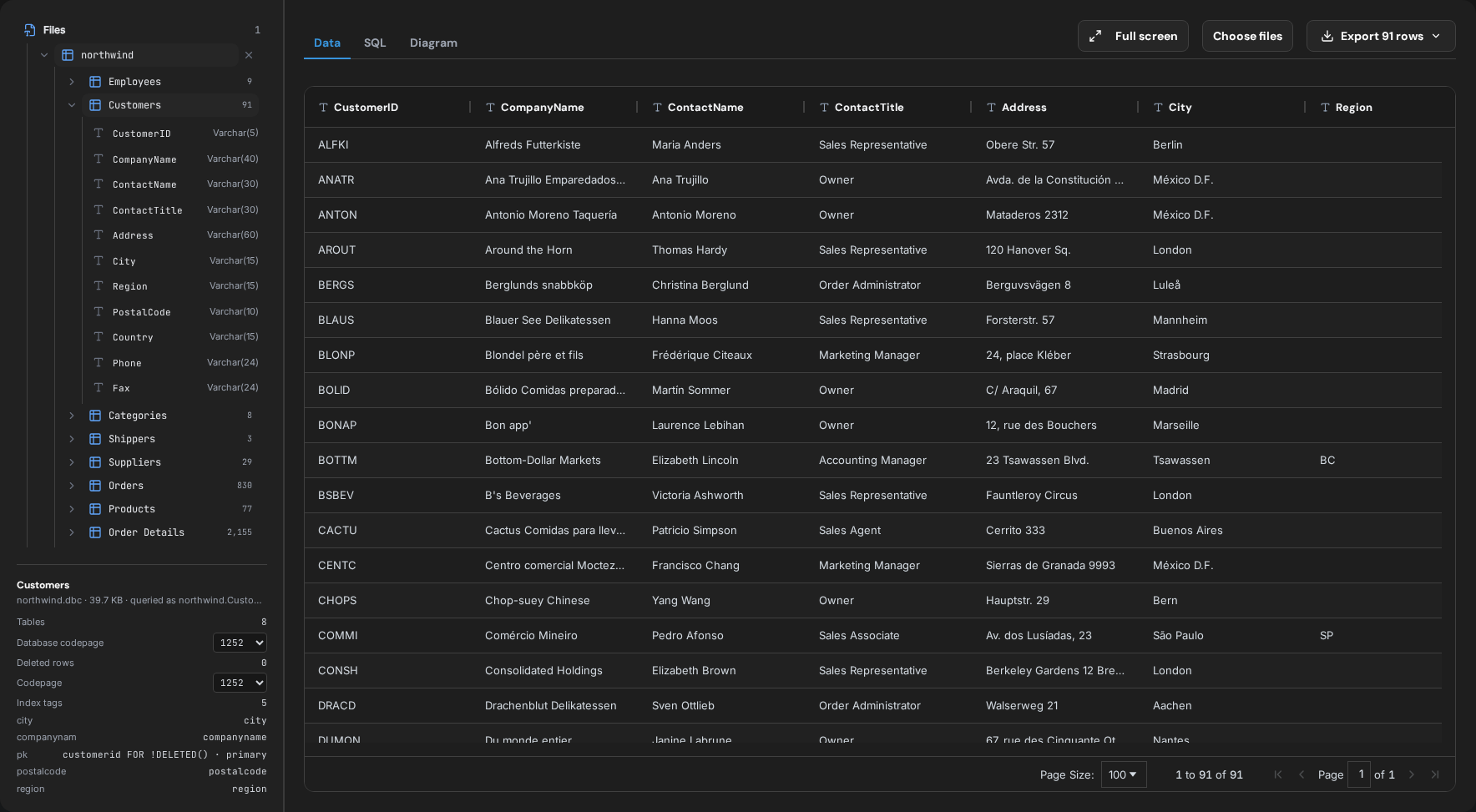
Northwind as a .dbc open in an editor tab: Customers with its rows, and its index tags in the file panel

No FoxPro. No ODBC. No Windows.

Pick a .dbf table or a .dbc database in the Explorer and it opens as a tab, on macOS, Linux or Windows. The files that belong to it come along from the same folder:

  • A .dbf brings its memo file (.fpt or .dbt) and its index (.cdx)
  • A .dbc brings its .dct and .dcx, and every table it names, each with its own memo and index

A memo file that is missing does not stop the table: its memo columns load empty and are named.

What it shows

  • Free tables from dBase III and IV, FoxPro 2 and Visual FoxPro, and .dbc databases
  • Every column with its FoxPro type — Character, Varchar, Numeric, Currency, Date, DateTime, Logical, Integer, Double, Memo, General, Blob, Varbinary — and NULLs where the table allows them
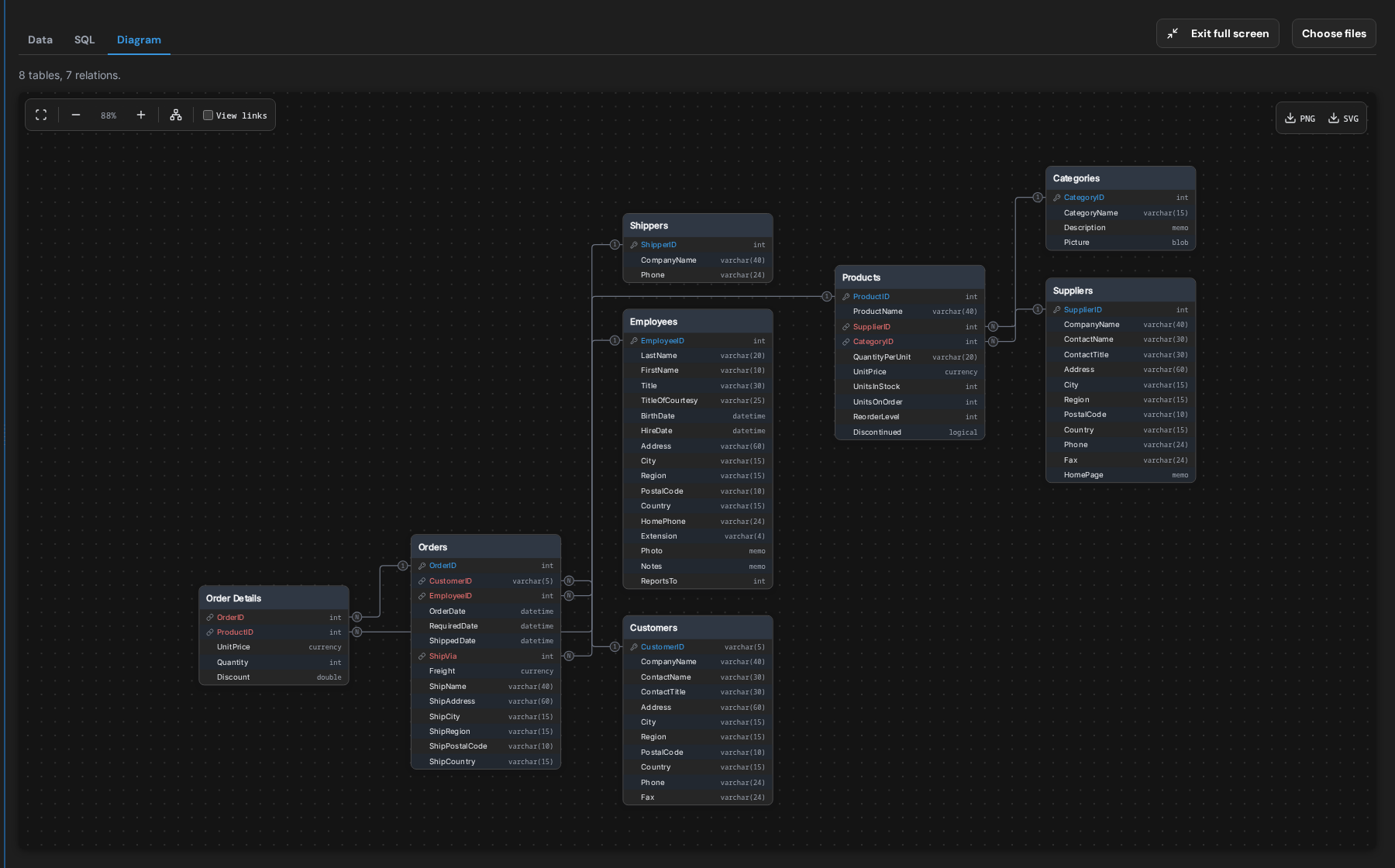
  • From a .dbc: long table and column names, primary keys, and relations, drawn on the Diagram tab
  • The index tags from the .cdx, with their expressions and which one is the primary key
  • Deleted rows hidden, as FoxPro hides them, with their count
  • The codepage from the table's header. A table with no codepage mark opens as 1252, and you can pick another one; the table is read again with it.

The relations of the Northwind .dbc, drawn on the Diagram tab

Read-only SQL over the tables

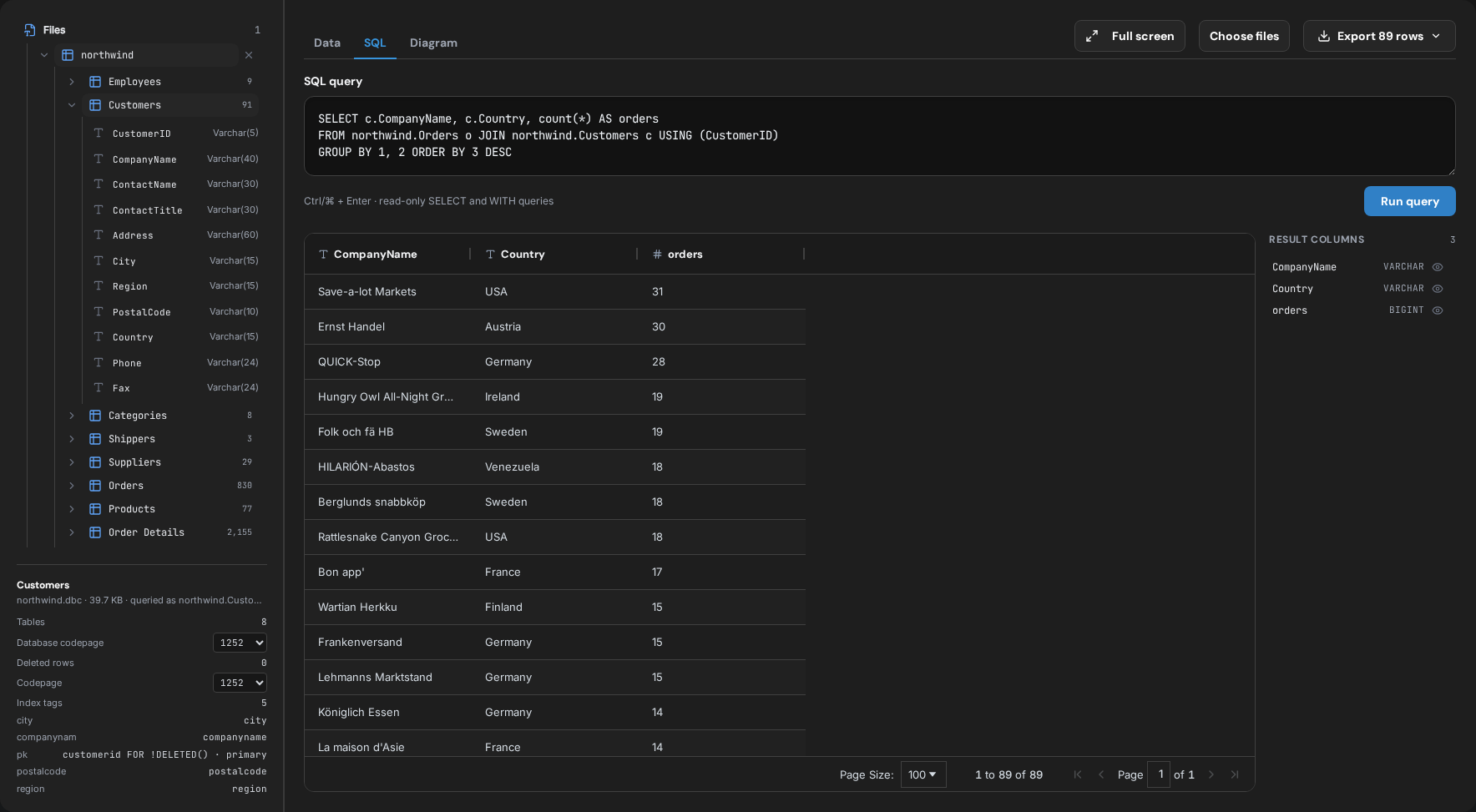
Each opened table or database becomes a schema named after its file, so a query reaches every table in it:

SELECT c.CompanyName, c.Country, count(*) AS orders
FROM northwind.Orders o JOIN northwind.Customers c USING (CustomerID)
GROUP BY 1, 2 ORDER BY 3 DESC

Orders per customer, joined across two tables of the Northwind .dbc

SELECT and WITH … SELECT only, in DuckDB's SQL rather than FoxPro's.

Every table pages to its last row. Export a result as CSV, JSON or Parquet: the first 10,000 rows free, the whole result with PRO.

Where the file goes

Nowhere. The editor reads it from disk and hands it to the panel; the panel parses it with WebAssembly in the editor itself. There is no account and no remote server. The one port the extension opens is the local one AI agents use (below), bound to 127.0.0.1 and closed by a token.

Ask AI about the open file

The file tab has an Ask AI about this file button. It opens the editor's own agent chat with the question already typed — "What is in northwind.dbc? Use the DBConvert viewer tools to look at its tables and data." — and the agent answers from the file, not from a guess.

The agent gets three read-only tools: list the tables of the files open in the viewer, describe a table, and run one SELECT. Each query it runs shows in the viewer, and a result comes back as at most 100 rows with the full row count.

Where each agent gets the tools from:

  • VS Code with Copilot Chat — nothing to set up. The tools are part of the chat.
  • Cursor — nothing to set up. The extension adds its server to Cursor's MCP list. Cursor asks before each tool call unless you allow it.
  • Claude Code and Codex — run Connect agent to open files from the Command Palette once. It adds the server to the agent's config and prints the first question to ask. Quit Codex before you connect it: a running Codex rewrites its config and drops the entry.
  • Windsurf, Cline, Roo, Kilo, Gemini CLI, Continue and others — the same command shows the config to paste: a JSON block, or the address and header.

In an editor with no agent chat to open, the button copies the question and offers Connect.

One server serves every open editor window and every installed DBConvert viewer, so an agent sees all the files you have open. Reset MCP token issues a new token; connected agents need Connect again after it.

The viewer never talks to a model itself. What the agent reads — table names, columns, the rows its queries return — goes to whichever model that agent uses.

The other viewers

Same viewer, one per format — install only the one you need, so a SQLite user never downloads the Parquet engine.

  • SQLite Viewer — VS Code · Open VSX · Chrome
  • Parquet Viewer — VS Code · Open VSX
  • JSONL Viewer — VS Code · Open VSX
  • MDB and ACCDB Viewer — VS Code · Open VSX
  • PostgreSQL Dump Viewer — VS Code · Open VSX

Built by DBConvert. The same viewer runs in a browser tab at streams.dbconvert.com/dbf-viewer if you would rather not install anything.

  • Contact us
  • Jobs
  • Privacy
  • Manage cookies
  • Terms of use
  • Trademarks
  • Your Privacy Choices
  • Consumer Health Privacy
© 2026 Microsoft