f4data — Data Dictionary for VS Code
📊 f4data brings your data dictionary into VS Code. Instantly explore dictionaries, tables, variable definitions, and documentation — right in your editor. Ideal for credit analysts, quants, and model risk teams focused on model governance and data onboarding.
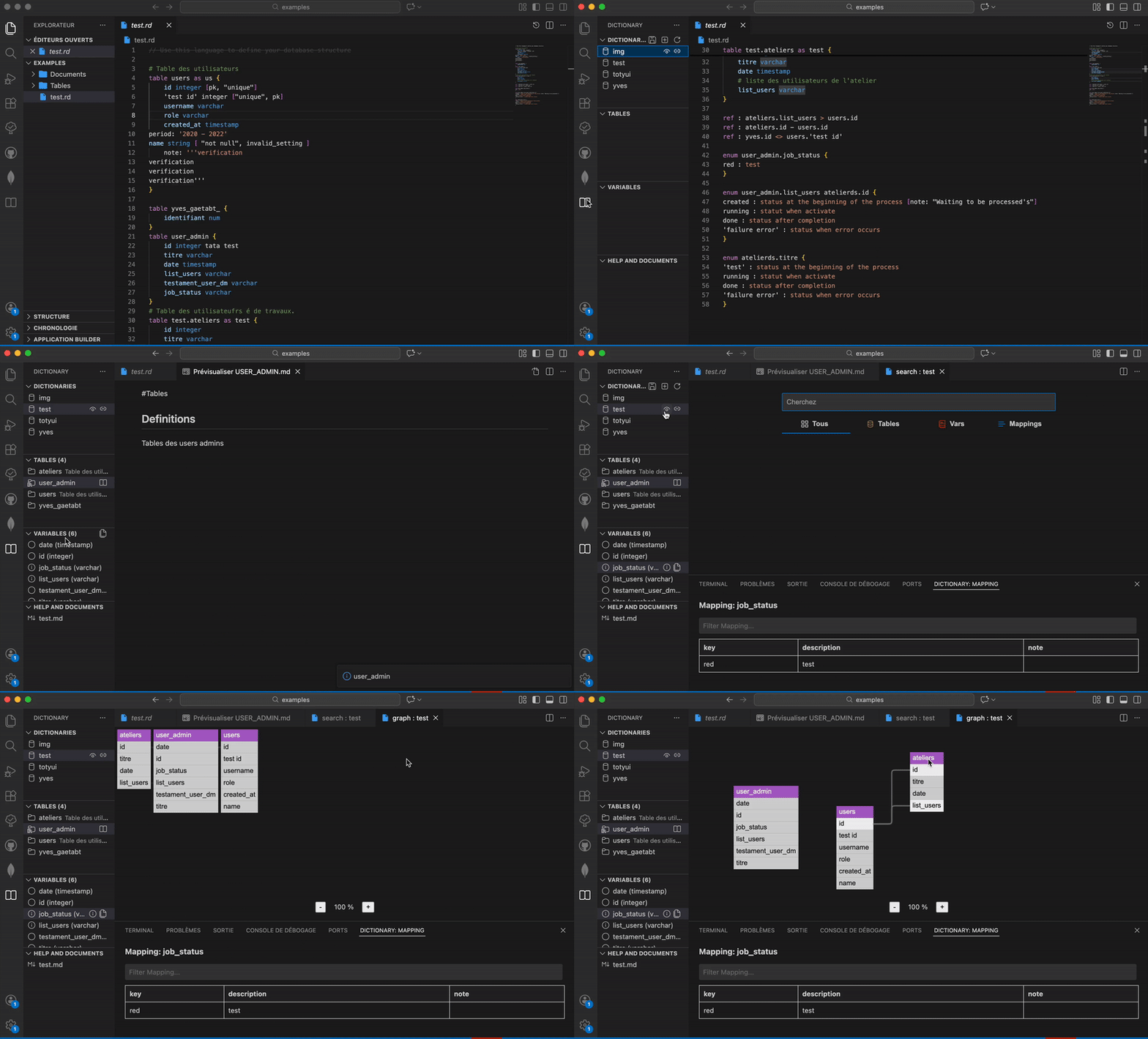
Table of Contents
Features
f4data enables seamless data dictionary management within VS Code:
- 📚 Navigate Dictionaries — List and explore multiple dictionaries with ease
- 📊 Visualize Tables — Interactive canvas view with zoom, pan, and intelligent layout
- 🔍 Explore Variables — Browse all columns, types, constraints, and mappings per table
- 📖 Markdown Documentation — Attach rich documentation to tables and dictionaries
- 🔗 Define Relationships — Create foreign keys and multi-table relationships with visual links
- 📥 Export to Excel — Generate formatted data sheets from your schema definitions
- ⚙️ Manage Workspace — Set working directories and persist configuration per dictionary
- 🔄 Real-time Updates — Reload dictionaries on file changes (with refresh command)
Installation
Via VS Code Marketplace (Recommended)
- Open VS Code
- Go to Extensions (Ctrl+Shift+X / Cmd+Shift+X)
- Search for f4data
- Click Install
- Reload VS Code if prompted
Direct Link
Install f4data from VS Code Marketplace
Getting Started
Step 1: Create a Dictionary Folder
Create a new folder for each data dictionary you want to manage:
my_database/
├── Documents/        # General documentation (optional)
├── Tables/           # Table-specific docs (optional)
└── schema.rd         # Table & relationship definitions (required)
Step 2: Define Your Schema
Create a .rd file (e.g., schema.rd) and define your tables:
# Table for all the users
TABLE users {
  id integer [PK]
  username varchar
  email varchar
  created_at date
  role varchar
}

TABLE orders {
  id integer [PK]
  user_id integer
  total float
  status varchar
  created_at date
}

TABLE order_items {
  id integer [PK]
  order_id integer
  product_id integer
  quantity integer
  price float
}

enum user_role {
  admin: Administrator
  editor: Can modify
  viewer: Read-only
}

enum order.status {
  pending: Awaiting payment [note: "Waiting to be processed's"]
  paid: Payment confirmed
  shipped: In transit
  delivered: Delivered
  cancelled: Cancelled
}

ref: orders.user_id > users.id
ref: order_items.order_id - orders.id
Step 3: Add Documentation (Optional)
Create markdown files to enhance your data dictionary:
Documents/ folder — Store general documentation (Change logs, modus operandi, etc.)Tables/ folder — Store table-specific documentation (naming conventions, business logic, examples)
Example structure:
my_database/
├── Documents/
│   ├── Change_Log.md
│   ├── Architecture.md
├── Tables/
│   ├── users.md
│   ├── orders.md
└── schema.rd
Step 4: View in VS Code
- Open your workspace containing the dictionary folder
- Look for f4data in the Explorer sidebar (or use View > Open View)
- Click on your dictionary to expand it
- Explore tables, variables, and documentation
The .rd (Reference Data) file is a custom format for defining your data schema.
Syntax Overview
Tables
TABLE table_name {
  column_name: type [CONSTRAINTS]
  another_column: type
}
Supported Types:
integer, float, booleanvarchar, text, stringtimestamp, date- (Custom types supported)
Constraints:
Mappings (Enums)
enum mapping_name {
  key1: "Description 1"
  key2: "Description 2"
  key3: "Description 3"
}
Relationships
ref: table1.column - table2.column
Special Rules
Supported File Types
| Format |
Purpose |
Status |
.rd |
Schema definitions (tables, variables, mappings, relationships) |
✅ Fully supported |
.md |
Documentation (markdown) for tables and dictionaries |
✅ Fully supported |
.pdf |
PDF documentation |
🔄 Planned |
Configuration
Settings
Access settings via Preferences > Settings > f4data:
f4data.excel.tableHeaderExcelColor.default — Header color for default tablesf4data.excel.tableHeaderExcelColor.tables — Header color for table sheets- (More settings available in
package.json)
Working Directory
For each dictionary, you can set a working directory via:
- Right-click dictionary in explorer
- Select Update Working Directory
- Enter the path to your data files
Commands
| Command |
Description |
f4data.refreshDictsDir |
Reload all dictionaries |
f4data.addDictionaries |
Add a new dictionary |
f4data.exportToExcel |
Export schema to Excel |
f4data.clickOnDicItem |
Navigate to dictionary item |
Troubleshooting
Dictionary Not Appearing
Problem: Your dictionary folder doesn't appear in the f4data sidebar.
Solutions:
- Ensure your folder contains a
.rd file
- Check that the folder structure matches the expected format
- Run f4data: Refresh Dictionaries command (Cmd+Shift+P / Ctrl+Shift+P)
- Reload VS Code (Cmd+R / Ctrl+R)
Syntax Highlighting Not Working
Problem: .rd files don't have syntax highlighting.
Solution:
- Ensure the extension is installed correctly
- Manually set file language: Click language indicator (bottom-right) → Select "f4data"
Mappings Not Linking
Problem: Variables with [ref: ...] don't show the mapping.
Solution:
- Ensure the mapping name matches exactly (case-sensitive)
- Verify the mapping is defined in the same
.rd file
Problem: Canvas is slow or unresponsive with 50+ tables.
Solutions:
- Hide large tables using underscore suffix (
table_name_)
- Use the table search feature to filter visible tables
- Ensure your system has adequate memory
Report Issues
Found a bug or have a feature request? Open an issue on GitHub
Roadmap
- [x] View dictionaries and tables
- [x] Visualize table relationships
- [x] Export to Excel
- [ ] Multi-language support
- [ ] Advanced search filters
License
This project is licensed under the Non-Commercial Use License — see the LICENSE file for details.
About
f4data is built by Yves for teams that need clarity in their data landscape. Perfect for credit risk analysts, quants, and model governance teams.
Keywords: Data Dictionary, VS Code Extension, Data Governance, BCBS 239, SR 11-7, Credit Risk, Quant Finance, SAS
Support
Happy data exploring! 🚀