Skip to content
| Marketplace
Sign in
Visual Studio Code>Data Science>Smart Data Viewer — AI Data WorkspaceNew to Visual Studio Code? Get it now.
Smart Data Viewer — AI Data Workspace

Smart Data Viewer — AI Data Workspace

vnstocks.com

|
53 installs
| (0) | Free
Explore CSV, JSON, Excel, Parquet, SQLite, DuckDB and more with AI context, EDA, SQL, annotations, and rich in-editor previews.
Installation
Launch VS Code Quick Open (Ctrl+P), paste the following command, and press enter.
Copied to clipboard
More Info

Smart Data Viewer

VS Code Extension Open VSX License: GPL-3.0

The AI-native data workspace for VS Code and Antigravity. Open the files your code and AI agents produce, understand them as tables, trees, databases, or documents, and turn the exact data you care about into useful AI context—without leaving the IDE.

Smart Data Viewer

Smart Data Viewer is not another single-format CSV plugin. It is the missing interaction layer between AI coding and data artifacts:

Open an artifact → inspect it visually → profile or query it
                 → select the evidence → send it to AI → preserve the insight

Why this extension exists

Modern development with AI is no longer a text-only workflow. Agents generate test fixtures, API responses, extracts, workbooks, Parquet files, local databases, HTML reports, and documents. Yet the IDE experience is still fragmented: binary formats open in external apps, every data type asks for another extension, and popular viewers often stop at rendering a file or editing a cell.

That breaks the flow precisely when the next step is to understand an output, point out an anomaly, or give an AI agent the right evidence.

Smart Data Viewer was built from a data practitioner's mental model. If a Pandas DataFrame can serialize or flatten almost anything into a table, the IDE should make that representation immediately useful. And if Exploratory Data Analysis can reveal schema, missingness, ranges, and suspicious values in seconds, those insights should sit next to the data—not in a separate notebook or heavyweight desktop tool.

The result is one focused workspace where developers, analysts, data engineers, and AI-first teams can move from file to understanding to action with far less friction.

What makes it different

Turn a selection into precise AI context

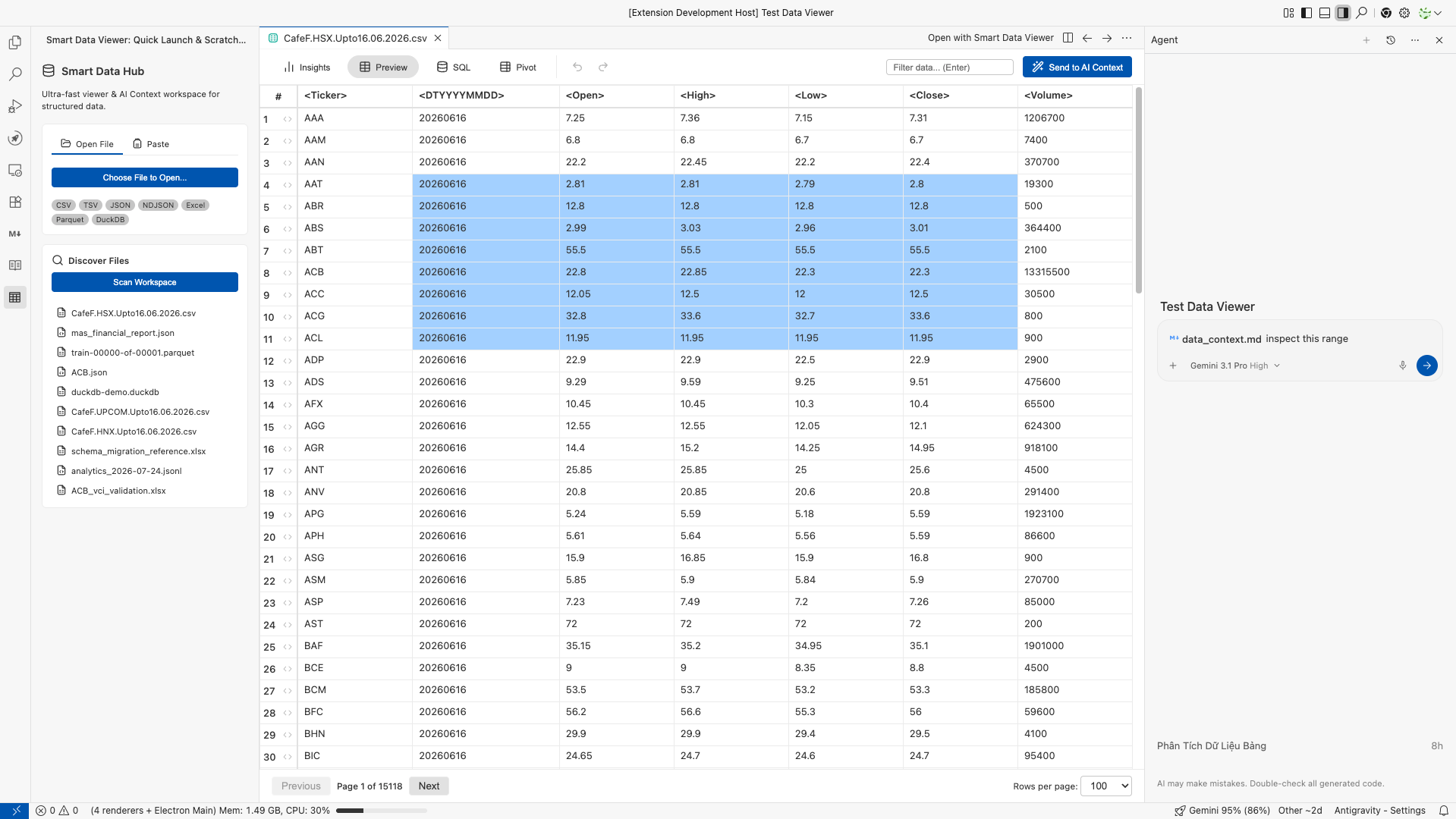
Select cells, rows, columns, or a range in the grid and choose Send to AI Context. Smart Data Viewer converts the selection into a compact Markdown table with headers and row indices, so the agent receives structure and meaning instead of an opaque file dump.

  • Single-cell, row, column, range, and non-contiguous selections
  • Automatic header inclusion
  • Pandas-style or spreadsheet-style row indices
  • JSON subtree context with its object path
  • Direct antigravity.addContext integration in Antigravity IDE
  • Clipboard fallback when the Antigravity context API is unavailable

This excerpt-first approach keeps prompts focused and avoids spending context on an entire dataset when only a few records matter.

Understand the dataset before asking AI

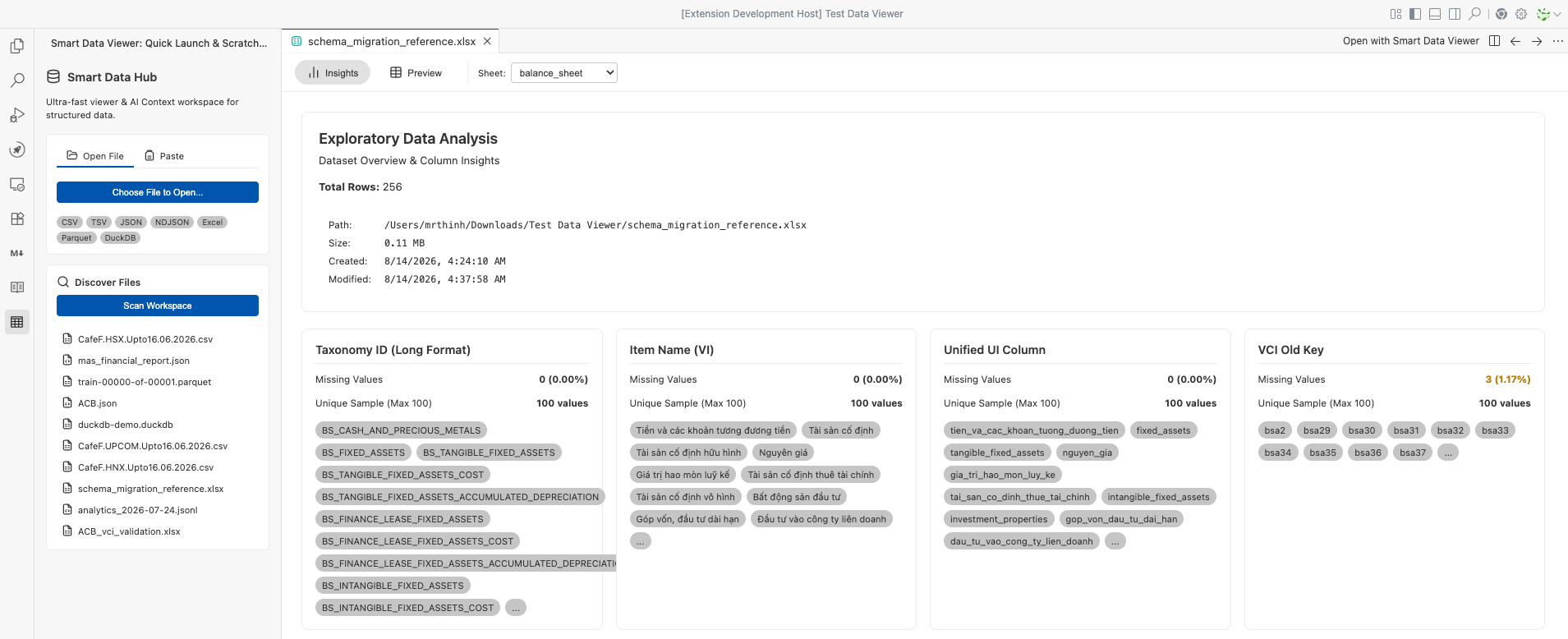
The built-in Insights panel performs background EDA and surfaces:

  • Row count and file metadata
  • Missing-value counts and percentages
  • Numeric min, max, mean, median, Q1, and Q3
  • Up to 100 sampled unique values per column
  • Column-level summaries that help reveal schema issues and outliers quickly

Dataset insights

Query data without leaving the editor

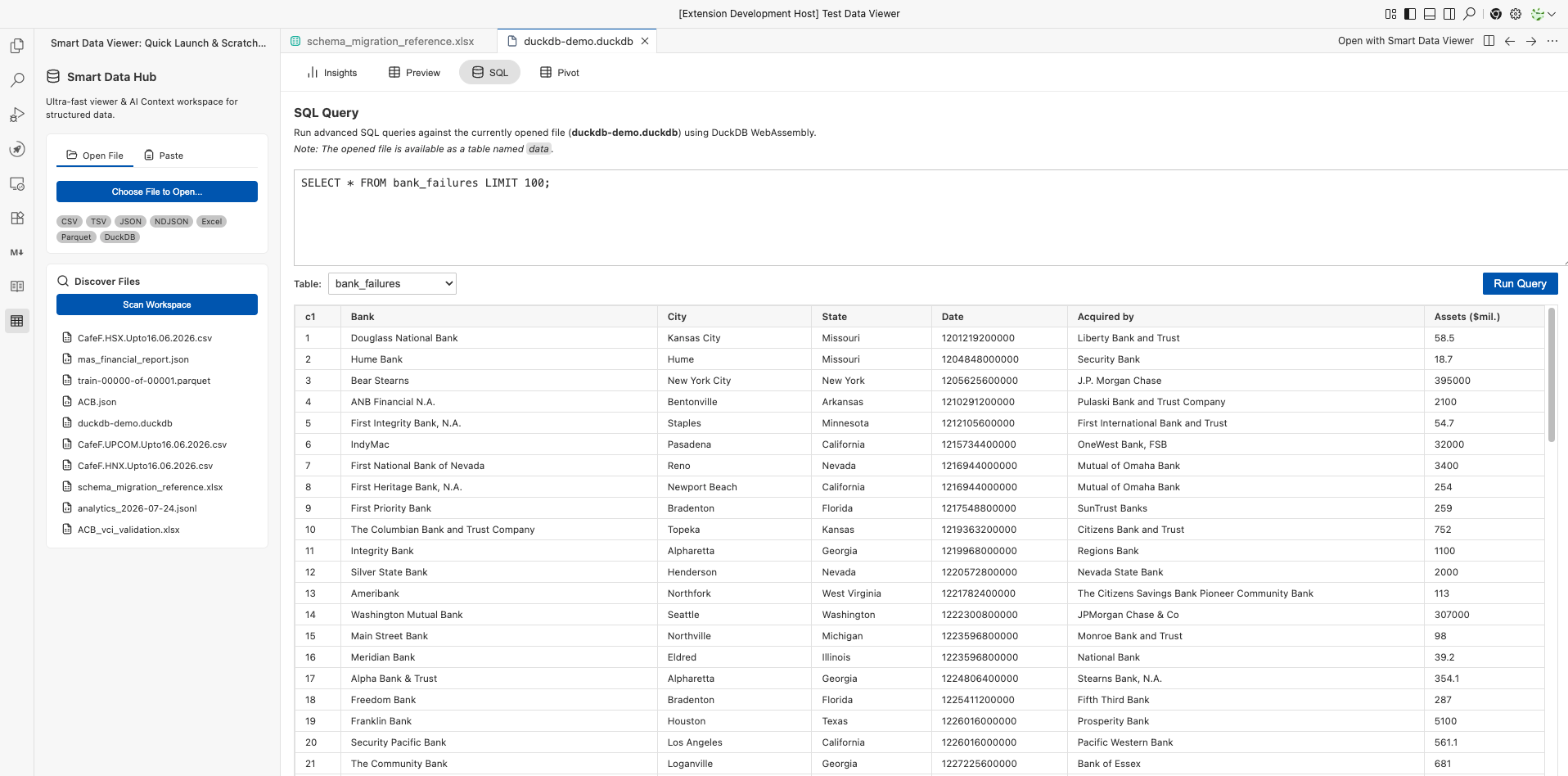
For CSV and DuckDB workflows, DuckDB WebAssembly adds an analytical layer directly inside the webview:

  • Run ad-hoc SQL queries
  • Browse tables in a DuckDB database
  • Preview query results in a grid

No external database server is required.

View the SQL query screenshot

SQL query panel

Keep analysis beside the data, not inside it

Add notes to a selected range or maintain a longer Markdown annotation for the file. Workspace annotations are stored under .tmp/notes/ with a source reference, leaving the original dataset untouched.

This is useful for:

  • Tagging anomalies and records that need review
  • Preserving AI findings and human decisions
  • Leaving context for teammates without adding columns to source data
  • Keeping an analysis trail next to the workspace

Stay responsive on large delimited files

CSV and TSV files are indexed by byte offset in the extension host, then loaded lazily in 100-row pages. The webview parses only the current page instead of loading the whole delimited file into the UI. CSV profiling runs separately in background chunks, keeping navigation responsive while Insights are prepared.

One viewer, many artifacts

Format Experience
.csv Paged data grid, filtering, current-page sorting, background EDA, SQL, selection-to-AI, annotations
.tsv Paged data grid, filtering, current-page sorting, SQL, selection-to-AI, annotations
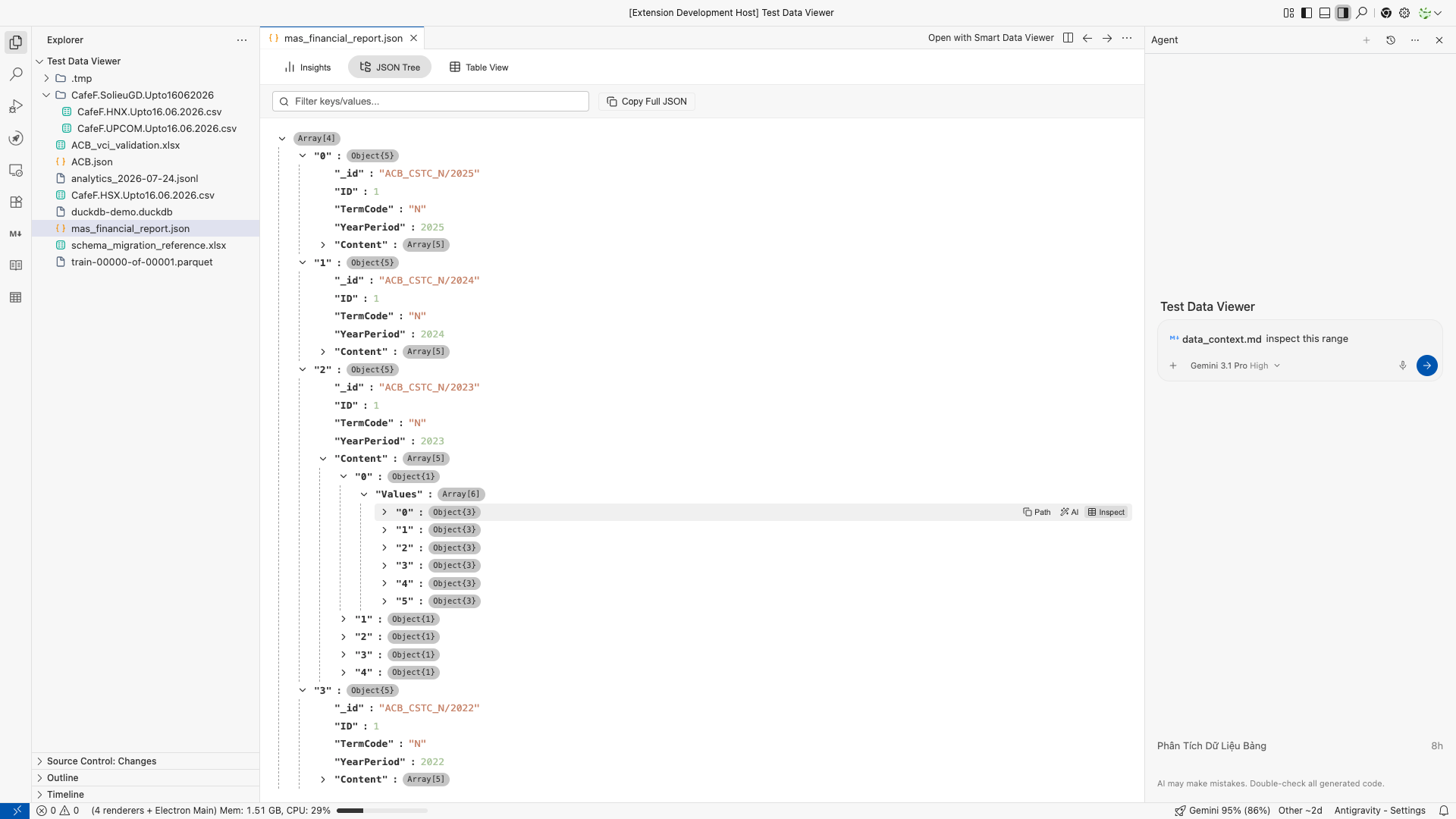
.json, .jsonl, .ndjson Table view, expandable tree view, filtering, EDA, subtree-to-AI
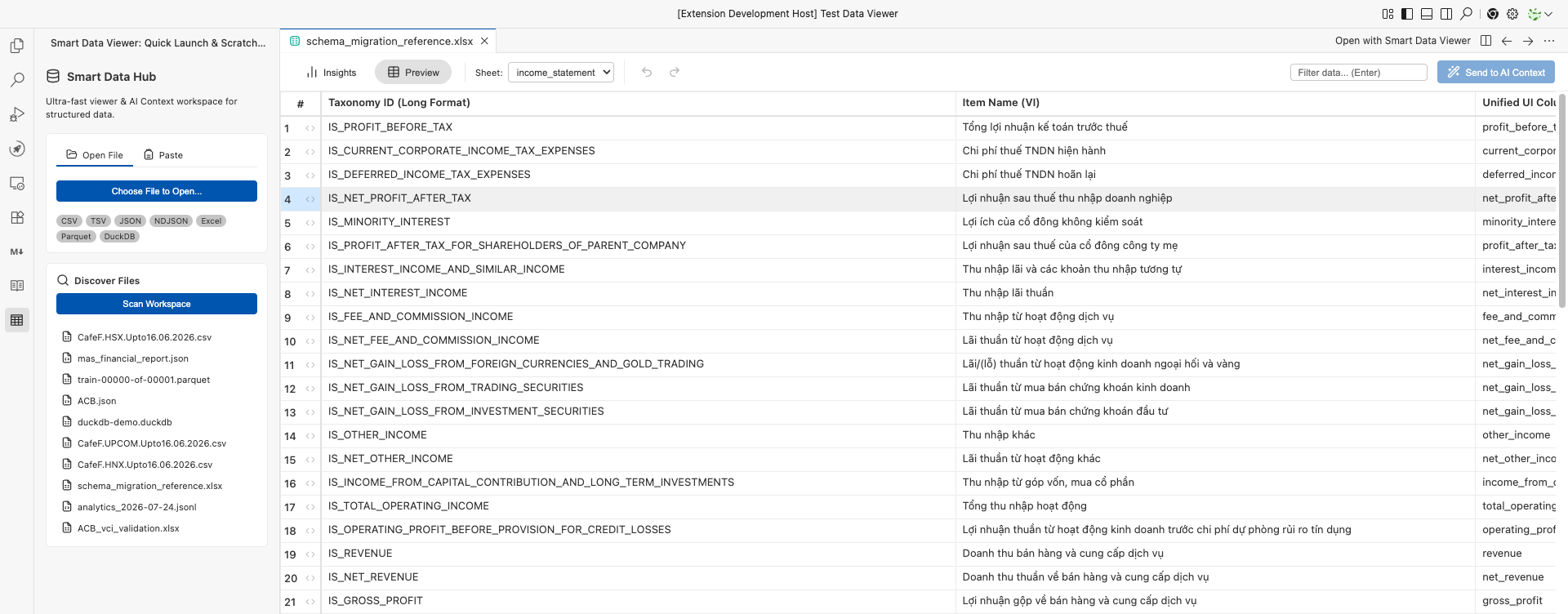
.xlsx, .xls Spreadsheet grid, multi-sheet switching, filtering, EDA, selection-to-AI
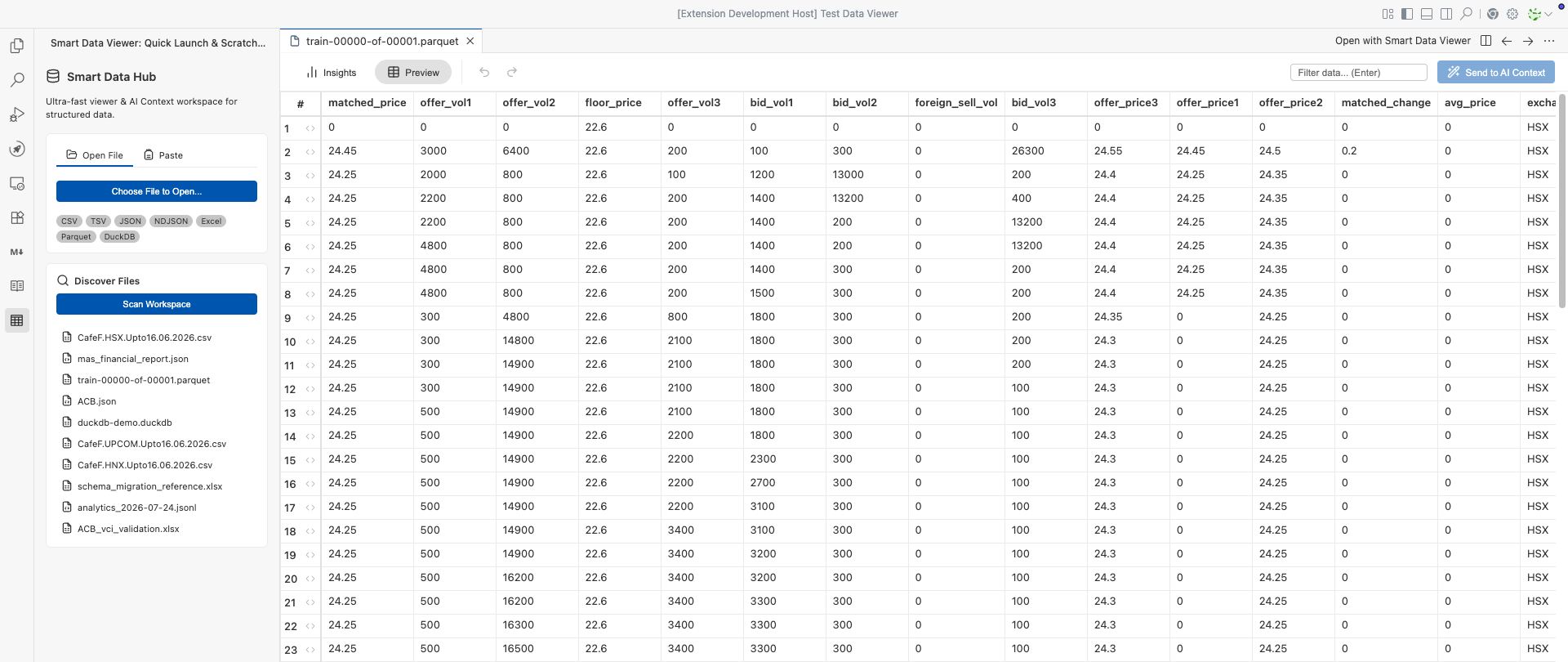
.parquet Typed-column grid, filtering, EDA, selection-to-AI
.duckdb Table browser, 1,000-row preview, SQL queries, selection-to-AI
.sqlite, .sqlite3, .db Read-only table and view browser, paging, filtering, type badges, EDA, selection-to-AI
.zip Discover and switch between supported files inside an archive
.docx Clean in-editor document rendering powered by Mammoth
.html, .htm In-editor HTML preview with hot reload as the source document changes

Parquet data grid

View Excel, JSON, and launcher screenshots

Excel preview

JSON tree

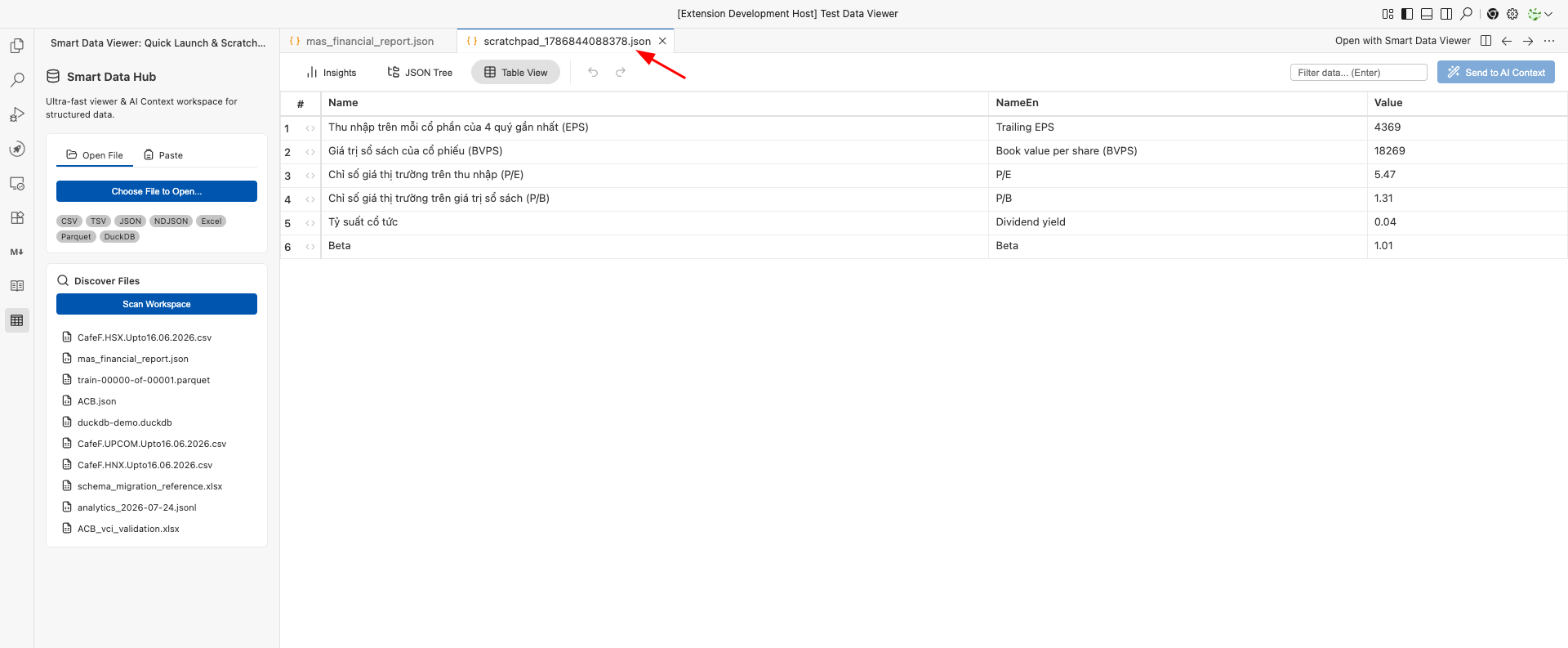
Data scratchpad

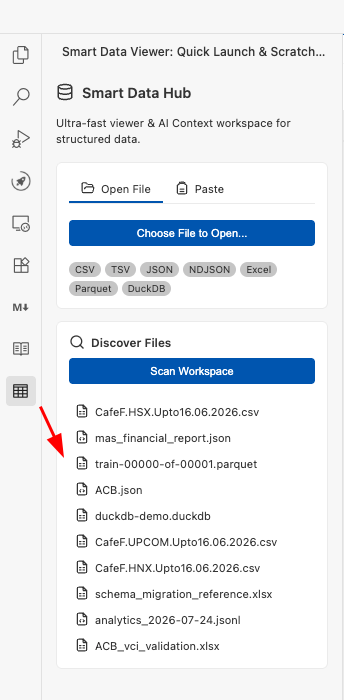
Data Hub launcher

Built for AI-first work

Smart Data Viewer is especially useful for:

  • AI and vibe coders reviewing generated artifacts without breaking focus
  • Data analysts and data scientists who think naturally in DataFrames and EDA
  • Data and backend engineers inspecting exports, fixtures, logs, and local analytical databases
  • QA and product teams reviewing structured test output and sharing exact evidence with an agent or teammate
  • Open-source users who want one coherent, free data workspace instead of a collection of disconnected viewers

The interface follows VS Code theme variables throughout, so grids, panels, controls, and document views feel native in light and dark themes.

Getting started

  1. Install Smart Data Viewer from the VS Code Marketplace or Open VSX.
  2. Open a supported file, or right-click it in Explorer and choose Open with Smart Data Viewer.
  3. Use the toolbar to switch between Preview, Insights, JSON Tree, SQL, and Notes when those views apply to the current format.
  4. Select data in the grid and choose Send to AI Context or Annotate.

When a text-based format is open in Smart Data Viewer, use the file-code button in the editor title bar to reopen it immediately in VS Code's default text editor. This is available for CSV, TSV, JSON, JSONL, NDJSON, HTML, and HTM files.

For raw output that is not yet a file, open the Command Palette and run:

Smart Data Viewer: New JSON Scratchpad

The Activity Bar hub can also open a file, paste JSON data, or scan the workspace for supported artifacts.

Current behavior and data safety

  • Data files open in read-only high-performance mode. The current release does not persist grid cell edits back to disk.
  • Annotations are separate Markdown sidecars; Smart Data Viewer does not add metadata columns or comments to the source dataset.
  • AI excerpts are written to .tmp/data_context.md in the workspace when available, then passed to Antigravity. If the API is unavailable, the excerpt is copied to the clipboard.
  • ZIP contents are extracted to an OS temporary directory for viewing and cleaned up when the viewer is disposed.
  • DuckDB WebAssembly assets are loaded from jsDelivr, and DuckDB may access its extension repository. SQL and DuckDB features therefore require network access when those runtime assets are not already available.
  • SQLite databases are opened as read-only in-memory snapshots by the bundled sql.js runtime. The source database is never modified, but memory usage scales with the database file size and uncheckpointed data from a separate WAL file may not be visible.

Settings

Setting Default Description
smartCsv.rowIndexStart 0 Use 0 for Pandas-style row numbering or 1 for spreadsheet-style numbering.

Design principles

  • AI-native, not AI-decorated: data selection and context transfer are core interactions.
  • Understand before prompting: EDA and SQL help you ask better questions.
  • Source-safe by default: viewing and annotation should not silently mutate generated artifacts.
  • One coherent workspace: formats can differ without forcing users into a different tool for every file.
  • Extensible format engines: new artifact types can be added over time without collapsing the host/webview boundary.

Project and support

  • Source code: GitHub
  • Issues and feature requests: GitHub Issues
  • Author: Thinh Vu

Ecosystem

a href="https://vnstocks.com/" img src="https://vnstocks.com/img/vnstock_logo_trans_rec_hoz.png" width="200" alt="Vnstock Ecosystem"

Vnstock provides both open-source tools for the community and premium memberships featuring advanced libraries and features, serving a vibe coding experience for quantitative stock market analysis and trading with a focus on the Vietnam market.

Smart Data Viewer is free and open source under the GNU General Public License v3.0.

  • Contact us
  • Jobs
  • Privacy
  • Manage cookies
  • Terms of use
  • Trademarks
  • Your Privacy Choices
  • Consumer Health Privacy
© 2026 Microsoft