Omni-FS
One file system client for S3, FTP, FTPS, SFTP and WebDAV — inside VS Code.
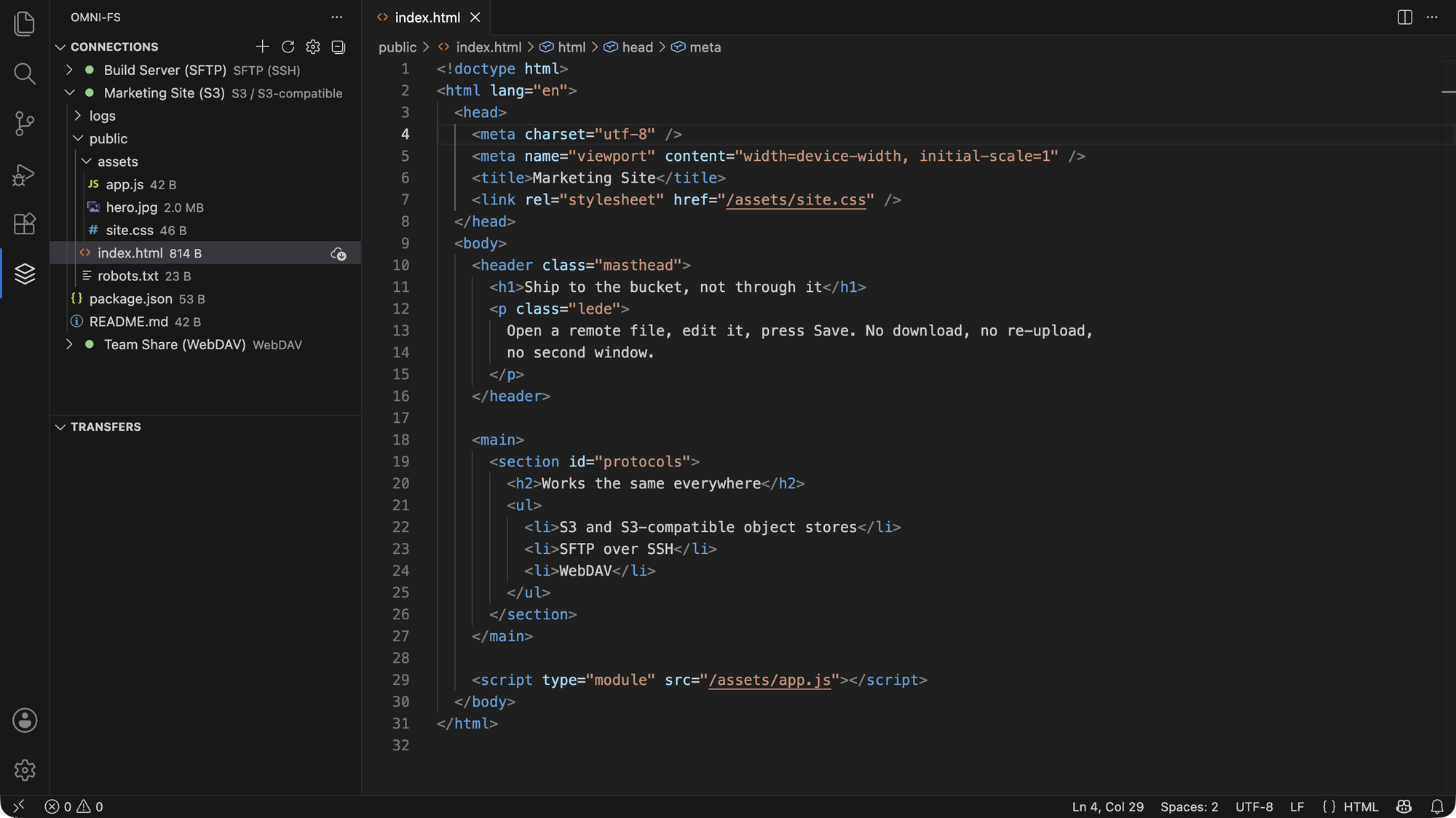
Open a remote file, edit it, press Ctrl+S. That's it. No
download, no re-upload, no separate window.

Pre-release. Every protocol listed below works, but Omni-FS is pre-1.0 and
still has gaps — read Status and the changelog before
installing.
Install
Releases are pre-releases for now, so on the Marketplace choose Switch to
Pre-Release Version if it offers you nothing to install.
What it does
- Remote files are real files. Omni-FS registers an
omnifs:// file system,
so remote files open in normal editors, save normally, and work with search,
quick-open and diff. Add a bucket to your workspace and it behaves like a
folder.
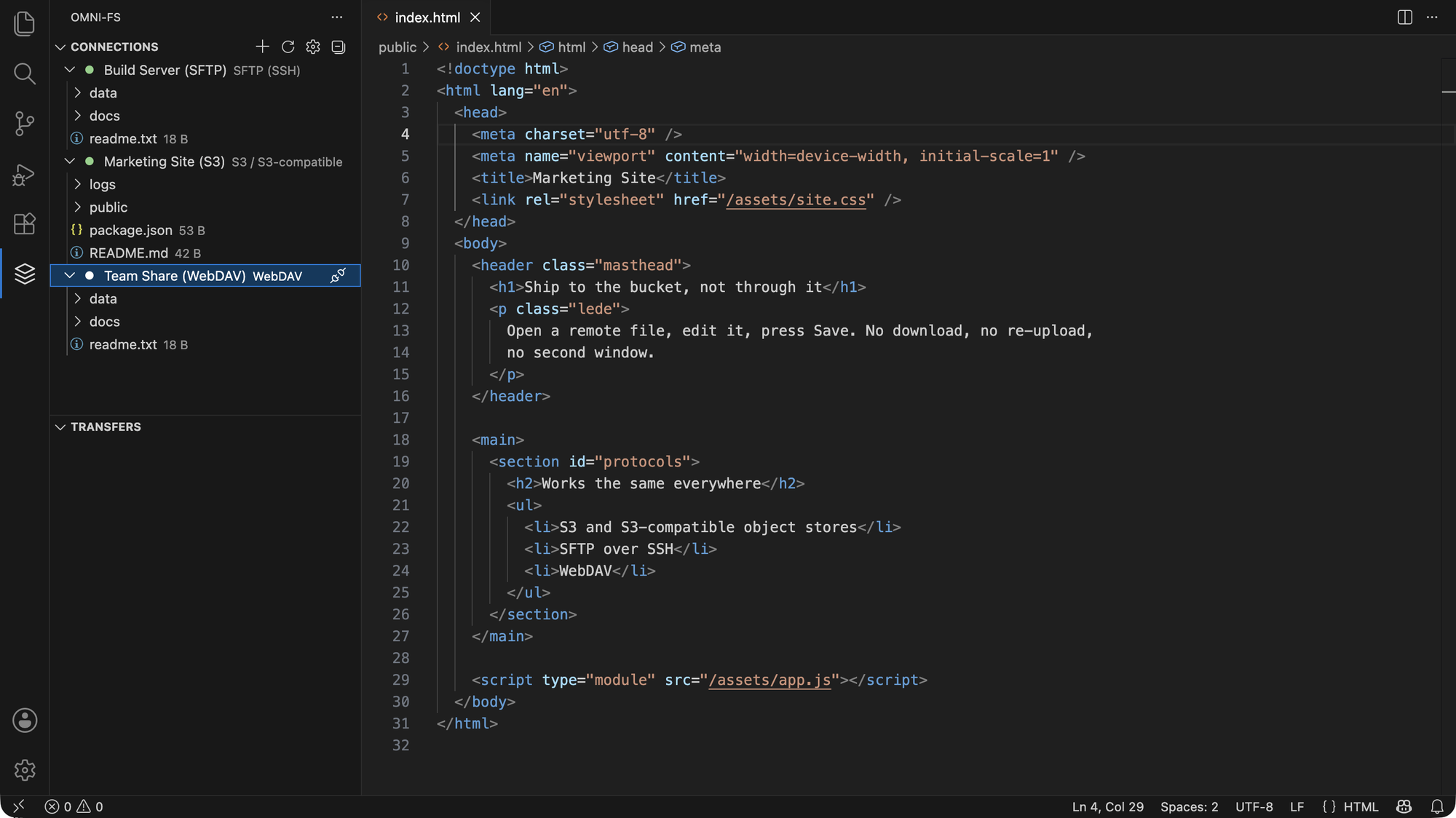
- A connections sidebar for status, connect/disconnect, credentials, and
browsing a server you haven't mounted.
- A transfers view with progress, automatic retry on transient failures, and
cancellation.
- Protocol-aware behaviour. Each backend declares what it can genuinely do,
and Omni-FS adapts instead of failing after you click. S3 has no real
directories, so a new folder appears once it holds a file. An FTP connection
carries one operation at a time, so bulk work serialises there — unless you
allow it more connections — while S3 runs sixteen transfers in parallel. You
don't have to think about any of it.
- Colour-tagged connections, so production is hard to mistake for staging.
The colour follows the connection's files into the Explorer and editor tabs.
- Read-only connections, switched from the tree's context menu and applied
to the next write without reconnecting.
Status
| Protocol |
Status |
Notes |
| S3 / S3-compatible |
✅ Working |
AWS S3, MinIO, Cloudflare R2, Backblaze B2, DigitalOcean Spaces, Ceph |
| SFTP (SSH) |
✅ Working |
Password, private key, SSH agent |
| WebDAV |
✅ Working |
Nextcloud, ownCloud |
| FTP / FTPS |
✅ Working |
Explicit and implicit TLS, configurable minimum TLS version |
Each protocol passes the same conformance suite against a real server of its
kind in CI.
The Download… and Upload… commands are not wired up yet. Everything else
listed above works against every protocol.
Getting started
- Open the Omni-FS view in the Activity Bar.
- Click Add Connection and pick a protocol.
- Fill in the settings, then the credentials.
- Click Connect.
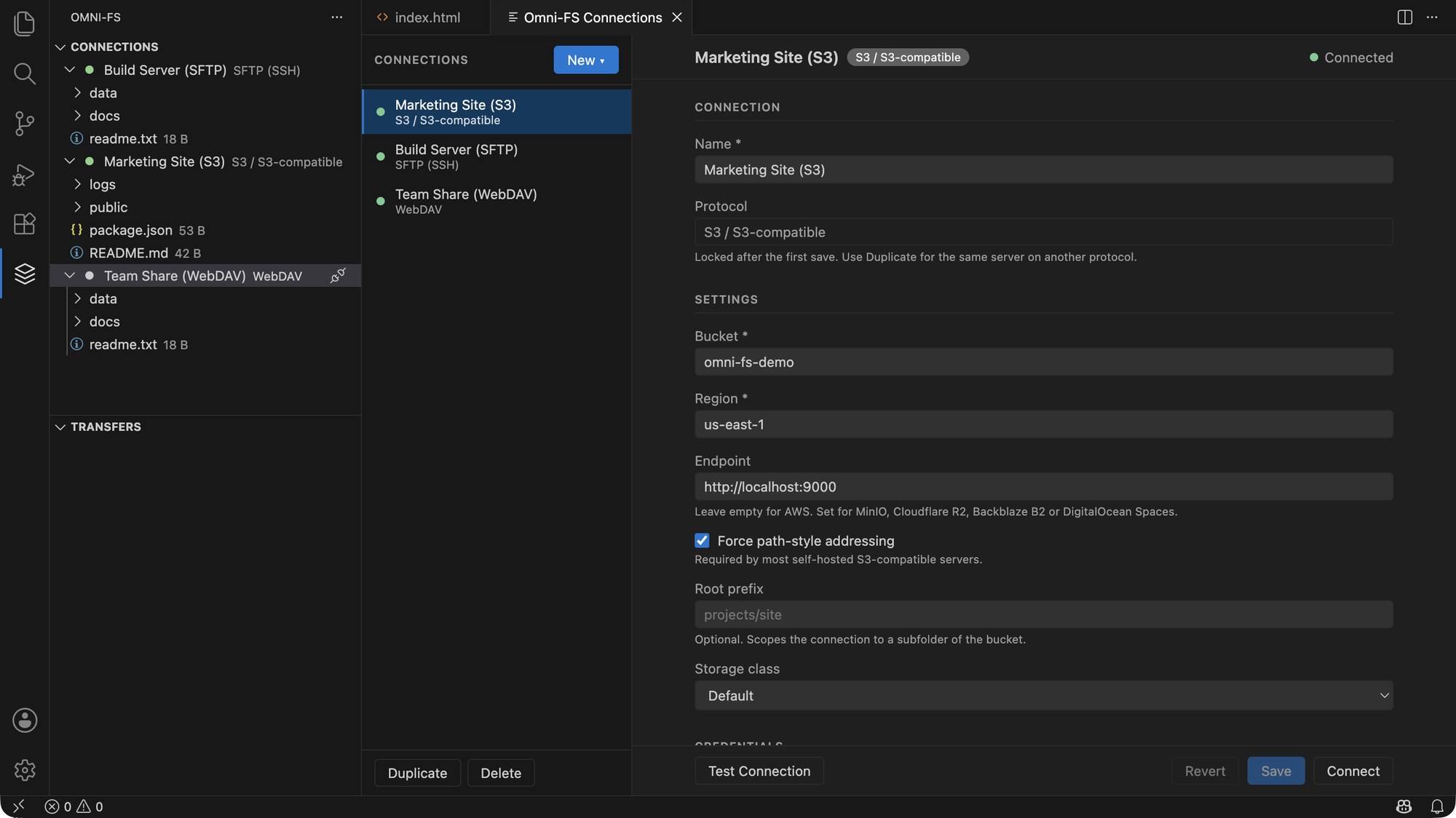
To work in a remote folder as if it were local, right-click the connection and
choose Open as Workspace Folder.
Connecting to S3-compatible storage
Leave Endpoint empty for AWS. For anything else, set it and turn on
Force path-style addressing, which most self-hosted servers require:
| Service |
Endpoint |
Path-style |
| AWS S3 |
(leave empty) |
off |
| MinIO |
https://minio.example.com |
on |
| Cloudflare R2 |
https://<account>.r2.cloudflarestorage.com |
on |
| Backblaze B2 |
https://s3.<region>.backblazeb2.com |
on |
| DigitalOcean Spaces |
https://<region>.digitaloceanspaces.com |
on |
Root prefix scopes a connection to a subfolder of the bucket, which is handy
for keeping a production connection pointed at exactly one deploy directory.
Connecting over FTP / FTPS
Pick the Encryption that matches the server:
| Encryption |
Port |
When |
| FTPS — explicit TLS |
21 |
The default, and what most servers mean by "FTPS" (AUTH TLS) |
| FTPS — implicit TLS |
990 |
Servers that expect TLS from the first byte |
| Plain FTP — unencrypted |
21 |
Only on a network you trust: the password is sent in the clear |
- Minimum TLS version is Automatic by default. Choose TLS 1.0 or 1.1 only
to reach an old server that offers nothing newer — it also relaxes the cipher
policy those servers need.
- Allow self-signed certificates turns off certificate verification. Use it
only for a server you control.
- Maximum connections defaults to 1. FTP carries one command per
connection, so with one, browsing waits behind a transfer. Raising it (up to 8) opens more logins so they run side by side. If the server refuses the
extra logins, Omni-FS drops back to the number it accepted instead of
failing.
- Root prefix scopes the connection to a subfolder of the login directory,
or to an absolute server path if it begins with
/.
Listings use MLSD/MLST where the server offers them, for exact sizes and
timestamps, and fall back to parsing LIST where it does not. Rename and delete
work on directories too, and a recursive delete walks the tree for you.
Your credentials
Credentials go to your operating system's keychain — Keychain on macOS, DPAPI on
Windows, libsecret on Linux — through VS Code's secret storage. They are never
written to a settings file.
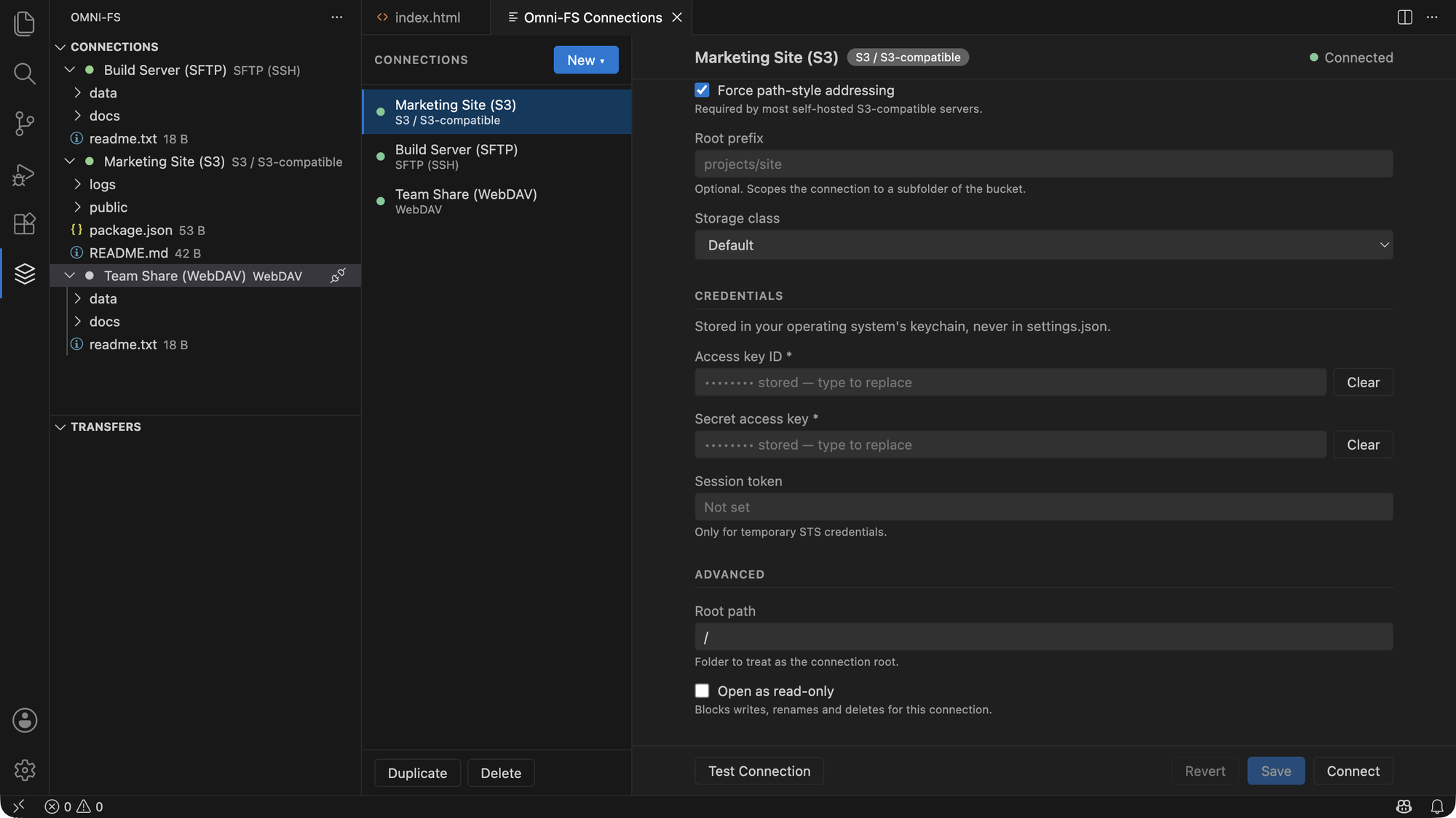
Connection settings (endpoint, bucket, host, username) live in the
omniFs.connections setting, which contains no secrets and is safe to commit to
.vscode/settings.json and share with your team. Each person supplies their own
credentials on first connect.
Settings
| Setting |
Default |
What it does |
omniFs.connections |
[] |
Connection definitions. No credentials. |
omniFs.cache.ttlSeconds |
15 |
How long directory listings stay cached |
omniFs.connection.idleTimeoutSeconds |
300 |
Close an idle connection after this long; 0 keeps it open |
omniFs.transfers.maxConcurrent |
4 |
Simultaneous transfers across all connections |
Troubleshooting
Open the Omni-FS output channel, click the gear and choose Set Log
Level…. The level applies at once and VS Code remembers it.
info — connects, disconnects and why (idle, edited, lost), and for FTP the
server greeting, negotiated TLS version and cipher.debug — every operation with its timing, entry or byte count, cache miss,
and on failure the error code.trace — also cache hits and, for FTP, the raw control channel (> LIST,
< 226 …). The password is written as PASS ###.
S3-compatible servers disagree with AWS about error codes, so when reporting a
problem please say which server you're using. Never paste credentials or an
endpoint URL containing one.
Contributing
Omni-FS is open source and built so that adding a protocol touches no existing
code. The repository, architecture notes and contribution guide are at
github.com/ryftcore/omni-fs.
License
MIT © ryftcore

