
Power AgentsPower Agents — multi-host local orchestration (Claude, Grok, Codex, Kimi). Multi-account & rate-limit relief, auto-resume, session recovery + Token Saver. Free 7-day Pro trial. Installation Launch VS Code Quick Open ( Ctrl+P), paste the following command, and press enter.Copied to clipboard |

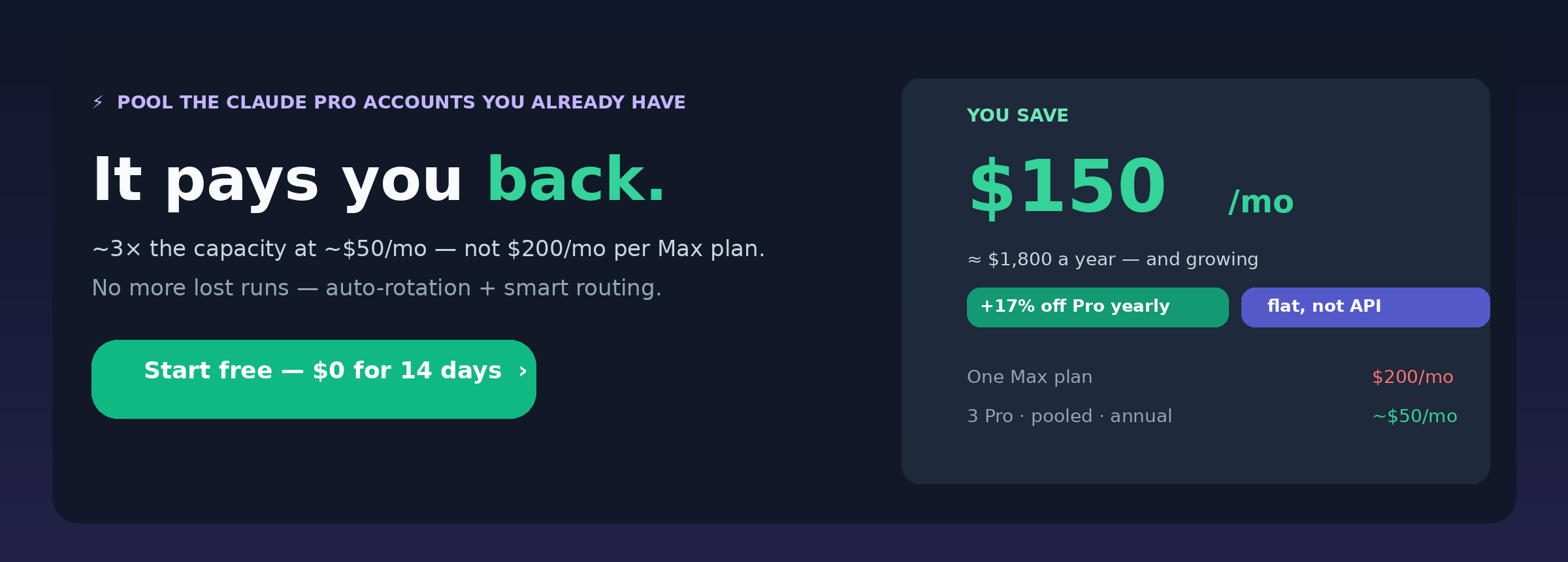
Power Claude — Save $115+/mo vs Claude Max
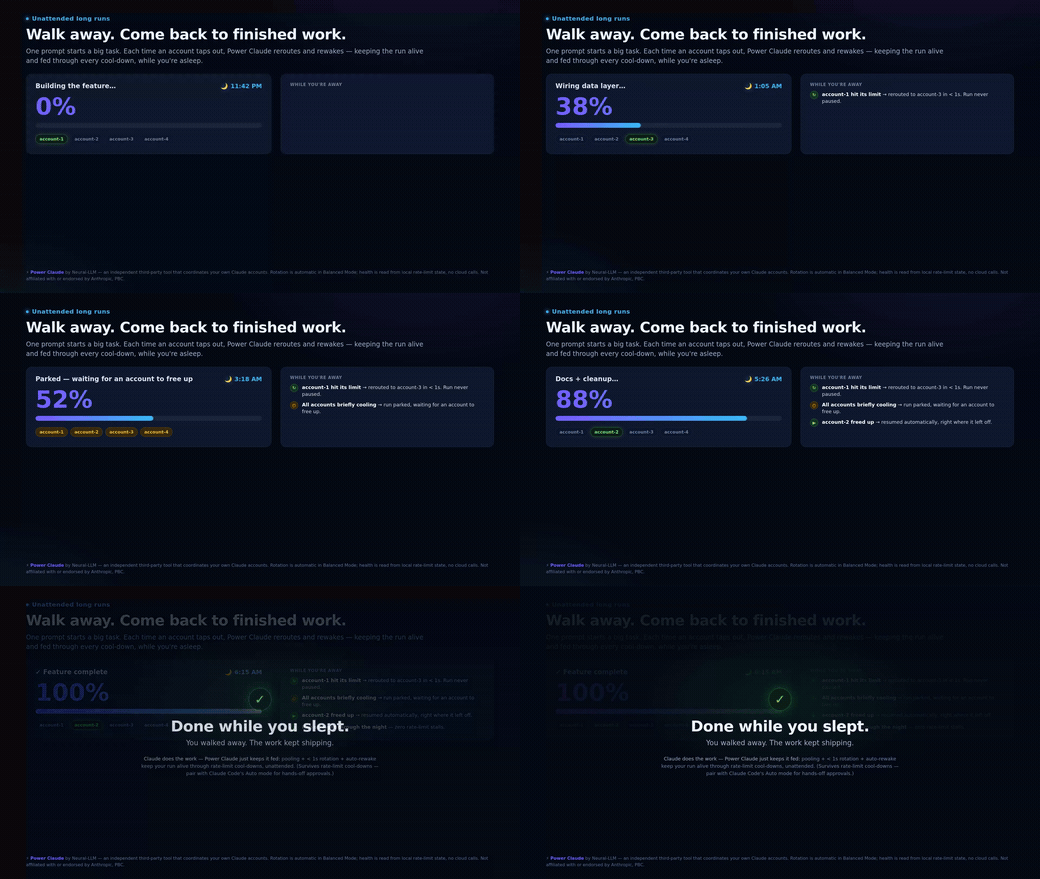
⚡ Save $115+/mo vs Max — and Claude Code that keeps working when you walk away. 5 Pro seats you own match one Max‑20× session ceiling; prove it on your stalled sessions in 60 seconds (
|





| Channel | Best for | Get it |
|---|---|---|
| VS Code Marketplace | VS Code — one click | code --install-extension neural-llm.power-claude |
| Open VSX | Cursor · VSCodium · Gitpod · Windsurf | cursor --install-extension neural-llm.power-claude |
| npm (CLI) | any terminal · CI | npm install -g power-claude |
| Direct .vsix | air-gapped · manual · pinned version | code --install-extension power-claude-<version>.vsix |
| neural-llm.com | downloads · docs · account | neural-llm.com |
No install yet? One-shot Health Check (optional A/B):
npx -y power-claude proof           # personal scan (uses local ~/.claude history)
npx -y power-claude proof --recover # recover one unfinished session
code --install-extension neural-llm.power-claude
After the extension is installed, prefer the short alias: pc proof.
Power Claude is an independent extension by Neural-LLM. It is not affiliated with Anthropic; "Claude" is a trademark of Anthropic, PBC. Power Claude interoperates with Claude Code's local files — it is third-party tooling.
Stop overpaying for Claude capacity
You're hitting the wall every afternoon. The obvious fix — upgrade to Max, or start paying per-token API rates — costs a multiple of what you pay now. Power Claude gives you a cheaper path to the same headroom.
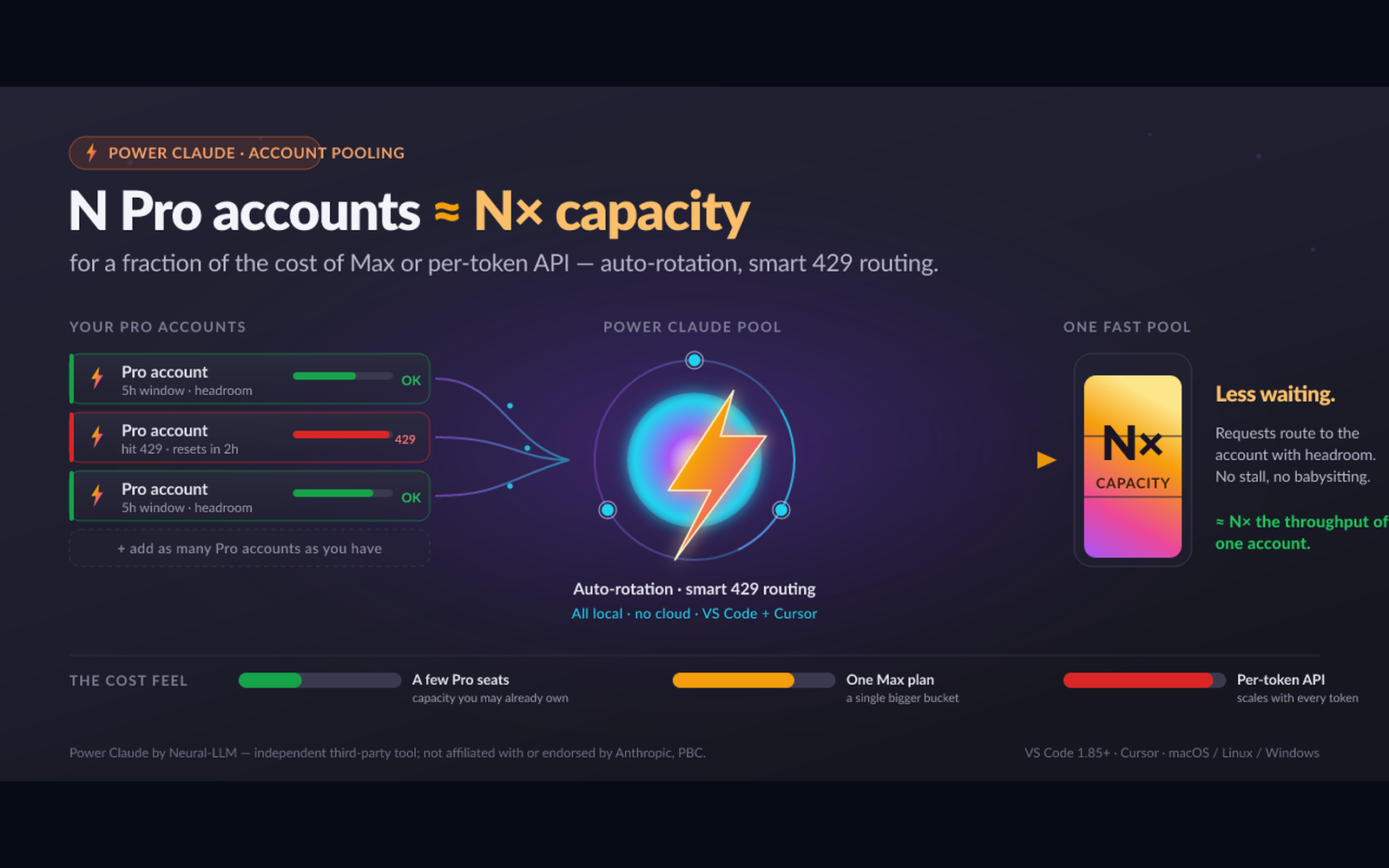
Right-size with seats you own. Each Claude.ai Pro or Max subscription is a completely independent organization on Anthropic's side, each with its own 5-hour, 7-day, TPM, and RPM windows. N seats you own ≈ N independent windows — at the price of N Pro subscriptions instead of one Max plan. Install default is manual multi-account; the Auto-Rotation Engine (optional, OFF by default, grey-area warning) can keep work moving across those seats when you opt in.
- 📅 Annual billing is ~17% cheaper. Claude Pro is $20/mo month‑to‑month, but $200/yr billed annually — an effective $16.67/mo, ~17% less. Annual Pro is the cheapest seat for multi-seat capacity math.
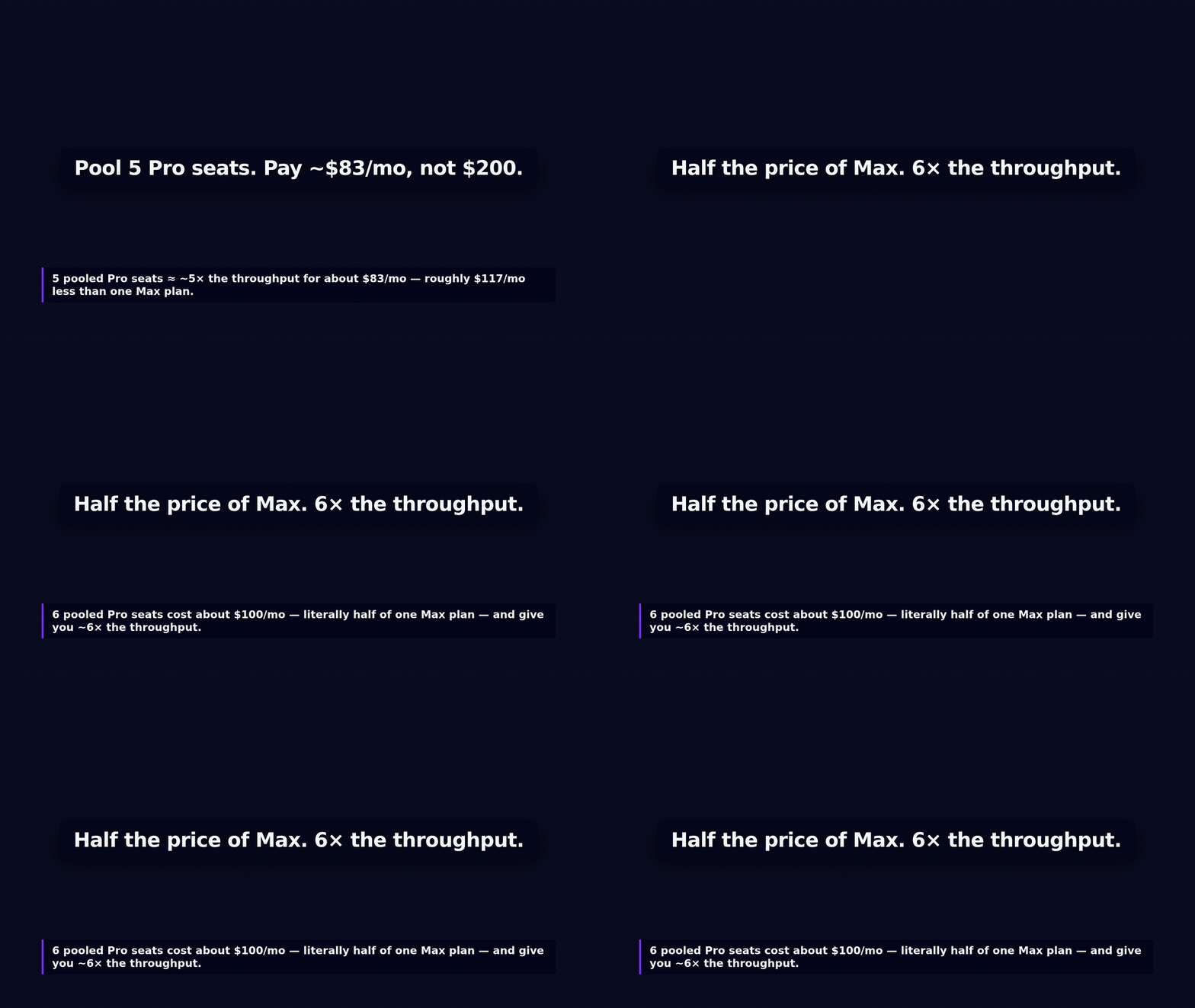
- 💰 Apples‑to‑apples: 5 Pro = one Max‑20×'s session ceiling, for ~58% less. The wall you hit mid‑task is the 5‑hour session token ceiling. One Claude Max‑20× tops out around ~220k tokens per session; 5 Pro seats you own (~44k each) reach the same ~220k — for a fraction of the price, and with 5 independent windows instead of 1:
| 1 × Claude Max‑20× | 5 × Pro seats you own (annual) | |
|---|---|---|
| 5‑hour session token ceiling | ~220k | ~220k (5 × ~44k) — same |
| Independent rate‑limit windows | 1 | 5 |
| Monthly cost | $200 | $83 → save $117/mo (58%) |
Honest basis: Anthropic publishes plan multipliers (Max‑20× = "20× Pro") and prices, not exact token caps — the ~44k/~220k figures are consistent 2026 estimates. That 20× is Max‑20×'s weekly sustained volume; the 5× here is the per‑session ceiling — the mid‑task wall. Power Claude's own subscription is $12/mo, shown separately, never folded into the figures above. Your dashboard runs this against your real seats, so it's verifiable — not a slogan.
- 📊 See the savings locally. Per-account, per-model $/token tracking shows your effective cost under your current subscription tiers versus what the same work would have cost at pay-per-token API rates — so the savings aren't a marketing claim, they're a number in your dashboard.
- 🎯 Know when an upgrade is actually worth it. The cap-hit recommender flags exactly when upgrading a plan would eliminate the throttling that regularly stalls your workflow — and stays quiet when it wouldn't. No upsell guesswork.
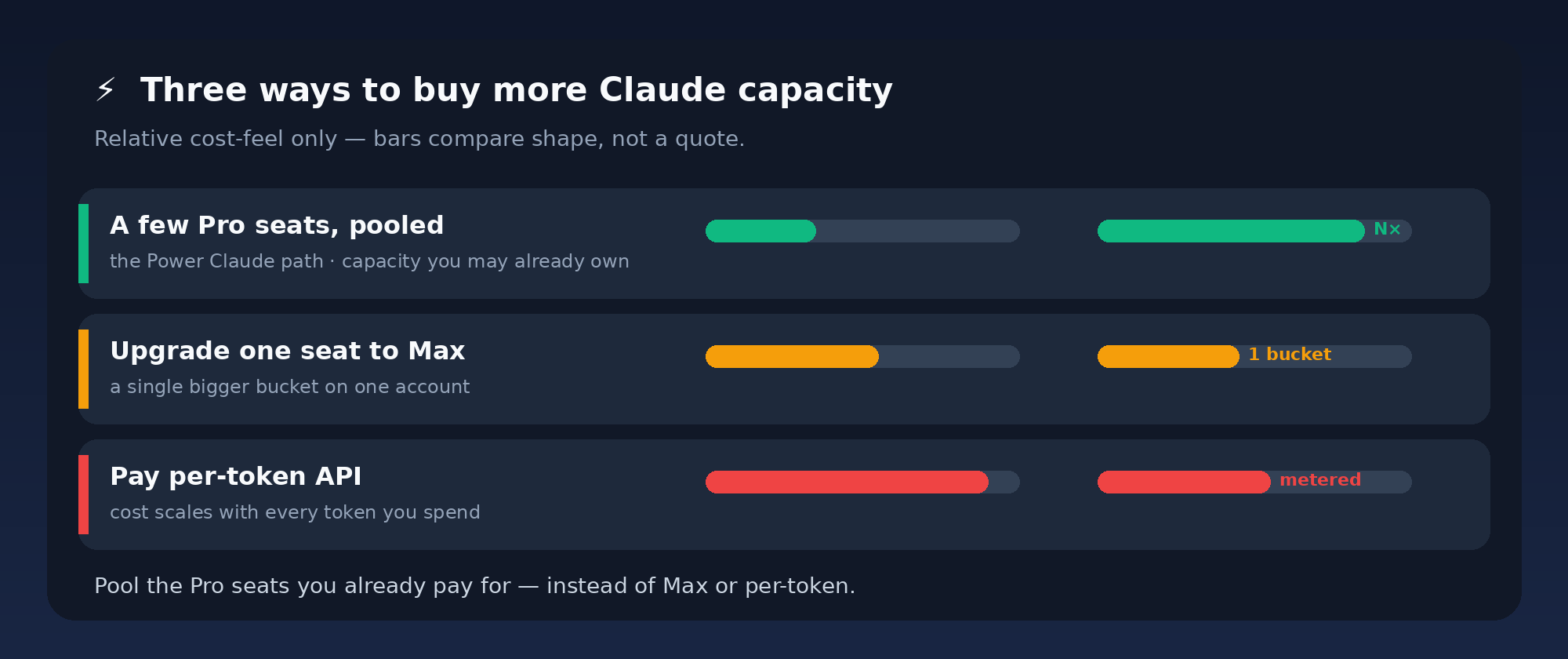

Why it works: Claude.ai Pro and Max subscriptions each carry their own 5-hour, 7-day, TPM, and RPM windows — independent organizations on Anthropic's side. Capacity math compares seats you own to Max. Continuity automation is opt-in. Every account stays within its own published limits — Power Claude does not claim Anthropic approval of automated rotation.
All cost math runs locally. Power Claude reads Claude Code's own local state and session transcripts — the same files Claude Code writes. No token counts, transcripts, or usage data leave your machine.
More visuals
Savings and multi-seat capacity overview (after the walk-away proof above):
Power Claude vs. vanilla Claude Code
| Claude Code alone | With Power Claude | |
|---|---|---|
| First 60 seconds | Feature docs / config | pc proof Health Check on your stalled sessions |
| Cost of more capacity | Upgrade to Max, or pay per-token API rates | Right-size with Pro seats you own + Token Saver — N seats ≈ N independent windows (vs Max math) |
| Usage limit (429) | Wait for the window to reset | Pause + preserve by default; optional Auto-Rotation Engine (opt-in, grey-area) continues across seats you own |
| Cost visibility | None built in | Per-account, per-model $/token tracking + subscription-vs-API comparison |
| Multiple accounts | Manual logout / login each time | Profiles + manual switch; Auto-Rotation Engine only after warning ack |
| Crashed / stalled session | Notice late, restart by hand, lose context | Watchdog + same-profile auto-resume + one-click recover |
| Session history | Hunt through JSONL transcripts + git diffs | Session Explorer: files touched, model, cost, completion status |
| Where your data goes | — | All local — no prompts or code ever leave your machine |
| Editors | VS Code, Cursor | VS Code, Cursor, and a CLI — one shared ~/.power-claude/ |
Core capabilities
🩺 Claude Health Check (Proof Mode) — first win
Before license tours or multi-seat setup:
pc proof              # scan YOUR recent Claude sessions (local)
pc proof --recover    # recover the most recent unfinished session
pc proof --protect    # arm same-profile continuity for the next run
Personal counts and minutes only. No prompts, paths, or accounts leave your machine. Share cards are explicit and anonymized (pc proof --share).
🔄 Multi-account continuity + Auto-Rotation Engine (opt-in)
Install default: Manual multi-account. You switch seats yourself; same-profile recovery and watchdog still apply.
Auto-Rotation Engine (optional): OFF until you acknowledge a firm grey-area warning (pc rotation engine enable --i-understand or Setup Guide). Not approved by Anthropic; use at your own risk. When ON, classic continuity behavior applies across seats you own (score/select, cooldowns, anti-ping-pong, load distribution) with an OAuth boundary designed so Power Claude does not hold subscription OAuth as a third-party vault.
When the engine is ON and a seat hits a limit/health signal:
- The Stop hook / proxy path detects the rate-limit or health signal
- The next eligible user-owned account is selected
- The session resumes with preserved local state
Status is always visible (pc rotation status, dashboard badge ON/OFF/PAUSED). Kill-switch: pc emergency.

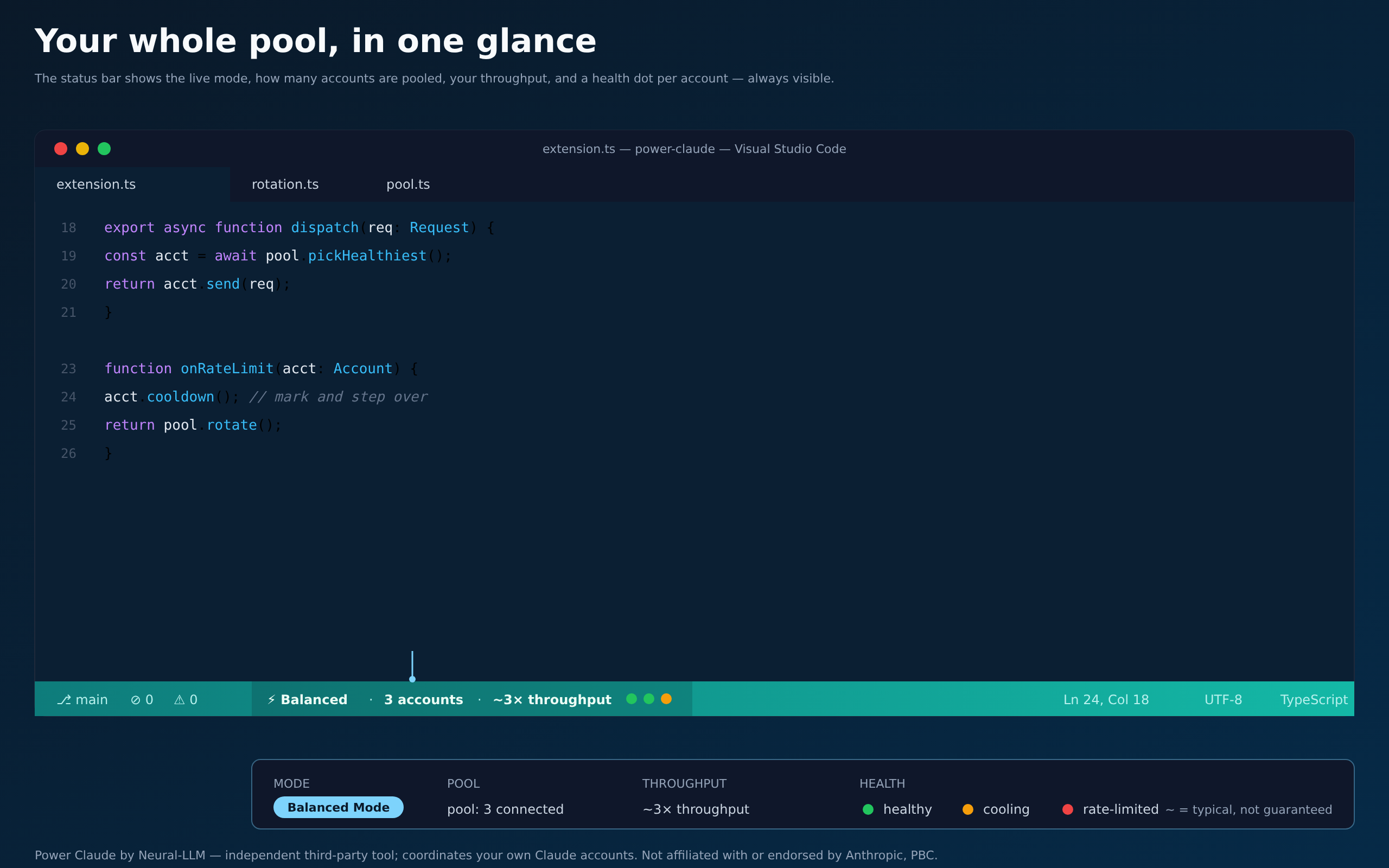
🏠 Home · View 2.0
Modern Home dashboard with multi-view compare (Classic Home remains available). Built for day-to-day ops: sessions, accounts chrome, and recovery without the old single-pane clutter.
⌨ Command Deck
Open CLI is a dedicated command deck — not a delayed Home tab. Health, Usage, Sessions, and Settings stay in the webview. Only deck Run CLI starts a terminal. pc help / power help is a boxed reference.
🔀 Model tabs stay honest
When you switch Model chrome to a pure non-Claude host (lab), capacity and “needs login” counts stay on that host — they never silently reuse Claude pool expired numbers.
🗺 Harness Flow
See the harness design map (Blueprint), what a session ran (Session), and the path on the map (Compare) — local visibility tools for how orchestration behaves.
🗂️ Account groups (isolated context)
Partition Claude accounts into named groups (Work / Personal / clients) with isolated projects/memory trees so context does not bleed across roles.
- Create groups in the dashboard (Profiles → Account groups) or
pc scope create - Drag accounts between groups, or
pc scope add/pc scope move - Use this group /
pc scope useselects the active set for new work - Credentials stay private per account — groups organize membership and local context only
⚡ Power Mode — N× windows (requires Auto-Rotation Engine ON)
When the Auto-Rotation Engine is enabled, Power Mode routes work to the least-busy seat among those you own so independent windows fill in parallel. With three seats you get an effective ~3× concurrency on independent 5h / 7d / TPM / RPM windows during heavy sub-agent fan-out.
| Mode | How it works | Best for |
|---|---|---|
| Manual / engine OFF | You pick seats; same-profile recovery still works | Default install, compliance-first |
| Engine ON — standard | Stays on one seat until health/limit, then switches | Light to moderate multi-seat |
| Engine ON — Power Mode | Prefers least-loaded seat among serveable accounts | Heavy / continuous coding sessions |
Enable engine first (warning ack), then Power Mode from Power Claude Settings or power-claude balanced on.

🔥 Reset burn-down — don't leave capacity on the table
When multi-account rotation is on, Power Claude does more than equalize fill. Reset burn-down (default ON) watches each seat's Anthropic 5h/7d reset timestamps and residual capacity. As a seat approaches reset with usage still left, the router pulls more work onto that seat — progressively harder over the full remaining window (steepest at the end) — so residual quota is used before the window rolls. Pin a host seat to stay attached until it is limited. Farther-from-reset seats stay available for later.
| Signal | Role |
|---|---|
| Reset times | Authoritative Anthropic headers (exact) |
| Residual | 1 − utilization on 5h (then 7d) |
| Urgency | Progressive ramp in the last ~90 minutes |
Toggle: powerClaude.proxy.resetBurnDown (default true). Pairs with smart parallel mode (default).
Extra usage auto-apply — expiring reset credits
GET /api/oauth/usage now exposes extra_usage. Unused extra-usage / reset credits that expire are auto-applied 5 minutes before expiry (default ON). Toggle: powerClaude.proxy.autoApplyExpiringExtraUsage.
⏱ Runout Forecaster — see the wall coming hours in advance
Power Mode and smart 429 routing prevent most rate-limit hits, but they can't stretch your subscriptions past their real limit. The Runout Forecaster watches utilization across every account and projects, at your current burn rate, whether you'll exhaust capacity before the 5-hour or 7-day windows reset.
| State | Banner |
|---|---|
| Safe | green — "Capacity safe through next reset (~3h 41m)" |
| Some accounts at risk | amber — "3 of 12 accounts at risk" |
| Exhaustion imminent | red — "Seats exhaust in ~28m" |
Each account row also gets a tiny per-account ETA chip (✓ safe, ETA 1h 47m, ETA 14m) so you can spot the bottleneck without opening drawers.
The math is honest: reset times come from Anthropic's authoritative rate-limit headers, so the "will I make it before reset?" half of the calculation is exact. Only burn rate is estimated, from a rolling sample buffer of the last 30 minutes of utilization observations. When there isn't yet enough data to project (first ~2 minutes after activation, or no activity), the banner is suppressed and the chips show —.
↻ Auto-resume + resilience watchdog + Auto-Resume Nudges
Rate limits aren't the only thing that kills a session. Process kills, OOM events, IDE crashes, network drops mid-tool-call, and sessions that ended cleanly but left work unfinished all used to leave you with a stale tab and a manual recovery.
The watchdog polls every 30 seconds and applies four detection rules:
| Trigger | Signal | What it means |
|---|---|---|
| Heartbeat-stale | No lifecycle:heartbeat in N seconds AND JSONL idle |
Process kill, OOM, IDE crash, or network drop |
| Tool-truncation | Last assistant record is stop_reason: tool_use with no follow-up |
Died mid-tool-call |
| Ended with pending tasks | Stopped cleanly but task items still pending | Session said "done" but work remains |
| Rate-limit | pending-recovery.json written by Stop hook |
Standard rate-limit rotation |
When the watchdog fires, Power Claude surfaces a one-click QuickPick with a reason-aware resume prompt — each death type gets tailored wording so the agent picks up with the right context.
Auto-Resume Nudges catch the more annoying case: sessions that stop politely when they should keep going. Claude pauses to ask "want me to continue?", offers a three-option menu when one option is obvious, or tells you to run a command it could have run itself. A family of toggleable detectors fires on every Stop event; when a pattern matches and no hard-stop veto fires (auth failure, missing credential, destructive op pending, approval gate), the Stop hook re-issues the turn with a targeted corrective prompt:
| Default-on nudge | What it catches | What the agent sees back |
|---|---|---|
ask-permission-to-continue |
"Want me to continue?" / "Should I keep going?" | "Continue the work. Don't ask permission for obvious next steps." |
offer-multi-choice |
"Three reasonable next moves — 1) … 2) … 3) … which?" | "Pick the most obvious option and proceed." |
tell-user-to-do-work |
"You can run X to verify" / "You'll need to deploy" | "You have the tools to do this yourself." |
pseudo-checkpoint |
"Good stopping point" / "Let's pause here" with no reason | "There's no reason to pause. Continue to the next concrete deliverable." |
Four more nudges ship opt-in for aggressive cases. A shadow mode logs every would-fire decision without resuming so you can audit before going live, and a loop guard caps consecutive nudges at 3. An optional LLM fallback (off by default; Haiku 4.5 when on) handles ambiguous stops the deterministic catalog missed — bounded to one ~128-token classification call per Stop, empirically ~3% of stops. The catalog lives at ~/.power-claude/config/nudges.json; edit it directly to tune patterns.

🩹 Session Actions — one-click recovery, right on the line that broke
When a turn dies with "Prompt is too long", you don't have to copy context into a fresh chat by hand. Power Claude detects the error on the chat line and injects a branded Heal button right there — click it and the session is trimmed and resumed automatically (the same trim-and-resume recovery the watchdog uses), no retyping.
Heal is the first of a family of Session Actions — recovery actions matched to how a session got stuck:
| Action | When it appears | What it does |
|---|---|---|
| Heal | "Prompt is too long" / compaction thrash | Trim the conversation and resume in a fresh session |
| Unstick | Repeating tool loop | Fork from the last good checkpoint |
| Revive | Crashed / abandoned | Fork from the last good checkpoint |
| Re-run tool | Truncated mid tool-call | Re-issue the tool call |
| Finish tasks | Stopped with TODOs pending | Resume and inject the pending tasks |
| Resume | Idle / stuck after a rate-limit window | Plain resume |
| Repair turn | Wedged thinking turn (HTTP 400 on resume) | Trim the orphaned turn |
Every action is available three ways: the inline button on the chat line, the Power Claude: Session Actions command (pick a session → pick an action), and the CLI (pc session action heal <session-id>). Each action is settings-gated (powerClaude.sessionActions.*) and its recovery strategy is configurable. Manual by default — you stay in control.
📊 Insight Graph + cost analytics + editor-gutter blame
After a long session, you want to know: What did it change? Which files? What model, and what did it cost? Did it finish? Today you answer those by hunting through JSONL transcripts and git diffs. Power Claude answers them in one click, rendering your session history as a commit-graph-style lane view — the visual language GitLens made familiar for git, applied to AI coding sessions.
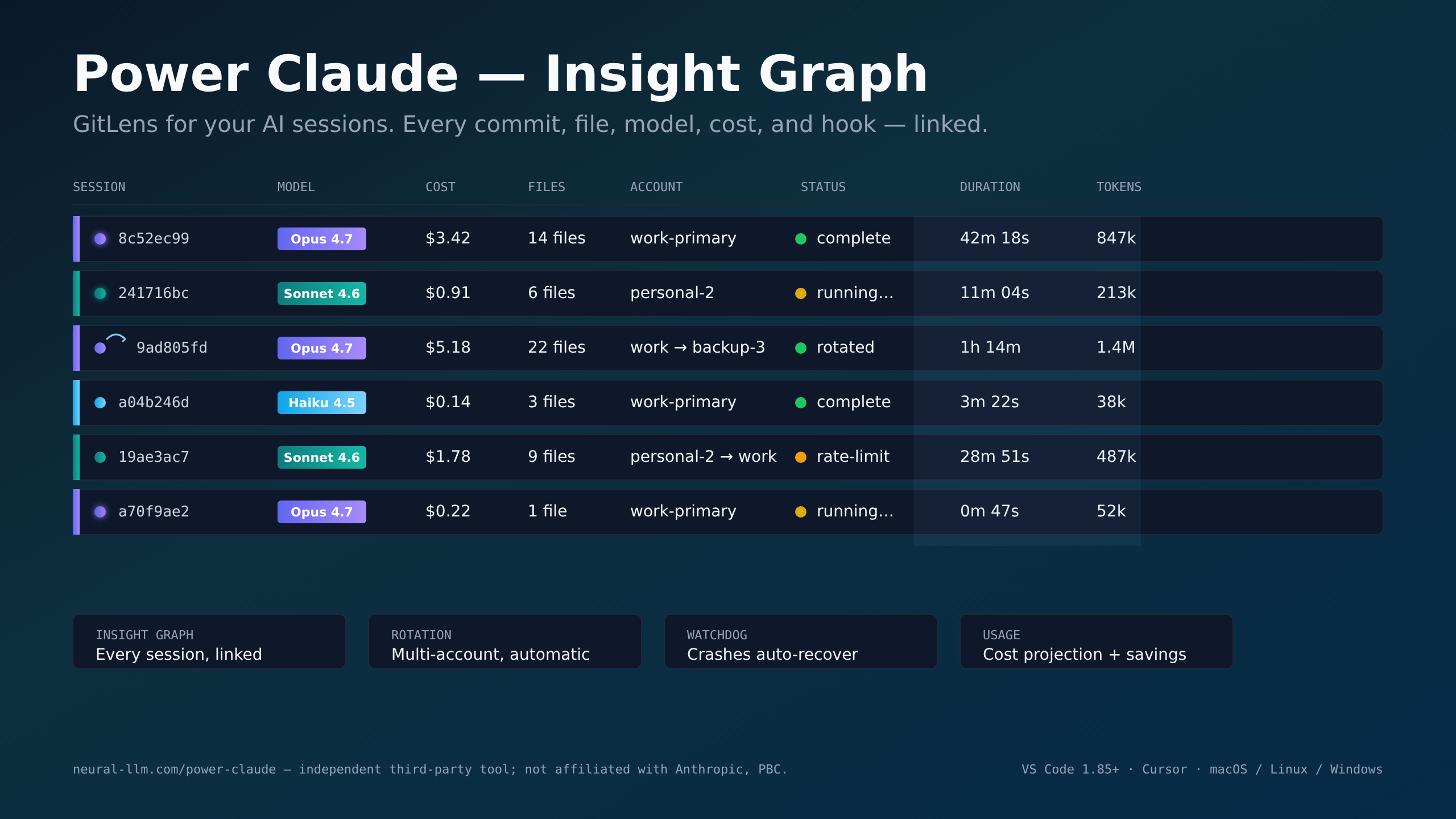
Each row is a session, carrying a model badge (with version), total cost, files-changed count, the account that handled it, and a completion status (done / pending / untracked). Click any session to expand the full detail without leaving VS Code:
- Files panel — every file read, written, or edited, with per-file diff vs the session's git snapshot, op-type counts, and timestamps
- Sub-agents — forked agents appear as child lanes linked to the parent
- Hooks fired — which Claude Code hook scripts ran, with exit codes and timing
- Rate-limit events — when the session hit a cap, which account it rotated to, and the cooldown length
- Plans drafted and commits authored — plan-mode artifacts and every
git commit, clickable to open the diff - Multi-track timeline — tool calls, hook firings, model switches, and rate-limit events on one synchronized time axis
Cost analytics & honest metering track token consumption and dollar cost per session, per account, and per model with plan-tier-aware math: per-account breakdowns by model with daily / weekly / monthly rollups, provider-separated anchors (Claude vs Grok never collide) on real window start/end times so you can test marketing claims against measured periods, user-defined anchors (pc tracking), trip odometers, the cap-hit upgrade recommender, and subscription savings versus pay-per-token API rates.
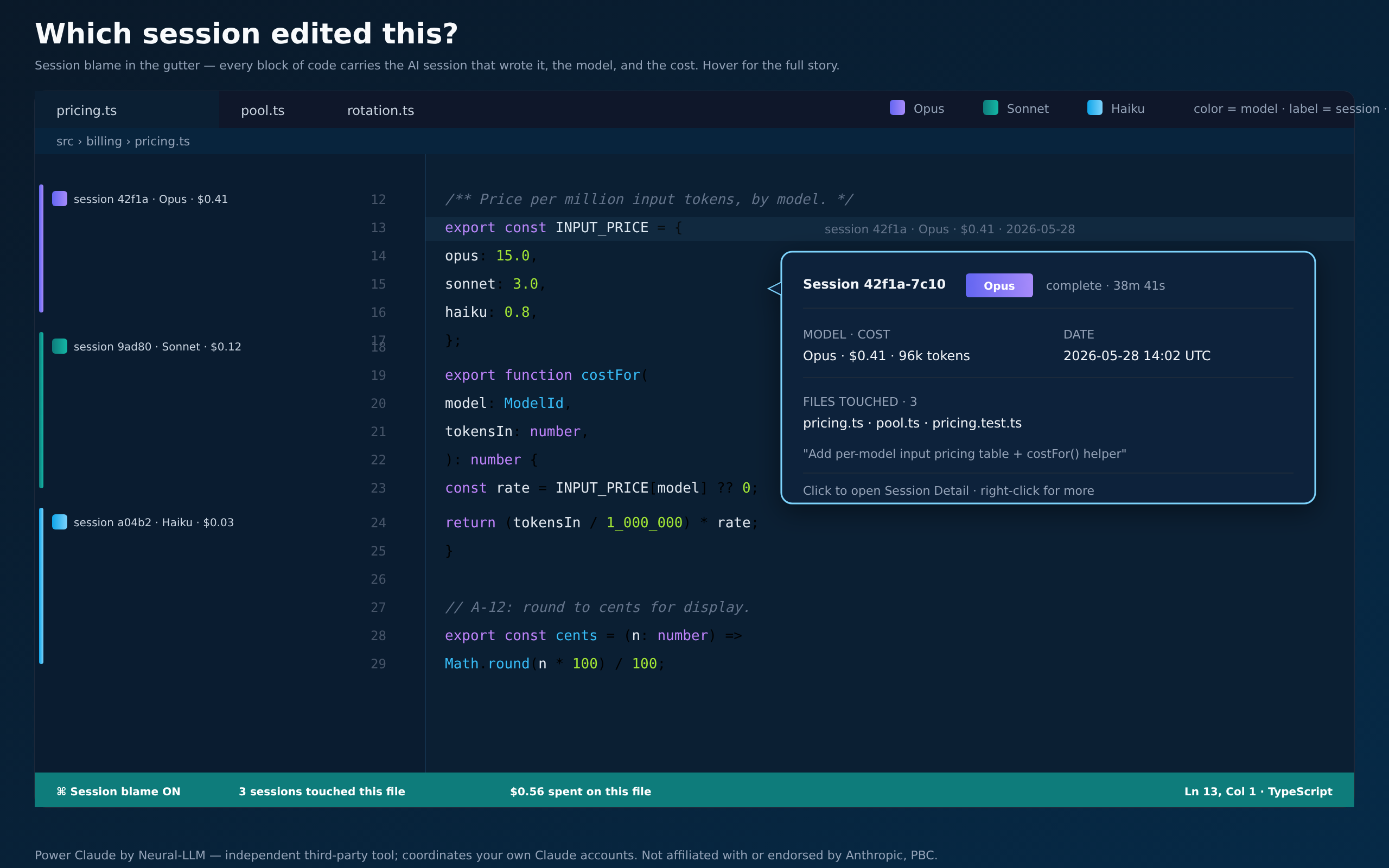
Inline session blame annotates each region of any open file with the Claude session that last touched it — exactly like git blame, but for AI editing activity. Hover for the session summary (date, model, cost, completion status); click to jump to the full detail view. It runs alongside GitLens in a separate gutter column with distinct visual language, so the two never conflict.
🎯 Preserve-Focus Fix — stop Claude Code from yanking your cursor
You're typing in a file. Claude finishes a response. Suddenly your cursor jumps to the Claude panel and your keystrokes land in the wrong place — or you accidentally accept a pending action because your finger was already on Enter.
This is anthropics/claude-code#32726 — open since early 2026, no shipping fix. The Claude Code VS Code extension calls WebviewPanel.reveal() without preserveFocus: true on six code paths. Power Claude ships the patch Anthropic hasn't:
- Two settings —
powerClaude.preserveFocusFix.enabled(default OFF — opt in once) andpowerClaude.preserveFocusFix.autoRunOnUpgrade(default ON). Flip the first totrue, reload the window, and the focus-steal is gone. - Six surgical patches to the installed
extension.js, anchored on stable string literals; after every Claude Code upgrade Power Claude detects the changed mtime and re-patches automatically. - Idempotent and reversible — a sentinel comment makes re-runs a no-op, and a one-shot
.preserve-focus.origbackup beside each patched file lets you undo cleanly. - Manual command —
Power Claude: Re-apply Preserve-Focus Patch to Claude Code Extensionfor the rare case the auto-detector misses an upgrade.
If Anthropic ships the proper upstream fix, you'll uninstall this in one toggle.
📱 Mobile TUI Input — type into terminal agents from your phone
Browser-hosted terminals (code-server on a phone) often garble TUI input: mobile IMEs compose and rewrite text, so Grok Build, Codex, and other terminal agents see duplicated or corrupted characters.
Power Agents adds a native textarea (not a fake terminal) and an IME-safe reconciliation engine. Clean bytes go to one captured integrated terminal via sendText(payload, false) — no xterm or code-server patches.
- Off by default —
powerClaude.mobileTuiInput.enabled - Optional auto-attach for Grok, Codex, Claude CLI, Gemini, and Kimi launches
- Attach-active for
pc watch(pcWatch.enabled) or any integrated terminal (genericTerminal.enabled) - Designed to address Samsung Keyboard / Gboard-style composition; regression-tested with synthetic IME sequences (not a substitute for physical phone QA)
Command: Power Agents: Open Mobile TUI Input.
🎨 Purple Scrollbars — Power Claude's brand, on your scrollbars
A small one: Power Claude themes VS Code's scrollbars in its own brand violet, on by default.
- One setting —
powerClaude.scrollbarTheme.enabled(default ON). VS Code has no per-extension or per-tab scrollbar API, so this necessarily colors scrollbars across the whole editor, not just Power Claude's own views — turn it off any time via Settings → Power Claude: 🎨 Branding & Theme. - Non-destructive — your prior
workbench.colorCustomizationsvalues (or the absence of any) are snapshotted before the first apply and restored exactly on disable or uninstall. - No reload needed — applies and reverts live.
⬆️⬇️ Chat scroll buttons — jump to the top or bottom of a long conversation
Small purple floating ↑ / ↓ buttons on the right edge of the Claude Code chat thread: one click jumps straight to the beginning of the conversation, one click jumps to the newest message — no hand-scrolling through a thousand-line thread.
- One setting —
powerClaude.chatScrollNav.enabled(default ON, Settings → Power Claude: 🧩 Claude Core). - Only when useful — the buttons appear only while the thread is actually long enough to scroll; short chats stay clean.
- Smooth scrolling that respects your OS's reduced-motion preference, and survives Claude Code auto-updates via Power Claude's self-heal.
🧪 Detached Sessions (experimental · Pro) — your turn keeps running when you close the tab
Love that the Claude CLI keeps working when you refresh or close the window — but want a real graphical UI instead of a bare terminal? That's Detached Sessions.
Turn it on and a turn you launch runs inside its own systemd user service — its own cgroup, the same escape the rotation proxy relies on — so a browser-tab sleep, a page refresh, or closing the window can't kill it. When you come back, the dashboard reattaches and replays everything you missed, then live-tails the rest. The CLI's persistence, behind the GUI.
- Resilience — stop losing a 10-minute agent run to a flaky code-server / remote connection. It finishes whether or not you're watching.
- Efficiency — reconnect to the same running work instead of burning a fresh turn to rebuild context; you don't pay twice for the same thing.
- Safe by construction — default OFF; every turn still routes through the rotation proxy (quota & savings tracking intact); bounded by a hard turn-timeout, an idle reaper, and a concurrency cap; honours the
pc emergencykill-switch. - Requires Linux with a
systemd --usermanager (typical for code-server / remote dev). On other hosts the toggle stays disabled — it never pretends to persist when it can't.
Enable it from the dashboard's Rotation Safety Controls or the Setup & Optimize wizard.
Quickstart
Two install paths, both fully working from a single command.
VS Code Marketplace (recommended):
code --install-extension neural-llm.power-claude
Or search "Power Claude" in the VS Code Extensions panel. After install, click the Power Claude icon in the activity bar. The extension creates ~/.power-claude/ automatically, migrates any legacy data, and starts the local rotation proxy. No PATH changes required — every action is available from the dashboard and command palette.
npm CLI (terminal-only or scripting):
npm install -g power-claude
power-claude install
npm install -g puts two binaries on your PATH: power-claude (canonical) and pc (short alias). power-claude install creates ~/.power-claude/, deploys lib + hook scripts, and appends the bin path to your shell rc. Use pc help to see the full command list.
Commands at a glance:
pc list                       # all accounts with quota bars + status
pc status                     # proxy status dashboard
pc watch                      # LIVE TUI — account table + activity stream + modal hotkeys
pc rotate                     # rotate to next healthy account
pc rotate work-account        # rotate to specific account
pc health                     # probe accounts and render with live data
pc add                        # add an account profile
pc switch <name>              # switch active account
pc relogin <name>             # re-authenticate one account (OAuth flow)
pc save-profile <name>        # save current credentials as named profile
pc remove <name>              # delete a profile
pc export --output backup.json # export/back up all accounts to a file
pc import backup.json         # restore / move accounts onto another machine
pc logs -f --level error      # tail event log with filters
pc proof                      # Claude Health Check — first win on YOUR sessions
pc run                        # launch `claude` (engine path only if Auto-Rotation ON)
pc serve --port 8888          # start engine/proxy process (when engine ON)
pc doctor                     # full diagnostic checklist
pc config get|set|list        # CLI configuration
pc disable [--strip-profiles] # turn off rotation (destructive variant strips non-active)
pc enable                     # turn rotation back on
Both install paths use the same runtime directory (~/.power-claude/), so you can have the extension AND the CLI installed and they share state.
Add more accounts: click Link Account in the accounts tree (extension) or run pc relogin <name> (CLI). Multiple seats enable multi-account capacity and optional Auto-Rotation Engine. See Multi-seat accounts — one inbox, many logins.
Move accounts to another workspace or computer: set everything up once, then carry profiles over instead of re-logging in everywhere. In the extension, use the Export / Import buttons on the Accounts panel; from a terminal, pc export --output accounts.json then pc import accounts.json on the other machine. The bundle contains your login credentials in plain text — keep it private, move it over a trusted channel, and delete it once imported (or use pc export --gpg <key> for an encrypted bundle). Accounts that already exist on the destination are skipped automatically.
Multi-seat accounts — one inbox, many logins
Each Claude account is a separate Anthropic subscription with its own rate-limit windows — that independence is the capacity basis for multi-seat right-sizing. Every account you add is a real, paid subscription (more seats ≠ free capacity); the trick below is how to manage many logins without juggling many inboxes. Continuity automation is opt-in (Auto-Rotation Engine). Every account stays within its own published limits.
You don't need a separate inbox per account. Sign each one up with its own email alias that all forward to a single inbox, then claude login each as a Power Claude profile:
| How | What you do | Cost |
|---|---|---|
| Plus-addressing | you+pc1@gmail.com, you+pc2@gmail.com, … all land in you@gmail.com (Gmail, Fastmail, iCloud, most providers). |
Free, instant — but some signup forms reject the +. |
| Custom-domain aliases / catch-all | Own a domain? Route pc1@yourdomain.com, pc2@yourdomain.com (or a *@ catch-all) to your inbox. Cloudflare Email Routing is free; Google Workspace and Fastmail support it natively. |
Free–cheap; most reliable for signups. |
| Alias service | SimpleLogin, addy.io, Apple Hide My Email, or Firefox Relay mint unlimited forwarding aliases on demand. | Free tiers cover plenty. |
| Separate real inboxes | Just use distinct real email addresses. | Free. |
If you run your own mail server, a single admin command per alias is enough — e.g.:
# one alias per account, all forwarding to your real inbox
setup alias add power-claude-1@yourdomain.com you@yourdomain.com
setup alias add power-claude-2@yourdomain.com you@yourdomain.com
# …repeat, then `claude login` each at https://claude.ai and save it as a profile
Then add each in Power Claude (Link Account, or pc relogin <name>). Pro accounts on annual billing are the cheapest seats for multi-seat capacity math — see Stop overpaying.
Enable the full resilience watchdog (optional, extension only): run "Power Claude: Install Session Lifecycle Hooks" from the command palette. Three lightweight hooks land in ~/.power-claude/hooks/lifecycle/ and emit heartbeat / session-end markers; the watchdog's precision detection depends on these. Opt-in; nothing in your Claude Code config is modified without explicit consent.
Enable editor gutter blame (optional): run "Power Claude: Install Timeline Hook" from the command palette to enable AI-edit annotations in VS Code's Timeline view and the editor gutter.
Pro features: enter your license key in Settings > Power Claude > License Key. A 7-day free trial starts automatically on install — no card required. See Free Trial vs Pro for what each tier includes.
Free Trial vs Pro
See neural-llm.com/pricing for current pricing and tier details.
Free to download and install. On first run Power Claude automatically starts a 7-day free trial — no card required, full Pro access for the window. After the trial, paid features (Auto-Rotation Engine path, multi-seat advanced features, parallel dispatch, account pinning, the full watchdog) lock and the extension runs in passthrough mode; only the read-only dashboard, profile management, and session resume remain. There is no ongoing free tier.
Pro unlocks unlimited accounts, the full watchdog with all four detection rules, the editor gutter blame annotations, the session graph view (Cytoscape.js force-directed and hierarchical layouts), pre-commit review, advanced search with field filters, and session history with no day limit.
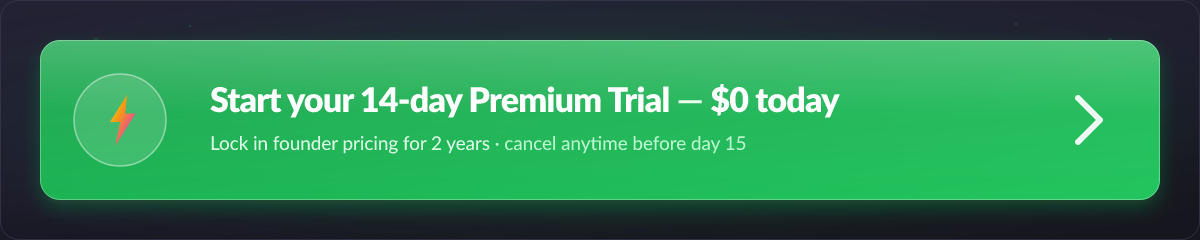
Try Pro with founder pricing — the best value. Start a 14-day Premium Trial at neural-llm.com/pricing: card on file, $0 today, and your first charge isn't until day 15 — at the discounted founder rate you lock in for 2 full years. Cancel anytime before day 15 and you're never charged. Prefer no card at all? The 7-day free trial (no card) starts automatically on install.
FAQ
Does this work with the Anthropic API directly, or only with Claude Code?
Power Claude is built specifically for Claude Code — the CLI and IDE tool at claude.ai/code. It reads the local state Claude Code writes under its own config directory. It does not work with raw Anthropic API calls or with Claude.ai in the browser.
What data leaves my machine?
Only your license key, a hashed machine identifier, and the extension version are transmitted — to api.neural-llm.com during license validation. That validation is cached locally for 24 hours; no call is made on every keystroke. No prompts, no file contents, no transcripts, no usage data, no authentication tokens. Full details at neural-llm.com/privacy-policy.
Can I use multiple Claude accounts?
Yes. Add as many seats as you own. Power Claude tracks health, cooldown, and spend per profile. Manual multi-account is the default. Automatic continuity across seats requires the Auto-Rotation Engine (opt-in, OFF by default, grey-area warning — use at your own risk). Session Explorer annotates which profile handled each part of a session when multi-seat is in use.
Can I run several accounts from one email inbox?
Yes — you don't need a separate inbox per account. Sign each Claude account up with its own email alias (plus-addressing like you+pc1@gmail.com, a custom-domain catch-all, or an alias service such as SimpleLogin / iCloud Hide My Email), all forwarding to one inbox, then add each as a Power Claude profile. Each account is still its own real, paid Anthropic subscription within its own limits — the alias is purely for managing many logins from one place. Step-by-step: Multi-seat accounts — one inbox, many logins.
What happens when I hit a Claude rate limit?
If you have a second healthy account, Power Claude rotates to it automatically and resumes your session — usually within a few seconds. If all accounts are in cooldown, Power Claude displays the soonest-recovering countdown and optionally (powerClaude.autoSelectSoonest) activates the first account whose cooldown clears.
How is this different from GitLens?
GitLens maps your git history to your code. Power Claude maps your AI session history to your code. The two are complementary and designed to coexist. GitLens tells you which commit introduced a line. Power Claude tells you which Claude session wrote that commit, what it cost, which model it used, and whether it finished what it started.
How much does Pro cost?
See neural-llm.com/pricing for current pricing. A 7-day free trial (no card) starts automatically on install. The 14-day Premium Trial (card on file, $0 today, first charge on day 15, cancel anytime before then) locks in founder pricing for 2 years. There is no ongoing free tier — after the trial a paid subscription is required for Pro features.
What is the refund policy?
Full refund within 14 days of purchase, no questions asked. Contact support@neural-llm.com with your order details.
Extending Power Claude
Power Claude exposes a stable public API for other VS Code extensions to read session data, contribute custom tabs to the Session Detail webview, and enrich the Insight Graph with domain-specific data.
// In your extension's activate():
const powerClaude = vscode.extensions.getExtension("neural-llm.power-claude");
const api = await powerClaude.activate();   // PowerClaudePublicApi

// Read the live session index.
const sessions = api.sessions.list({ limit: 20 });
api.sessions.onDidChange(() => /* re-read */);

// Contribute a new tab to the Session Detail webview.
api.contributeSessionDetailTab({
  id:    "myExt.audit",
  label: "Audit",
  render(ctx) {
    return {
      html: `<p>Audit findings for ${ctx.sessionId}</p>`,
      messageHandlers: {
        "myExt.audit.openTrace": (payload) => /* … */,
      },
    };
  },
});

// Contribute a session enricher (lightweight read-only augmentation).
api.contributeSessionEnricher({
  id: "myExt.severityScore",
  label: "Severity Score",
  enrich(session) { return { score: 0.42 }; },
});
Full API surface at neural-llm.com/power-claude. Contracts under the PowerClaudePublicApi interface follow semver — breaking changes are rare and announced in the changelog.
What Power Claude does NOT do
- Does not make API calls to Anthropic on your behalf
- Does not bypass, circumvent, or violate any Anthropic rate limit or term of service — every account stays within its own published limits
- Does not transmit your prompts, code, transcripts, or authentication tokens off your machine
- Does not modify your global Claude Code config without explicit consent (all hook installers are opt-in command-palette invocations)
- Does not require any VS Code workspace to be open — the extension activates on Claude Code state changes regardless
What Power Claude writes to disk
Everything runtime lives under ~/.power-claude/:
| Path | Contents |
|---|---|
~/.power-claude/profiles/ |
OAuth profiles for each Claude account (rotation pool) |
~/.power-claude/state/ |
Rotation state, lockouts, pending-recovery markers |
~/.power-claude/logs/ |
events.jsonl, watchdog.log, rotation-audit.log |
~/.power-claude/lib/ |
Bundled shell helpers, deployed at install time |
~/.power-claude/hooks/ |
Lifecycle + rate-limit hook scripts |
~/.power-claude/cache/ |
devtools-data.json, session-index.json |
~/.power-claude/config/ |
config.json, auto-rewake-config.json |
The only files Power Claude writes outside ~/.power-claude/:
| File | Why |
|---|---|
| Claude Code's credentials file | Claude Code reads its OAuth credentials from here. Power Claude overwrites this file on rotation so Claude Code sees whichever account is active. |
| Claude Code's settings file | Hook registrations (with your consent). Power Claude appends entries; entries from other tools and your own settings are preserved. Removing the extension via "Power Claude: Uninstall Everything" strips every Power Claude entry cleanly. |
Earlier versions stored profiles, state, and hook scripts under Claude Code's config directory. On first run, the migration module moves any legacy data into ~/.power-claude/ and deletes the legacy copies — no manual cleanup needed.
Complete uninstall: run "Power Claude: Uninstall Everything" from the command palette, or rm -rf ~/.power-claude && code --uninstall-extension neural-llm.power-claude. The uninstall command strips every Power Claude entry from Claude Code's settings file and removes ~/.power-claude/; your Claude Code credentials and other settings are untouched.
Privacy
Local-first. Power Claude reads from:
~/.power-claude/profiles/— your rotation pool's OAuth profiles~/.power-claude/state/— rotation state, lockouts, recovery markers~/.power-claude/logs/— events.jsonl, rotation-audit.log- Claude Code's own session transcripts — used only for token-bucket counts and session indexing (read-only)
- Claude Code's edit-history state — only if you opt in to Timeline tracking
The only files Power Claude writes outside ~/.power-claude/ are Claude Code's credentials file (so Claude Code picks up the rotated account) and Claude Code's settings file for hook registrations (with your consent). See What Power Claude writes to disk above for the complete list.
No data leaves your machine. No cloud telemetry. Full privacy policy at neural-llm.com/privacy-policy.
Get Power Claude
code --install-extension neural-llm.power-claude
Two ways to start, both $0 today: the 7-day free trial (no card, auto-starts on install), or the 14-day Premium Trial that locks in founder pricing for 2 years (card on file, nothing charged until day 15, cancel anytime). Start with pc proof, then add seats you own and watch savings in your dashboard.

Support
- Bug reports: github.com/neural-llm-io/power-claude/issues
- Email: support@neural-llm.com
- Sales / licensing: support@neural-llm.com
License
Neural-LLM commercial EULA — see LICENSE and neural-llm.com/eula. Copyright (c) 2025-2026 Neural-LLM.
Trademarks
Claude and Claude Code are trademarks of Anthropic PBC. Visual Studio Code is a trademark of Microsoft Corporation. Cursor is a trademark of Anysphere Inc. Neural-LLM is not affiliated with, endorsed by, or sponsored by Anthropic, Microsoft, or Anysphere. Power Claude is an independent third-party tool that interoperates with the public file outputs of Claude Code.