What it is
A BPMN (Business Process Model and Notation) diagram describes a business
process as a flowchart of events, tasks, and decisions; a DMN (Decision
Model and Notation) diagram captures the decision logic behind it as tables. A
Camunda Form defines the user-facing fields for a Camunda 8 user task.
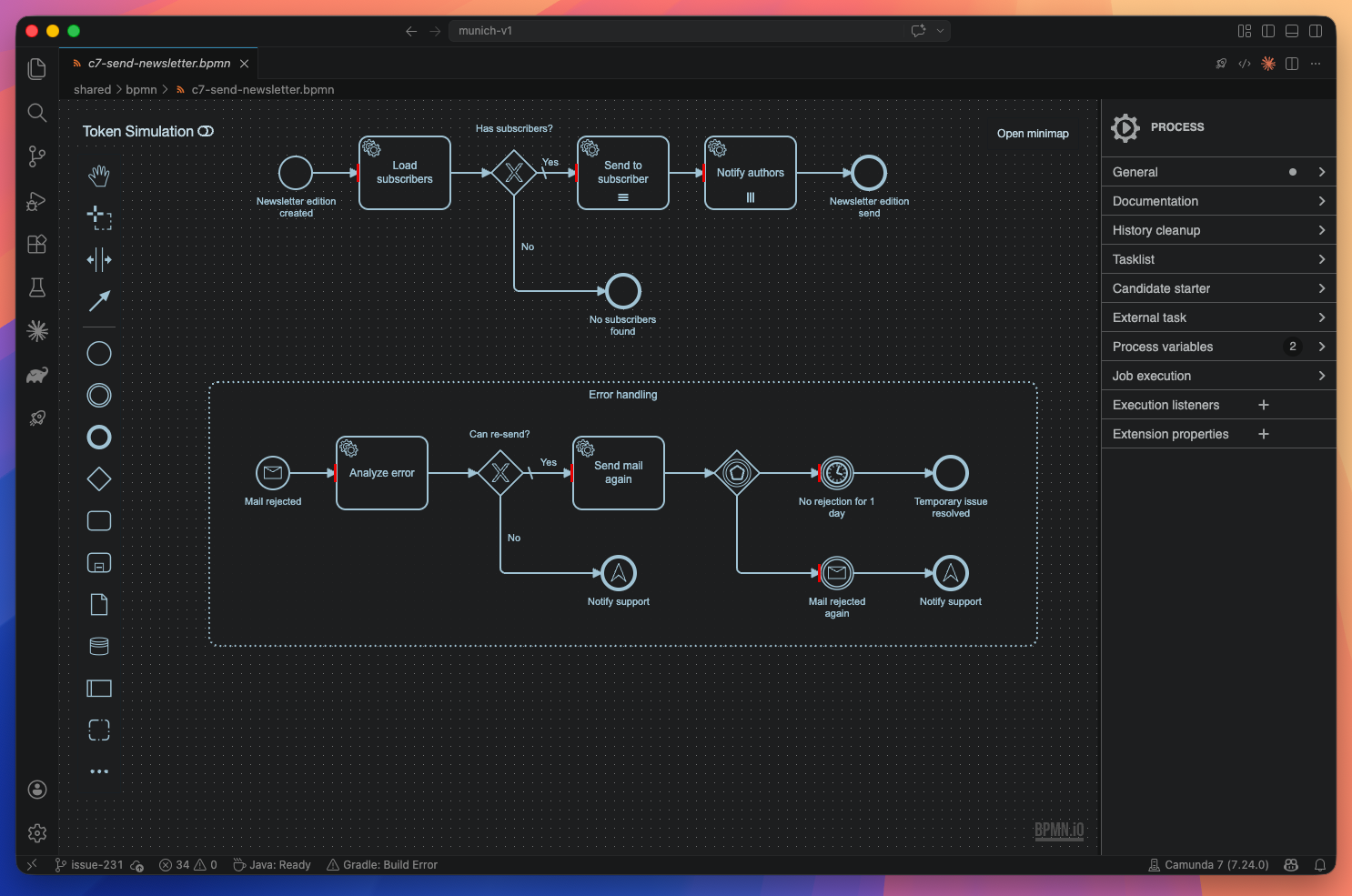
This extension opens .bpmn, .dmn, and .form files in graphical editors
inside VS Code, while the text file stays the source of truth — so save, Git,
and diff keep working, and models are versioned and reviewed in the same
workflow as the rest of your project. No context switch into a separate desktop
modeler.
Powered by bpmn.io — built on
bpmn-js and
dmn-js, plus
form-js.
Getting started
Install BPMN Modeler (publisher miragon-gmbh) from the VS Code
Marketplace, then get oriented in a couple of minutes:
- Take the walkthrough first. The built-in Get Started with BPMN
Modeler walkthrough is the recommended first stop — open it from
Help: Get Started in the Command Palette. It walks you through creating,
editing, and deploying a diagram.
- Create a model. Make a new file ending in
.bpmn (a BPMN 2.0 process),
.dmn (a DMN decision table), or .form (a Camunda Form). VS Code opens it
straight in the matching graphical editor instead of the plain text editor.
- Open an existing one. Any
.bpmn, .dmn, or .form file opens the same way.
Reading a diagram
New to the notation? Here is the 30-second version — full primers are linked
under Develop and learn more.
A BPMN process reads left to right along its flow:
- Events (circles) mark what starts, happens during, or ends the process.
- Tasks (rounded rectangles) are the work being done.
- Gateways (diamonds) split or merge the flow to model decisions and
parallel paths.
- Sequence flows (arrows) connect the elements in the order they run.
A DMN decision table reads as rows of rules: input columns on the left map to
output columns on the right, so each row says "when the inputs look like this,
the decision is that".
Editing a diagram
- Graphical editor for
.bpmn / .dmn. Add elements from the palette or
the context pad on a selected shape, connect them into sequence flows, and set
each element's name, type, and Camunda 7 / Camunda 8 attributes in the
Properties panel. Everything is written straight back into the underlying
XML. Flip to the raw XML at any time with BPMN Modeler: Toggle Standard
Text Editor (Ctrl+Shift+E); it also sits in the editor title bar.
- Visual editor and preview for
.form. Build a Camunda Form visually and
switch to Preview without losing edits. Use BPMN Modeler: New Form to
create a valid starter form. Toggle the standard text editor to edit the raw
JSON; VS Code validates it against the form-js JSON Schema and displays
problems in the editor and Problems panel.
- Navigate from a C8 User Task to its linked form. A User Task whose
formId resolves to a workspace .form file shows a link action in its
context pad. Select it to open the form in a separate editor tab.
- Review forms as JSON. Current VS Code releases open
.form comparisons in
the standard text diff editor. VS Code 1.76–1.128 can still route custom-editor
comparisons to the visual editor; use Reopen Editor With… → Text Editor on
those legacy releases.
- Element templates — convention-based discovery: drop templates under
<configFolder>/element-templates/ anywhere between your BPMN file and the
workspace root. No extra project config needed.
- Deploy to Camunda — open the Deploy Diagram view from the activity
bar (the rocket icon) or run BPMN Modeler: Deploy Diagram from the editor
title bar to deploy a diagram and start process instances against Camunda 7
or 8. Supports no auth, Basic Auth, and OAuth2 Client Credentials; payload
files are discovered by convention from
<configFolder>/payloads/.
- Compare two diagrams — select two
.bpmn files in the Explorer (or
right-click one, Select for Compare (BPMN), then Compare with
Selected (BPMN) on another) to open a side-by-side read-only diff with element-level
colour coding (added / removed / changed / moved) via
bpmn-js-differ, synchronized
pan/zoom, and a prev/next change navigator.
- Linting — diagrams are checked with bpmnlint
(a bundled default, or a
.bpmnlintrc found in your workspace); findings show as
hints on the canvas, in the Problems panel, and in the status bar. Only
drawing processes, not automating them? Turn linting off — for all your files —
from the switch on the lint hint, the BPMN Modeler: Toggle Linting command,
the status-bar badge, or the miragon.bpmnModeler.linting.enabled setting.
- Export — copy the current diagram to the clipboard as SVG, or save an SVG
next to the source file, via the SVG commands below.
- Multi-language UI — palette, context pad, and properties panel available
in English, Deutsch, Español, Français, Nederlands, Português (Brasil),
Русский, 简体中文, and 繁體中文.
Commands
Search for "BPMN Modeler" in the Command Palette (Ctrl+Shift+P / Cmd+Shift+P).
| Command |
Keybinding |
Description |
| BPMN Modeler: Deploy Diagram |
|
Open the Deployment sidebar for the current BPMN/DMN diagram |
| BPMN Modeler: Copy Diagram as SVG |
|
Copy the current diagram to the clipboard as SVG |
| BPMN Modeler: Save Diagram as SVG |
|
Save an SVG file of the current diagram next to the source file |
| BPMN Modeler: Change Engine Version |
|
Switch between engine versions (within a platform) |
| BPMN Modeler: Migrate All BPMN Diagrams |
|
Switch the engine versions of all BPMN diagrams in the workspace |
| BPMN Modeler: Change Modeler Language |
|
Change the UI language of the modeler |
| BPMN Modeler: New Form |
|
Create a valid Camunda Form and open its visual editor |
| BPMN Modeler: Toggle Linting |
|
Turn BPMN linting on or off (applies to all files) |
| BPMN Modeler: Toggle Standard Text Editor |
Ctrl+Shift+E |
Open the XML or JSON text editor next to the visual editor |
| BPMN Modeler: Display Logging Information |
|
Open a console showing modeler log output |
The compare commands — Select for Compare (BPMN), Compare with Selected (BPMN), and
Compare Selected (BPMN) — are available from the Explorer right-click menu on
.bpmn files rather than the Command Palette.
Settings
Search for "BPMN Modeler" in Settings (Ctrl+, / Cmd+,).
| Setting |
Default |
Description |
miragon.bpmnModeler.configFolder |
.camunda |
Folder name used for element template and payload file discovery |
miragon.bpmnModeler.linting.enabled |
true |
Run BPMN linting; turn off to hide all lint hints (design-only users) |
miragon.bpmnModeler.language |
en |
UI language for the modeler (e.g. de, fr, zh-Hans) |
miragon.bpmnModeler.colorTheme |
automatic |
Color theme for the BPMN canvas (automatic or light) |
miragon.bpmnModeler.favouriteBpmnElements |
["bpmn:ServiceTask", ...] |
BPMN element types pinned at the top of the append menu palette (max 6) |
miragon.bpmnModeler.showTransactionBoundaries |
true |
Show transaction boundaries in the BPMN canvas (C7 only) |
miragon.bpmnModeler.c8ApiVersion |
v2 |
REST API version prefix for Camunda 8 deployment endpoints |
miragon.bpmnModeler.alignToOrigin |
false |
Align the diagram to the origin when opening a new diagram |
Troubleshooting
The modeler logs to the bpmn.modeler output channel. Open it from the
Output panel (View: Output, then select bpmn.modeler) or with the command
BPMN Modeler: Display Logging Information.
By default the channel shows Info and above. When a diagram, element
template, or the webview misbehaves, raise the level to see the full trace:
run Developer: Set Log Level…, pick bpmn.modeler, and choose Debug.
Debug adds the per-message transport trace, the element-template discovery scan
(which config folder was searched and what was found), and any warnings or
errors the webview forwards (prefixed with [webview:<file>]).
Filing a bug? Set the log level to Debug, reproduce the problem, then
copy the whole bpmn.modeler channel into the report — the Info-level
breadcrumbs (editor opened/closed, deployment started/result, SVG export) plus
the Debug transport trace let us reconstruct the exact steps that led to the
failure. Credentials are never logged, so the channel is safe to paste.
Develop and learn more
Support and feedback
License
Distributed under the Apache License 2.0.