NiceTiming: Time Tracker for VS Code and AI AgentsAutomatic time tracking for VS Code: your coding time and your AI agents' time apart (Claude Code, Codex, Copilot), reports, timesheets, invoices, and a voxel island that grows as you work. Installation Launch VS Code Quick Open ( Ctrl+P), paste the following command, and press enter.Copied to clipboard |


NiceTimingFree to use; NiceTiming Pro is optional. Works in VS Code, VSCodium, Cursor and Windsurf. Website · Pricing Automatic time tracking for VS Code. NiceTiming records the time you spend in each project while you work, shows the time AI agents such as Claude Code or Codex spend editing your files apart from yours, and turns your days into reports, timesheets and billable hours. A voxel island grows with the hours you put in. Your data stays on your computer. There is no account to create and nothing to set up before it starts counting.
Free, and NiceTiming ProEverything on this page that is not marked Pro is free and stays free: the tracking, the dashboard, billing and timesheets, ticket links, exports and imports, the AI features with your own provider, your agents' tokens and the coach, and the whole island game, alone or online. Money never buys an advantage in the game: the island packs change its looks only. NiceTiming Pro adds tools for people who follow their working time and their AI agents closely: a planner, focus insights and written reviews; each request to your agents with its cost and result; a prompt panel and library; PDF invoices, quotes, budgets, reports and integrations; workspaces, rules and custom fields. It also lifts the limits of NiceTiming Cloud: every computer syncs, the web shows your whole history, and you get an API with webhooks and a weekly email. It has a free trial without a card: see the plans. When Pro ends, everything you made stays here and readable. The NiceTiming Pro screen (the dashboard's footer, or the status bar menu) starts with where this computer stands, synced with NiceTiming Cloud or not and on which plan, then the ways to get Pro. Until Pro is open, the Pro tabs of the dashboard carry a small lock, and a feature that waits for Pro opens this screen on itself. Getting started
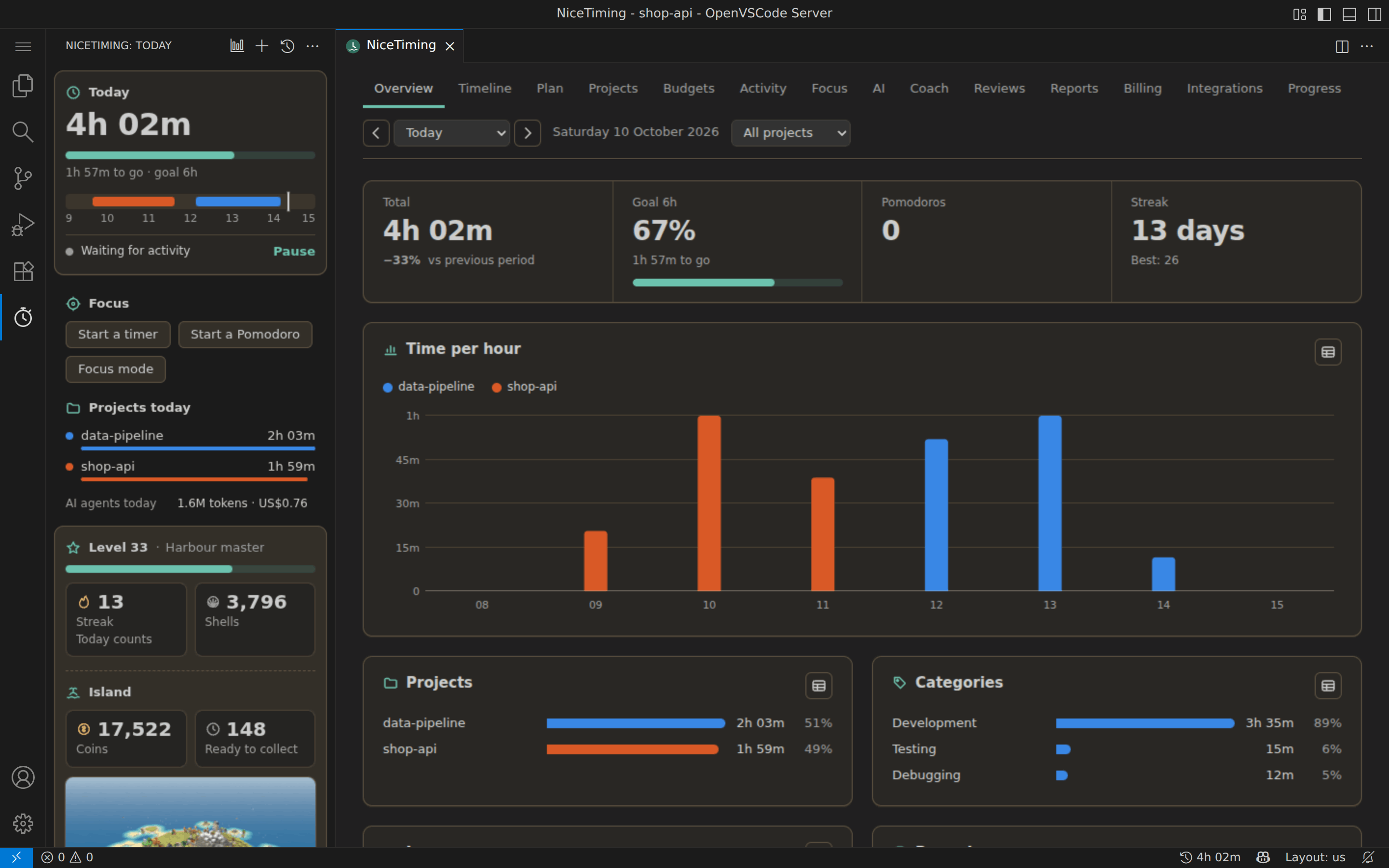
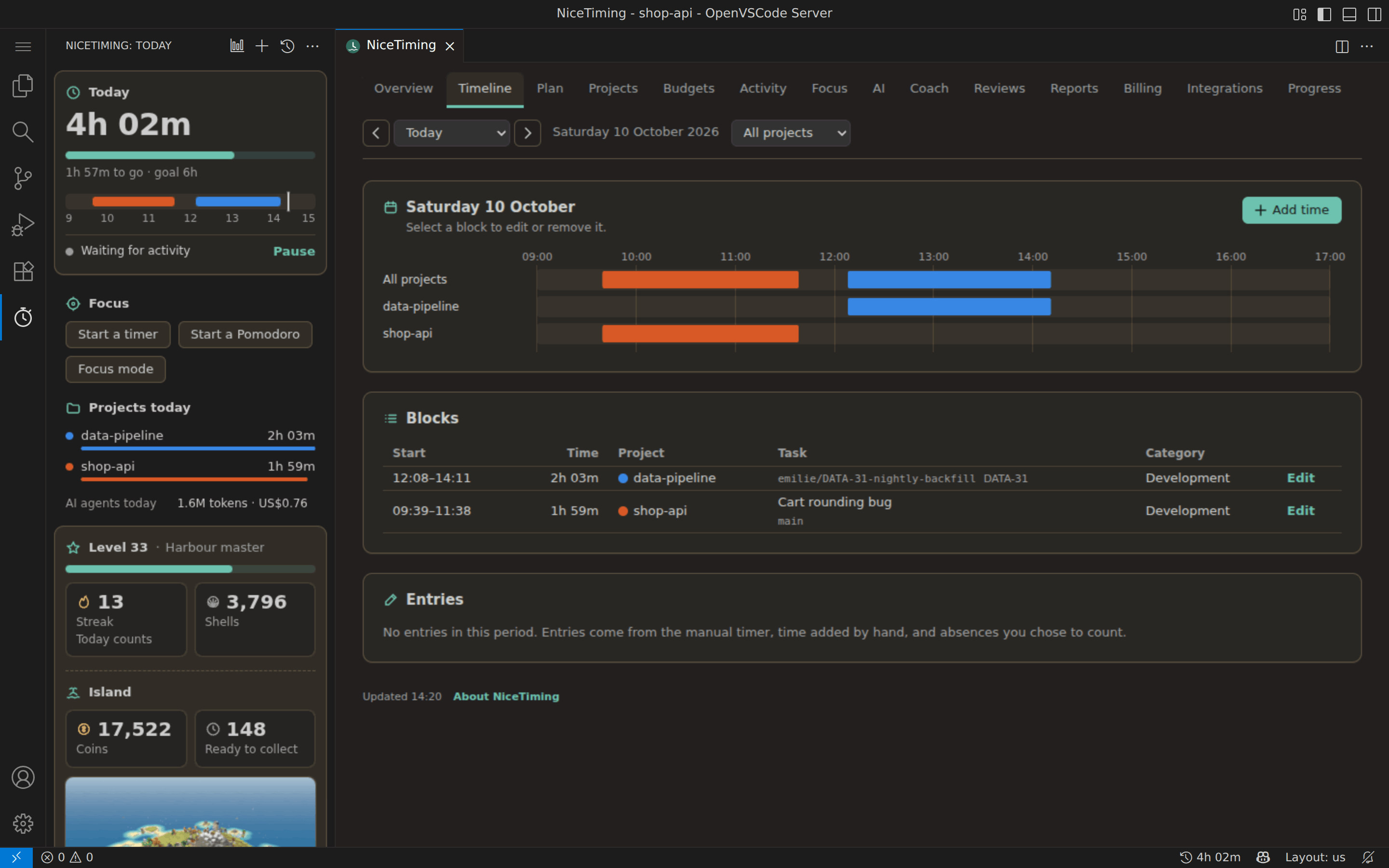
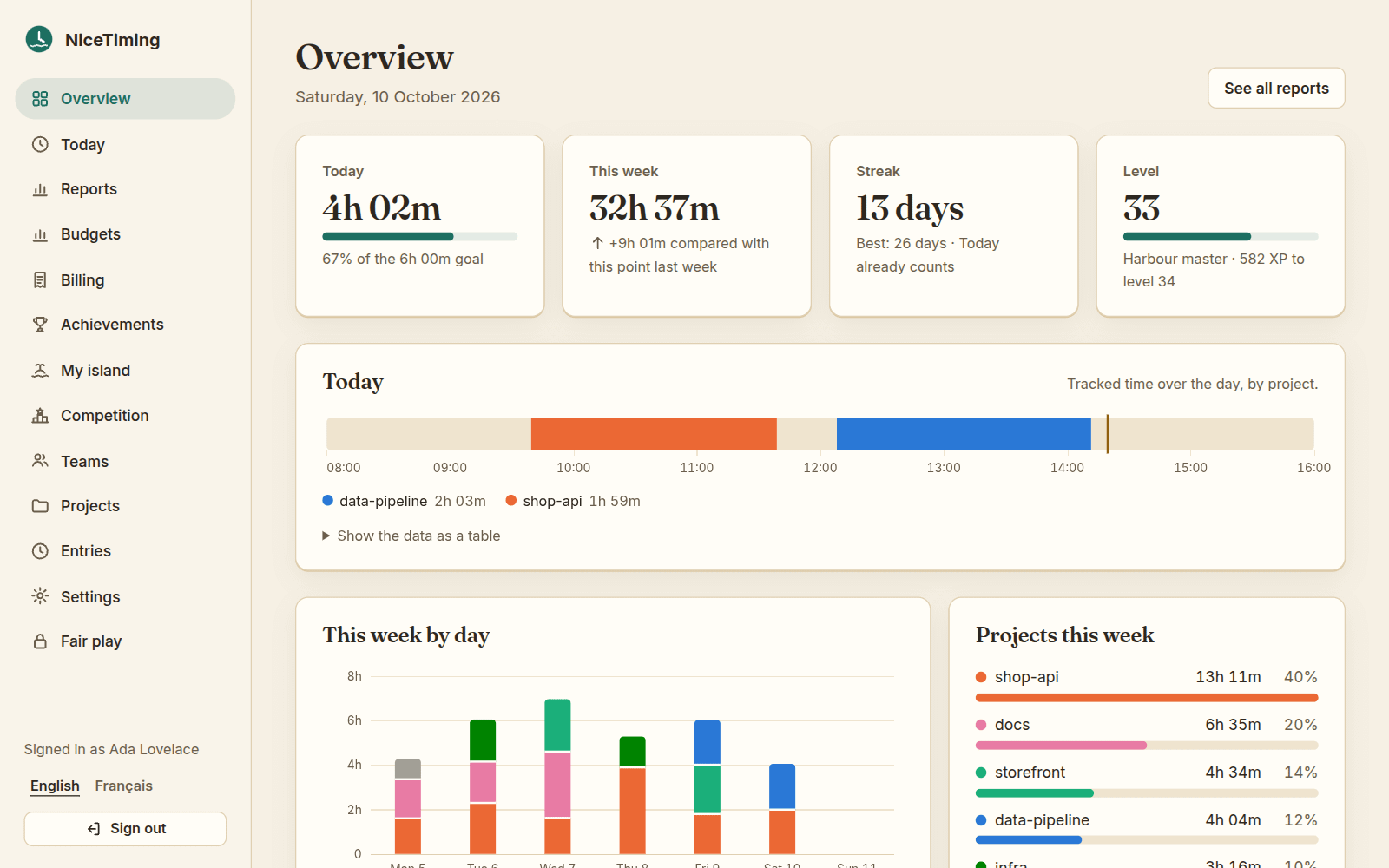
The walkthrough Get started with NiceTiming, under Help › Welcome, shows the rest in six steps. NiceTiming needs VS Code 1.90 or later, and everything works without GitHub Copilot: the stand-up and the reports then come from an Anthropic API key, an OpenAI compatible server, a local Ollama model, or templates. Time trackingTracking that needs no attention. Time counts while you type, read and move around your code (the cursor, the scroll, other files, the diff of a commit or of a pull request), debug or run commands in the terminal. A pause shorter than the idle threshold (5 minutes by default) counts as work; a longer one ends the stretch at your last action, so nothing is padded. Several windows open at the same time never count the same minute twice. Every language counts under its name, also the ones VS Code has no extension for, such as Vue, Svelte or TOML, named from the file. Today, always in sight. The status bar shows today's total and, on hover, where it went. It keeps counting while you read without a move, until the pause reaches the idle threshold: then it goes back to your last action, as the totals count it, and shows an outline until you are back. Click it to set the current task or category, add tags, start the manual timer or a Pomodoro, or pause tracking. The NiceTiming view in the activity bar shows the same day at a glance, with your goal and streak. A dashboard for any period. Time per day or per hour, projects, categories, languages, branches, tasks, tags and files, the hours of the week when you work the most, a year calendar and your records. Every chart has a table view. In the timeline you can move part of a block to another project or task, change its category, remove it, or add time spent away from the editor. The views wear your theme's colours, high contrast themes included, and work from the keyboard. English and French.
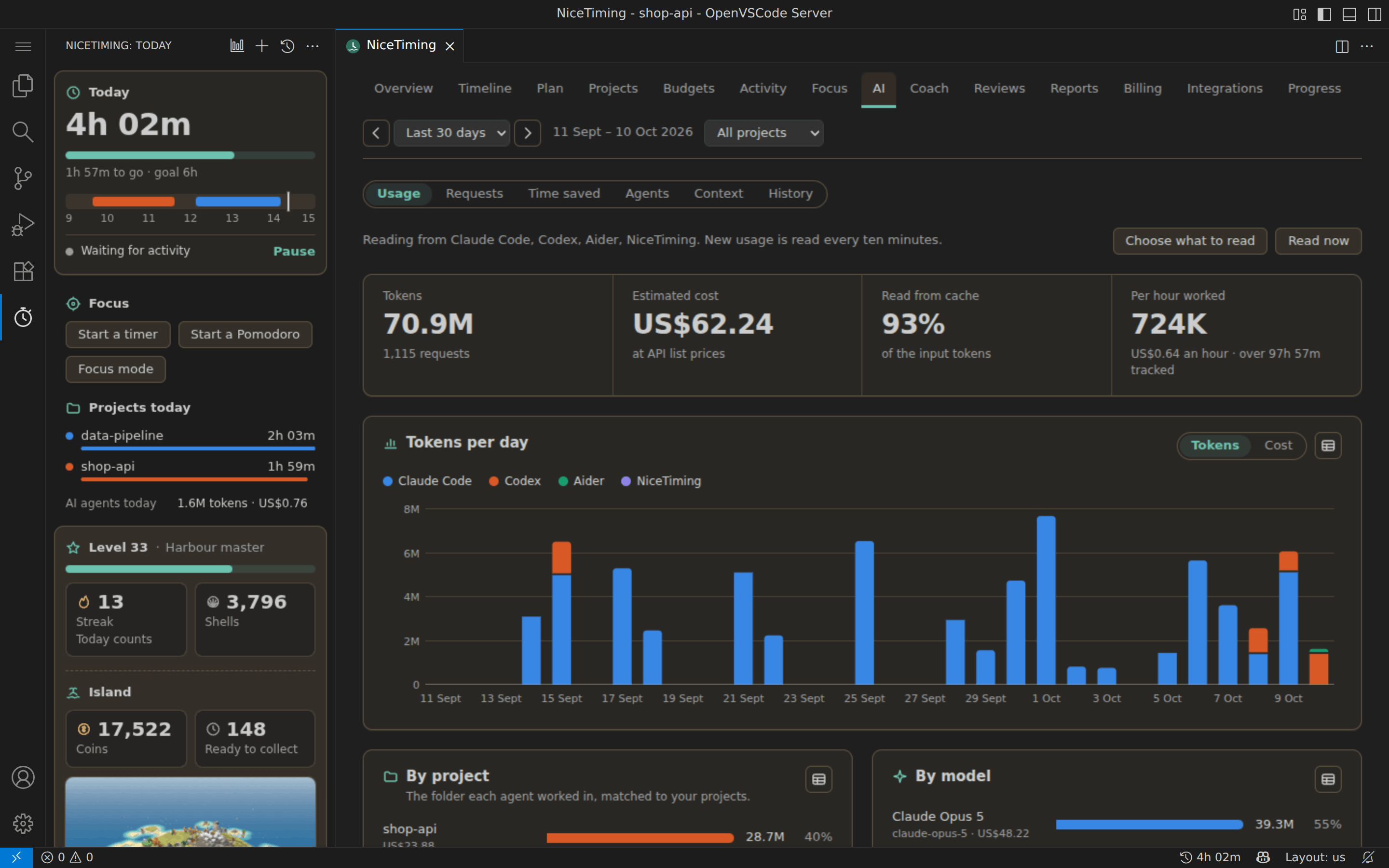
Focus tools. A manual timer for calls and meetings, a Pomodoro timer that survives restarts, a reminder to take a break after 90 minutes of work, and a question when you come back after an absence: count that time on the project, as something else such as a meeting, or not at all. Add time in plain words. NiceTiming: Add time entry understands a line of English or French, such as "1h30 on storefront yesterday afternoon, checkout review" or "hier de 14h à 16h réunion client", and shows what it understood before saving. Exports and imports. CSV, timesheet CSV, Markdown, iCalendar (work blocks as events) and JSON. Imports NiceTiming backups, CSV files from Toggl Track and Clockify, and the data of NiceTiming 1.x. Your AI agentsTheir time, apart from yours. When an AI agent such as Claude Code, Codex, Copilot, Cursor or Cline edits your files, that time is recorded and shown apart from yours, in the dashboard, the reports and the island. While you act in the window yourself (you acted in the last 30 seconds), what you do stays what you do: reading or typing while an agent writes counts as your own reading or typing, on the island too; once you stop, its writes count as its time. It carries the agent's name: from the live session working in that folder (Claude Code from its own VS Code extension included), else from its terminal or the editor; when nothing tells which agent it was, it is "AI agent". The tokens they use, and what they cost. Turn it on with NiceTiming: Choose where to read AI token usage and the AI tab shows the tokens used by Claude Code, Codex, Aider, Cline, Roo Code and Kilo Code, by project, model and agent, per day or per hour, with what they would cost at the public API prices. Only numbers are read and kept: tokens, model, time and folder, never the text of your conversations.
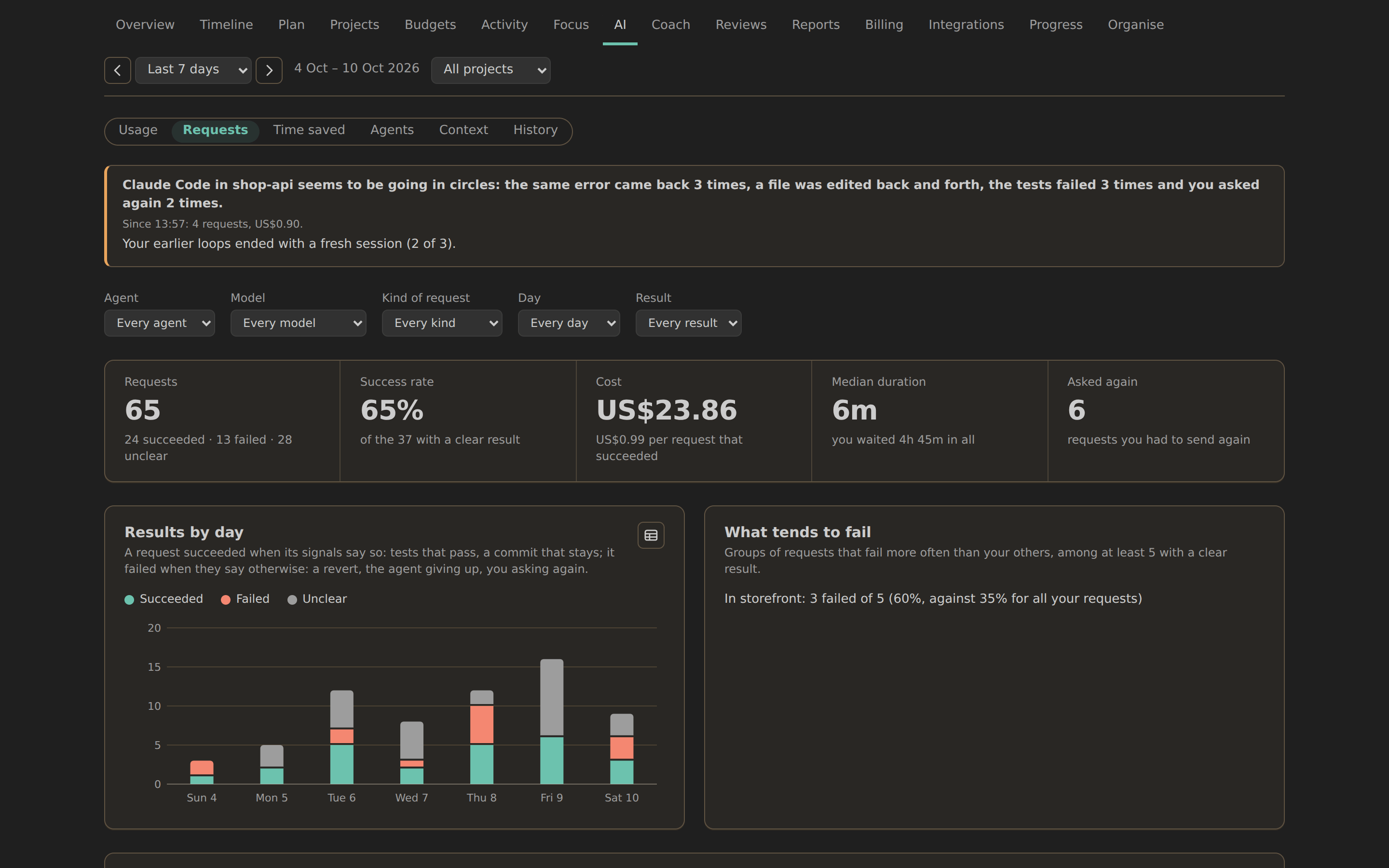
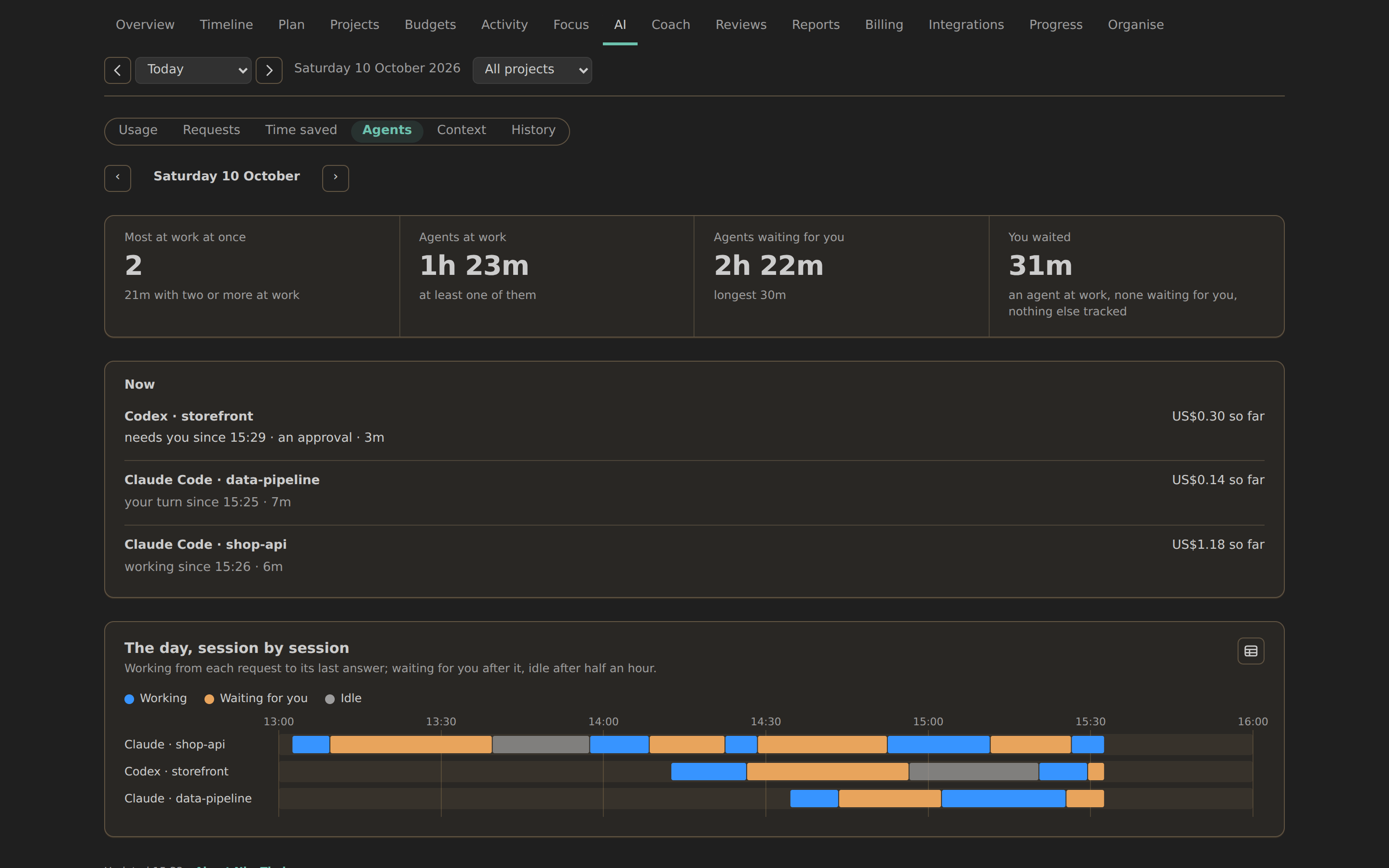
A coach for your setup. For Claude Code and Codex, the AI tab looks at each prompt you sent: the model and effort it ran with, and the tool calls, files edited, time and tokens it took. From these numbers it estimates whether a lighter model or a lower effort would likely have done the same work, and what that would have cost, shown as estimates (≈). If you allow it, the coach also reads the text of your prompts on your computer, and never stores it. Under By agent, the tab also says how many of each agent's output tokens its subagents wrote. Your agents at work, wherever you are. While Claude Code, Codex, Cline, Roo Code or Kilo Code work, NiceTiming tells you when one finishes or needs you: a status bar item while a session is going on ("2 · 1 waits for you"), a notification when one is done or waits for an approval (by default only when its terminal is not in sight), and an "Agents at work" list in the Today view. One click brings you back to the session's terminal. NiceTiming follows the logs these tools write; NiceTiming: Get exact alerts from Claude Code makes approvals and ends of turns exact. Each request, its cost and its result (Pro). The AI tab's Requests view lists each request you sent to Claude Code and Codex with what it cost, how long it took, how long you waited and whether it succeeded, read from what happened: tests that pass or fail, a commit that stays or is reverted, the agent giving up, you asking again. It shows the costliest and slowest requests, what tends to fail, and which model and effort gave you the best result for the cost. When a session goes in circles, you are told once, gently. Agents puts the day's sessions on one timeline, with who waits for you and since when.
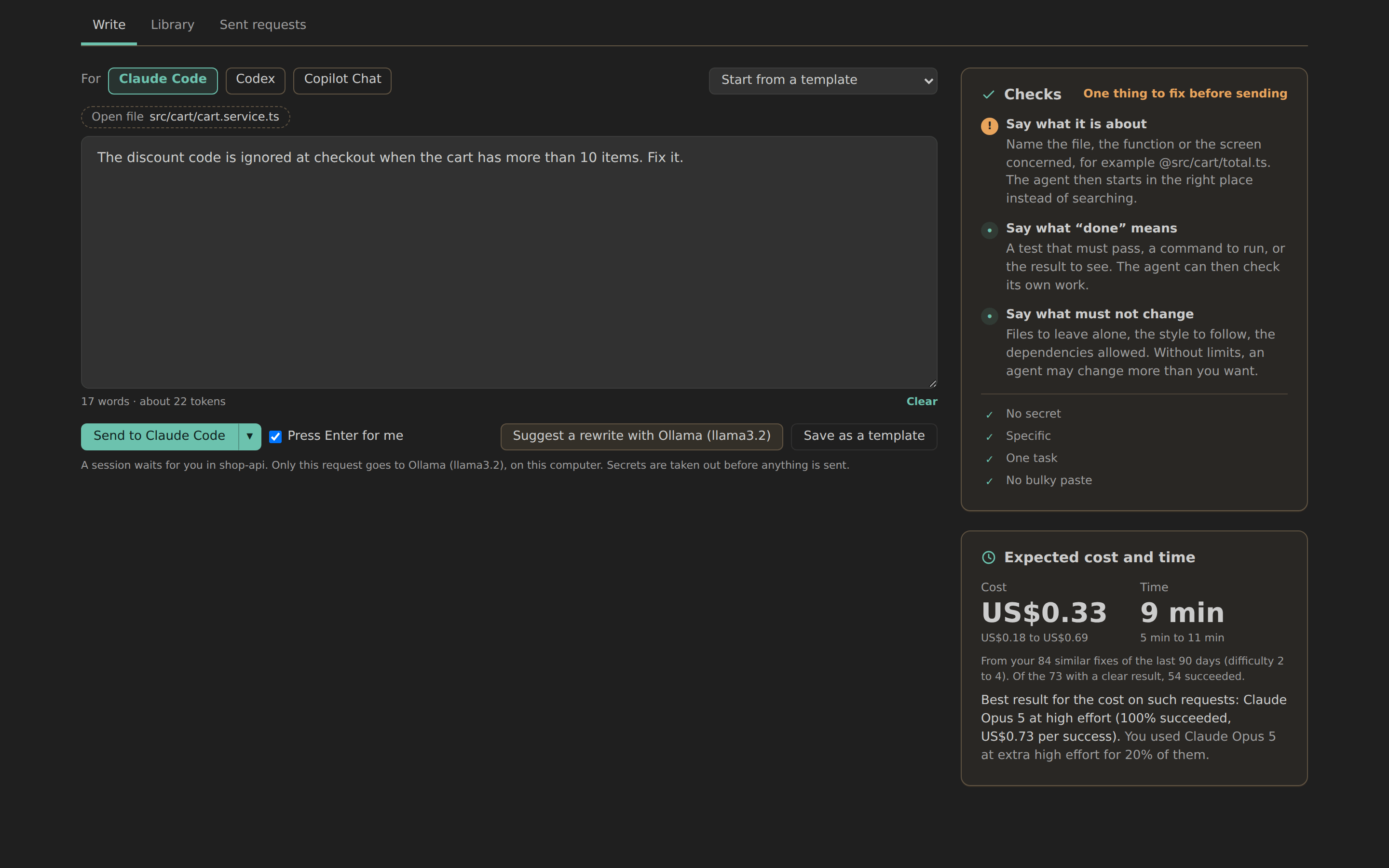
Better requests (Pro). NiceTiming: Write a request for a coding agent checks your request as you type: whether it says what it is about, wording too vague to act on, several tasks at once, what "done" means, a large paste, a secret pasted by mistake. It suggests a rewrite with your AI provider (a local model through Ollama works), gives the cost and time to expect from your own similar requests, then sends it to Claude Code or Codex in their terminal, to Copilot Chat, the editor or the clipboard. The prompt library keeps templates with variables, folders and versions, each with the success rate and cost of the requests it started.
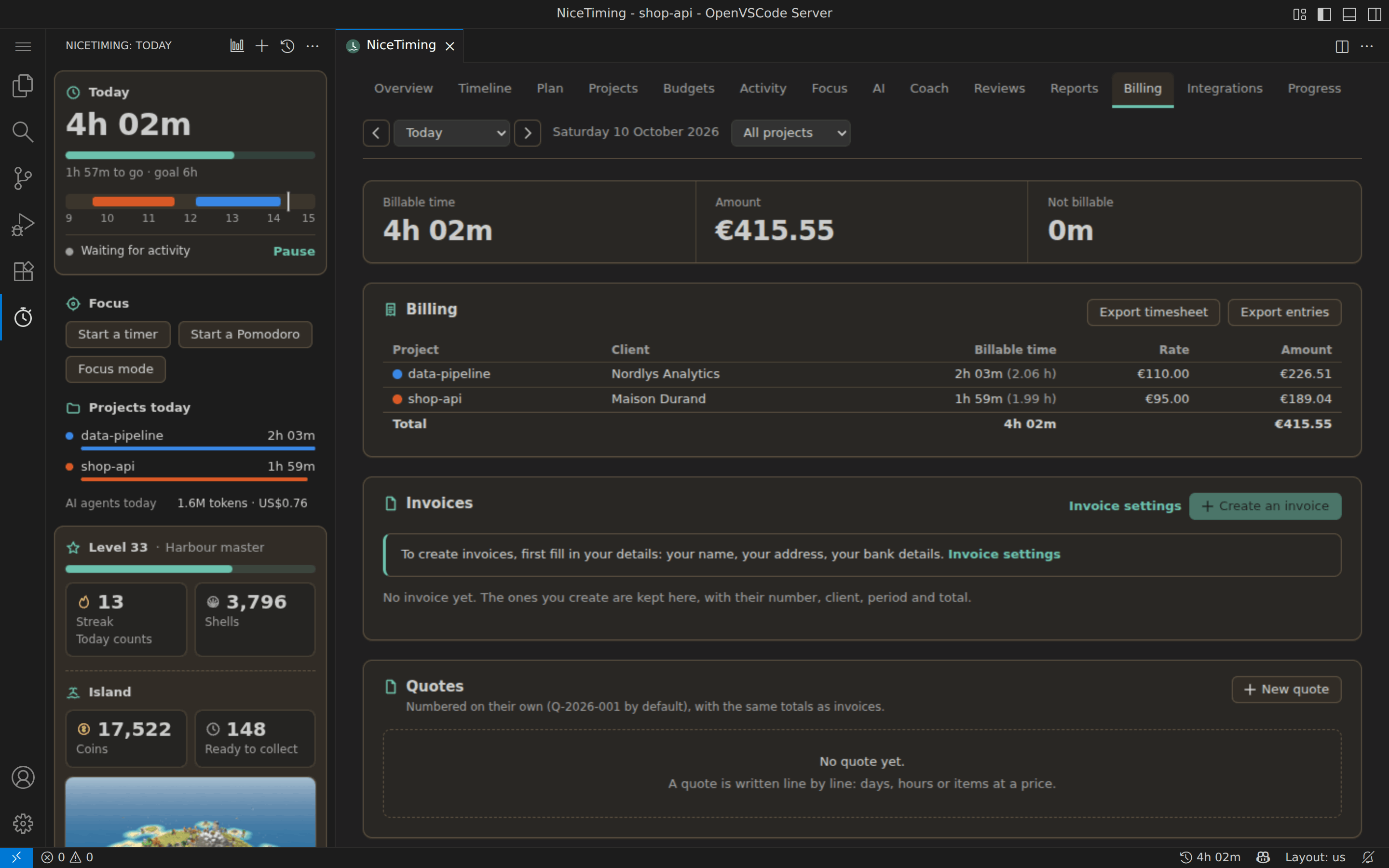
It writes for you. Estimates for a new task from similar tasks you finished, insights about your rhythm and forecasts for the week and the month are computed on your machine from your own data, with the numbers behind them. With a language model, NiceTiming also writes your stand-up and your weekly report, and answers questions such as "how much time did I spend on tests last month?". It works with GitHub Copilot (through VS Code), an Anthropic API key, a local Ollama model, or any server that speaks OpenAI's API (OpenAI, Azure OpenAI, OpenRouter, LM Studio, vLLM, llama.cpp); keys stay in VS Code's secret storage. In the chat, Billing and invoicesBilling. Hourly rates per project, clients, budgets with a warning at 80 % and 100 %, amounts per client and a timesheet by day, all exportable.
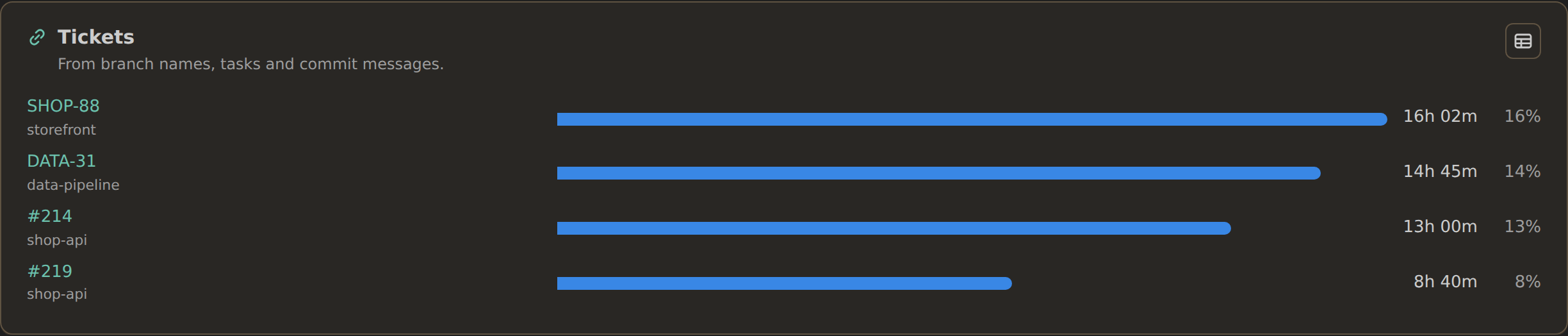
Ticket links. NiceTiming finds the tickets your work is about in your branch names (
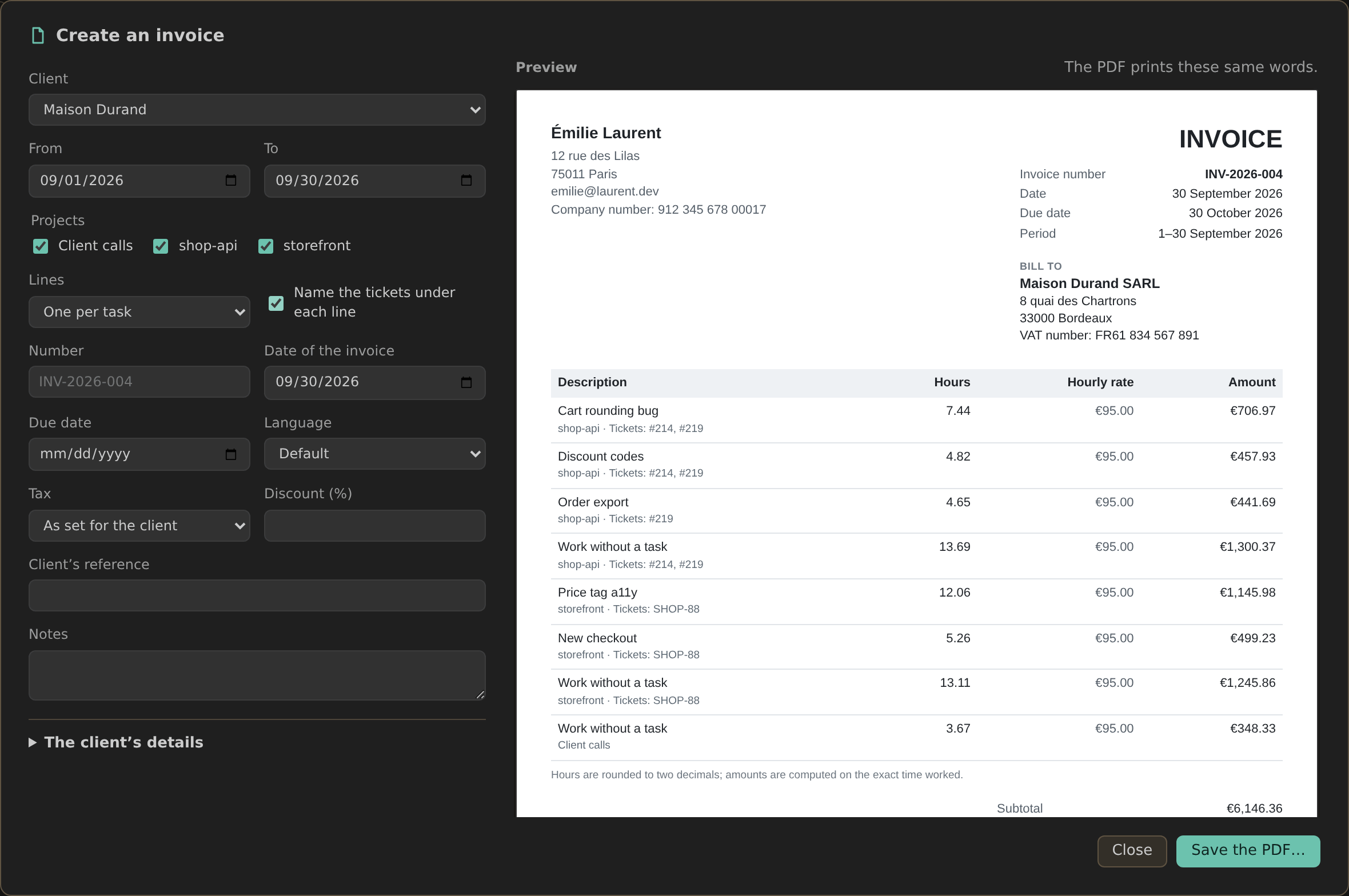
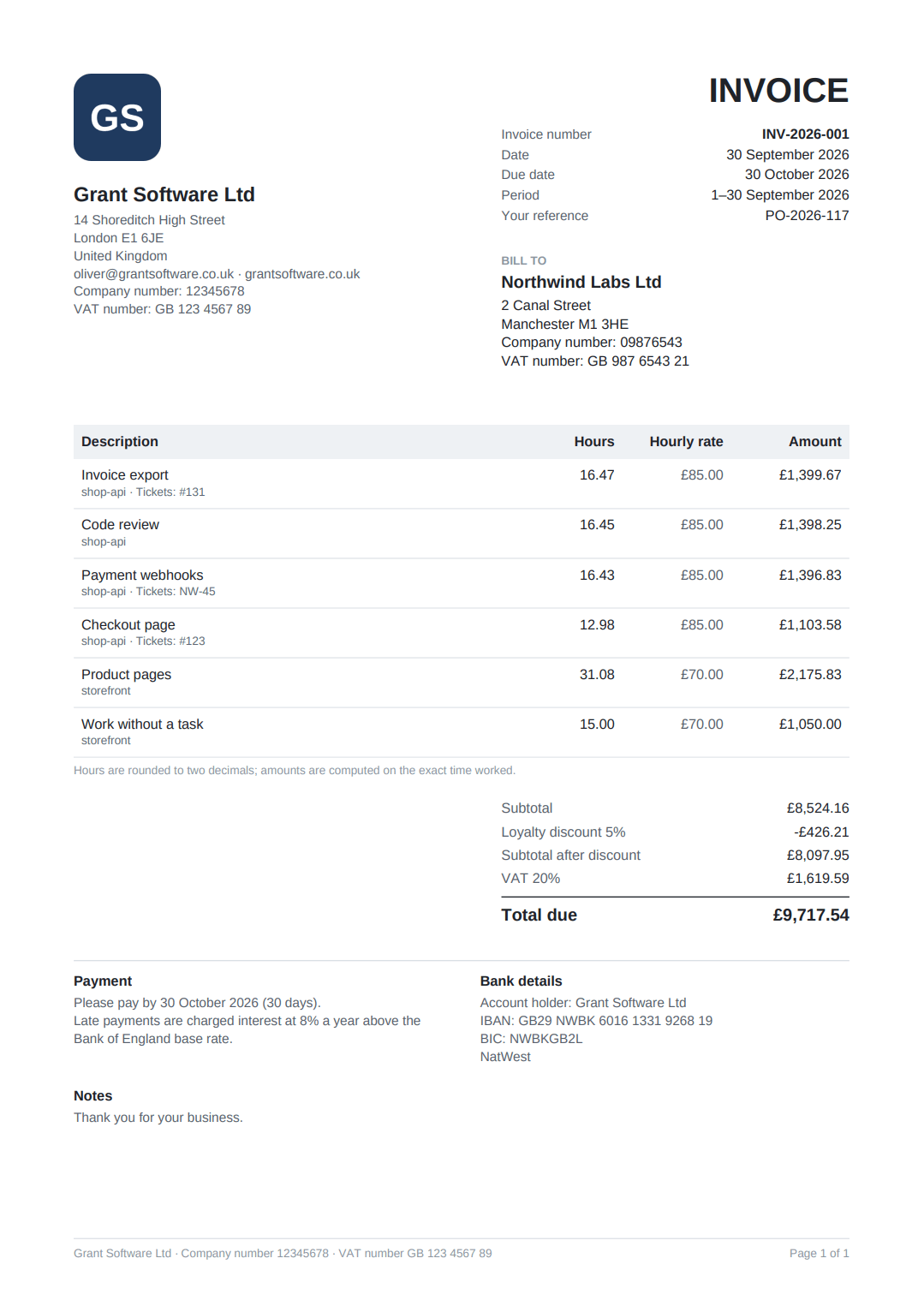
Invoices (Pro). Create an invoice in the billing tab makes a PDF invoice for a client and a period, with one line per project, task, day or ticket, and a preview of the PDF. Your details and the numbering (INV-2026-001) are set once; each client gets its address, a VAT rate or the mention your country asks for (« TVA non applicable, art. 293 B du CGI »), its payment days and the language of its invoices, English or French. Amounts follow the billing tab to the cent. Issued invoices are kept: the billing tab marks them paid, cancels them, saves their PDF again, and warns before the same days are billed twice. Pro also adds quotes, recurring invoices, payment reminders, Factur-X files and the AI agents' cost as invoice lines. Without Pro, the invoices you made stay listed and can be saved again.
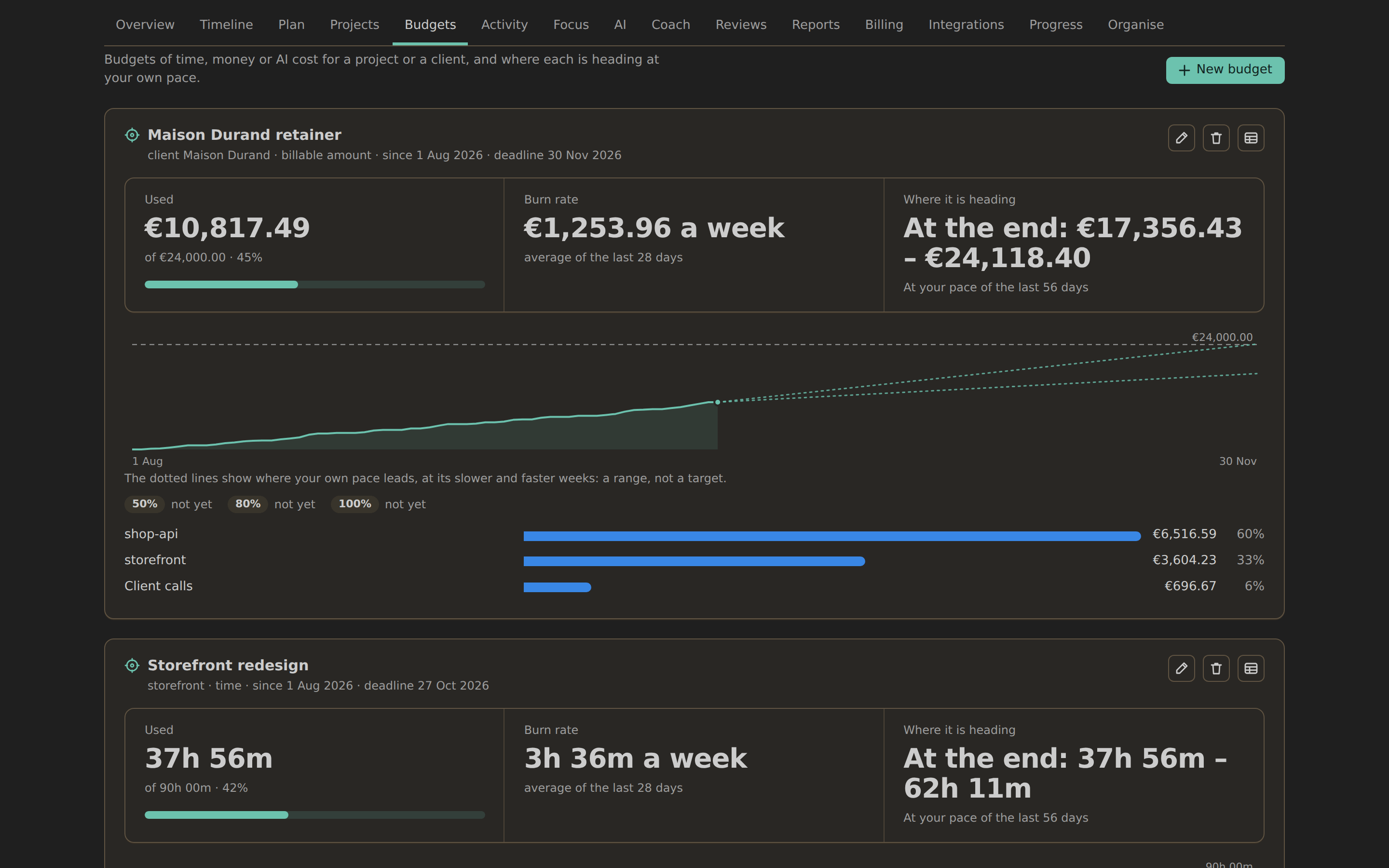
Budgets, reports and integrations (Pro). Budgets of time, money or AI spend per project or client, with the pace and where each is heading. Reports you build (what to measure, how to group, a chart), saved as PDF or Excel, or made every week or month. Your time goes to Toggl Track, Clockify, Harvest or Jira worklogs and theirs comes in, after a preview, never twice; Linear and GitHub issues become tasks.
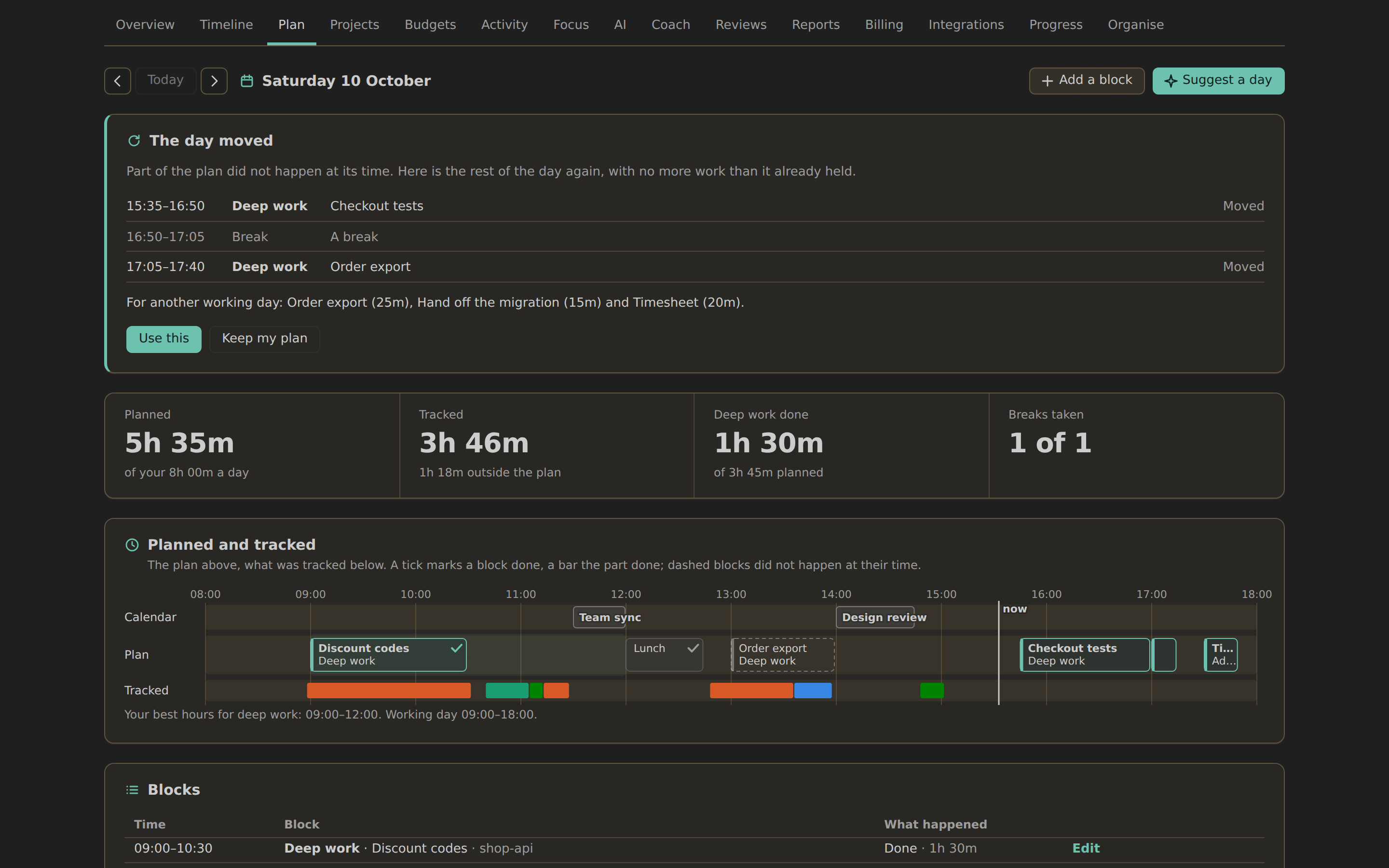
Your working time (Pro)Four tabs of the dashboard go further than the free reports, from your own days and without ever pushing you to work more. Plan lays out the day in blocks of deep work, meetings, review, admin, work handed to an agent and breaks, never past your daily cap, with your Google or Outlook calendar. Coach shows the week's facts and recommendations drawn from your numbers, then measures what you try against the weeks before, with the uncertainty, and never a score. Focus shows your deep sessions, what interrupts them and what a context switch costs you. Reviews writes the week, the month and the stand-up from the facts.
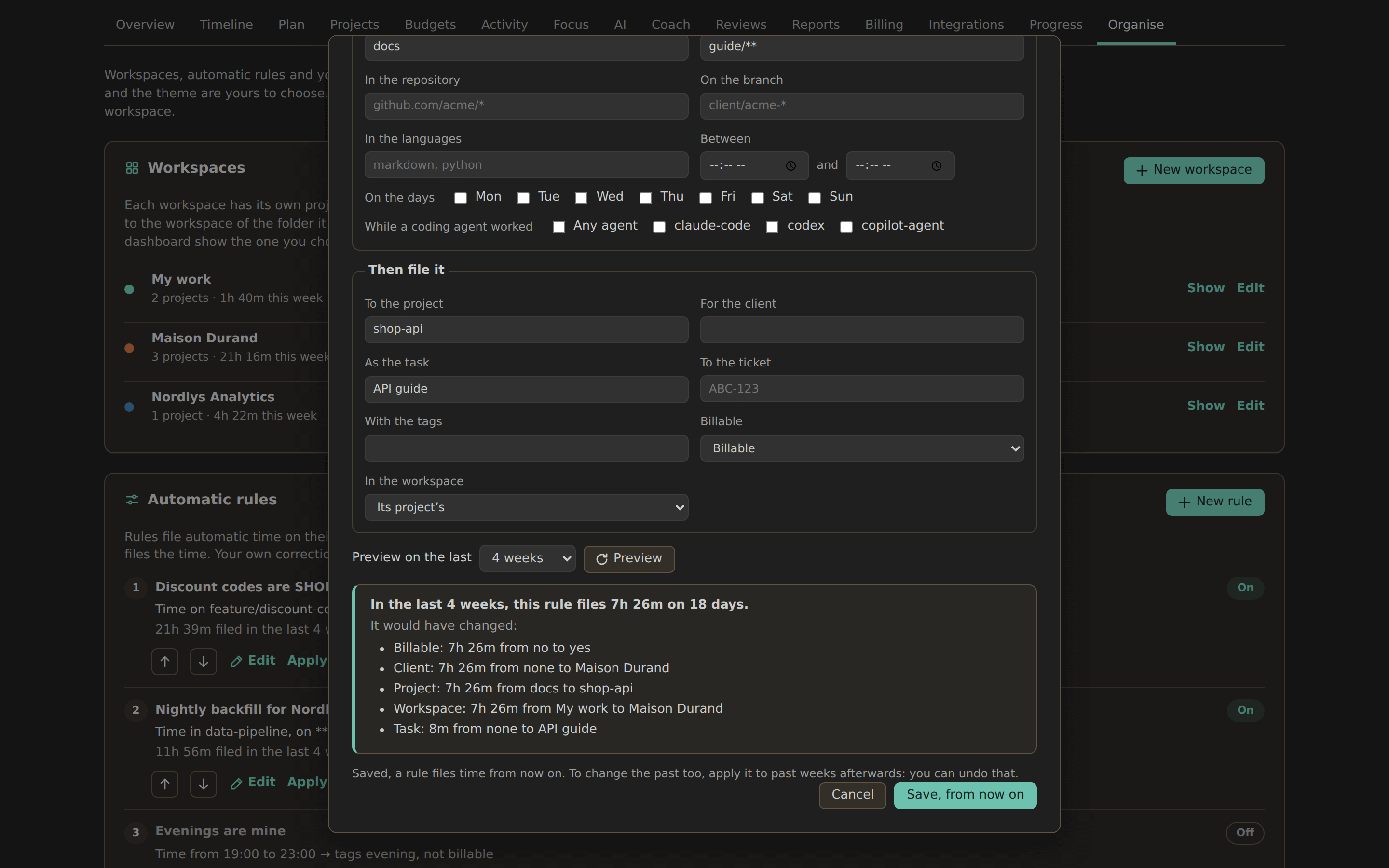
Workspaces keep clients, jobs and your own projects apart, each with its projects, rate, goal and reports. Automatic rules file your time by folder, files, repository, branch, language, agent, day or hour, and show what they would have moved on your past weeks before you save them. Custom fields go on entries and projects. Three more looks, Paper, Night sea and Sand, dress the dashboard and the Today view.
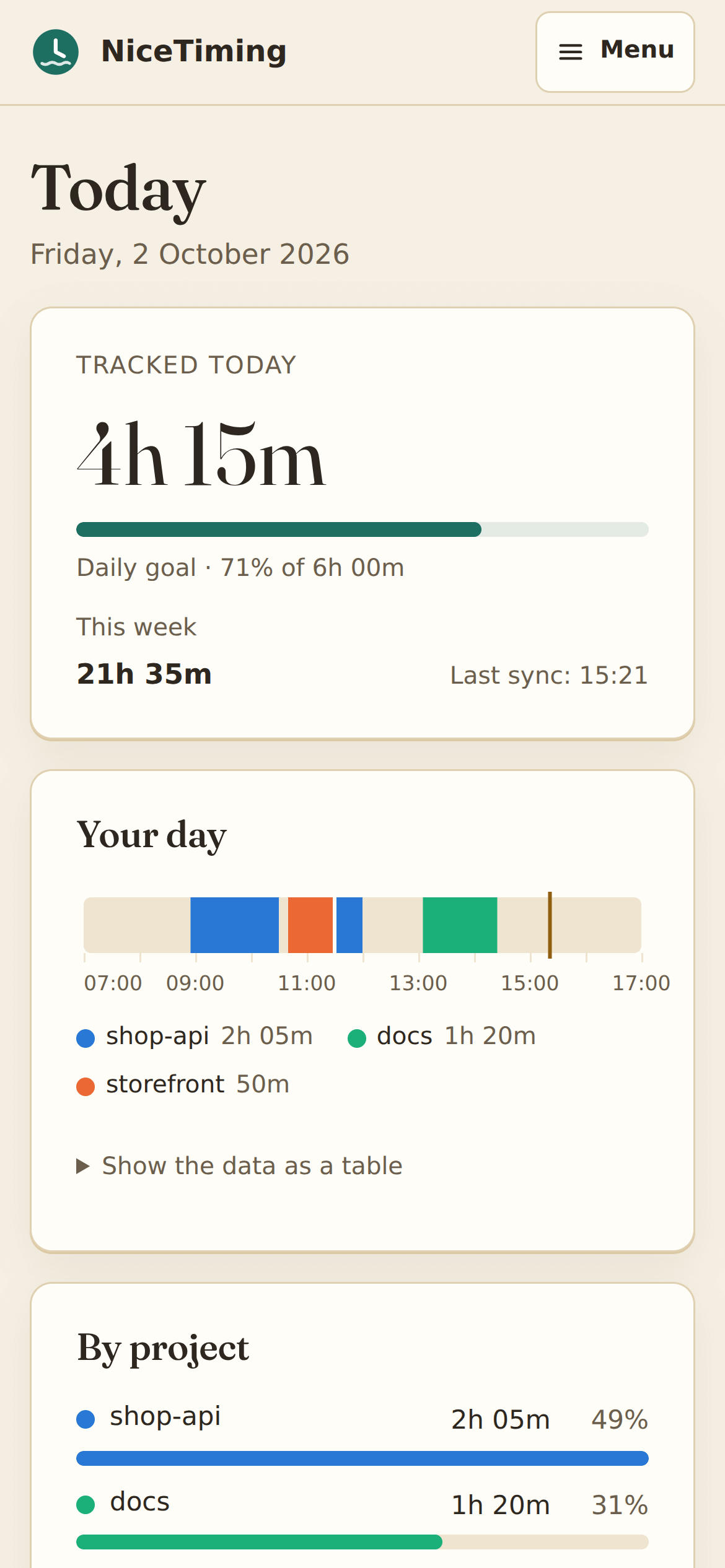
NiceTiming CloudSync with NiceTiming Cloud to see your time in the browser, merge the time from your computers, and play your island online. The web dashboard has your reports, billing and invoices; its Today page shows the day on a phone and installs on the home screen. The free plan has limits on the computers that sync and the history the web shows (the plans give them); Pro lifts them. The
Where sync stands is at the top of the Today view: the account, when it last synced, or what needs you (the server out of reach since a given time, a token that was refused or is missing on this computer), with the button that fixes it. Every window says the same thing. The status bar stays as it is while sync works, and shows a crossed-out cloud when it needs you; its tooltip and About NiceTiming say where sync stands too. Sync now also sends the minutes being tracked, so the web shows what the status bar shows. Connect VS Code to NiceTiming Cloud, step by step: your other computers, Pro, and what to do when sync fails.
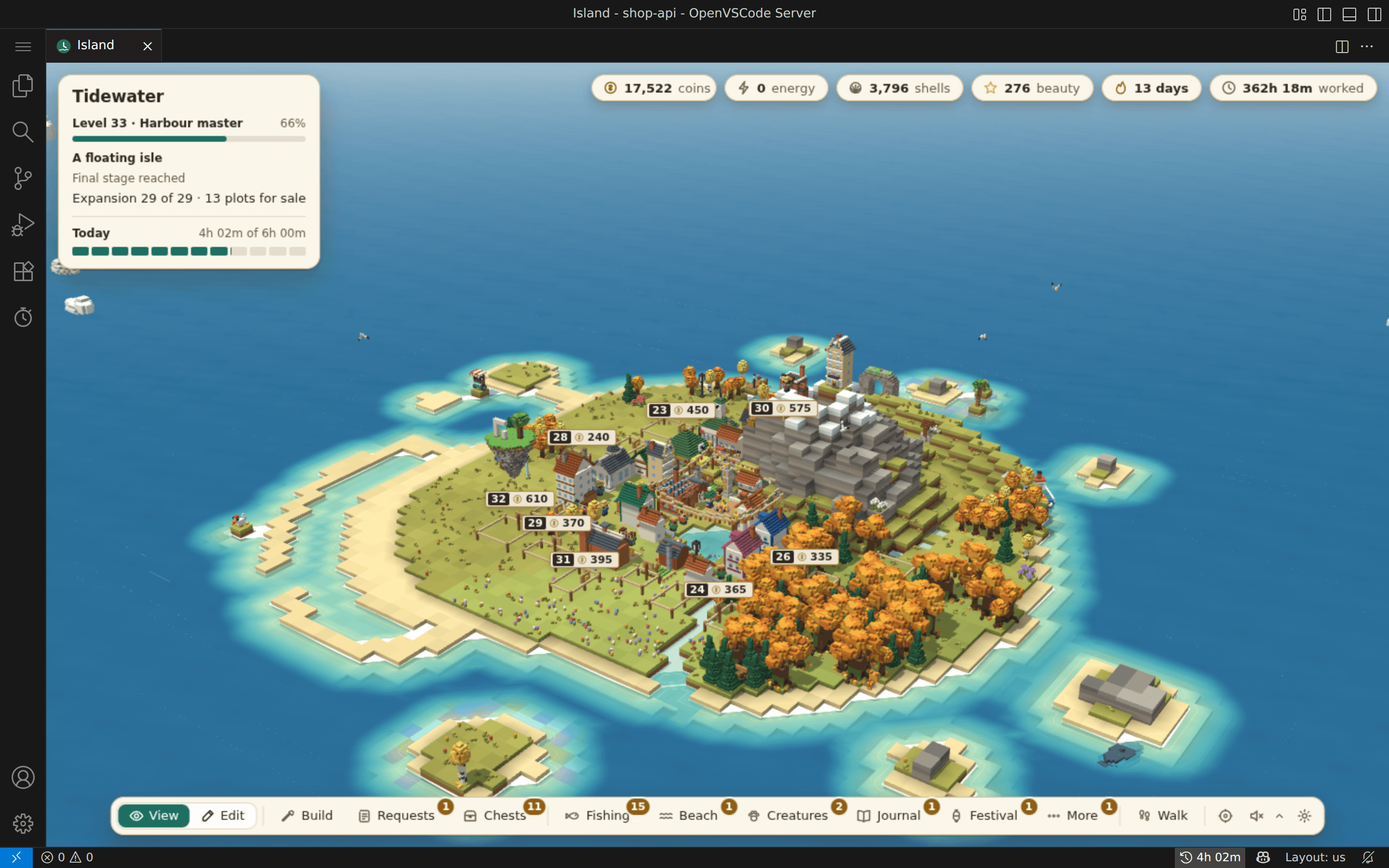
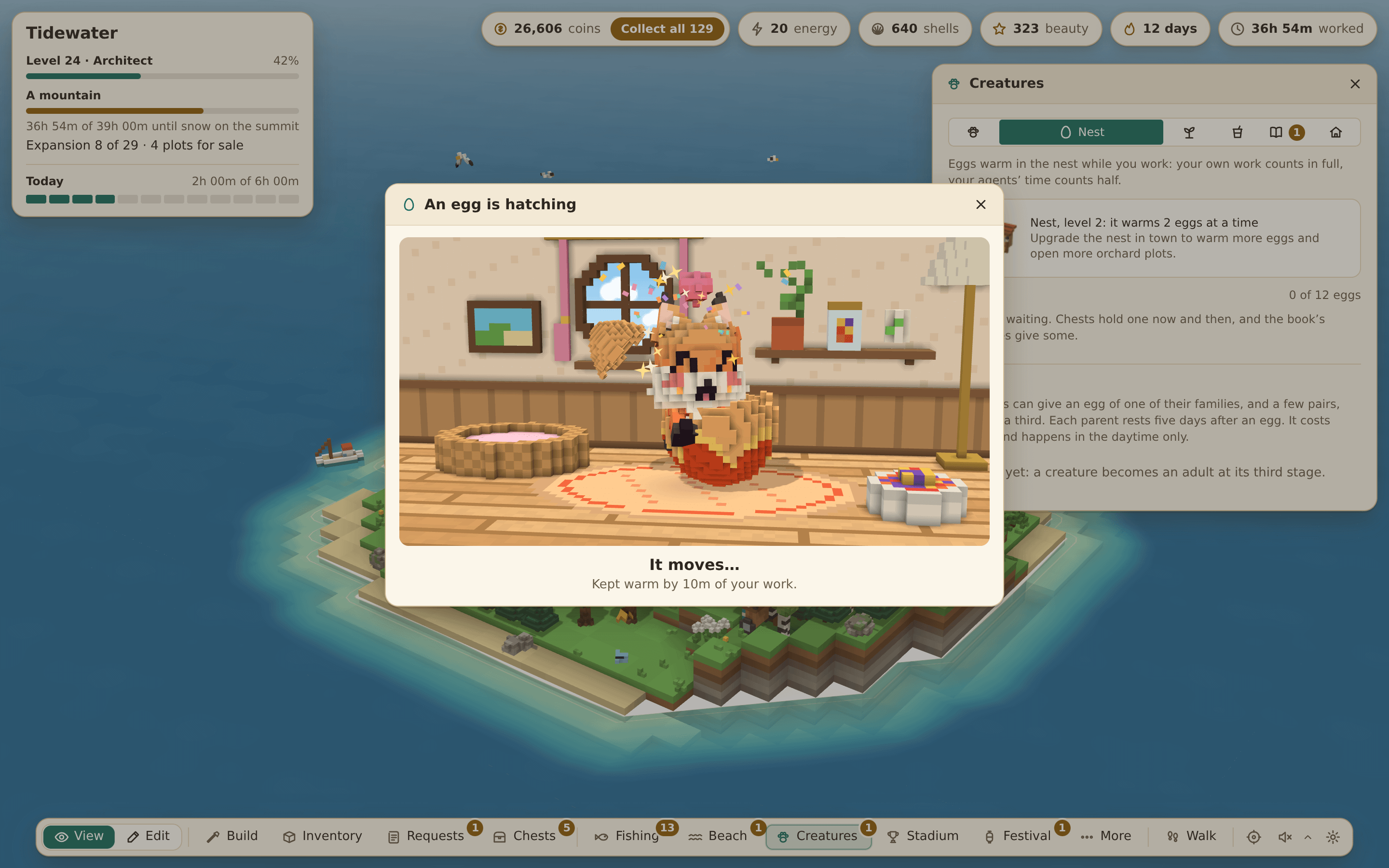
The islandEvery hour you track makes your island grow, through thirty expansions in its first 300 hours, from a sandbank to a floating isle. Each project with at least an hour of work gets a building that grows with it, the forest thickens, the campfire burns as long as your streak lasts, and the seasons, the weather and the light follow your calendar and your clock. The island is a small game that follows your work, never the other way round: night work is never rewarded, and a day off costs nothing.
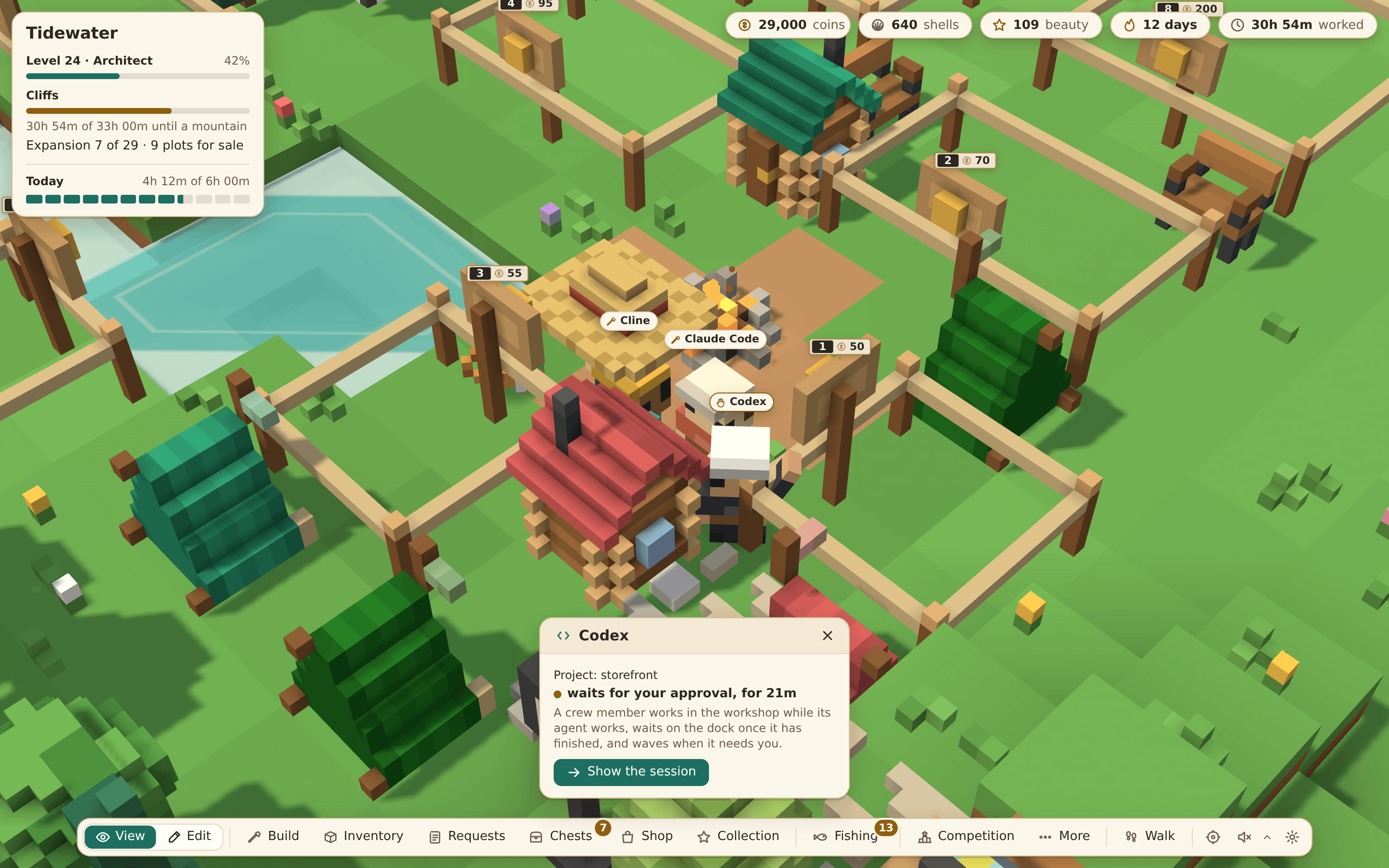
Every figure explains itself. Hover a figure at the top of the island, or reach it with the keyboard: a short card says what it is, what it is for and how to get more, with your own numbers (the XP to your next level and what it opens, the energy your breaks gave today, what today still needs for your streak). All the levels lists every level of the game in one place: yours, the island's stage, the other islands, buildings, the nest, creatures, research, fishing gear and the league. The "?" beside the nest, in the Creatures panel, works the same way. Your agents live there. While Claude Code, Codex, Cline, Roo Code or Kilo Code works for you, a crew member named after it works at the workshop; once it has finished it waits on the dock, and when it needs you it waves. Click one to bring its terminal back.
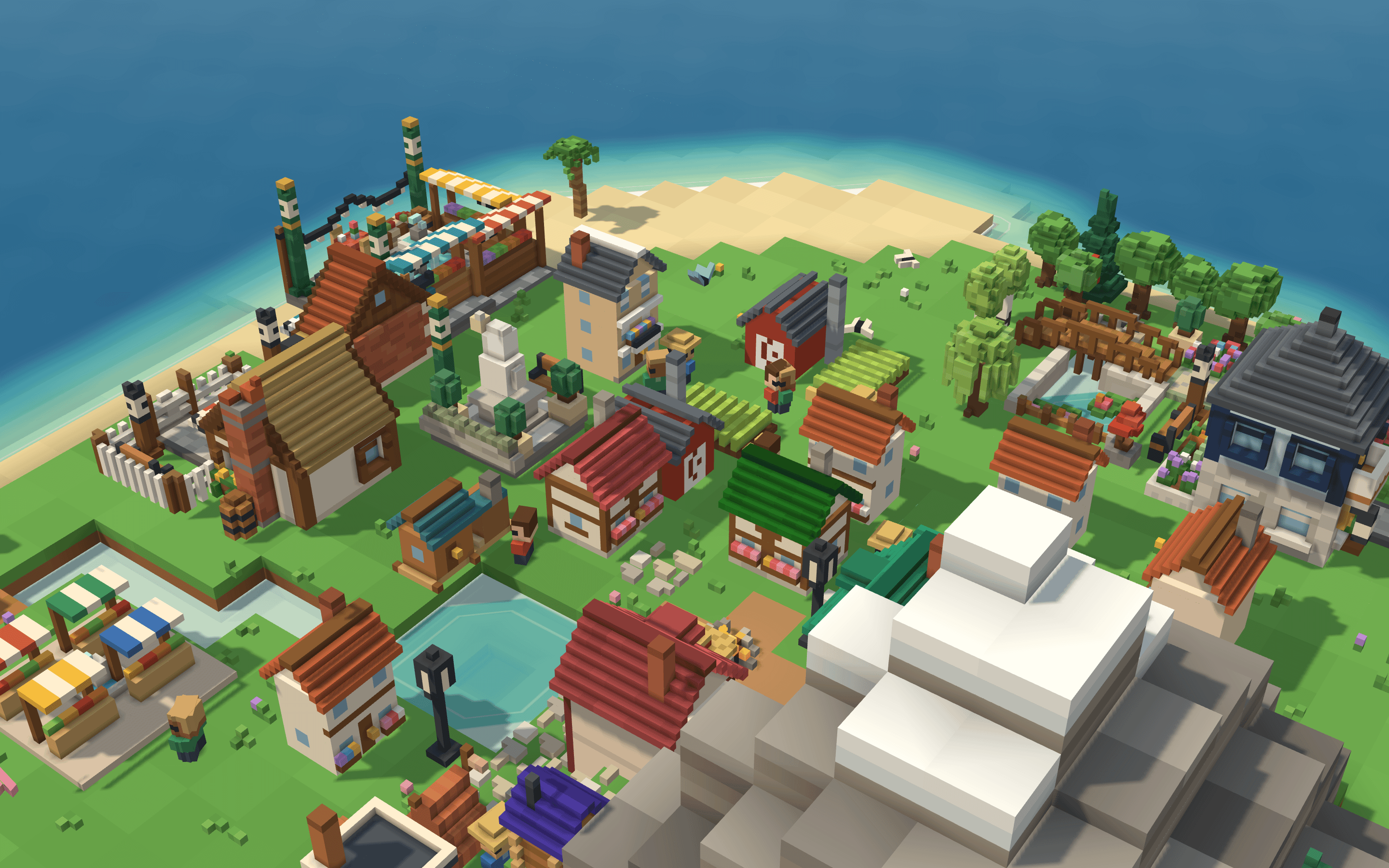
A town to run while your AI codes. Buy plots, build homes, farms, shops, workshops, a harbour and more, each with three levels: residents move in and the buildings earn coins. The cargo boat loads coins while an agent works for you. Build your own way with a construction kit of 140 pieces, walk around with your avatar, and repaint the town's buildings.
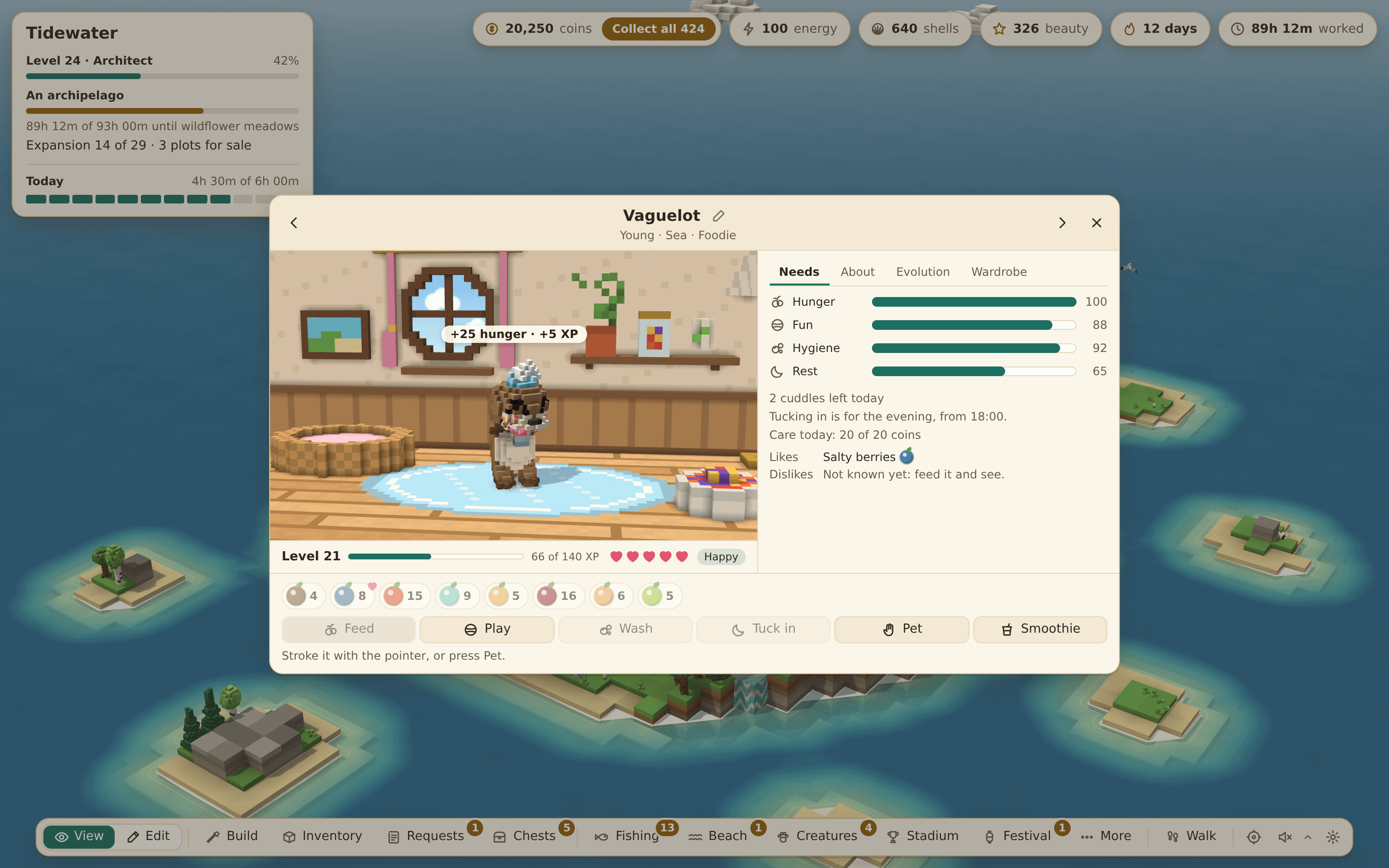
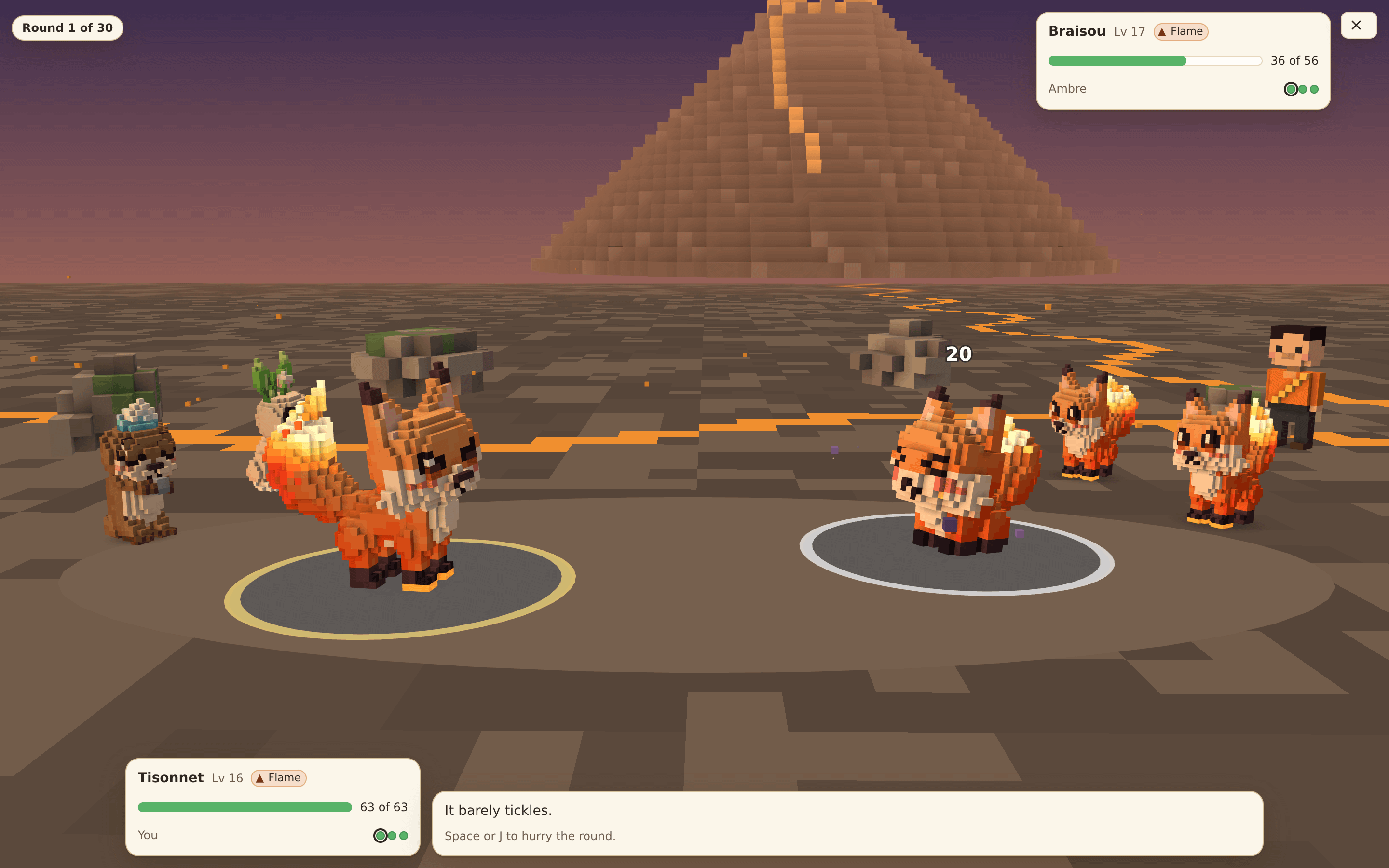
Creatures. Choose a first egg among three families; it warms while you work, and you name the baby. Every other egg warms in the nest, a town building you open at level 2. Feed it, play with it, wash it and tuck it in; with enough care, in daylight, it evolves. 36 species in twelve families and four legendaries, an orchard of berries, a smoothie bar that trains them, breeding and homes. Only you look after them.
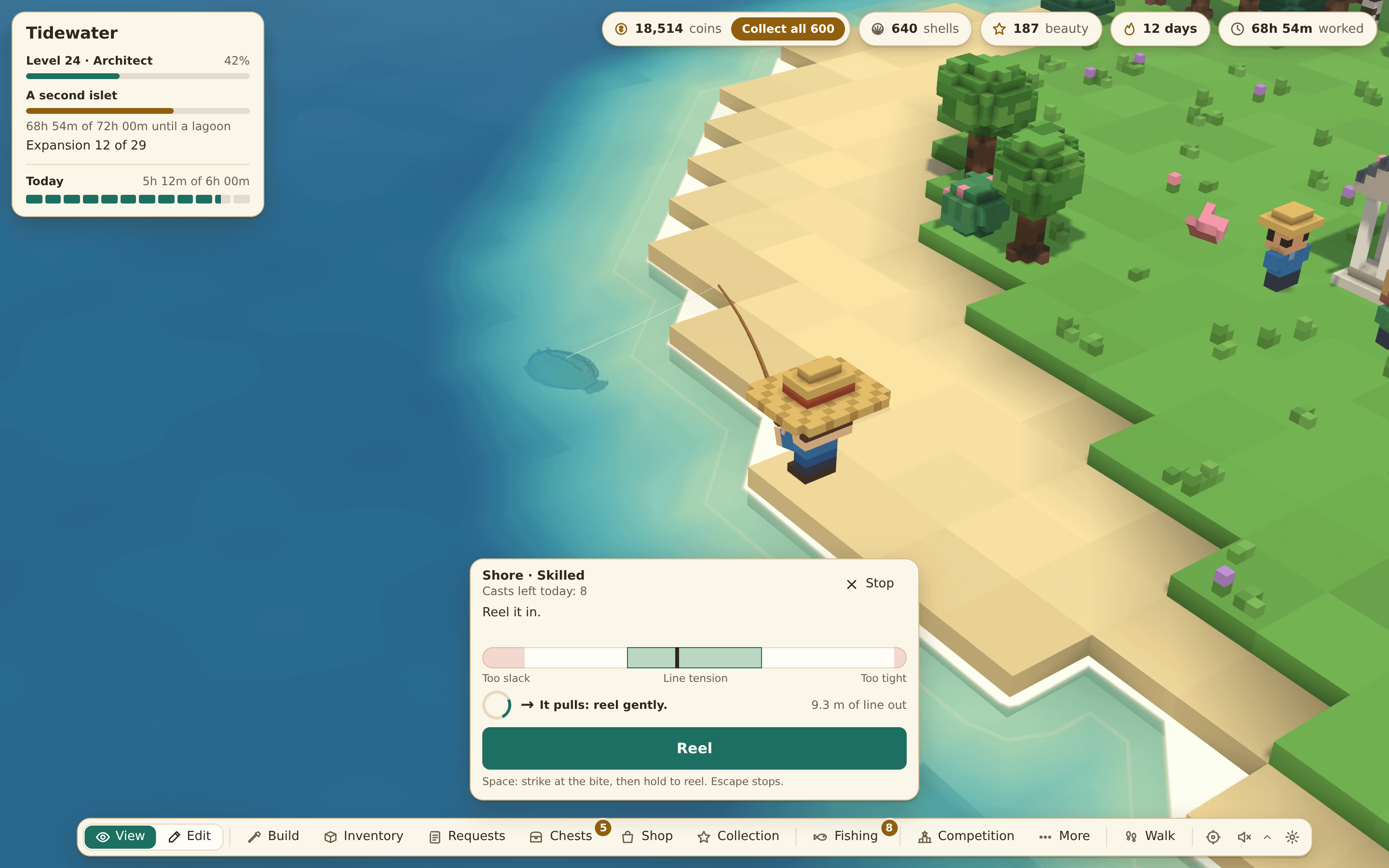
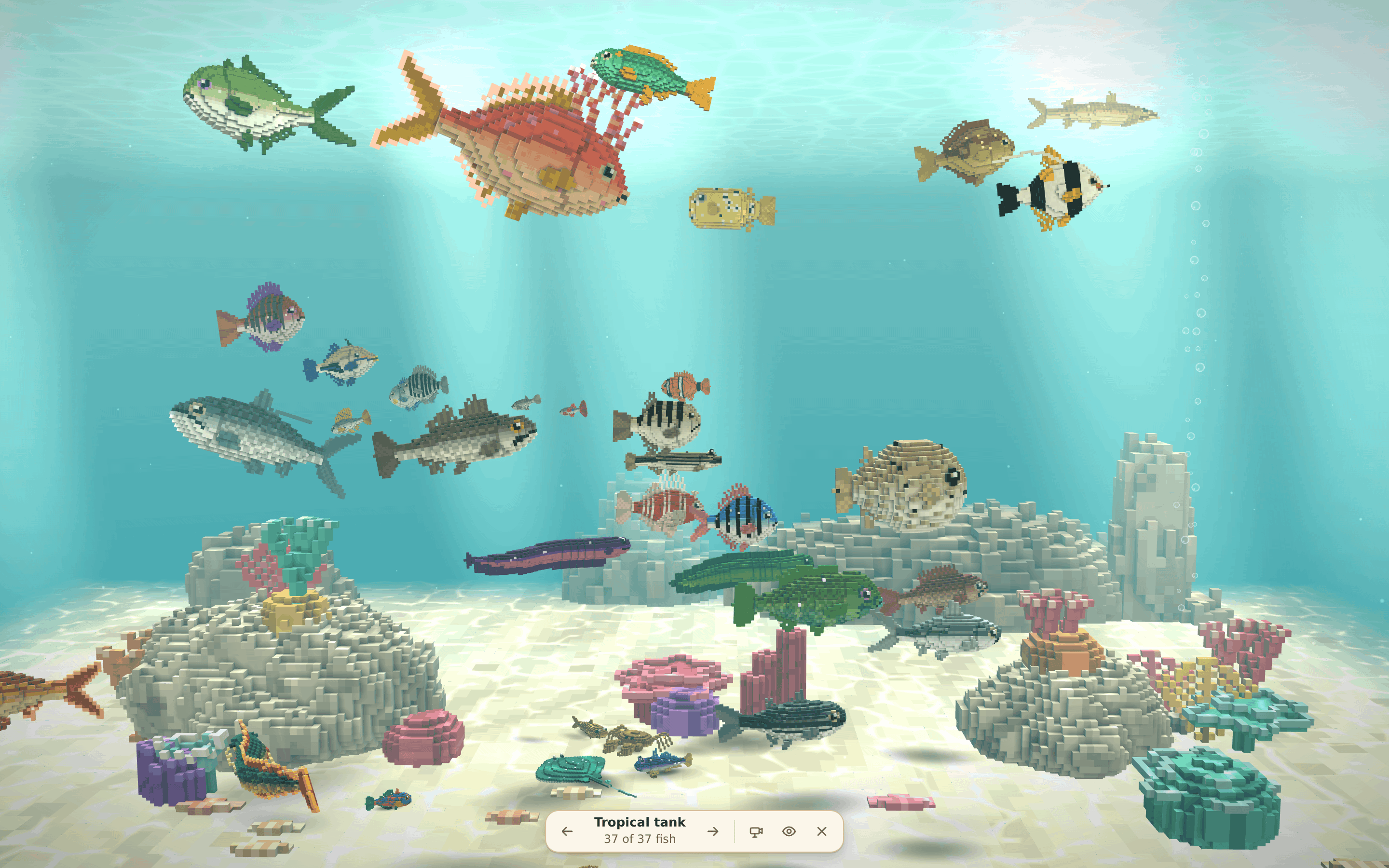
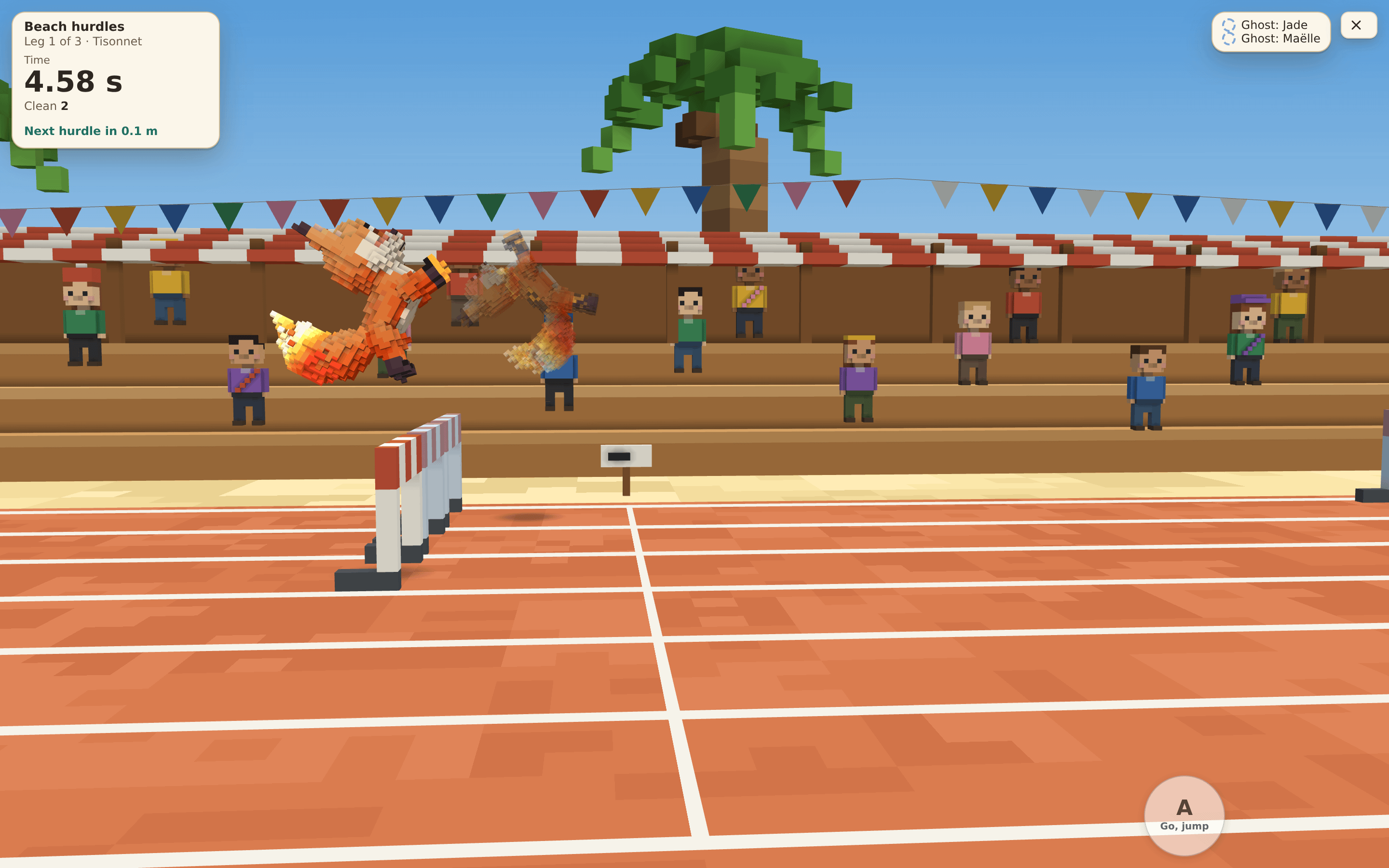
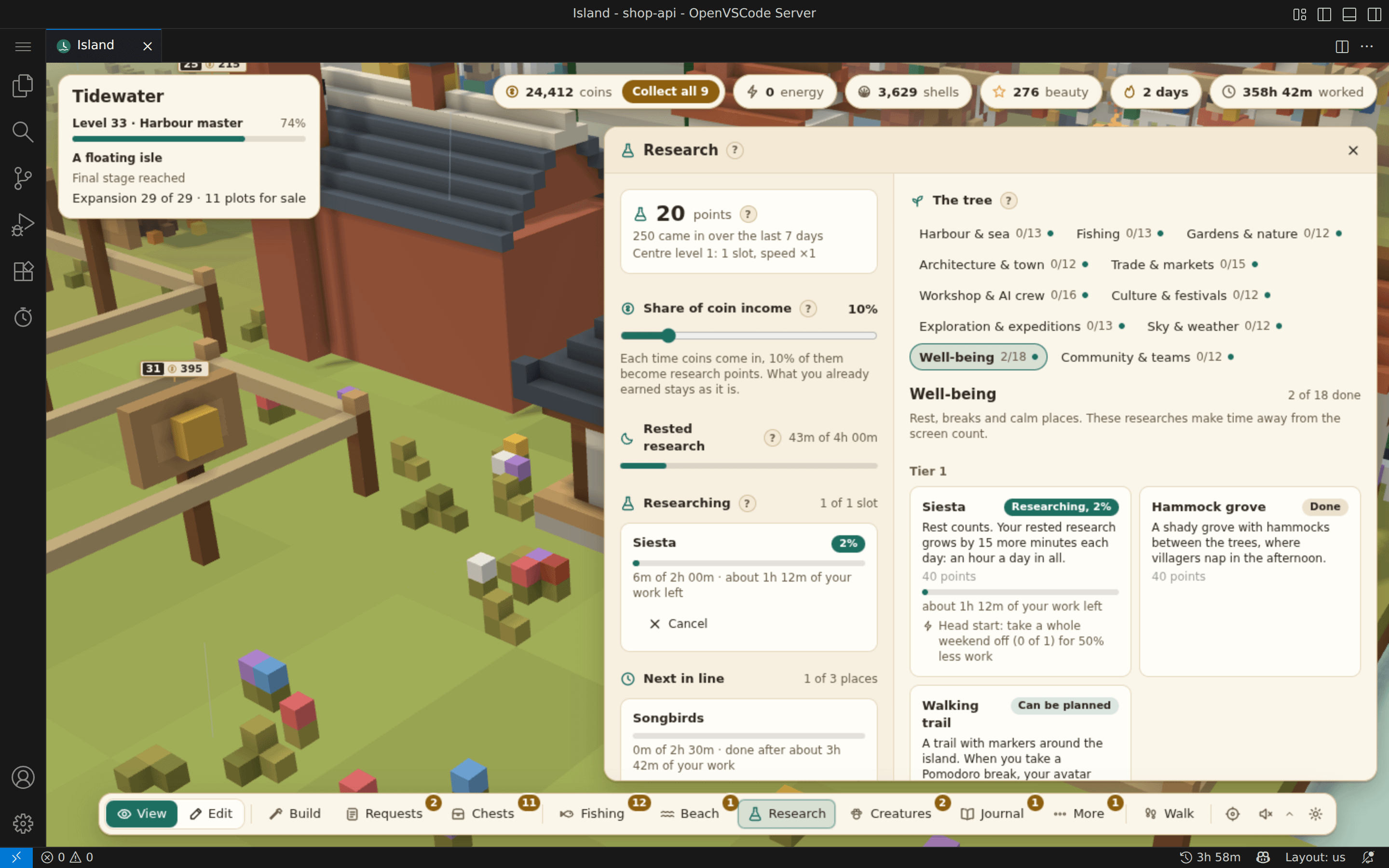
Fishing, the stadium, research. Fish in sixteen waters for 148 species, relaxed, quick or skilled; casts come from your work, never from coins. The fish you give to the aquarium swim in its six tanks, each with its own water and decor: click the aquarium in the town to watch them. Take your creatures to the stadium for ten athletics events played with a few keys, and three-against-three battles against the island's guardians. Plan research at the research centre (148 researches in eleven branches) and let your work carry it out: animals, rainbows and morning mist, music, festivals, photo mode and new places to build.
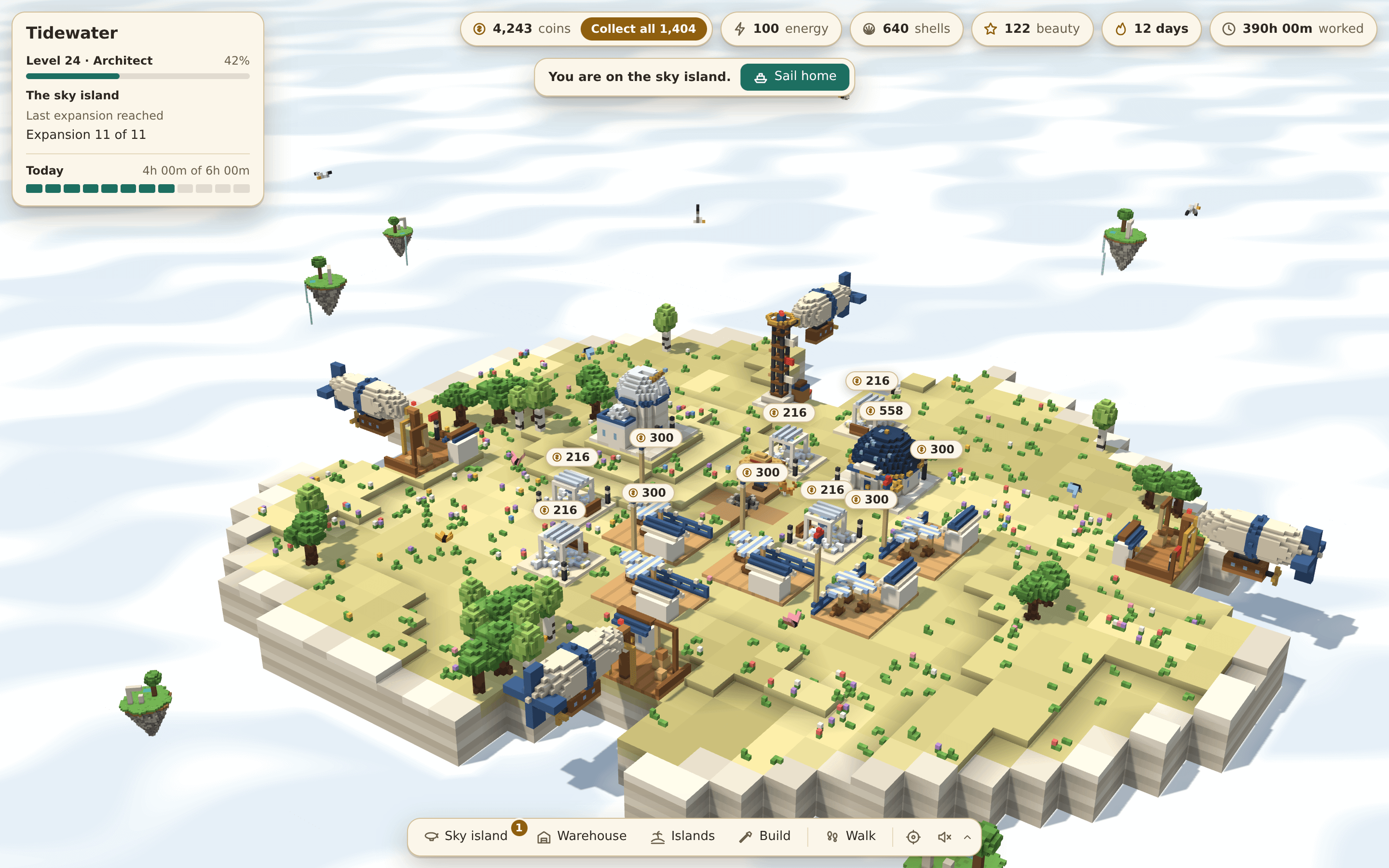
An archipelago. Once the home island is complete, the next one opens: six in all, the harbour island, an orchard island of fields and hives, a fire island whose workshops fill the others' orders, a market island with a shop to run, an ice island of sled expeditions and digs, and a sky island whose observatory maps the constellations. The islands you leave keep producing.
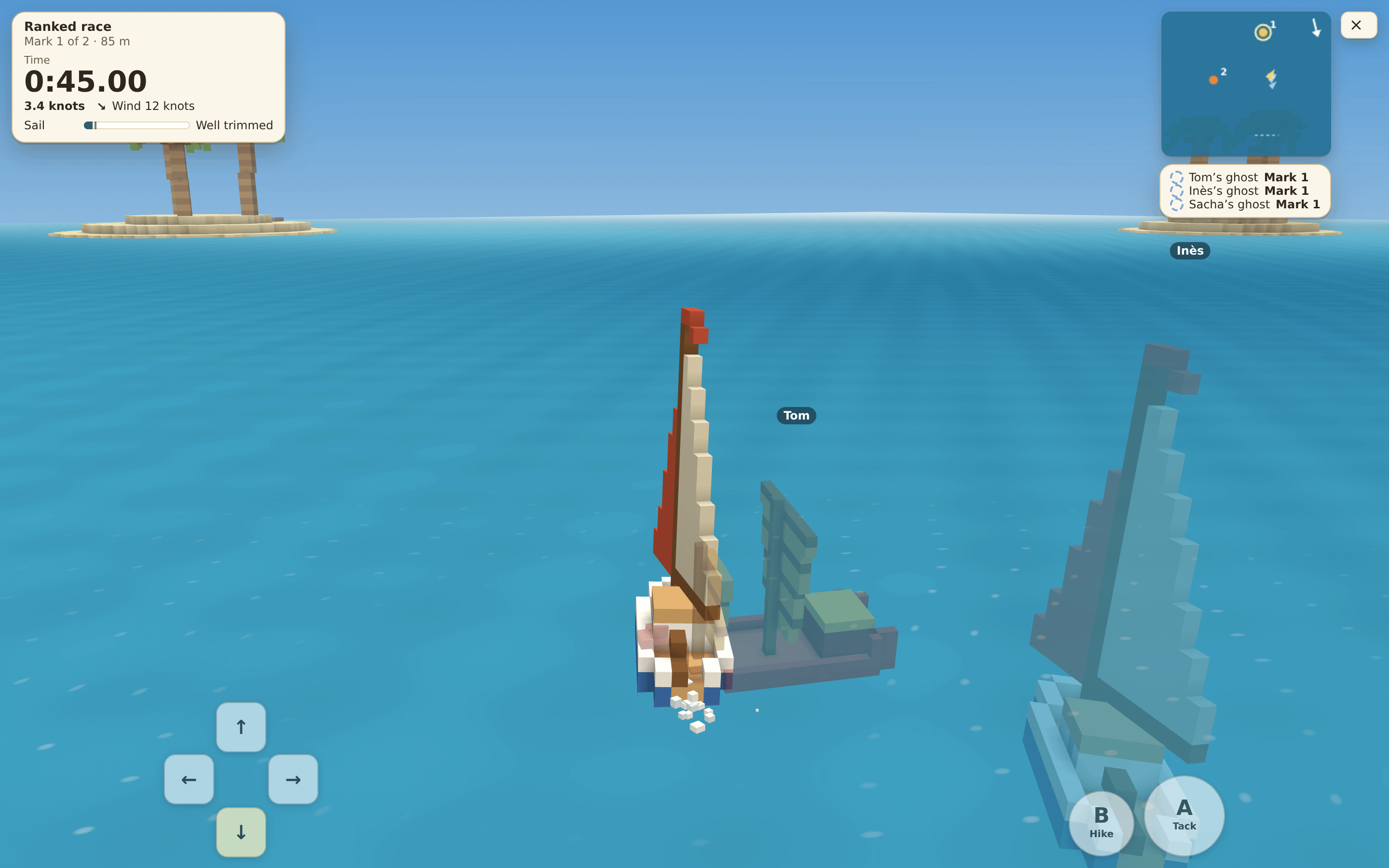
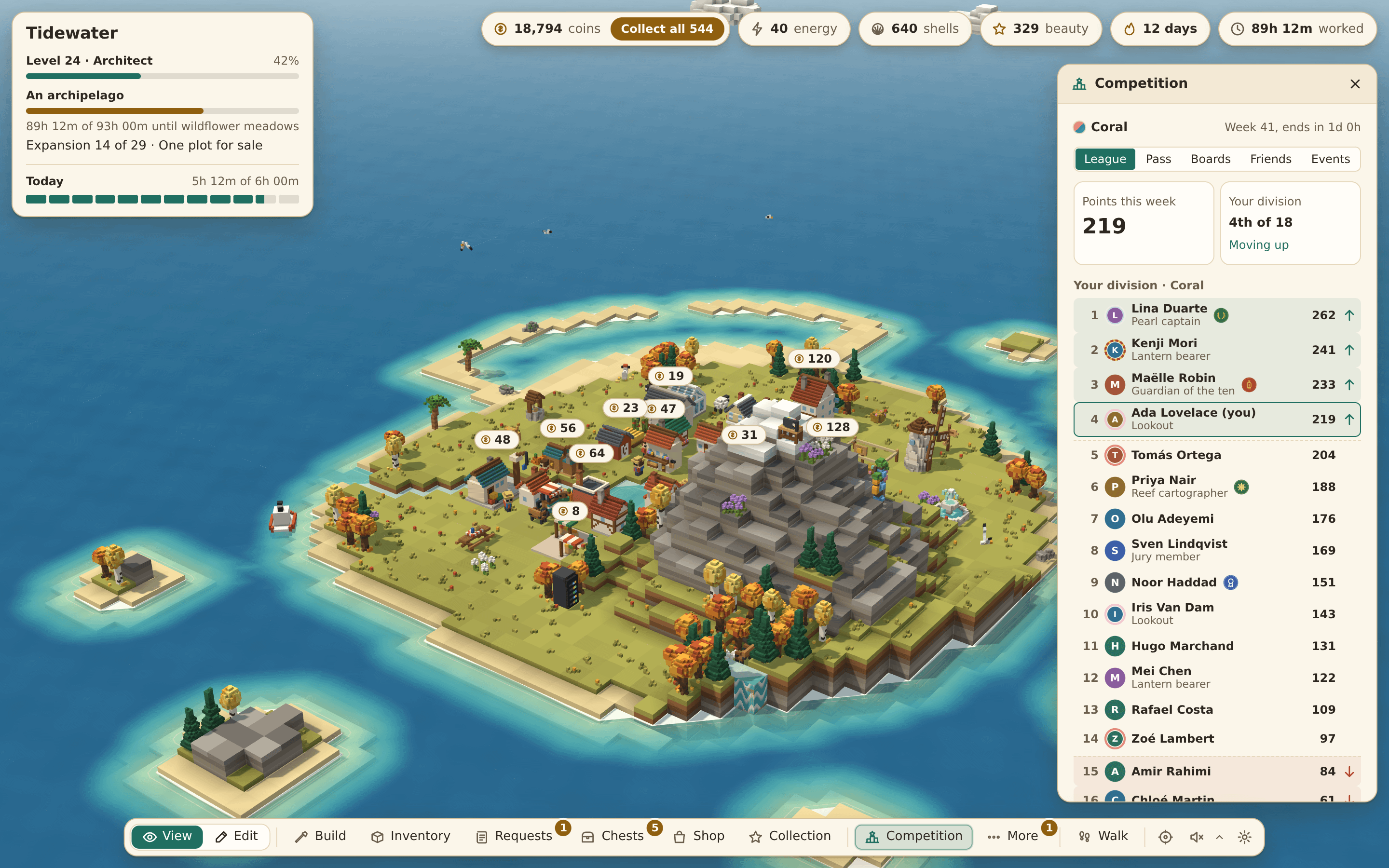
Online, and together. On NiceTiming Cloud, the server keeps your coins, town and energy, decides every random draw and replays every race, fight and catch before it counts, so nobody can cheat. Play regattas against other players' ghosts, fishing duels, a weekly community boss, an auction house and friendly pirates; meet a weekly league of people who play about as much, seasons with a pass of looks, boards, a prettiest-town contest and an archipelago war between teams. Rewards are titles, frames, badges and looks, never power. Solo mode keeps the rest on your computer.
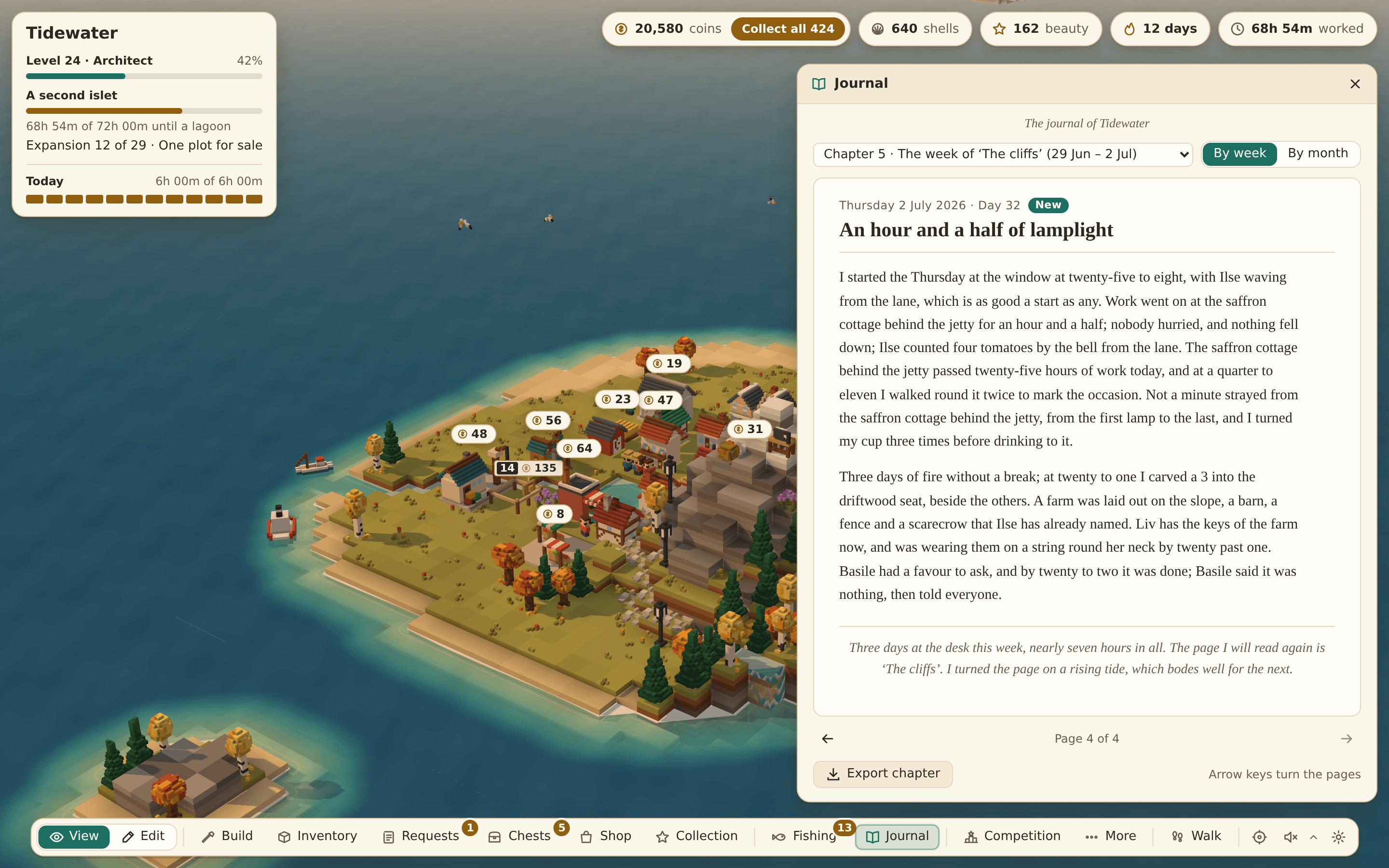
A journal, and quiet. A villager keeps a journal of your days, in English or French, in one of six voices: a page for each day you work, written the morning after. A new page puts the Journal on the island's toolbar with a mark, and the Today view says it waits; Open the island journal opens the book any time, and the island on nicetiming.app has it too. Focus mode and quiet hours (21:00 to 08:00 by default) keep the island silent; the sound is off by default; everything works from the keyboard, and Settings › Keys changes the keys of walking, the games, the dinghy, fishing, the drone and building. What a stretch of work brings comes in one notice: a new stage, a level and the buildings it opens, achievements, the daily goal and its shells, with the time you just added. Share the island as a picture, a time-lapse video, a poster or a public link, and visit the islands others share.
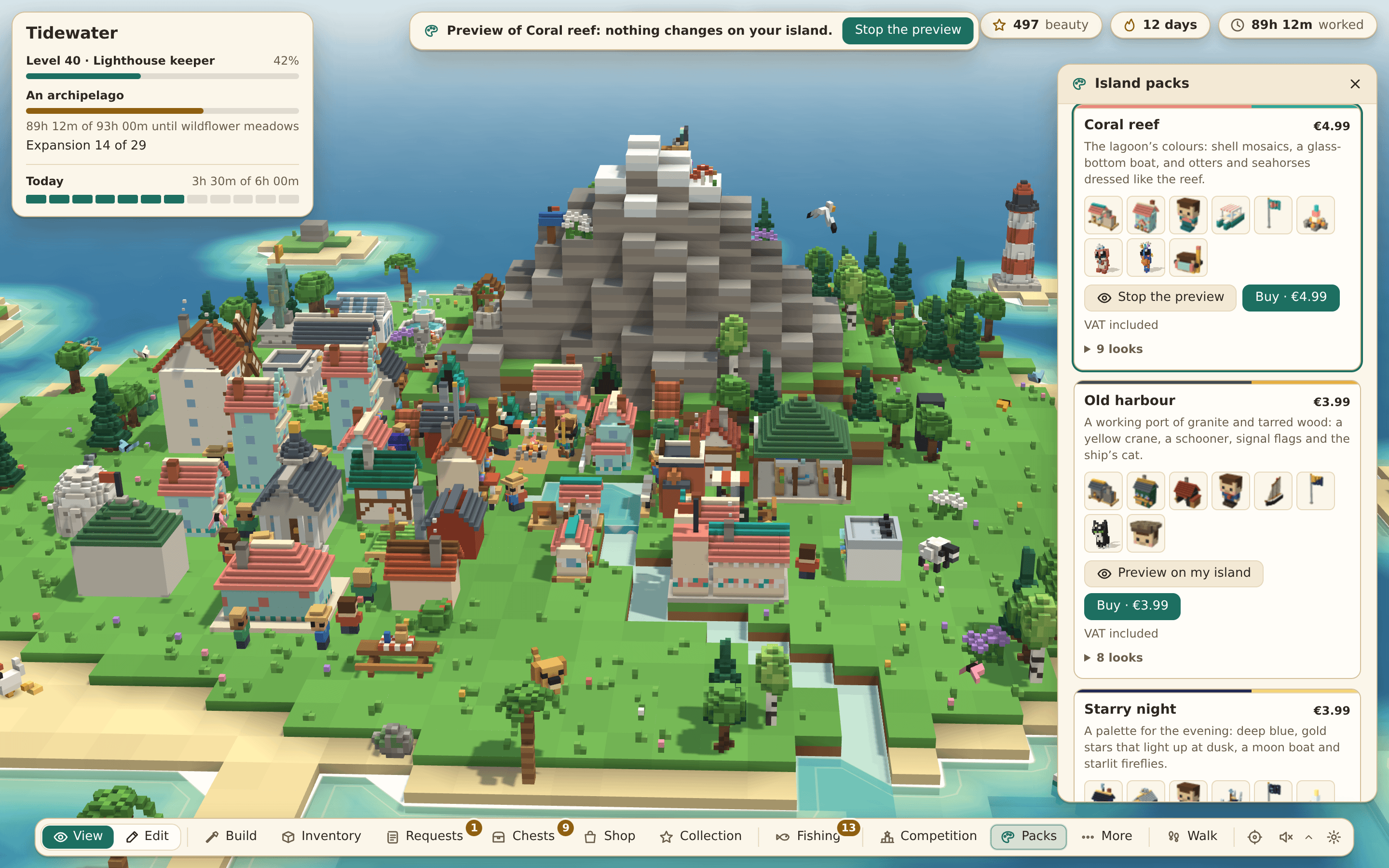
Island packs. Five packs of looks for the island (Lighthouse coast, Winter cabin, Coral reef, Old harbour, Starry night), each bought once and yours for good, previewed on your own island before you buy. They change how the island looks and nothing else: no coins, no energy, no odds, nothing drawn by chance.
CommandsAll commands start with "NiceTiming:" in the Command Palette.
SettingsThe ones people change most; search for "NiceTiming" in the Settings editor for all of them.
Your dataNiceTiming writes plain text files, one JSON object per line, in the storage folder VS Code gives the extension; NiceTiming: Open data folder opens it. Files are only ever appended to, one per day and machine, which keeps them safe with several windows and easy to back up. A compressed backup is written every day and the last seven are kept. When you turn on AI token usage, NiceTiming reads the files these tools keep on your computer ( To follow your coding agents, NiceTiming reads the end of the logs they changed in the last six hours, and of each line only its structure: its time and kind, whether a turn ended, the ids of tool calls. What you and the agents write is not kept. The exact alerts are yours to turn on: for Claude Code they add hooks to With NiceTiming Pro, request analytics keeps numbers and short hashes only (test runs, commits, error fingerprints). The prompt history, if you keep one, is the only place the text of your requests is stored: on this computer, with secrets replaced before anything is written, for as long as you choose. Nothing leaves your computer unless you turn on sync with NiceTiming Cloud, ask a cloud model for a text, let a model grade your prompts, or let one write your island's journal. Language models receive totals per project, category and day, and for the stand-up the subjects of your own recent commits; task names only if you turn on Upgrading from 1.xOn its first start NiceTiming 2 looks for the sessions recorded by 1.x and offers to import them. Your settings are kept, and the 1.x database is read, never changed. Support, terms and licenceWrite to contact@filarr.com for help or to report a problem; About NiceTiming has the address too. NiceTiming Cloud and NiceTiming Pro come with the terms of service, the terms of sale and the privacy policy. NiceTiming 2 is free to use under its own licence, shown with the extension, and includes components of others under theirs. Versions 1.x stayed under the MIT licence. If NiceTiming is useful to you, you can support its work on GitHub Sponsors; it changes nothing in the extension. © Mathis Belouar-Pruvot |