


Gitgg – Compare Branches & Files
Know exactly what is changing before you promote, merge, or deploy. Gitgg compares files and folders in your current Git repository with another branch or commit, right inside VS Code. It can also bring selected versions into your working branch and stage them.
Gitgg works within one repository; it does not compare separate repositories. It is especially useful for Salesforce DX teams, release managers, and developers reviewing changes across environment branches.
Who is Gitgg for?
- “Does my branch match UAT before promotion?”
- “What has changed since the last release?”
- “I only want to bring a few files from develop into my branch.”
Select a file, a group of files, or a folder to compare with a branch. Use release drift detection to check changes since a commit, or PR Comparison to validate a promotion against an environment branch.
✨ Features
🔎 Compare with another branch
Right-click a file, several files, a folder or an SCM change group and choose Compare with another branch... (or press Ctrl+Alt+\ / Cmd+Alt+\).
- Lists local branches and branches that only exist on
origin, with ⭐ favorites listed first.
- Compares against the latest
origin/<branch> (fetched automatically, configurable) and falls back to the local branch.
- Up to 5 files (configurable): choose between separate diff tabs or a single view. More files always open the single view.
- In a diff tab, the title bar shows the same actions as the single view (only when they apply; hover for a description): Use compared version, Stage, Unstage, Revert and Restore Changes.
- Your side is always the file on disk; when it has uncommitted changes it is labeled
(working tree).
🌿 Compare current branch with another branch
Run Gitgg: Compare Current Branch with... from the Command Palette, then select a branch such as PREPROD while checked out to UAT. Gitgg compares the selected branch with the current branch across the repository, including staged and unstaged changes on disk. The comparison opens in the single view, where files can be filtered by New, Changed or Deleted.
📊 Single-view report
A webview with a summary and the files grouped as New, Changed, Deleted and Unchanged, with inline diffs that follow your VS Code theme.
- Use
<branch> / Use all from <branch>: replaces your file with the version from the compared branch (or deletes it, if it does not exist there) and stages it. Restore Changes undoes it while VS Code is open (backups are shared between the single view and diff tabs).
- Stage / Unstage: shown only when the file has unstaged (or staged) changes; stages the file exactly as it is on disk.
- Salesforce type filters and Use actions: select multiple metadata types (the filter is hidden when only one type is present), then use a category or component-bundle button to replace its files with their version from the compared branch.
- Revert: shown only when the file differs from your current branch (local edits or after Use
<branch>). After confirmation it puts the file back as it is in your branch (HEAD), dropping staged and unstaged changes. Restore Changes brings them back while VS Code is open (backups are shared between the single view and diff tabs).
- View full Diff: opens VS Code's diff editor with syntax highlighting.
- Search (
Ctrl+F): filter thousands of files by name or folder, e.g. AccountService or lwc/payment.
- Salesforce-aware grouping: metadata is grouped by component type, related files are grouped together, and objects follow the Salesforce source-format folder hierarchy. Repositories without Salesforce structure continue to use regular file paths.
- Status, sorting and line totals: filter by New, Changed or Deleted; sort by name, number of changed files or line changes. Grouped rows show status and nonzero added/removed line totals before they are expanded.
- Built for big comparisons: categories with more than 200 changed files start collapsed, files are listed 200 at a time, unchanged files are collapsed, and bulk actions show completed file counts in their progress notifications. Hover any button to see what it does.
- Always know what is happening: long actions show the current step, a progress bar and the elapsed time; when they finish, a banner shows the result with an Undo button and the changed rows are highlighted. Errors show Details and are logged in the Gitgg output channel.
- Keep working while actions run: additional Use, Stage, Unstage or Revert requests enter a FIFO queue, and the panel shows how many actions are waiting.
🎯 Release Drift Detection
Pick a commit (from a branch, by SHA or from your ⭐ favorite hashes) and see whether every file it touched still matches your working tree. Handles merge commits, root commits and renames. Use Use <sha> to bring the version from that commit.
✅ PR Comparison
Before promoting code, validate it against the target environment:
- Your current branch is the promotion branch (its working tree is used).
- Choose the destination branch (where the PR goes): defines which files are in the PR.
- Choose the environment branch (source of truth, e.g. UAT): each file is compared with it.
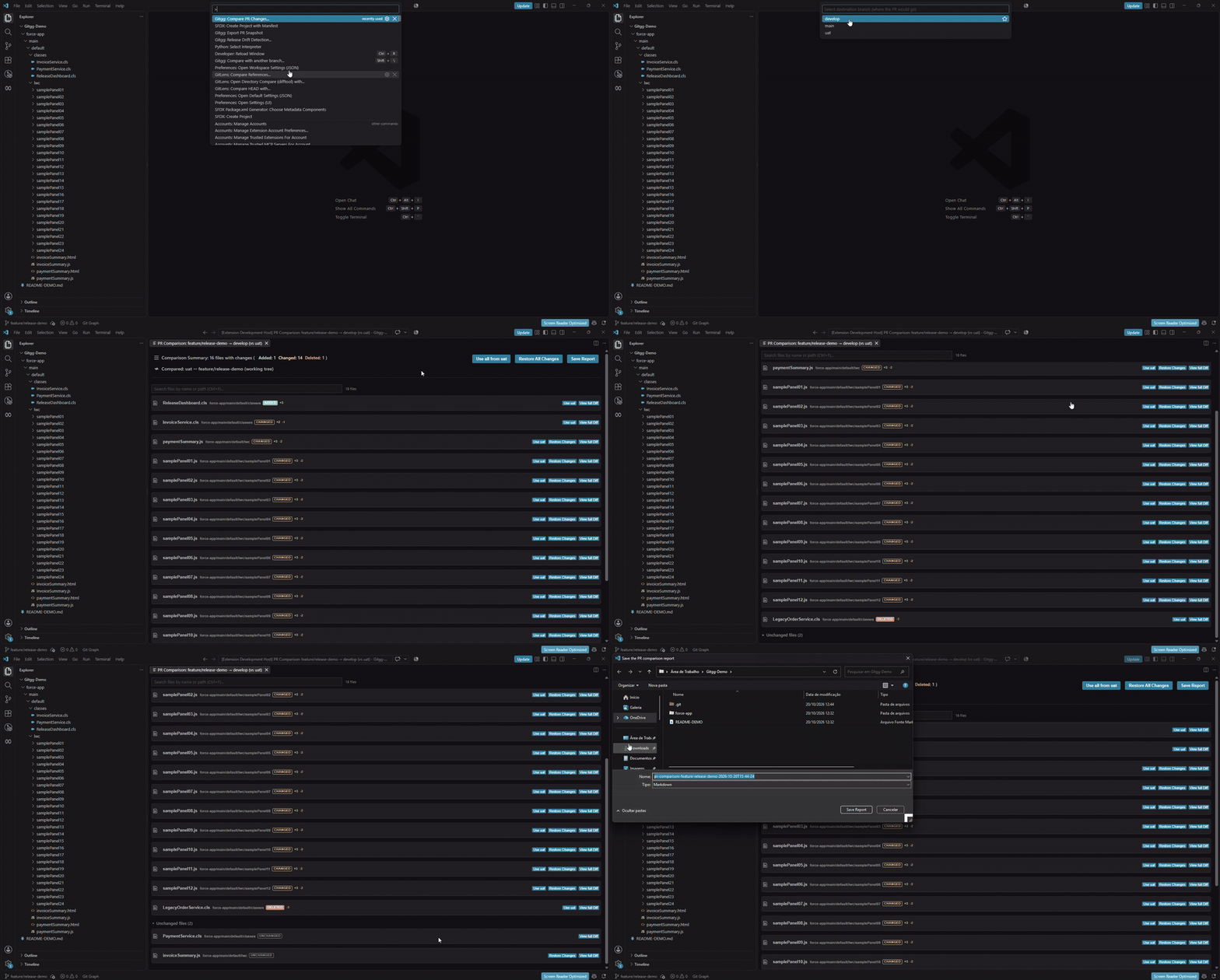
The file list is the committed tree diff between the promotion branch's HEAD and the destination branch. For those files, Gitgg compares the current promotion working tree (including staged and unstaged edits) with the environment branch. The panel repeats these inputs above the results.
Files are classified as IDENTICAL, DIFFERENT, MISSING_IN_ENVIRONMENT or MISSING_IN_PROMOTION. A Markdown report grouped by Salesforce component type (Apex classes, triggers, flows, LWC, Aura, objects, fields, layouts, profiles...) can be saved with the Save Report button in the panel: you choose where, and it reflects the current state of the comparison (including files you changed with Use <environment>). When recognized Salesforce metadata is present, the panel also has a Save Salesforce package.xml button. This creates a Salesforce Metadata API manifest for retrieving or deploying Salesforce components; it is not a general file list. Other file types are skipped. Deleted metadata requires Salesforce's destructiveChanges.xml; it is not represented by package.xml. Nothing is written to your repository unless you save it.
📦 Export PR Snapshot
Writes both versions of every file changed between your branch and a target branch into a snapshot/ folder (configurable), preserving the original folder structure, plus a SNAPSHOT_SUMMARY.md. Handy for code reviews and deployments.
The snapshot uses committed versions at the selected branch refs; uncommitted working-tree changes are not included.
The folder is replaced on each export, but Gitgg only deletes a folder it created itself (marked with a .gitgg-snapshot file). If a folder with that name already exists, you are asked first. Consider adding it to your .gitignore.
The progress notification shows the export stage and file counts. You can cancel it; Gitgg removes the temporary export and keeps the previous snapshot intact.
🎬 See Gitgg in Action
Right-click a file and compare branches
Right-click a file and choose Compare with another branch... to inspect the file versions side by side.

Compare an LWC folder and apply branch changes
Select the lwc folder to compare its files with another branch, apply the branch versions in bulk, and restore the previous state.

Compare PR changes and start a report export
Run Compare PR Changes..., select the destination and environment branches, review the results, and choose Save Report to start exporting the comparison.
⌨️ Shortcuts
| Shortcut |
Where |
Ctrl+Alt+\ (Cmd+Alt+\ on macOS) |
Editor, Explorer and Source Control |
Shift+\ |
Explorer and Source Control only (not in the editor, where it types \|) |
All commands are also available in the Command Palette under the Gitgg category.
⚙️ Extension Settings
| Setting |
Default |
Description |
gitgg.fetchBeforeCompare |
true |
Fetch the branch from origin before comparing. |
gitgg.separateTabsMaxFiles |
5 |
Up to this many files, ask between separate tabs and a single view. |
gitgg.diffLineLimit |
100 |
Diff lines rendered inline per file in the single view. |
gitgg.snapshotFolder |
snapshot |
Folder used by Export PR Snapshot. |
✅ Requirements
- Git 2.26 or later must be installed and available in your system's PATH.
- You must be working inside a project with an initialized Git repository.
🛠️ Development
Local development checks require Node.js 20.19+, 22.13+, or 24+. The CI workflow uses Node.js 22.
npm install
npm test          # unit tests (including tests against a temporary Git repository)
npm run lint
npm run compile   # production bundle in dist/
Press F5 in VS Code to launch an Extension Development Host.
Release History
For a detailed list of all changes, please see the CHANGELOG.md file.
Enjoy!

