This CloudFormation Snippets extension provides JSON and YAML snippets for over 2,000 AWS CloudFormation resources, plus AWS SAM snippets. Requires VS Code 1.140.0 or newer.
[!TIP]
Stop AWS bill surprises before they ship.
Most infrastructure changes look harmless until next month's AWS bill lands. CloudBurn analyzes the cost impact of your AWS CDK changes right in the GitHub pull request, so expensive mistakes get caught during code review, while a fix is still a one-line change.

💰 Set it up once, then never be surprised by AWS costs again
- Install the free CDK Diff PR Commenter GitHub Action in the repository where you build your AWS CDK infrastructure
- Then install the CloudBurn GitHub App on the same repository
From then on, every PR with infrastructure changes gets a comment with your CDK diff analysis, and CloudBurn adds a cost report next to it:
- Monthly cost impact: whether this change raises or lowers your AWS bill, and by how much
- Per-resource breakdown: which resources drive the change, old versus new monthly cost
- Region-aware pricing: rates match the region your infrastructure actually deploys to
Cost review happens inside code review, so you optimize as you code, while the context is still fresh.
CloudBurn is free during beta. After launch, a free Community plan (1 repository, unlimited users) stays available.
Features
- Resource Coverage: Generates snippets for every resource in the bundled AWS CloudFormation specification, alongside the included AWS SAM resource snippets.
- Nested Property Support: Expands nested properties with typed placeholders. Recursive objects and large resources use editable empty objects to keep each snippet within 400 lines.
- Documentation Hover Links: Access AWS documentation for resource types and nested property names in YAML, JSON and JSON with comments, including conditional branches.
- Flexible Template Support: Seamlessly works with both YAML and JSON CloudFormation templates.
- Efficient Autocomplete: Simply type the resource name (e.g.,
ec2-instance) to instantly load the corresponding snippet for AWS::EC2::Instance.
- Rich Feature Set: Incorporates intrinsic functions, conditions, and diverse parameter types for robust template creation.
- Enhanced Navigation: Features placeholders that enable swift movement through resource properties.
- Resource Documentation: Each snippet is linked to its official AWS documentation, providing quick access to detailed information.
- Up-to-Date: Regularly refreshed on a weekly basis to reflect the latest CloudFormation Resource Specification.
- Gitpod Ready: Made available on the Open VSX Registry to ensure compatibility with Gitpod.
Usage
- Install the CloudFormation Snippets extension in VS Code.
- Create a new
.yml or .json file.
- Ensure the file type is set to "YAML" or "JSON" in the bottom right corner of VS Code.
- Type cfn to insert the basic CloudFormation template structure.
- Add resources using their short prefix (e.g.
s3-bucket for AWS::S3::Bucket).
Example of auto-completion in action:
and an example of the hover information:
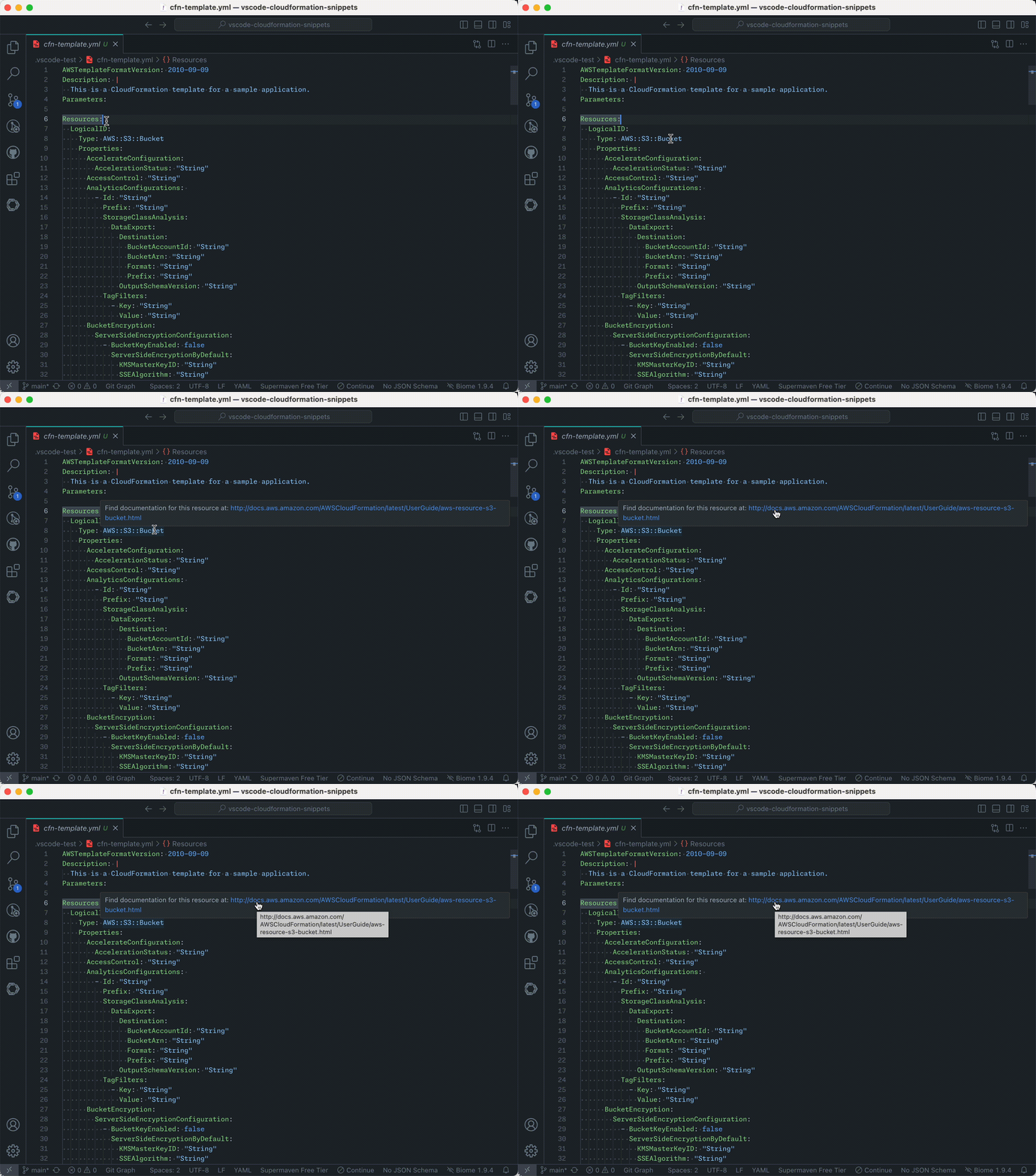
Note: Once you start typing a prefix (explained in step 5), the corresponding snippet will show up in the dropdown menu. If this doesn't happen automatically, press ctrl + space to invoke IntelliSense and search for the prefix of the resource type that you want to add (as listed in step 5).
Template file associations
Files ending in .template use JSON by default. For YAML templates with that extension, set "files.associations": { "*.template": "yaml" } in VS Code settings. The Red Hat YAML extension is installed alongside this extension for YAML editing support; snippets and documentation hovers also work independently of it.
Development
Use Node 26.11.1 (fnm use) and Python 3.12 or newer. CI uses Python 3.14.8; local Python installations can keep their current supported version. Install dependencies and run the checks:
npm ci
uv venv --python "$(python --version 2>&1 | sed 's/Python //')"
uv pip install --python .venv/bin/python -r src/requirements.txt
.venv/bin/python -m unittest discover -s tests -v
.venv/bin/python src/validate-snippets.py --spec specification/resource-specification.json.gz
npm test
VSCODE_VERSION=stable npm test
npm run package
.venv/bin/python tests/check-package.py .vscode-test/cloudformation-snippets.vsix
.venv/bin/python tests/run-package-tests.py .vscode-test/cloudformation-snippets.vsix
npm test runs the Extension Host regressions on the minimum supported VS Code by default. Test results and logs are retained in .vscode-test; Linux needs a display or xvfb-run -a. CI tests the VSIX on Linux, macOS and Windows, with the minimum version also checked on Linux.
Regenerate the checked-in snippets from the pinned specification:
.venv/bin/python src/generate-snippets.py --spec specification/resource-specification.json.gz
The weekly release workflow downloads one AWS snapshot, validates generated syntax, types, resource coverage and documentation, then tests the packaged extension. An unchanged specification skips the release. Manual runs support force for releasing code fixes. If publication fails, rerun the failed jobs to reuse the retained VSIX and version; already-published versions are skipped. The released specification hash advances only after both registries succeed.
We've developed the AWS CloudFormation Starterkit to streamline your infrastructure setup using CloudFormation.
It comes with pre-configured templates, automated validation scripts, and seamless integration with CI/CD pipelines, you'll be able to deploy robust, scalable, and secure AWS environments with ease.
The starterkit empowers you to adopt best practices effortlessly. By leveraging tools like Checkov for security compliance and cfn-lint for template validation, you ensure that your infrastructure is both reliable and secure.
Support
If you have a feature request or an issue, please let me know on Github
Author
Danny Steenman



