
Zero config documentation tool - Let AI write the Markdown. Let seemore show it better.






Website
·
Report Bug
·
Request Feature
AI tools write Markdown fast. They write specs, notes, guides, READMEs, and whole folders of files. No person can read that much Markdown at that speed.
seemore points at that folder and renders it as a real site. Other docs frameworks need a project first: a scaffold, a config file, a docs/ layout, and a build step in your repo. seemore needs only a folder that already exists. It does not move your files, and it does not need any code. If you stop using seemore, your files stay where they are.
Quick start
You can use seemore in two ways.
Desktop app
Download the app for macOS, Windows or Linux from the download page. Open a folder or a .md file, and it opens as a site.
Command line
seemore needs Node.js 20 or newer.
cd my-docs
npx seemore   # renders this folder at http://localhost:4040
npx seemore runs seemore without adding it to your dependencies. Open the address it prints. Add, rename, retitle, or delete a file, and the site updates at once. Navigation and search update too.
The seemore website is a folder of Markdown, rendered by seemore. Your own folder will look the same way.
Or ask an AI agent to set it up
If you work with an AI agent, the agent skill does the setup for you.
Claude Code (Plugin Marketplace)
/plugin marketplace add arifszn/seemore-skill
/plugin install seemore
Other agents (Codex, OpenCode, Antigravity, Gemini, Cursor, …)
This skill works in any agent that supports the SKILL.md format. See INSTALL.md for the skill path and commands for each agent.
Or paste this to your agent:
Fetch and follow the install instructions from
https://raw.githubusercontent.com/arifszn/seemore-skill/refs/heads/main/INSTALL.md
Usage
After you install the skill, tell your agent what you want:
Turn this folder of notes into a docs site I can read in my browser
Or call the skill by name:
/seemore
What you get
Point seemore at any Markdown you already have: AI-written notes, project docs, RFCs, API references, specs, or an engineering handbook. You get:
- Zero config: no config file, no code, no files to move
- Live preview: files appear, disappear and reorder as you edit them
- Edit in place: double-click any block in the preview to fix its Markdown
- Desktop app: for macOS, Windows and Linux, with an integrated terminal
- Editor integration: one extension covers VS Code, Cursor, Antigravity and other VS Code-compatible editors, including remote workspaces
- Documentation framework:
seemore build renders the whole site to HTML, ready to deploy on any host
- Password protection: protect the built site with one shared password, with no server required
- Page actions: copy a page as Markdown, or export it as one self-contained HTML file to drop into Slack, email or an AI chat
- Search built in: static full-text search with no server and no account, with shareable highlighted results. Algolia and Orama Cloud drop in when you want a hosted index
- Rich Markdown: GitHub Flavoured Markdown, admonitions, steps,
[[wikilinks]], Mermaid and D2 diagrams, click-to-zoom images, embedded PDFs
- Full MDX:
.mdx pages take real JSX, your own React components and CSS
- 12 themes: dark and light follow the system, with a toggle that remembers your choice. Your own CSS always wins
Edit from the browser
The preview is also an editor. Double-click any paragraph, heading, list item, quote or table cell. A small editor opens with that block's Markdown source: **bold** stays **bold**, links stay links, tables stay tables. Fix the text, press Save, and seemore writes the change to the file on disk.
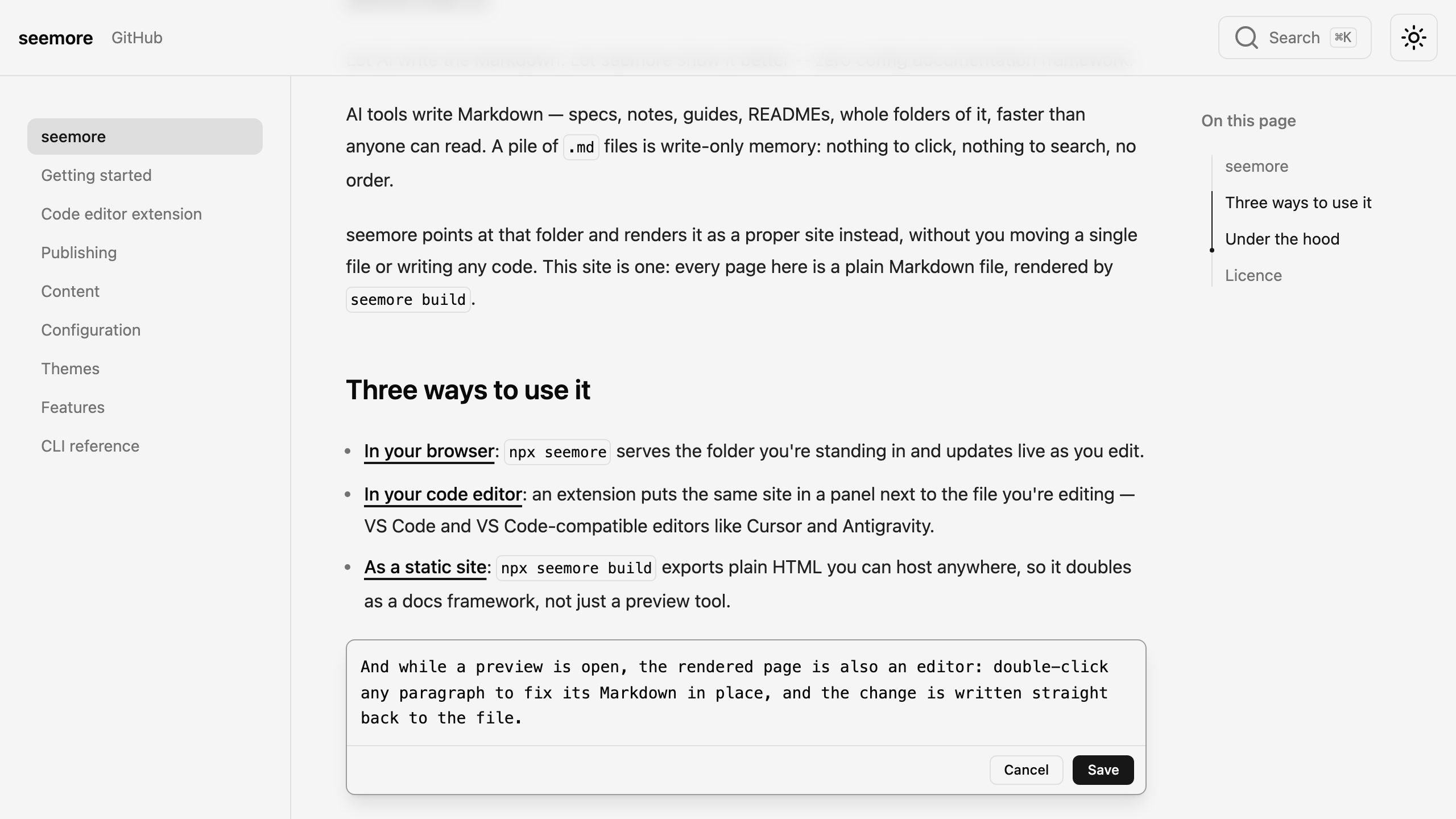
Inline editing works only for local previews.
Open with the desktop app
Download the app from the download page. It opens a folder or a .md file as a site in its own window, with an integrated terminal.
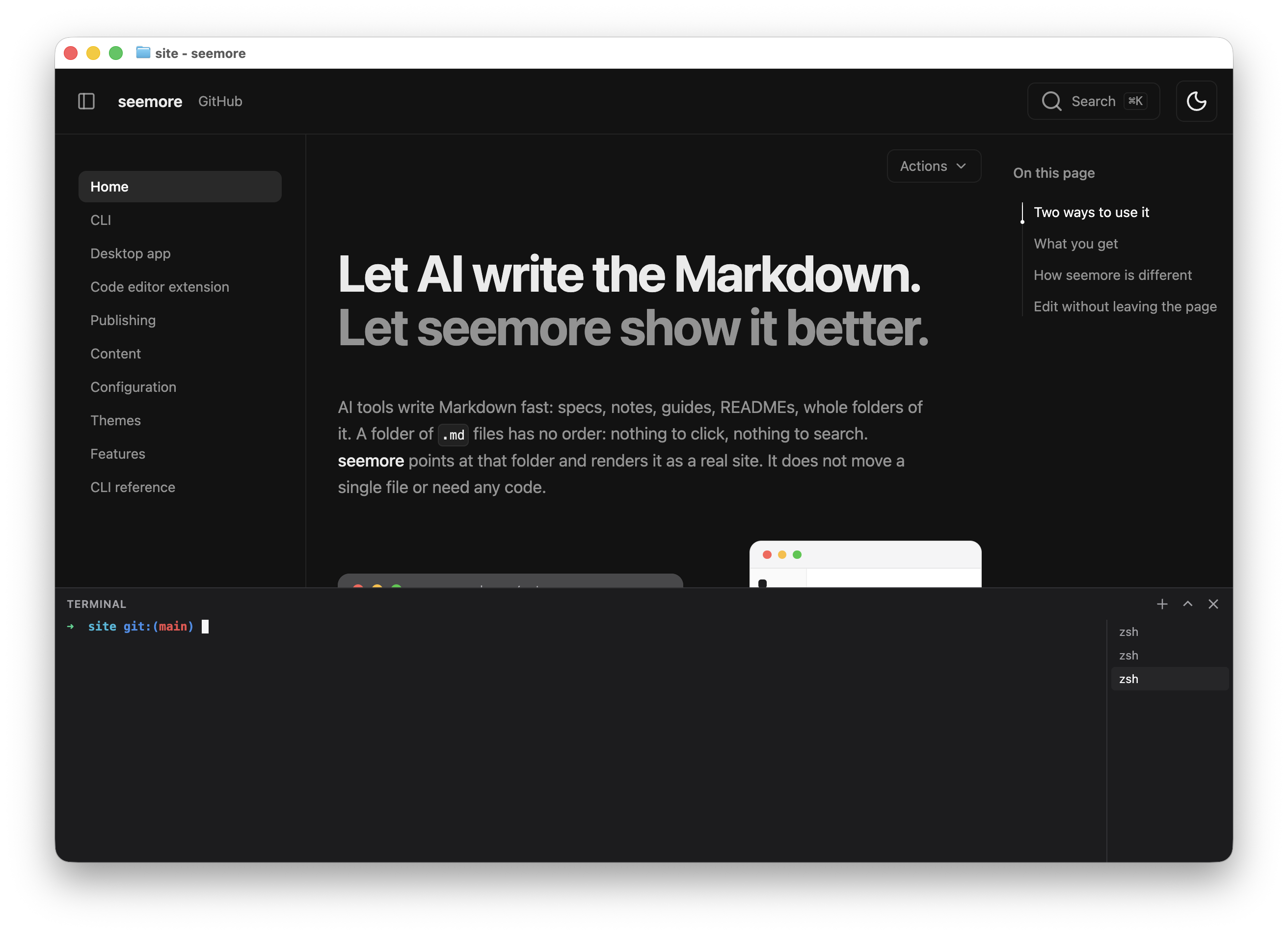
- Open a folder: use File > Open Folder, or drag the folder onto the app.
- Open a file: double-click a
.md file, or use File > Open File.
- Use the integrated terminal: it opens in the site's folder, so you can run an AI agent, git or a script next to the pages it changes.
View in your code editor
Install seemore from the VS Code Marketplace or Open VSX. You get the same rendered site as a panel beside your editor, with no terminal and no browser tab to manage. The extension bundles the CLI, so nothing downloads and nothing goes on your PATH.
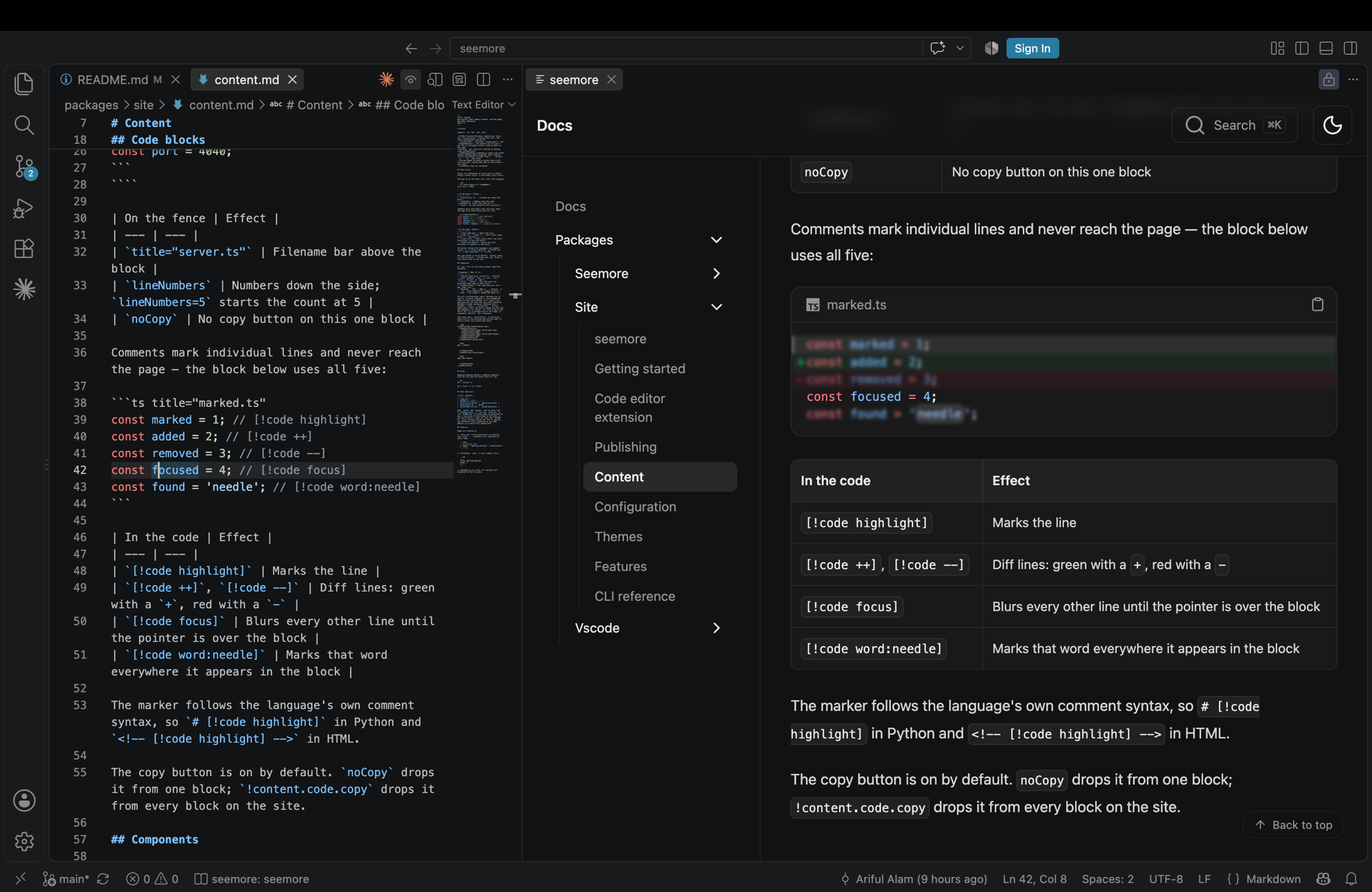
- Open any Markdown file.
- Click the seemore icon in the editor's title bar, or right-click a folder in the explorer and choose Open Folder in seemore.
- The rendered site opens beside your editor, scoped to that file's folder.
Publish it to the web
npx seemore build # static export to dist/ for any host
The result is a dist/ folder of plain web files. Drop it on Netlify, Surge, Cloudflare Pages or GitHub Pages, or hand it to any web host.
[!TIP]
Do you publish to GitHub Pages at username.github.io/my-repo/, not at the root? Set the subpath once with base: '/my-repo/'.
Password-protect a site
Add auth: true to seemore.config.ts. Set the password when you build:
SEEMORE_PASSWORD='a-long-passphrase' npx seemore build
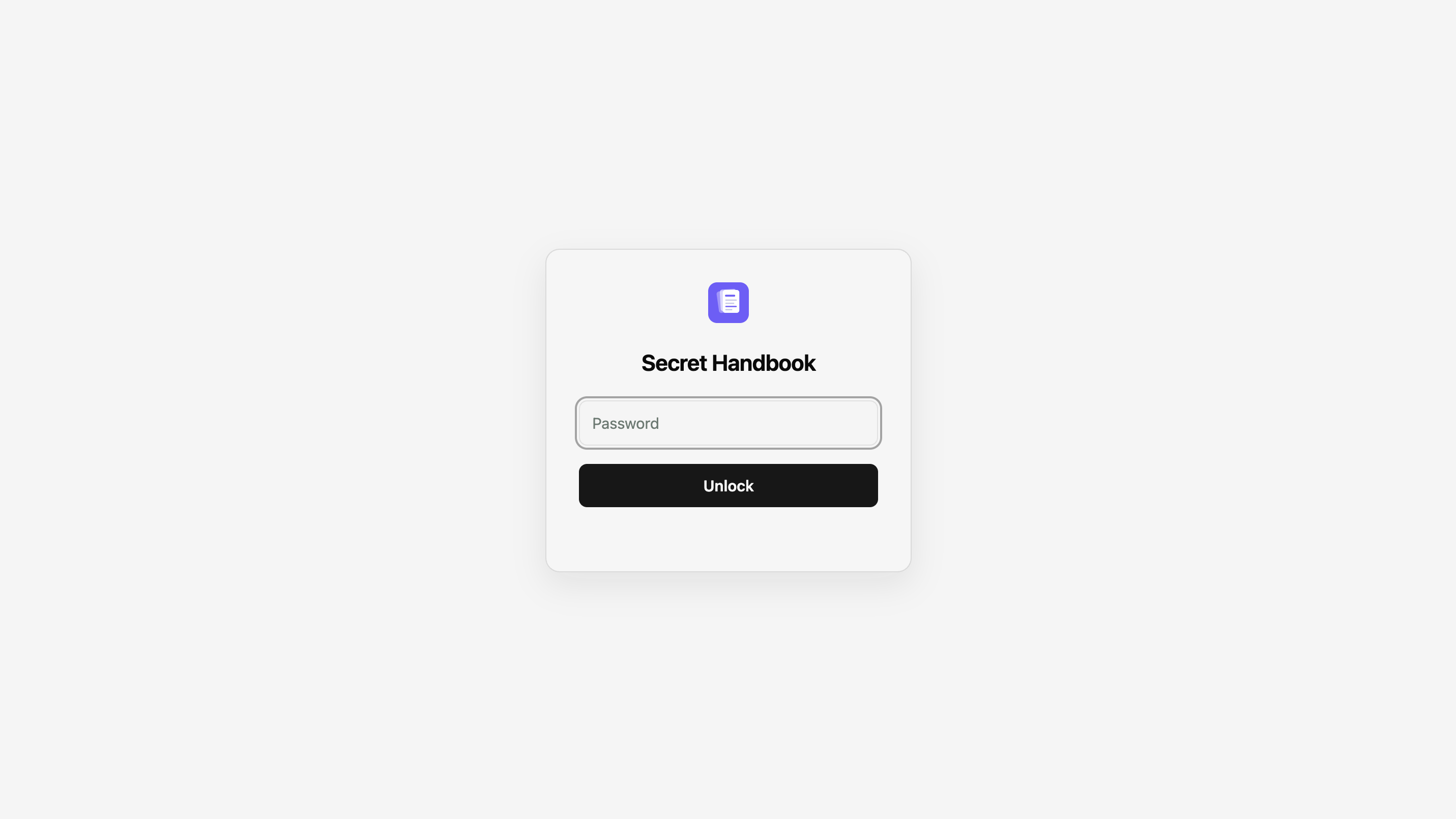
seemore encrypts the site content, so nobody can read a copy of the build without the password. A short password can be guessed offline, so use a long one.
Share a single page to Slack, email
To share one page instead of a site, use the Actions button above the page. It writes one self-contained HTML file that opens offline from a double-click. The CLI does the same without a browser:
npx seemore export docs/spec.md # writes spec.html next to the Markdown
Read more about all three methods on the publishing page.
Configuration
Configuration is optional. A folder with no config file builds correctly everywhere. To change settings, create seemore.config.ts next to your content:
// seemore.config.ts
export default {
  title: 'My Docs',
  description: 'Everything about the thing.',
  favicon: './favicon.svg',
  base: '/my-repo/',
  theme: 'ocean',
  css: './custom.css',
  features: { 'navigation.path': true, 'navigation.instant.preview': true },
  nav: [{ text: 'GitHub', link: 'https://github.com/you/repo' }],
  footer: { text: '© 2026' },
  editLink: { base: 'https://github.com/you/repo/edit/main/docs' },
  search: 'static', // or { provider: 'orama-cloud', endpoint, apiKey } / { provider: 'algolia', appId, apiKey, indexName }
  pageActions: ['copy-markdown', 'export-html'],
  exclude: ['drafts/**'],
  include: ['.notes'], // dot folders, build/, dist/ and similar are skipped unless listed here
  auth: true,
};
features is a set of switches for breadcrumbs, prefetching, the table of contents, code-block buttons and more. Name only the flags you want to change. Every other flag keeps its default value. The configuration and features pages document every key.
Themes
seemore has twelve built-in colour presets: neutral (default), black, catppuccin, dusk, ocean, purple, ruby, solar, aspen, emerald, vitepress, shadcn. Dark and light modes follow your system setting, with a toggle that remembers your choice. For anything else, put your own CSS in css. seemore appends it last, so it wins.
neutral (default) |
black |
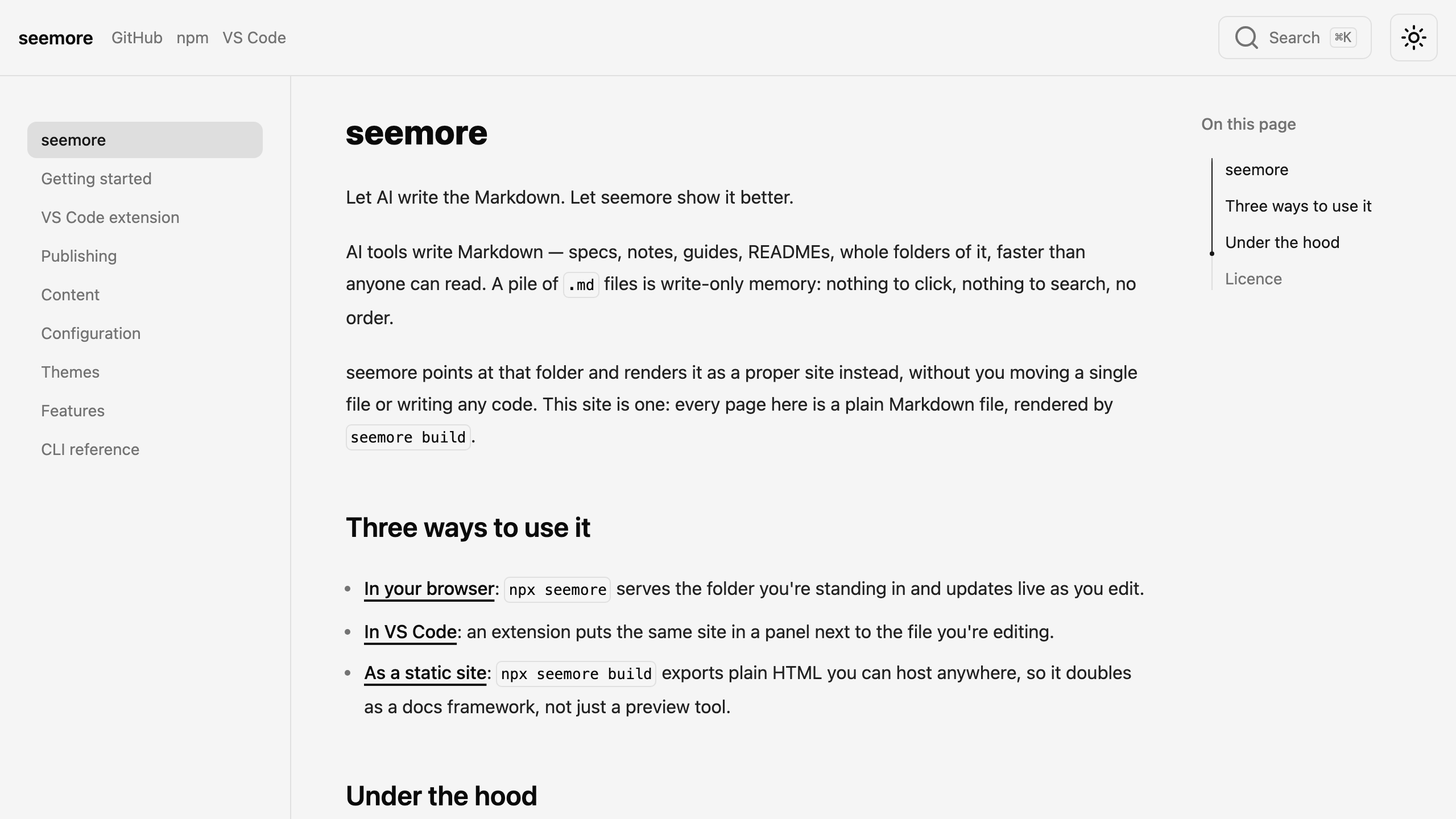 |
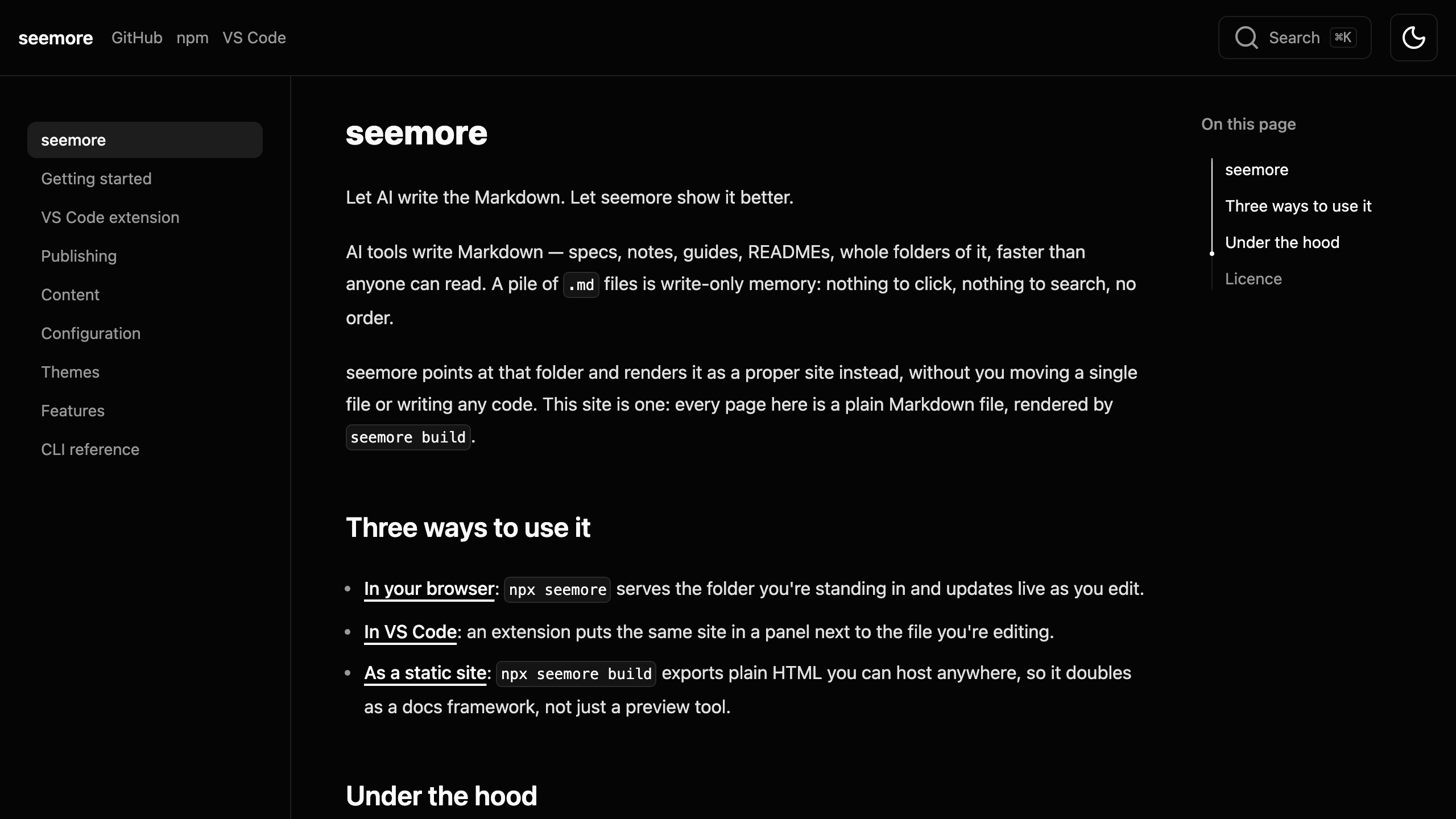 |
The themes page shows all twelve.
Content
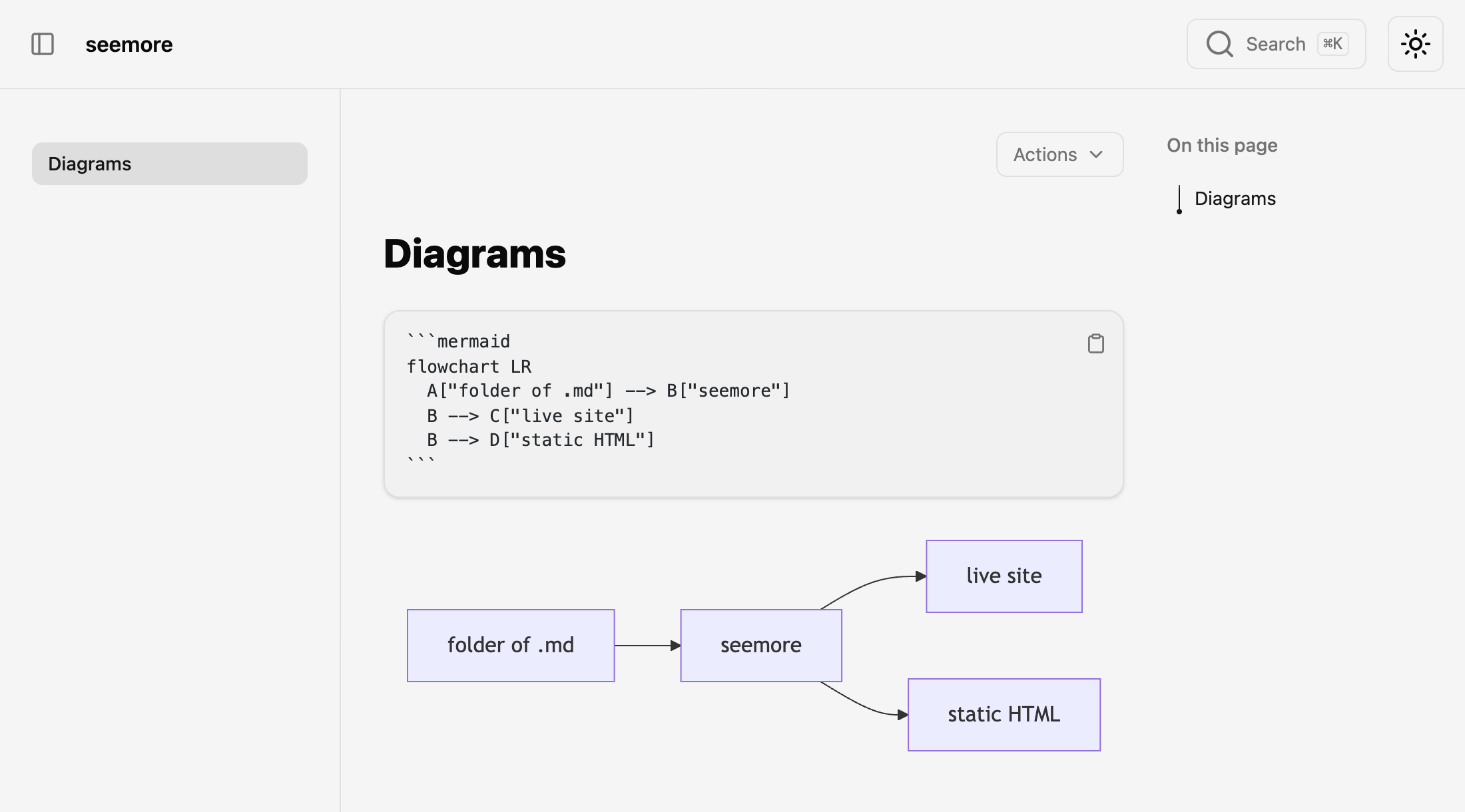
Works with .md, .markdown and .mdx. Mermaid and D2 diagrams render live in the browser, straight from a ```mermaid or ```d2 code fence:
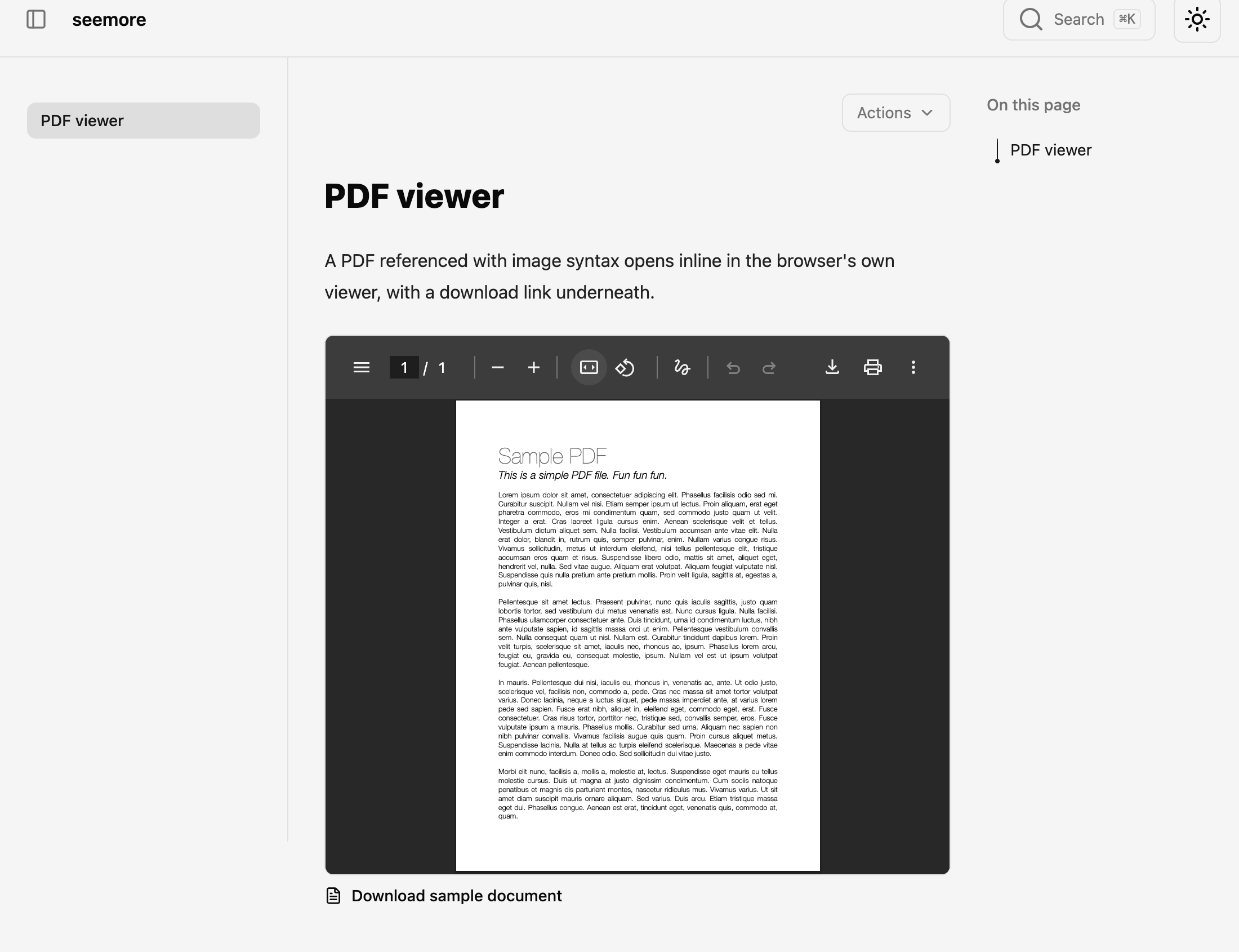
Reference a PDF with image syntax, and it opens inline with a download link underneath:

Page order comes from a meta.json file, a frontmatter order field, or the title, checked in that order. The content page renders every syntax seemore supports, live.
CLI
seemore [dir]           start the dev server
seemore build [dir]     build a static site into dist/
seemore export <file>   export a page as a standalone HTML file
Run seemore --help to see the options, or see the CLI reference page.
FAQ
Does anything leave my machine? No. The dev server, the build and the export all run locally, with no account and no telemetry. The only network calls are ones you configure yourself, such as a hosted search provider.
Does seemore move or rewrite my files? No. seemore reads your folder in place. It writes to a file only when you save an inline edit, or run build or export.
Is the password protection real? Yes. The content is encrypted at build time. There is no per-person access, and no way to revoke one password alone.
Under the hood
fumadocs provides the interface presets. Shiki, Mermaid, D2, Vite and React Router run underneath it. The code editor extension runs the same CLI as a child process it manages.
Contributing
seemore welcomes bug reports and pull requests. CONTRIBUTING.md covers how to get the repo running, the checks a pull request must pass, and how releases work.
Star it
If seemore saved you time, give it a star. A star helps other people find it.
Licence
MIT

