Skip to content
| Marketplace
Sign in
Visual Studio Code>Visualization>CostKeeperNew to Visual Studio Code? Get it now.
CostKeeper

CostKeeper

Preview

Argalla

| (0) | Free
What did your coding agents actually cost, per project and per client. Reads the Claude Code and Codex history already on your disk. Local, no account, no telemetry. Not affiliated with Anthropic or OpenAI.
Installation
Launch VS Code Quick Open (Ctrl+P), paste the following command, and press enter.
Copied to clipboard
More Info

CostKeeper

What did your coding agents actually cost — per project, per model, per client.

CostKeeper reads the history Claude Code and Codex already keep on your disk and turns it into a bill you can act on. No account, no telemetry, no network: everything is computed locally.

Install

VS Code Marketplace · Open VSX (Cursor, Windsurf, VSCodium) · or code --install-extension argalla.costkeeper

Then run CostKeeper: Open panel. There is nothing to configure — the transcripts are already there.

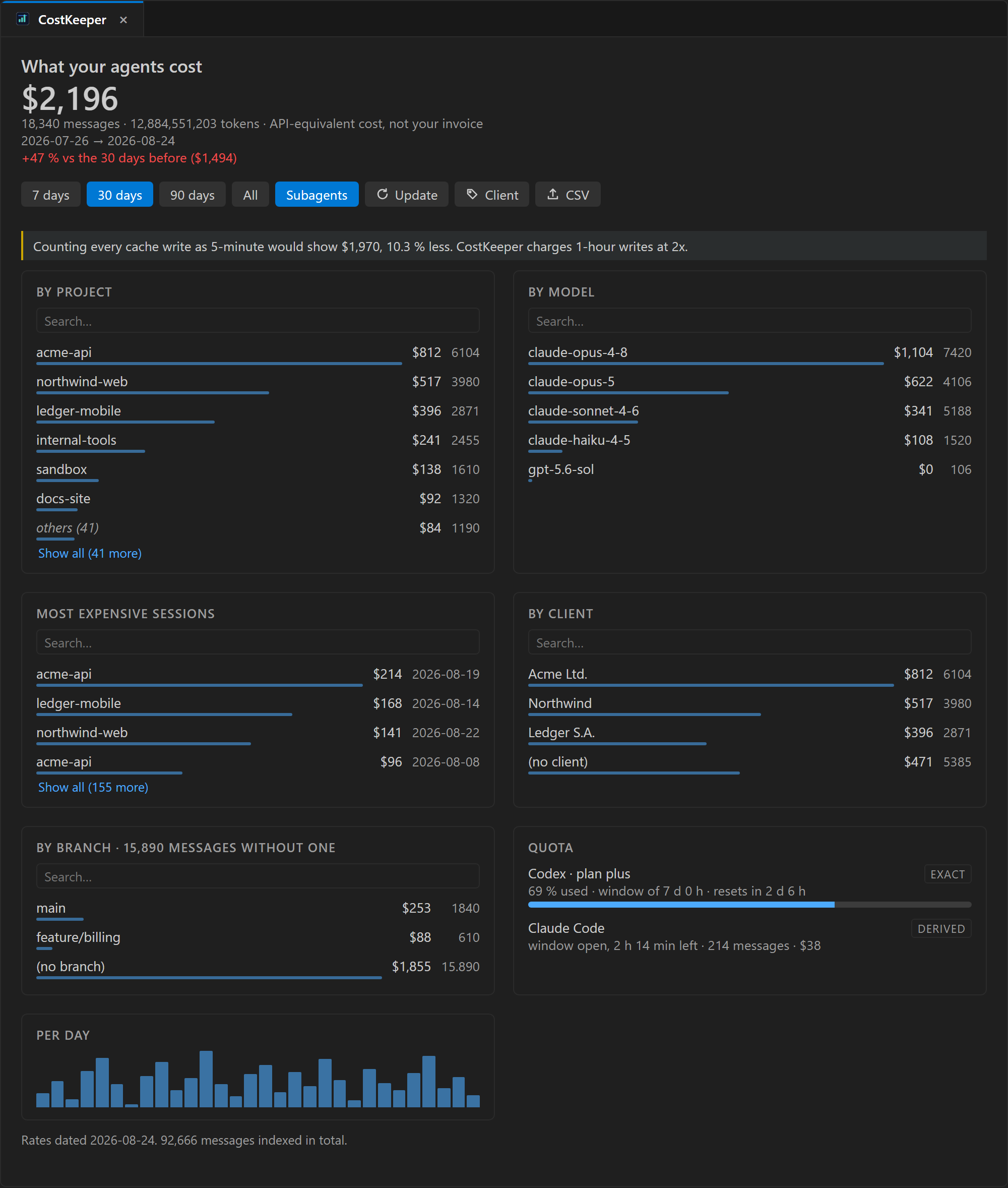
CostKeeper panel

Why the numbers here are different

Most usage extensions count one line of the transcript as one charge. That is the obvious reading, and it is wrong.

A single assistant message is written to the file several times — once per content block — each copy carrying the full usage object. On top of that, --resume, forks and git worktrees copy messages between files. On a real 2.5 GB history:

Lines with a usage object 192,262
Actual messages 92,666
Cost if you count lines $66,006
Cost of the real messages $29,087

That is 127 % too much. CostKeeper charges each message.id once, and when the same id appears with different usage it keeps the final state of the message.

Two more things nobody else does:

  • Cache writes are not all the same price. Claude bills a 1-hour cache write at 2× the input rate and a 5-minute one at 1.25×. Lumping them together understates the total by 10.3 % on that same history. CostKeeper keeps them apart.
  • Reasoning tokens are already inside output_tokens. Adding them again inflates the bill a second time.

What you get

Everything below is free. There is no paid tier today.

  • Claude Code and Codex in the same table, indexed incrementally. 4 GB of history in about 7 seconds; after that, updates are instant.
  • Cost by project, model, day, branch and session — click any row to filter the whole panel by it.
  • How you compare with the previous period: same number of days, right before, no overlap.
  • The most expensive sessions, named by project and date rather than by an id nobody can read.
  • Subagents on or off with one click.
  • Tag a project with a client, then group and export by client. The CSV is meant to go straight into an invoice.
  • Monthly budgets per project, with a notice at 50, 80 and 100 %.
  • Codex quota as published by Codex itself: percentage used, window, reset time, plan.
  • Claude's 5-hour window reconstructed from timestamps — labelled as derived, and deliberately without a percentage, because that number cannot be known.
  • Status bar with today's spend for the open project.
  • Search and «show all» in every table, so a long tail of small projects is never invisible.
  • Unlimited history.

A note on branches

Claude Code writes HEAD instead of the branch name whenever it cannot resolve one — which happens even in repositories sitting on main, when the session did not start inside the repository. CostKeeper does not pretend that is a branch: it counts those messages as no branch and tells you how many there are. The by-branch view is only useful for sessions started inside the repo.

Two numbers, never mixed

The dollar figure is the API-equivalent cost: what those tokens would have cost on pay-as-you-go. On a subscription plan it is not your invoice, and CostKeeper says so everywhere it shows one.

The quota figure is what you are actually consuming from your plan. Codex publishes it; Claude Code does not.

Rates ship in a dated file (src/core/precios/tarifas.json) and the date is shown in the panel and in every export. A model with no known rate is counted apart and reported — never estimated. Codex shows tokens and quota but no euros: there is no rate to quote, and inventing one would be exactly the mistake this extension exists to avoid.

Privacy

The index holds no free text at all: no prompts, no code, no edited file names. The most sensitive things it stores are the project path and the branch name. Nothing leaves your machine at all: the extension makes no network request. See PRIVACY.md.

Requirements

VS Code 1.95 or newer, on Windows, macOS or Linux. Claude Code or Codex installed, with some history. Nothing else.

Not affiliated

CostKeeper is an independent tool by Argalla · Tecniart Galicia, S.L. Not affiliated with, endorsed by or sponsored by Anthropic or OpenAI. Claude and Claude Code are trademarks of Anthropic; Codex is a trademark of OpenAI.

The transcript formats it reads are not public APIs. They can change without notice; when that happens the extension keeps working and reports what it could not classify, instead of guessing.

Español · Changelog · Issues

  • Contact us
  • Jobs
  • Privacy
  • Manage cookies
  • Terms of use
  • Trademarks
© 2026 Microsoft