ZemDomu — Semantic Accessibility Diagnostics for VS Code
ZemDomu finds supported semantic HTML and accessibility defects in HTML, JSX,
TSX, React, and Vue source. It reports each finding at the source and can follow
supported local component composition when a structural conflict is hidden
behind imports.
Try It in Under a Minute
- Install ZemDomu from the VS Code Marketplace.
- Open an
.html, .jsx, .tsx, or .vue file.
- Save the file, type, or run
ZemDomu: Scan Workspace for Semantic Accessibility Issues
(Ctrl+Alt+Z / Cmd+Alt+Z).
- Review the rule code, severity, file, line, and column in the editor or
Problems panel.
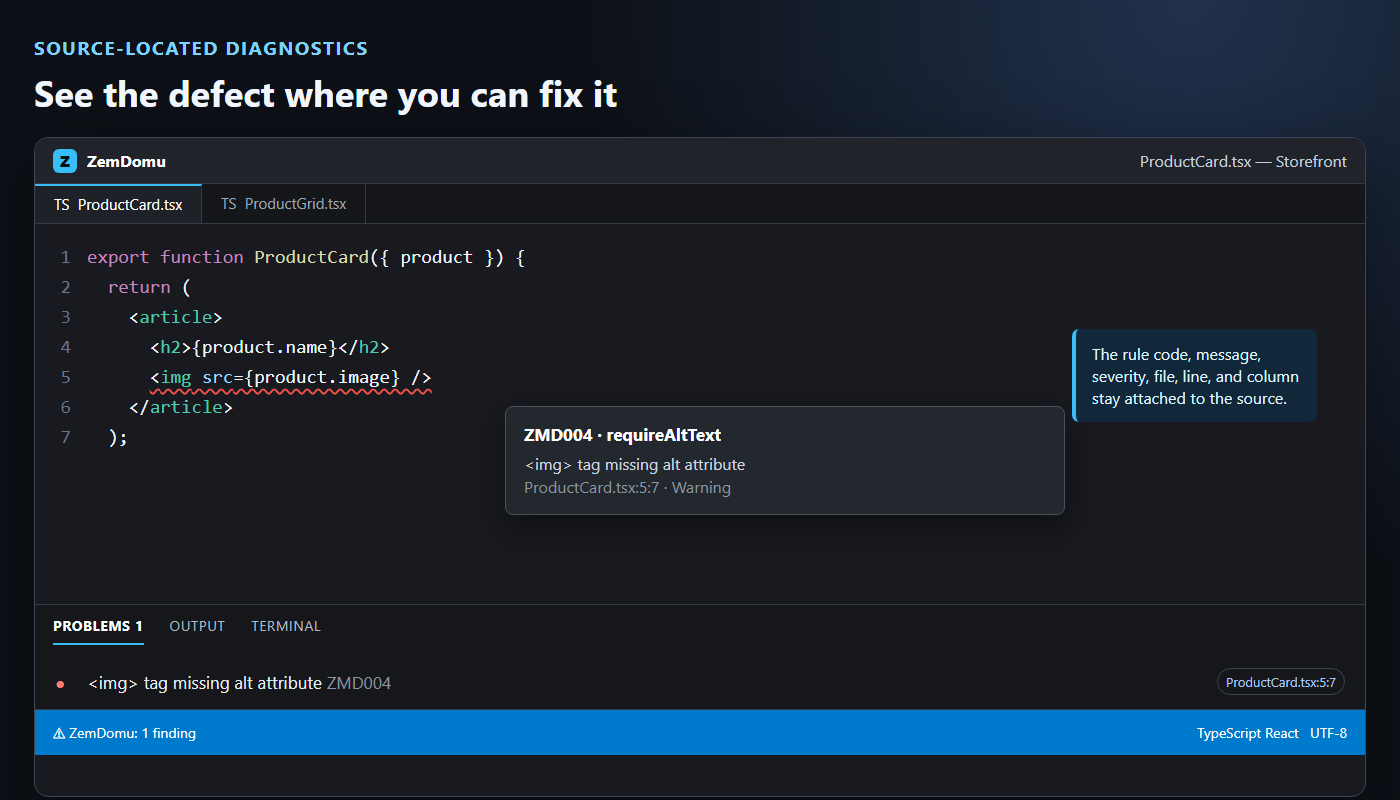
For example, this TSX source produces
ZMD004: <img> tag missing alt attribute at the image line:
export function ProductCard({ product }) {
  return <img src={product.image} />;
}
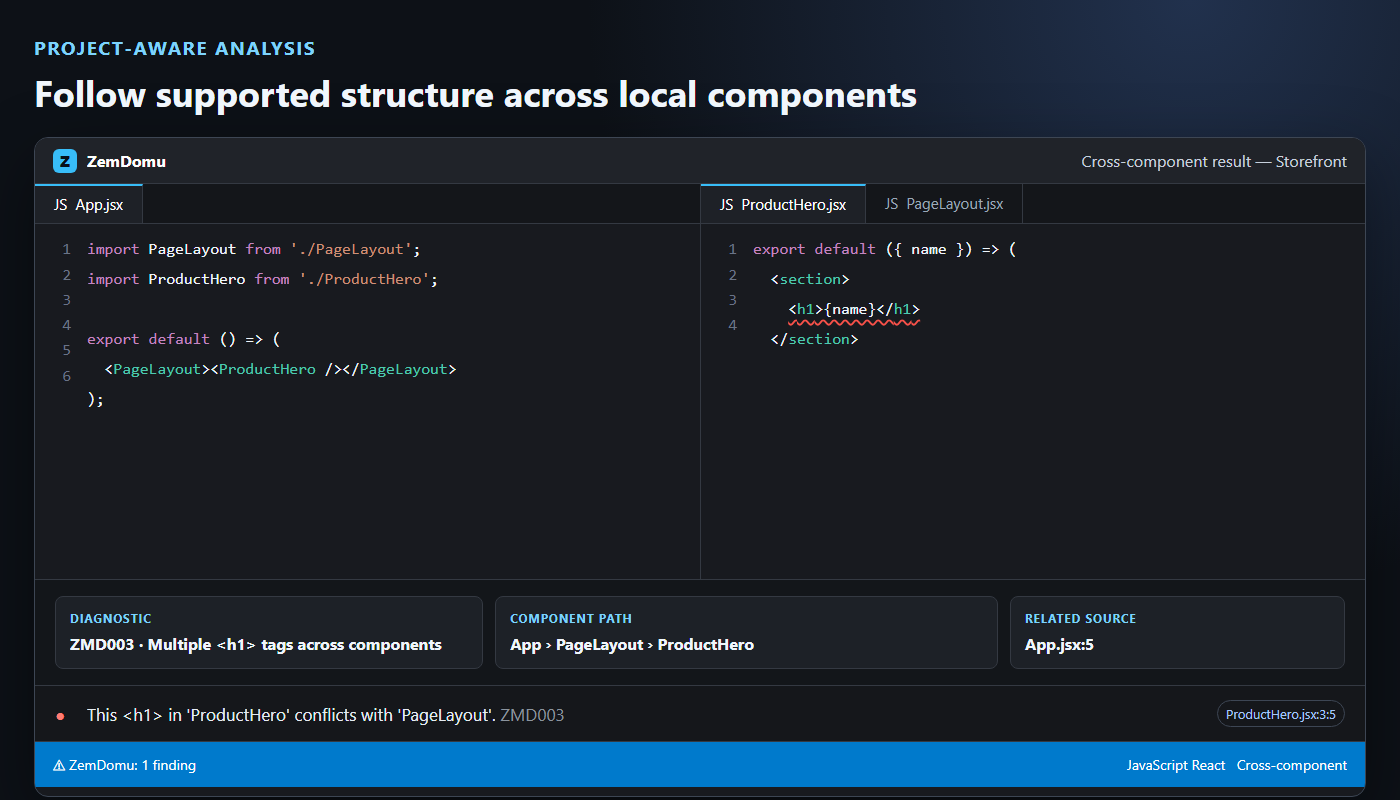
Cross-component analysis is the distinction: when enabled, ZemDomu follows
statically resolvable local React and Vue composition and adds supported page,
component-path, and related-source context to diagnostics.
Using the release candidate? Follow the privacy-safe
beta test guide
and return sanitized feedback through the
1.0 beta issue.
Configuration
Settings are under the zemdomu namespace.
"zemdomu.run": "onSave",
"zemdomu.crossComponentAnalysis": true,
"zemdomu.crossComponentDepth": 50,
"zemdomu.devMode": false,
"zemdomu.enableVerboseLogging": false
Run Modes
| Value |
Behavior |
onSave |
Lints the saved file after each save. This is the default. |
onType |
Lints the current unsaved editor buffer after a short debounce. |
manual |
Runs only when you use ZemDomu: Scan Workspace for Semantic Accessibility Issues. |
disabled |
Never starts an automatic scan. The manual workspace command remains available. |
Changing settings rebuilds the linter and listener configuration without
starting an implicit workspace scan. In disabled mode, ZemDomu preserves
existing diagnostics until a later successful manual scan refreshes them.
Manual workspace scans report file discovery, workspace-folder analysis,
diagnostic publication, and completion in a VS Code progress notification.
The ZemDomu status bar item exposes the same state with an explicit accessible
label; focus the VS Code status bar with the keyboard to review or activate it.
Scans are non-cancellable in 1.0 because the measured 1,000-file p95 is about
2.37 seconds and partial cancellation cannot yet preserve atomic results.
Rules and per-rule severity:
"zemdomu.rules.requireAltText": true,
"zemdomu.severity.requireAltText": "warning"
Supported Rules
requireSectionHeadingenforceHeadingOrdersingleH1requireAltTextrequireLabelForFormControlsenforceListNestingrequireLinkTextrequireTableCaptionpreventEmptyInlineTagsrequireHrefOnAnchorsrequireButtonTextrequireIframeTitlerequireHtmlLangrequireImageInputAltrequireNavLinksuniqueIdsnoTabindexGreaterThanZeropreventZemdomuPlaceholdersrequireDocumentTitlerequireSingleMainariaValidAttrValuerequirePageH1
Inline disabling:
<!-- zemdomu-disable-next -->
<!-- zemdomu-disable -->
<!-- zemdomu-enable -->
{/* zemdomu-disable-next */}
zemdomu-disable-next applies to the next markup line (or the remaining
markup on the same line). zemdomu-disable suppresses findings until the next
zemdomu-enable. All findings in the controlled range are suppressed in HTML,
JSX/TSX, and Vue templates.
Cross-Component and Multi-Root Workspaces
crossComponentDepth limits how many local dependency levels ZemDomu follows;
0 analyzes only the requested entry files. In a multi-root workspace, ZemDomu
analyzes each workspace folder independently with that folder as its project
root. Files outside the workspace are linted as standalone files without
cross-component analysis.
ZemDomu treats singleH1 and requireNavLinks as house-style rules.
requireTableCaption and requireSectionHeading are advisory by default;
whether their guidance is required depends on the document and the conformance
criteria that apply. Their default severity remains warning.
requirePageH1 is also advisory: it reports a missing first-level heading only
when Core can resolve a composed page with enough confidence. Page identity,
component path, related source locations, and conservative suggestions appear
with the diagnostic when Core supplies them.
enforceHeadingOrder compares each heading with the previous heading it can
observe and warns only when a later heading skips upward levels. The first
observed heading does not warn. singleH1 reports additional <h1> elements
but does not require one, so the current VS Code Extension does not report a
missing first or page-level <h1>.
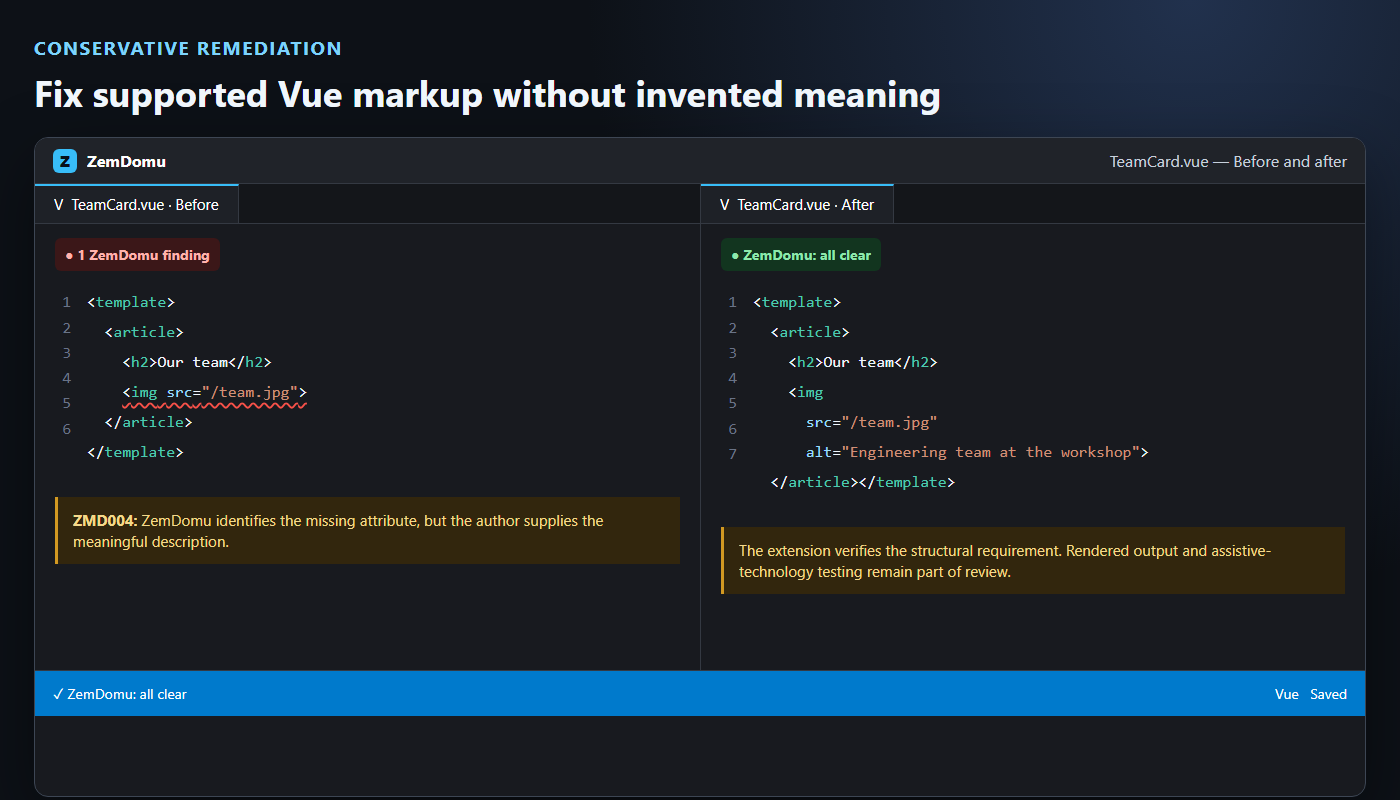
From Finding to Fix
ZemDomu identifies supported structural requirements without inventing the
author's meaning. When a fix needs a human-readable label, description, ARIA
state, or hierarchy decision, supply that intent and scan again. A TODO-ZMD
placeholder always requires author review.
What Static Analysis Cannot Prove
ZemDomu finds source patterns; it cannot establish WCAG conformance. A passing
scan does not prove that the rendered application is accessible. Continue to
test the rendered DOM, keyboard interaction, focus order, visual contrast,
zoom and reflow, browser accessibility trees, and relevant screen readers.
Runtime state, CSS, generated content, dynamic or bound values, conditional
rendering, fragments, and slotted content can change the accessible result.
ZemDomu handles supported static cases conservatively, but ambiguous cases
still require human review. Cross-component analysis follows resolvable local
imports up to crossComponentDepth; runtime-selected components, external
packages, and imports the project resolver cannot resolve may remain outside
the combined source model.
Supported VS Code Versions
ZemDomu supports VS Code 1.105.0 and later. Release validation runs in a real
Extension Host against 1.105.0 and the current stable VS Code release.
Privacy and Data Processing
Linting runs locally inside the VS Code Extension Host. ZemDomu reads supported
workspace files to calculate diagnostics and does not transmit source files,
diagnostics, or usage telemetry. Documentation links open only when you choose
to follow them.
The ZemDomu and ZemDomu Perf output channels can contain local file paths,
rule names, timings, and diagnostic summaries. Review and sanitize that output
before sharing it in a public issue.
Set zemdomu.devMode to true to enable the ZemDomu Perf output channel.
After a workspace scan, it reports phase timings and the slowest analyzed file.
Set zemdomu.enableVerboseLogging to true for structured lint lifecycle data
in the ZemDomu output channel. Keep both settings off during normal use and
enable them while reproducing a performance or diagnostic-lifecycle problem.
When reporting performance, include your hardware, operating system, VS Code
and ZemDomu versions, workspace file counts, relevant settings, operation, run
count, median or p95 time when available, and peak memory use.
Troubleshooting
No diagnostics appear
- Confirm the file language is HTML, JavaScript React, TypeScript React, or Vue.
- Check
zemdomu.run. In manual or disabled, run the workspace-scan command.
- Confirm the relevant
zemdomu.rules.* setting is enabled.
- Open Output: ZemDomu and rerun the scan to look for an actionable error.
Cross-component findings are missing
Confirm zemdomu.crossComponentAnalysis is enabled, the files share the same
workspace folder, and zemdomu.crossComponentDepth is large enough. Reduce the
case to local static imports; runtime-selected or unresolved imports cannot be
combined reliably by source analysis.
A scan fails
ZemDomu preserves the last known diagnostics instead of replacing them with an
empty result. Open Output: ZemDomu, copy a sanitized error, and retry the
manual scan. If it still fails, use the bug-report form linked from the
Marketplace listing.
A quick fix leaves TODO-ZMD
The marker means the extension could target the correct node but could not
safely invent the needed human-readable label, content, ARIA state, or list
ordering. Replace the marker, save the file, and scan again.
ZemDomu withholds a quick fix when the correct change depends on author intent,
including heading hierarchy, duplicate landmark roles, keyboard focus order,
label associations, and props on custom framework components. Make those
changes manually so the extension does not encode a plausible but incorrect
semantic choice.
Development
To build and package the extension:
npm run release
Individual steps if you prefer to run them separately:
npm ci
npm run compile
npm run bundle
npm run package
The bundling step produces dist/extension.js with runtime code inlined.
node_modules/ is excluded via .vscodeignore, keeping the packaged
extension small.
Links
License
The ZemDomu VS Code Extension is open source under the MIT License.
Copyright (c) 2025 Zacharias Eryd Berlin