Skip to content
| Marketplace
Sign in
Visual Studio Code>Programming Languages>TAcroManNew to Visual Studio Code? Get it now.
TAcroMan

TAcroMan

TAWilts

|
5 installs
| (0) | Free
Smart LaTeX acronym completion, plain-text detection, interactive replacement, and TAcroMan database integration.
Installation
Launch VS Code Quick Open (Ctrl+P), paste the following command, and press enter.
Copied to clipboard
More Info

TAcroMan logo

TAcroMan

Smart acronym support for LaTeX in Visual Studio Code.
Write first — let TAcroMan take care of the acronym commands.

GitHub · Report an issue


The Tex Acronym Manager (TAcroMan) helps you use acronyms consistently while writing LaTeX documents.

Instead of repeatedly looking up acronym keys or manually replacing plain text, TAcroMan connects your acronym database directly to Visual Studio Code and provides:

  • acronym-aware completion for commands such as \ac{...};
  • suggestions for acronyms written as plain text;
  • lookup by both short form and long form;
  • an integrated acronym browser in the VS Code sidebar;
  • interactive scanning and replacement of acronyms in existing text;
  • live synchronization when the acronym database changes.

Use Ctrl+Space (Ctrl+Whitespace) to see the suggested acronyms.

It is especially useful for theses, dissertations, papers, reports, and other large LaTeX projects with many acronyms.

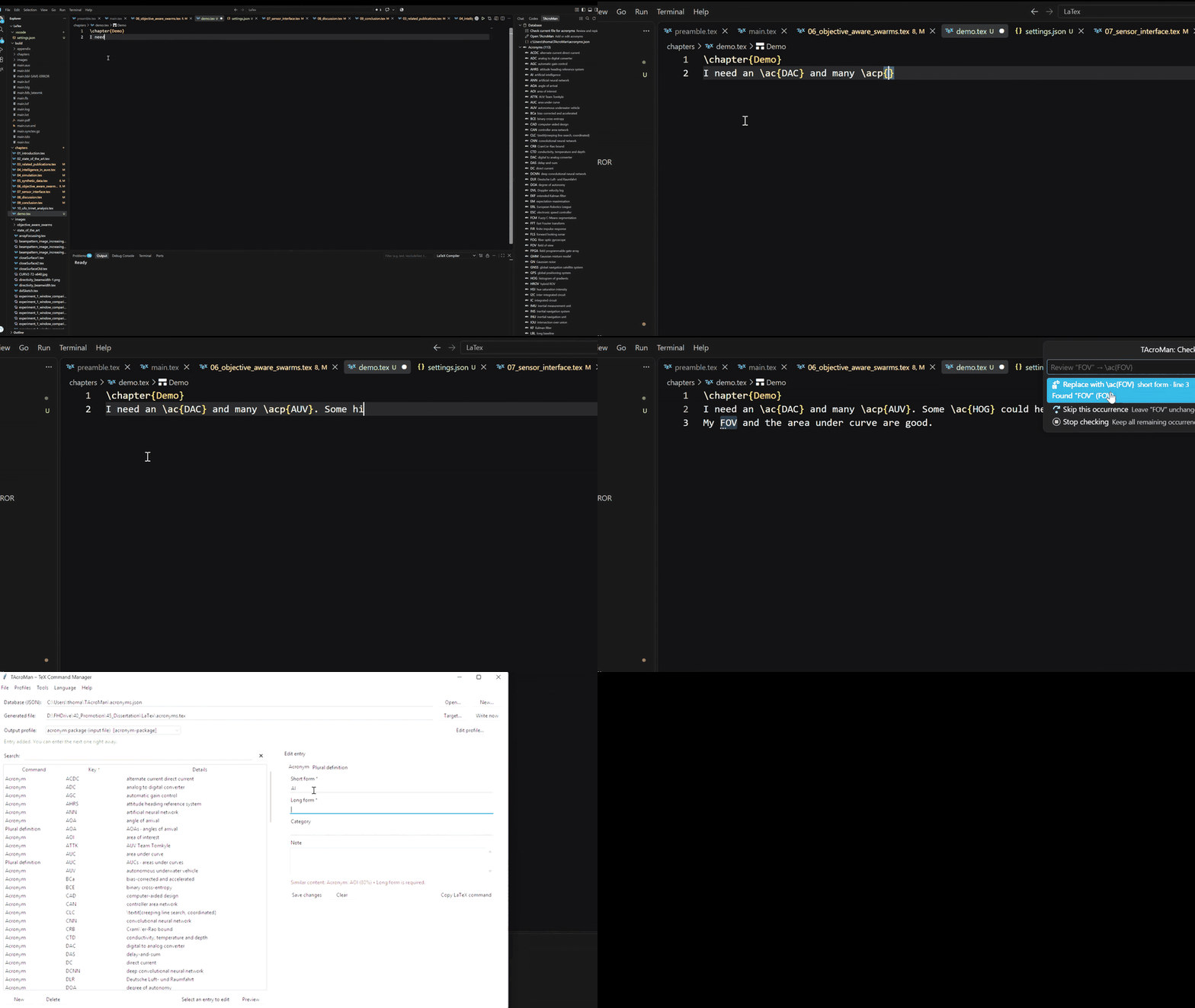
TAcroMan feature demonstration

✨ Features

1. Complete \ac{...} commands

Start typing an acronym command:

\ac{AU

Then press Ctrl+Space (Ctrl+Whitespace)(as it always will be...). TAcroMan searches the active database and suggests matching acronyms:

\ac{AUV}

The suggestion shows the acronym together with its long form, so you can choose the right entry without leaving the editor.


2. Convert plain acronyms to LaTeX commands

If you type an acronym directly in your text:

The AUV performs the mission autonomously.

TAcroMan can suggest:

The \ac{AUV} performs the mission autonomously.

Plural forms are supported as well:

Several AUVs were deployed.

can become:

Several \acp{AUV} were deployed.

The singular and plural commands are configurable.


3. Search by long form

Forgot the acronym itself?

Just start typing the long form:

autonomous underwater...

TAcroMan can still find:

\ac{AUV}

This works through normal VS Code IntelliSense and lets you search the acronym database by both abbreviation and meaning.


4. Manage acronyms directly from VS Code

TAcroMan adds its own view to the Secondary Side Bar.

There you can:

  • browse all acronyms in the active database;
  • search and filter the acronym list;
  • see short and long forms at a glance;
  • insert \ac{...} or \acp{...};
  • select or reload the active database;
  • open the integrated editor to add, edit, or delete entries.

The optional desktop application can still be launched through TAcroMan: Open Desktop Application.

Changes to the database are detected automatically — there is normally no need to reload the extension manually.


5. Check an existing file for acronyms

Already have a chapter, paper, or older LaTeX file containing plain acronyms?

Use:

TAcroMan: Check Current File for Acronyms

TAcroMan scans the active .tex file for known short and long forms.

For every occurrence, you decide individually whether it should be replaced.

Example:

The autonomous underwater vehicle uses a DVL.

TAcroMan may suggest:

The \ac{AUV} uses a \ac{DVL}.

For each match you can:

  • Replace
  • Skip
  • Stop checking

The scanner avoids common non-text contexts such as existing acronym commands, comments, citations, references, labels, acronym definitions, and verbatim content.


🚀 Getting started

1. Install the extension

Install TAcroMan from the Visual Studio Code Extensions view.


2. Create or select an acronym database

On first use, TAcroMan creates ~/TAcroMan/entries.json and keeps the shared UI/extension state in ~/TAcroMan/state.json. This state file is the only source used for remembered paths; older integration files, obsolete VS Code path settings, and workspace database discovery are deliberately ignored.

  1. Open the Command Palette with Ctrl+Shift+P and run TAcroMan: Open TAcroMan or click Open TAcroMan in the sidebar.
  2. Create your first acronym entry in the integrated TAcroMan editor and save it.

The extension reloads automatically. The generated entries.tex defaults to the current VS Code project folder and is updated after every database change.

Using an existing database

Run TAcroMan: Select Database from the Command Palette or use Select database in the integrated editor. The separately installed desktop application remains available through TAcroMan: Open Desktop Application.

Working with multiple authors

The acronyms.json file is the shared source of truth for the acronym database. If several authors work on the same project, keep this file synchronized between their computers using a suitable method:

  • Git is recommended. Commit and push changes to acronyms.json, and pull the latest version before editing it.
  • A cloud-synchronized folder can also be used, but simultaneous edits or synchronization conflicts may overwrite changes. Use this option with care and avoid editing the database concurrently on multiple computers.

After synchronizing the file, point TAcroMan to the local copy. In the VS Code extension, use TAcroMan: Select Database. In the desktop application, select the corresponding database path in the upper-right corner or use the database-selection command. Once the path is set, all authors can use the same acronym database.


3. Start writing

Try any of the following:

\ac{
AUV
autonomous underwater

or open the TAcroMan sidebar and browse the database directly.


🔄 Live database synchronization

The active JSON database and the shared ~/TAcroMan/state.json file are watched automatically.

When an acronym is added, edited, or deleted in either frontend (or directly in the JSON file), the other frontend updates automatically and regenerates the selected output file.

This also works when the database is located outside the current VS Code workspace.


🧭 TAcroMan sidebar

The sidebar provides quick access to the most common actions:

  • Check current file for acronyms
  • Open TAcroMan
  • view the active database
  • search/filter acronyms
  • reload the database
  • select another database
  • insert singular or plural acronym commands

Right-click an acronym to insert it directly into the active LaTeX document.


⌨️ Commands

Open the Command Palette with Ctrl+Shift+P and search for TAcroMan.

Command Description
TAcroMan: Check Current File for Acronyms Scan the active .tex file and review replacements interactively
TAcroMan: Open TAcroMan Open the integrated acronym manager
TAcroMan: Open Desktop Application Open the optional Python desktop application
TAcroMan: Select Database Select an acronyms.json database
TAcroMan: Reload Database Force the current database to reload
TAcroMan: Insert \ac{...} Insert the selected acronym in singular form
TAcroMan: Insert \acp{...} Insert the selected acronym in plural form

⚙️ Configuration

For most users, the default settings should work without modification.

Show advanced settings

tacroman.latexCommands

Defines the LaTeX commands for which acronym completion is enabled.

For example:

[
  "ac",
  "acp"
]

tacroman.plainTextCompletion

Enable suggestions while typing acronym short forms or long forms directly in normal LaTeX text.


tacroman.plainTextDiagnostics

Detect known acronyms written as plain text and offer Quick Fixes.


tacroman.quickFixSingularCommand

LaTeX command used for singular replacements.

Default:

ac

tacroman.quickFixPluralCommand

LaTeX command used for plural replacements.

Default:

acp

tacroman.inferPlainTextPlurals

Allows TAcroMan to recognize simple plural forms even when no explicit plural is stored in the database.


tacroman.ignoredArgumentCommands

Defines LaTeX commands whose braced arguments should not be interpreted as normal prose during acronym detection.


tacroman.launchArguments

Additional arguments passed when launching the desktop application.


🖥️ TAcroMan desktop application

The VS Code extension is part of the larger TAcroMan project.

The integrated editor and desktop application render the same shared web interface and manage the same JSON database, profiles, and generated output:

Integrated editor ─┐
                   ├─ acronyms.json ─ entries.tex
Desktop app ───────┘

The desktop host is installed with the Python tacroman package and uses pywebview for its native window. Its desktop-only menu includes the former file, profile, tool, language, and help actions. Profile editing, citation migration, and reference auditing run entirely in the shared Web interface.

The database remains a normal JSON file, so the extension does not lock you into a proprietary document format.

🧭 Roadmap

  • Develop a safer cloud-based synchronization method for shared acronym databases.
  • Suggest converting a word or phrase to an acronym command when it occurs a configurable number of times in the document.
  • Add an online acronym check to determine whether the spelling is correct, whether an acronym is commonly used, and whether alternative acronyms exist.

🤝 Works alongside LaTeX Workshop

TAcroMan is designed to complement LaTeX Workshop.

It does not modify LaTeX Workshop and does not replace its LaTeX editing, building, citation, or navigation features.

TAcroMan simply adds acronym-specific tooling on top of your normal VS Code LaTeX workflow.


🐛 Feedback and feature requests

Found a bug or have an idea for another acronym workflow?

Please open an issue:

https://github.com/TAWilts/TexAcronymManager/issues

If possible, include:

  • your VS Code version;
  • your TAcroMan extension version;
  • your operating system;
  • a small LaTeX example that reproduces the issue.

👨‍💻 Development

The VS Code extension lives in the same repository as the desktop application.

To build it locally on Windows:

.\build-vscode-extension.cmd

The script automatically:

  1. installs/updates the Node dependencies;
  2. runs the extension tests;
  3. selects an unused extension version and builds the .vsix package.

Package version

VERSION is the source of truth for the next extension package. Put the desired release version in vscode-extension/VERSION, for example 0.6.9, then run either build command above (or npm run package from vscode-extension/). The package build updates package.json to use that version.

If tacroman-vscode-0.6.9.vsix already exists in vscode-extension/, the build automatically increases the patch number until it finds a free version: 0.6.9 becomes 0.6.10, for example. It writes the selected version back to VERSION, so the file always records the last packaged version.

Alternatively, from vscode-extension/:

npm install
npm test
npm run package

📄 License

TAcroMan is released under the MIT License.

Linux development

The VS Code extension itself is platform-independent. Build it on Linux with:

bash build-vscode-extension.sh

For desktop integration, install and start TAcroMan with bash install-linux.sh and bash run-tacroman.sh. Both frontends use ~/TAcroMan/state.json.

  • Contact us
  • Jobs
  • Privacy
  • Manage cookies
  • Terms of use
  • Trademarks
  • Your Privacy Choices
  • Consumer Health Privacy
© 2026 Microsoft