WorkspaceGPT — the coding agent that knows your whole org
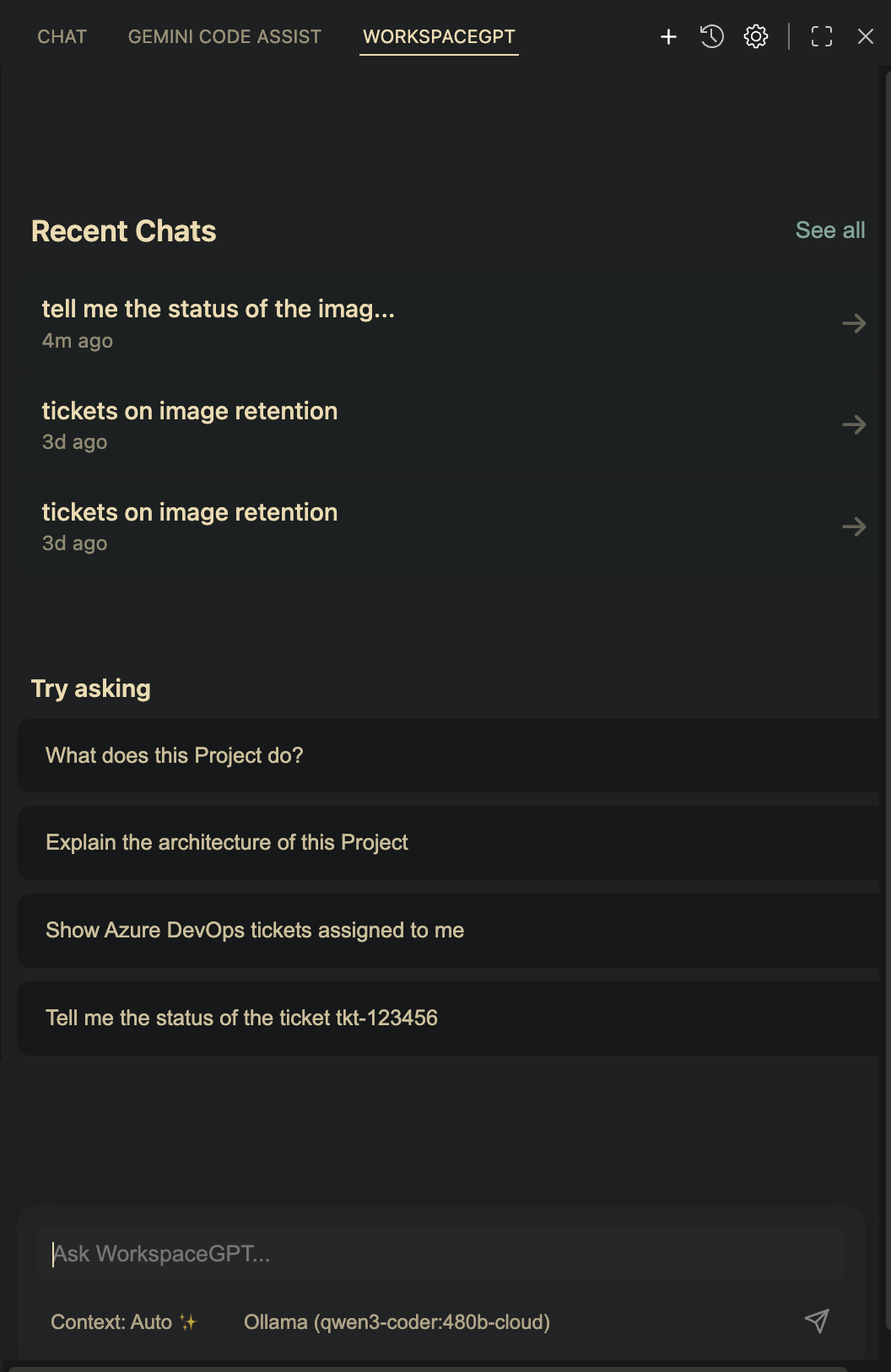


🖥️ No editor? WorkspaceGPT Desktop runs the same agent as an app for macOS (Apple Silicon and Intel, macOS 12+) and Windows (x64). macOS: curl -fsSL https://github.com/ritesh-kant/workspaceGPT/releases/download/desktop-latest/install.sh | sh. Windows (PowerShell): irm https://github.com/ritesh-kant/workspaceGPT/releases/download/desktop-latest/install.ps1 | iex. More
Visit our homepage: workspacegpt.in
WorkspaceGPT is the coding agent that knows your whole org.
Other coding agents start from your repo and a prompt. The knowledge about why the code should change — the ticket, the design page, the release process — lives in Confluence, Jira and Azure DevOps, and you're expected to copy-paste it in. WorkspaceGPT reads it directly, mid-task.
It's a full agent: it searches and reads your code, edits files, runs your tests, and shows you every change for approval before it touches disk.
🧭 What makes it different
- It knows your org, not just your repo. Your Confluence docs and Jira and ADO tickets are first-class context the agent can pull mid-task — ask about a ticket and it can find the design doc and the code that implements it.
- Privacy is architecture, not a promise. Embeddings and the search index are always on your machine — in both modes. In Local mode the model runs there too, so none of your content leaves it, and no account is needed. Other tools offer a privacy policy; this is a privacy mode.
- It participates in shipping. Release config-sync and hotfix automation (plan → approve → apply) mean the work doesn't stop at "PR opened."
🔐 Two modes, your choice
The switch moves one thing: where answers are generated. Your embeddings and search index are always local, in both modes.
- Local mode — bring your own model: Ollama (fully offline), or your own key for OpenAI, Claude, Gemini, Groq, OpenRouter, NVIDIA, Requesty or any OpenAI-compatible endpoint. No account.
- Remote mode — WorkspaceGPT's managed model. Sign in with GitHub; no model keys to supply. Your question and the snippets retrieved for it are sent to our inference endpoint; your documents and index stay on your machine.
Local mode never adds a network dependency.
🧠 Features
- 🧑💻 Agentic coding: The agent reads your code, makes multi-file edits, and runs commands to verify its own work
- ✅ Review before it writes: Every file change is shown as a diff you approve or reject; one-click revert restores any checkpoint
- 📄 Your Confluence: Connect your spaces with one-click Atlassian sign-in and the agent reads your team's design docs, runbooks and decisions mid-task — and cites them
- 🎫 Your Jira: The same one-click sign-in; issues are synced and searchable, and the agent reads the issue it's working on
- 🔷 Your Azure DevOps: Your assigned work items open under Your work; start a run straight from a ticket, grounded in its acceptance criteria and PR history
- 🔎 Codebase understanding: ripgrep search, symbol/definition/reference lookup, and repo orientation via your editor's language server
- 💬 @-mentions: Pull specific files and folders into the conversation
- 🚀 Release automation: Config-sync and hotfix pipelines with a terraform-style plan → approve → apply flow
- 🔌 MCP server: Exposes your Confluence, Jira, ADO and workspace search to Claude Desktop, Claude Code, Cursor and Copilot
- 🛡️ Runs offline: In Local mode, no remote APIs and no data leakage
🚀 Getting Started
Prerequisites
No specific prerequisites required. Pick Remote mode (sign in with GitHub, no model setup) or bring your own model in Local mode:
- Ollama - For 100% local operation
- OpenAI, Claude, Gemini, Groq, NVIDIA - With your own API key
- OpenRouter, Requesty - One key for many models
- Custom - Any OpenAI-compatible endpoint (self-hosted, proxy or gateway)
🧠 Default Model
By default, WorkspaceGPT uses a lightweight model: llama3.2:1b when using Ollama. If you're looking for more accurate and context-rich responses, you can switch to a more capable model that fits your system — such as llama3.2:4b, gemma3:4b, or mistral, or choose one of our cloud provider options.
Installation
- Open Visual Studio Code
- Navigate to the Extensions view (
Ctrl+Shift+X or Cmd+Shift+X on macOS)
- Search for "WorkspaceGPT"
- Click Install
🛠 Setup Guide
- Open the WorkspaceGPT sidebar in VSCode
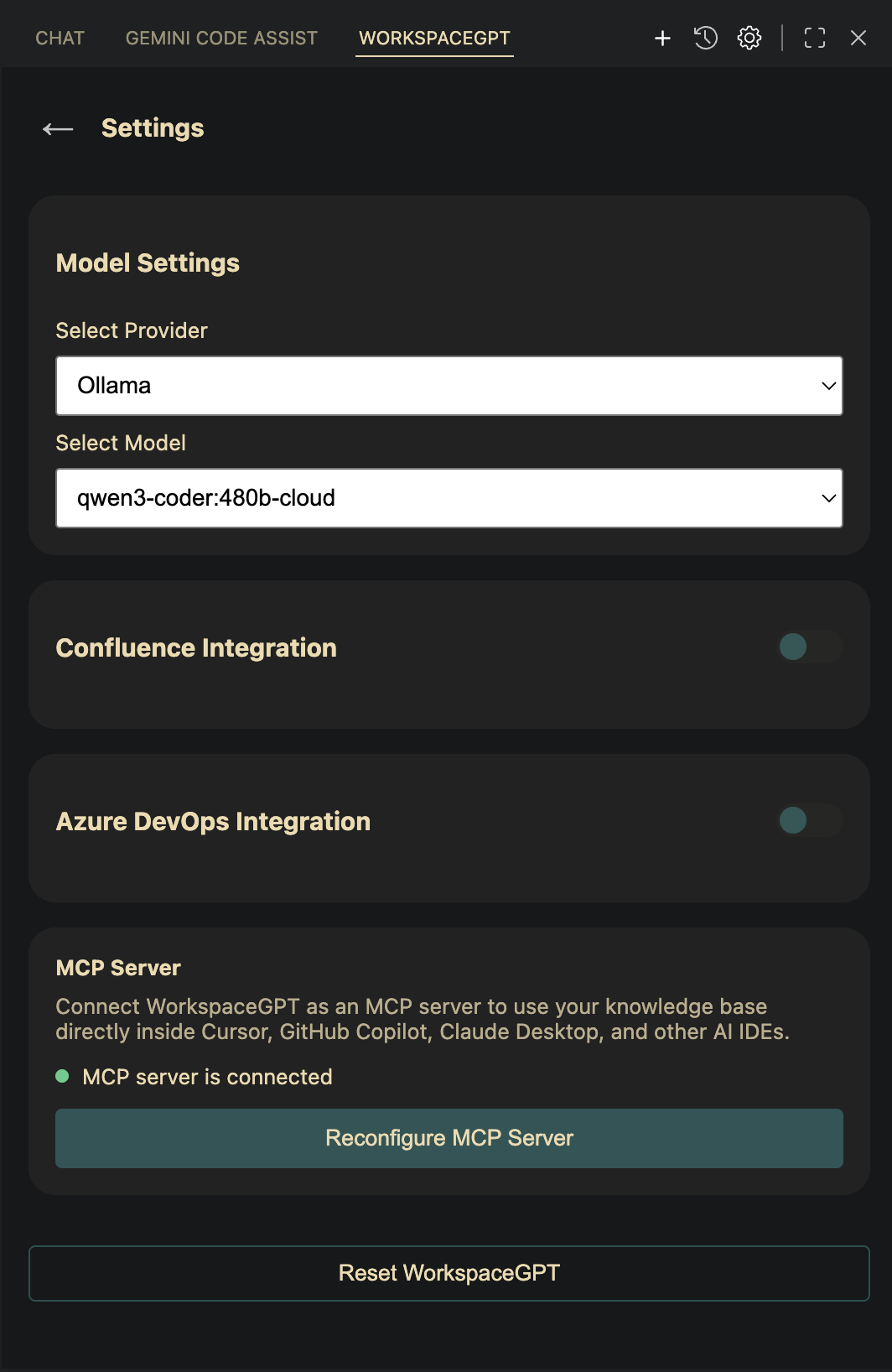
- Select your preferred AI provider from the settings menu
- Configure your selected provider (API keys for cloud providers or connection settings for Ollama)
- Confluence: Go to
Settings > Knowledge > Confluence, click Connect to Confluence to sign in with Atlassian, pick a space and sync.
- Jira: Go to
Settings > Knowledge > Jira, click Connect to Jira, pick a project and sync.
- Azure DevOps (ADO): Go to
Settings > Knowledge > Azure DevOps, enter your organization and a Personal Access Token, and sync.
🔁 Reset WorkspaceGPT
If you ever need to reset WorkspaceGPT to its default state, simply go to:
Settings > Reset VSCode State
🧑💻 Running the project locally
If you have source access, you can run the project locally:
pnpm install
pnpm run dev
Development Commands
pnpm run dev - Start development modepnpm run watch - Watch for file changes and rebuildpnpm run lint - Run ESLintpnpm run test - Run test suite
📦 Publishing
The extension is distributed through two registries:
- VS Code Marketplace (
vsce) — used by Microsoft VS Code.
- Open VSX (
ovsx) — used by VS Code forks such as Antigravity, Cursor, Windsurf, and VSCodium. The Microsoft Marketplace cannot be used by these forks, so the extension must be on Open VSX to be discoverable there.
Per-target packages
onnxruntime-node (a dependency of the embedding model) ships a separate native binary for every OS/arch. A single universal .vsix has to bundle all of them, which produces a 200+ MB package — slow enough to upload that vsce publish/ovsx publish can appear to hang with no progress output. pnpm run vscode:publish-all instead builds and publishes one .vsix per target (win32-x64, win32-arm64, linux-x64, linux-arm64, darwin-x64, darwin-arm64), each carrying only its own binary. The Marketplace and Open VSX both serve the correct one to each user automatically.
Vendored onnxruntime-web/transformers.js .wasm and .map files are stripped from every package regardless of target — the extension only ever runs the Node (onnxruntime-node) backend, so that wasm path never executes (see esbuild.config.js's createDependencyFilter).
Commands:
pnpm run vscode:package — build and package a single universal .vsix locally (all platforms bundled). Used for manual install / local testing, not for publishing.pnpm run vscode:package-targets — build and package all per-target .vsix files locally without publishing (useful for checking sizes before a real release).pnpm run vscode:publish-all — build, package, and publish a .vsix per target to both registries, then tag the release.pnpm run vscode:publish-pre-release-all — same, marked as a pre-release.
Both -all scripts (scripts/publish-targets.mjs) are safe to re-run after a partial failure (e.g. a registry outage mid-way through the target list) — publish calls pass --skip-duplicate, so already-published targets are skipped rather than rejected, and the tag is only created once every target succeeds.
Setup for Open VSX (one-time): create a publisher namespace matching Riteshkant at open-vsx.org, generate an access token, and export it before publishing:
export OVSX_TOKEN=<token>
pnpm run vscode:publish-all
Manual install (any fork): pnpm run vscode:package, then use the IDE's Install from VSIX action.
🧩 Chrome companion
A browser side panel for your Confluence & Azure DevOps questions. Pairing is paused for new setups: the panel reads your search index directly, and that index now lives only on your machine, so there is nothing for another browser to connect to. Existing installs are unaffected. The Chrome listing stays up while a hosted index is in progress.
📄 License
This software is proprietary. See the LICENSE.md file for more details.
💬 Support
Have questions or issues?
- Check the documentation
- Open an issue on GitHub
- Email us at contact@workspacegpt.in
- Reach out to the maintainers
🙏 Acknowledgments
- Big thanks to the VSCode team for a powerful extension API
- And to all the contributors who help shape WorkspaceGPT
WorkspaceGPT – Talk to your code and your Confluence docs. Locally, privately, and intelligently.

