Siemens Language Support
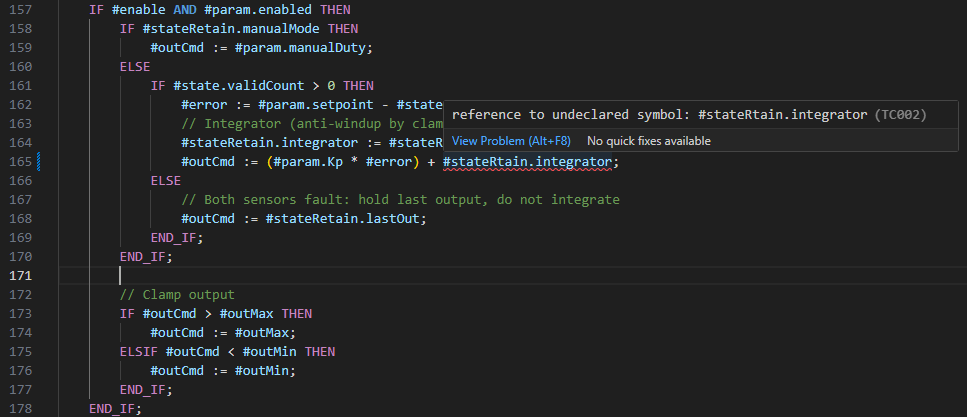
This VS Code extension provides syntax highlighting and language tooling (diagnostics, hover, completion, and go-to-definition) for Siemens SCL / Structured Text projects, plus related TIA export formats.
Documentation: danielv123.github.io/vscode_siemens/docs
Bugs/incorrect/missing diagnostics can be reported to danielv@danielv.no - reproducible examples are appreciated.
Features
- Syntax highlighting via TextMate grammar for Siemens source files
- Table based editor for tag table XML tags and project constants
- Text-backed FBD editor for
.s7dcl files with variable highlighting, syntax-aware completion, and side-by-side graphical Git diffs
- Comment toggling and bracket pairing via language configuration
- Diagnostics and type checking via the Go language server backend
- Hover type information, completion, and go-to-definition (including quoted identifiers)
.s7dcl inlay hints for .s7res titles + navigation from .s7dcl references to .s7res entries- Workspace type scoping via
.plc.json roots
- Dedicated PLC testing framework with
.scltest support


File associations
Files ending in .scl, .st, .s7res, .s7dcl, .udt, .db, and .awl will be highlighted.
PLC tag-table .xml files are scanned to resolve tags and project constants as global symbols, and receive dedicated XML diagnostics (for example undefined types, duplicate names, and name conflicts).
Settings
siemensLanguageServer.goBinaryPath: absolute path to a custom siemens-lsp backend binary (leave empty to use the bundled binary).siemensLanguageServer.telemetryEndpoint: telemetry ingestion API URL; leave empty to disable extension telemetry uploads.siemensLanguageServer.logAttachmentMaxBytes: maximum raw attachment size for uploaded error logs.
PLC scopes with .plc.json
- Place a
.plc.json file in each PLC project folder to give it an isolated type scope. This keeps types from one PLC from spilling into another when you have multiple PLCs inside one VS Code workspace.
- The language server treats the folder containing
.plc.json (plus any extra libraries you list) as one scope. Every subdirectory under that PLC root automatically shares the same type index.
- Project Libraries (v1): If a PLC root contains
.liblink placeholders (e.g., under Program blocks/Library/ or PLC data types/Library/), the server automatically discovers and includes sibling ../Types as a read-only library source.
- GUID-Driven Matching: Resolution is based on
TypeGuid inside .liblink matching against .libinfo/.libint sidecars in the Types tree.
- Strict Sibling Layout: The
Types folder must be a direct sibling of the folder containing .plc.json.
- Additive: Project-library discovery is additive and does not replace explicit
libraries in .plc.json.
- Example configuration:
{
	"name": "PackingLine PLC",
	"description": "Main line controller",
	"libraries": [
		"../shared_types",
		"../lib/opc_blocks"
	]
}
libraries paths are resolved relative to the .plc.json file and must exist to be used.- Type lookups never fall back to other PLC roots; each
.plc.json keeps its scope isolated.
- Editing or adding
.plc.json files causes the language server to rescan automatically.
Project-Library Support
The language server provides specialized support for Siemens project-library exports. This mechanism is separate from the standard .plc.json libraries list.
To use libraries exported from the TIA portal, make sure the Types directly is available as ../Types from the .plc.json indicating the root directory of the PLC. The server automatically discovers .liblink placeholders under the PLC root and matches them to .libinfo and .libint sidecars in the sibling ../Types directory using their shared TypeGuid. This wiring enables cross-file and cross-library Go-to-Definition, Hover, and Completion support for project libraries, plus automatic invalidation and diagnostics refresh when library source or metadata files change.
TIA Portal Export and Compare
VS Code uses the fast direct exporter for linked TIA projects. Compare checks a fresh PLC export against local sources and their last synchronization baseline, including .s7res texts; it does not require TIA checksums or a compile. Imports still use Openness and recheck the current TIA content before overwriting. See direct comparison for CLI options and conflict handling.
The TIA sidebar refreshes automatically when the linked project's saved data changes. Background comparisons leave local files and unsaved TIA edits untouched; the Compare button remains available for a manual refresh.
PLC Testing
The extension includes a dedicated testing framework for Structured Text using .scltest files. It supports both whole-program and isolated unit tests for FCs and FBs.
- Authoring: Write tests in the DSL to
SET values, WAIT_CYCLES, and ASSERT boolean conditions.
- Discovery: Use the VS Code Test Explorer to manage and run your suites.
- Reporting: Failures are mapped back to the source
.scltest lines with detailed diffs.
See docs/testing.md for a full guide and example snippets.


