 | FactoryLineTrace AI changes from intent through six audits to reviewable proof and a human-owned release decision. Installation Launch VS Code Quick Open ( Ctrl+P), paste the following command, and press enter.Copied to clipboard |

FactoryLine for VS CodeYou used an AI agent to change the app. The tests are green. Before you merge, you need one answer: could the test actually fail when the behavior is wrong? FactoryLine starts with that question. Run a bounded local command, inspect the receipt beside the diff, and decide what needs a person—not another confident agent message. It never uploads your workspace, code, or receipts. The proof path, in three moves
Your choice remains explicit throughout: inspect the evidence, approve the next boundary, or stop and repair. A green check is useful only when you can see what it actually proves. Catch AI-generated tests that could never fail — before review. Keep the
receipts and proof path next to the code, then open Graph Ops to see what is
evidenced, blocked, or next. First run 1.0.1 release preview: the editor surfaces typed intent-to-proof handoffs, route traces, current checkpoints, and proof-delta retry stops beside the existing First Proof and AppForge paths. Searchable audit rules and exact-hash receipt reuse make evidence easier to locate without loading the whole rule set. This is a release preview; marketplace publication requires its own verified provider read-back. New First Lap control: New in 0.9.4: the Oracle Firewall blocks same-ID rewrites of a blocking or release obligation's meaning, source binding, provenance, criticality, effect, or gate semantics. AppForge Oracle dossier receipts now retain a matching, hash-valid evidence path for review. Also in 0.9.1: the Agent Proof Bridge makes an Eve, Junie, Grok Build, or generic handoff inspectable in Graph Ops. It verifies the typed DAG, sealed scope, source preconditions, real before/after artifacts, declared checkpoint continuity, and current Oracle Contract binding. It never starts or resumes an agent, posts a worklog, or inherits agent authority. AppForge Mission Control turns a confirmed app story into a visible review path and checks 30 exact-build Apple policy and prior rejection classes before submission. Credential references—not raw secrets—can be handed to a supervised agent for evidence preparation; final TestFlight/App Review submission stays human-authorized. The workflow is designed to save avoidable rework/waiting time and minimize rejection risk, not guarantee Apple approval. Unified Graph Ops also shows SaaS Reality receipts: whether OAuth/OIDC identity, tenant authorization, checkout, verified webhook, entitlement, feature access, and revocation agree. The core works across standards-compliant providers, keeps unknowns blocked, rejects raw credentials, and never contacts or mutates the provider. The Open VSX extension and local proof core remain free. Every capability shipped before the transition is free through December 14, 2026. Beginning December 15, Founding Proof Pro may remain $5.95/month or $60/year for early adopters; standard Proof Pro is planned at $9/month or $90/year, AppForge Builder at $24/month or $240/year, and Team Assurance at $20 per active contributor/month annually or $24 monthly. Hosted execution is metered separately; downloading the extension and using local CLI, MCP, Studio, Graph Ops, receipts, and proof gates remain free. See the Open VSX service plan. Commands
Each command requires a trusted VS Code workspace. FactoryLine accepts only a feature name containing letters, digits, hyphens, and underscores; it does not pass arbitrary shell fragments to your terminal. For a GitHub pull request, the optional
For a team-operated agent change, run the CLI’s
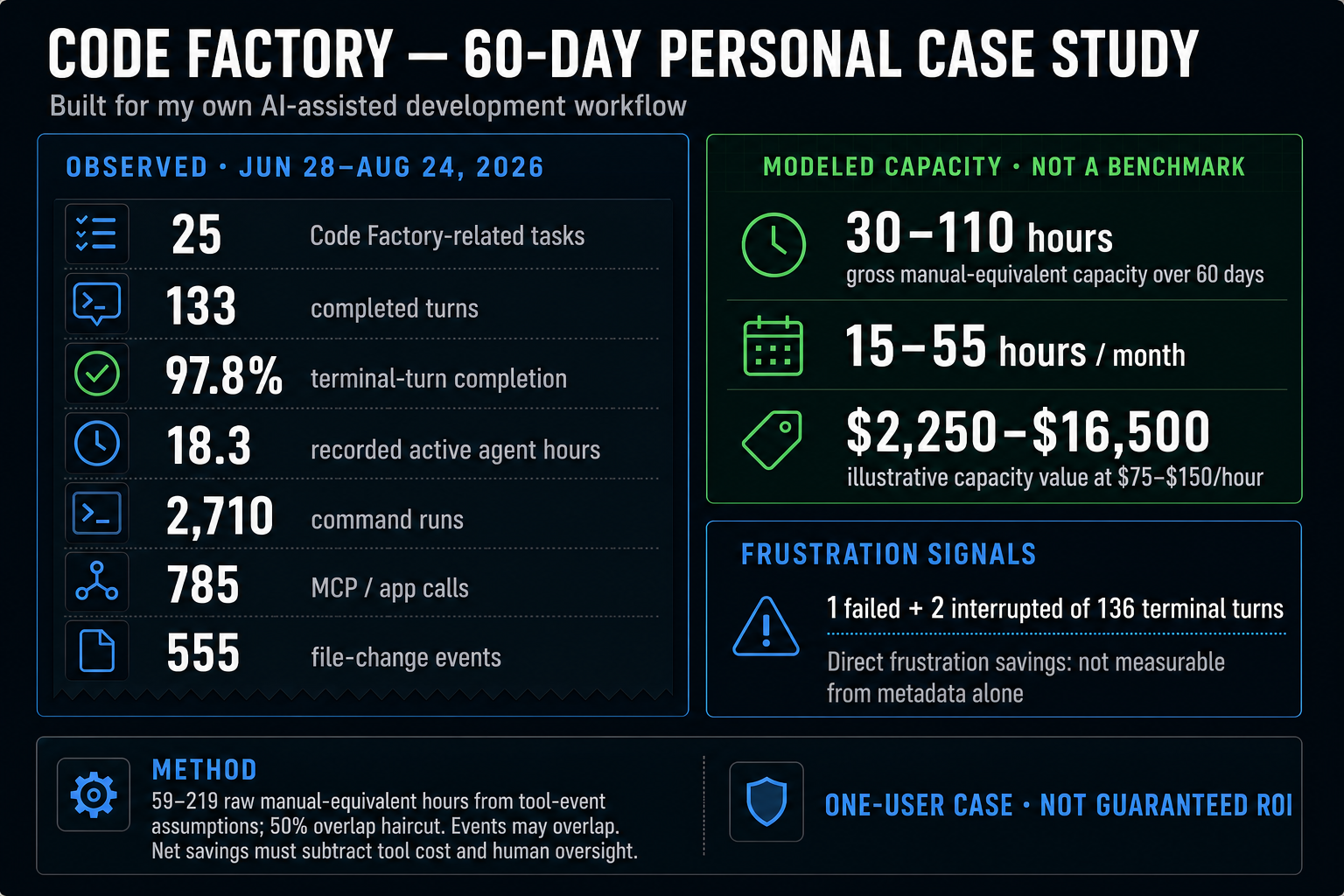
For UI-scoped work, add the optional Prestige Design Review to the same local evidence path. It supplies a purpose-led design brief and review artifacts for hierarchy, responsive behavior, affordances, consistency, and design tokens. The extension does not apply a design change or treat a visual score as production readiness. Expected outcomesCode Factory was built first for the creator's own AI-assisted workflow. A 60-day local Codex metadata slice observed 25 related tasks, 133 completed turns, 2,710 command runs, 785 MCP or app calls, and 555 file-change events. A separate, transparent counterfactual model estimates 30–110 gross manual-equivalent hours over the period after a 50% overlap haircut, or 15–55 hours per month. At an illustrative loaded rate of $75–$150/hour, that is $2,250–$16,500 of modeled gross capacity value. This is one user's case—not a benchmark, guaranteed ROI, or verified cash saving. Net savings must subtract tool cost and human oversight. For vibe coders, the practical target is less context reconstruction and fewer false "done" states. For engineers, it is reviewable proof beside the diff. For teams and enterprises, it is repeatable evidence with explicit human authority.
InstallInstall the Code Factory CLI first: Build a local VSIX from this directory, then install it in VS Code: Set If this free, local-first workflow helps, use the post-success Star Code Factory action or visit the GitHub repository. That action is optional, opens only GitHub when selected, and sends no workspace data. Code Factory 0.20 also includes an optional hosted GitHub PR-assurance adapter,
durable mission graphs, and secret-free BYOK policies. VS Code workspaces use
those controls through the local ScopeThis is the VS Code adapter. The separate JetBrains Platform adapter and its compatibility boundary are documented in docs/INTELLIJ.md. Verifier Plane
Contradiction gate
Habituation gate
|