Screenshots
| Real-time diagnostics |
Hover for details |
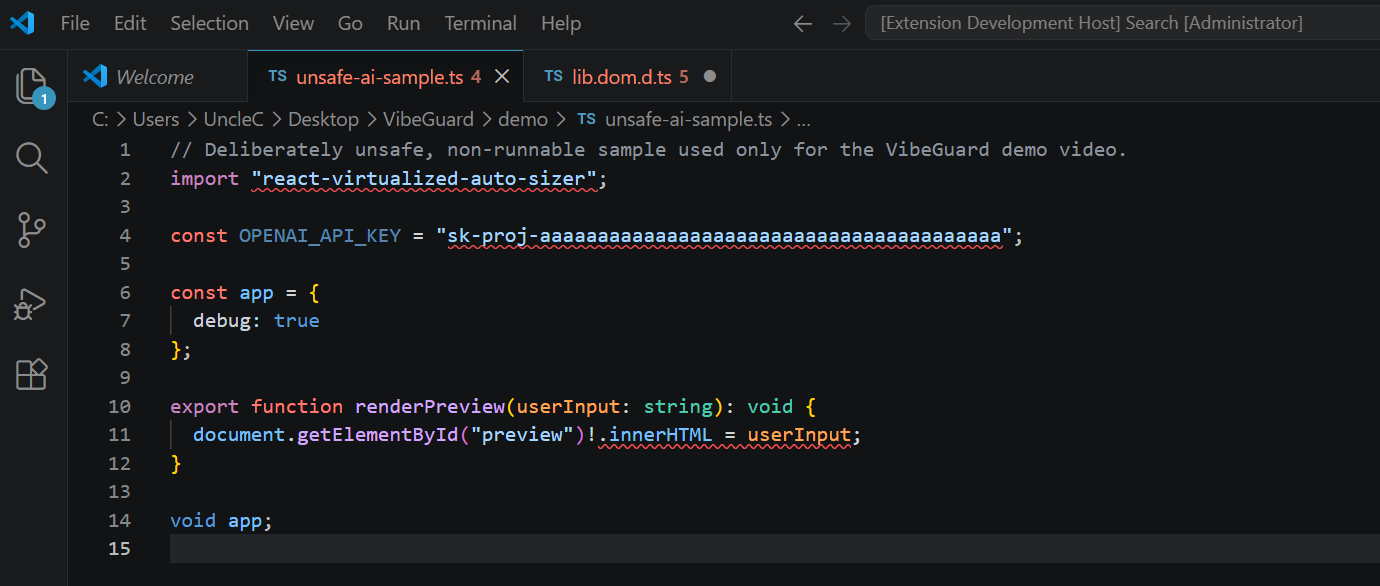 |
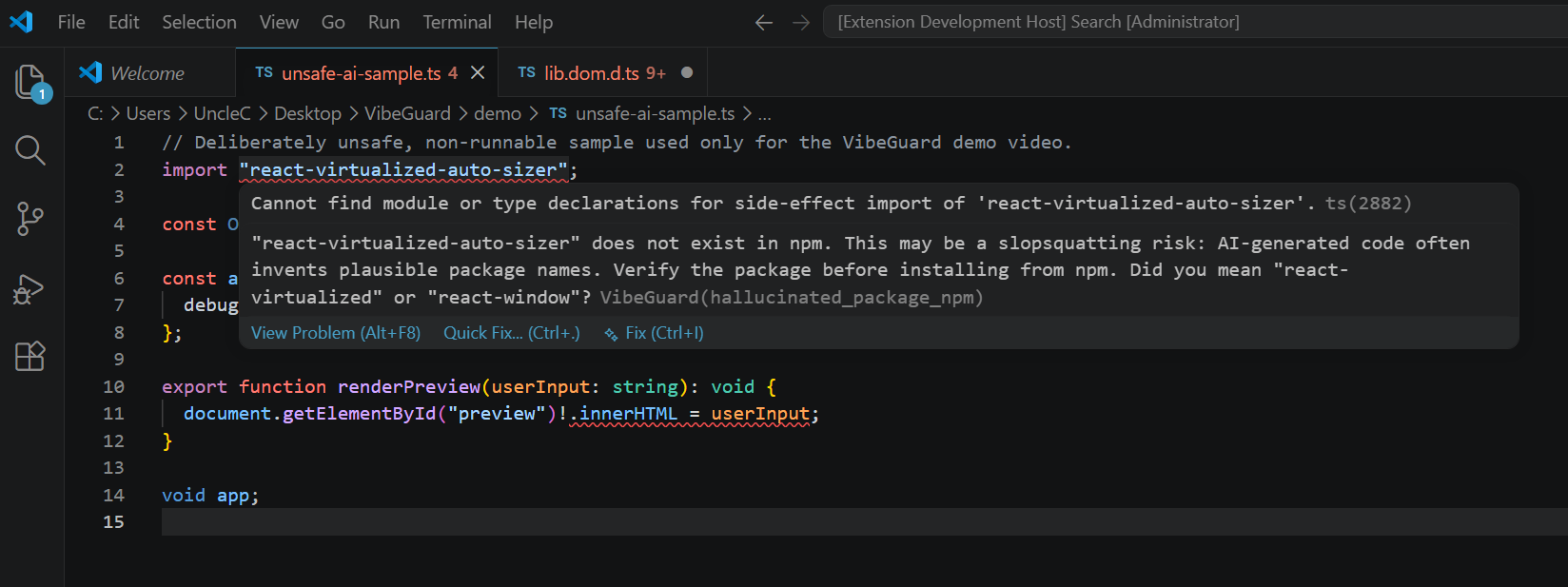 |
| Quick Fix menu |
Problems panel |
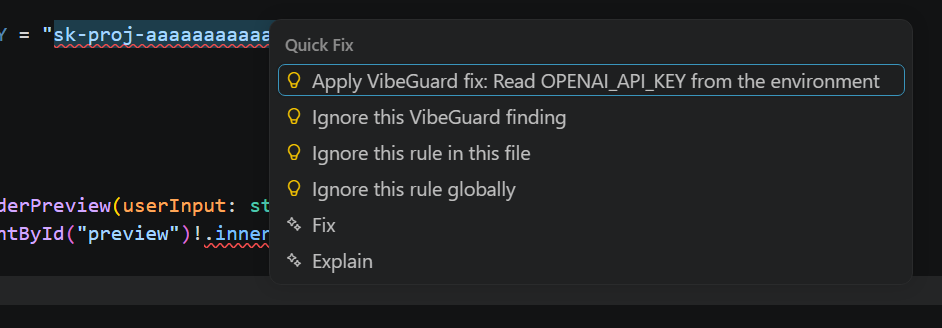 |
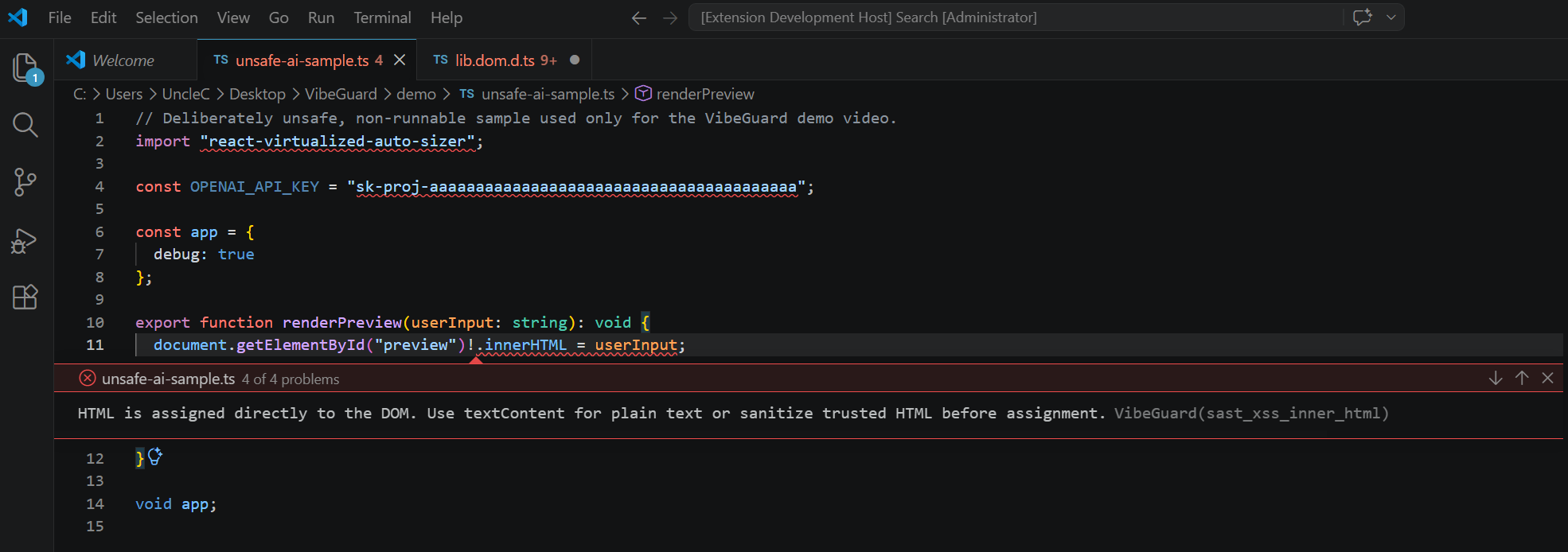 |
Why VibeGuard?
AI coding assistants are fast — but they hallucinate packages, leak secrets, and skip security controls. VibeGuard catches those mistakes as you type, before they reach production.
- Hallucinated packages — non-existent npm/PyPI/Cargo/Go/Maven packages
- Hardcoded secrets — API keys, tokens, credentials left in source
- Unsafe configurations — debug mode, wildcard CORS, disabled TLS
- Insecure coding patterns — injection, XSS, SSRF, path traversal, and more
Quick Start
git clone https://github.com/vibeguard/vibeguard.git
cd vibeguard
nvm use          # Node.js 22 LTS
npm install
npm run build
VSCode — Open the folder in VSCode, press F5 to launch the Extension Development Host.
CLI — Scan any project:
node dist/cli.js scan path/to/project --fail-on high
node dist/cli.js scan src --json
node dist/cli.js scan . --sarif vibeguard.sarif
Docker — No local install needed:
docker build -t vibeguard:local .
docker run --rm -v "$PWD:/workspace" vibeguard:local scan /workspace --fail-on high
Watch the 14-second CLI demo for a real scan of the deliberately unsafe demo sample.
Architecture
┌─────────────────────────────────────────────────────┐
│                    Editor / IDE                      │
│  ┌──────────┐  ┌──────────┐  ┌──────────────────┐  │
│  │  VSCode  │  │ JetBrains│  │  Any LSP Client  │  │
│  └────┬─────┘  └────┬─────┘  └────────┬─────────┘  │
│       │              │                 │             │
│       └──────────────┴─────────────────┘             │
│                      │ LSP Protocol                  │
│              ┌───────┴────────┐                      │
│              │  VibeGuard LSP │                      │
│              │  (Node / Rust) │                      │
│              └───────┬────────┘                      │
│    ┌─────────────────┼─────────────────┐            │
│    │                 │                 │            │
│  ┌─┴──┐  ┌──────┐  ┌──────┐  ┌──────────────┐     │
│  │ L1 │  │  L2  │  │  L3  │  │  Package     │     │
│  │<50ms│  │<2s   │  │<5s   │  │  Cache/Sync  │     │
│  └────┘  └──────┘  └──────┘  └──────────────┘     │
└─────────────────────────────────────────────────────┘
         │                    │
   ┌─────┴─────┐      ┌──────┴──────┐
   │  SQLite   │      │  Registries │
   │ findings  │      │ npm/PyPI/   │
   │   .db     │      │ Cargo/Go/   │
   └───────────┘      │ Maven       │
                      └─────────────┘
| Layer |
What |
Speed |
How |
| L1 |
Hallucinated packages, secrets, config, AI patterns |
< 50ms |
Regex + entropy + seed catalog |
| L2 |
SQL injection, XSS, SSRF, path traversal, etc. |
< 2s |
Tree-sitter WASM AST analysis |
| L3 |
Missing auth/rate-limit/validation, semantic gaps |
< 5s |
LLM (DeepSeek/Claude/OpenAI/Ollama/Pro) + local heuristics |
Key Features
- VSCode Extension — real-time diagnostics with a findings sidebar
- JetBrains Plugin — bundled LSP server for JetBrains 2025.2+ IDEs
- L1 Hallucination Detector — package checks across 5 registries, Java class imports, hardcoded secrets, loose config, 31 AI error patterns
- L2 Tree-sitter SAST — JS/TS/Python/Java injection, XSS, SSRF, deserialization, redirects, info leakage
- L3 Semantic Analysis — DeepSeek, Claude, OpenAI-compatible, local Ollama, or VibeGuard Pro; local heuristic fallback when no API key
- CLI Scanner — local and CI usage with JSON/SARIF/Markdown output
- Package Cache — offline seed mode + optional remote checks for npm/PyPI/Cargo/Go/Maven
- SQLite History — local scan history in
~/.vibeguard/findings.db
- Team Dashboard — deployable dashboard with developer risk, compliance, and trend views
- GitHub Action — PR annotations, SARIF, Markdown reports, AI-code-scan mode
Table of Contents
CLI
Basic Usage
node dist/cli.js scan path/to/project --package-verification seed --fail-on high
node dist/cli.js scan src --json
node dist/cli.js scan . --sarif vibeguard.sarif --github-annotations
node dist/cli.js scan . --markdown vibeguard-report.md
node dist/cli.js scan . --format markdown
node dist/cli.js scan . --ignore-rules ~/.vibeguard/ignore-rules.yml
node dist/cli.js scan src --custom-rules ./vibeguard-rules.yml
node dist/cli.js scan src --no-dedup-existing-tools
node dist/cli.js config init
node dist/cli.js config ignore-finding vg_12345678
L3 Semantic Analysis
DEEPSEEK_API_KEY=... node dist/cli.js scan src --l3 --llm-provider deepseek
VIBEGUARD_PRO_API_KEY=... node dist/cli.js scan src --l3 --llm-provider vibeguard
node dist/cli.js scan src --l3 --llm-provider local --llm-model llama3.2
--l3 enables semantic endpoint checks. When a configured provider has credentials, VibeGuard calls the LLM with detected framework, function, and route context. Before source is sent to a remote provider, high-confidence secret literals are replaced with placeholders, and only the source filename is included rather than its directory path. Local Ollama analysis keeps source local entirely.
Without credentials, VibeGuard falls back to conservative local heuristics for missing authentication, rate limiting, input validation, parameterized database queries, IO error handling, and output encoding around Express, FastAPI/Flask, Django, and Spring MVC route handlers.
Framework coverage:
- Django — resolves same-file
urlpatterns path/re_path entries and standalone views.py function views
- Spring MVC — includes class-level
@RequestMapping prefixes; recognizes @PreAuthorize, @RateLimiter, @Valid, and try/catch
- Express — recognizes same-file
app.use/router.use authentication and rate-limit middleware
Provider controls:
node dist/cli.js scan src --l3 --llm-provider deepseek --llm-model deepseek-v4-flash
node dist/cli.js scan src --l3 --llm-provider claude --llm-api-key-env ANTHROPIC_API_KEY
node dist/cli.js scan src --l3 --llm-provider openai --llm-base-url https://api.openai.com/v1
node dist/cli.js scan src --l3 --llm-provider local --llm-base-url http://localhost:11434
node dist/cli.js llm-key set --provider deepseek --from-env DEEPSEEK_API_KEY
node dist/cli.js llm-key status --provider deepseek
Remote LLM base URLs must use HTTPS. HTTP is accepted only for localhost/127.0.0.1 loopback development.
Detection Coverage
L1 — Secret scanner — provider-specific signatures, sensitive assignment context, Shannon-entropy scoring, false-positive filters for placeholders/hashes/fixtures/UUIDs. High-confidence JS/TS and Python secret assignments include quick fixes that replace committed literals with environment-variable reads.
L1 — AI pattern library — placeholder credentials, unsafe JWT handling, wildcard CORS with credentials, disabled TLS verification, weak password hashing, plaintext password comparison, insecure random token generation, placeholder framework secrets, public object-storage ACLs.
L2 — SAST:
| Pattern |
Coverage |
| SSRF |
Fetch, Axios, Node HTTP(S), Requests, HTTPX, Java RestTemplate, WebClient, JDK HttpRequest, OkHttp |
| Command injection |
Node exec/execSync, shell-enabled spawn/execFile, Python execution APIs |
| Path traversal |
Node fs/fs.promises, Java Files/Paths/File |
| Open redirect (Java) |
Servlet, RedirectView, redirect: targets |
| Error leakage (Java) |
5xx Servlet or Spring responses returning exception messages |
High-confidence innerHTML and unsafe yaml.load() findings include mechanical quick fixes.
Findings Management
node dist/cli.js findings status
node dist/cli.js findings list --limit 20
node dist/cli.js findings list --all --json
node dist/cli.js findings summary --days 30 --top 10
node dist/cli.js findings dashboard --days 30 --top 10 --output vibeguard-dashboard.html
node dist/cli.js findings compliance --framework all --days 90 --output vibeguard-compliance-report.md
node dist/cli.js findings audit --limit 100
node dist/cli.js findings prune --days 30
node dist/cli.js scan . --no-store-findings
findings summary aggregates by severity, type, top rules, dismissal reason, git author, daily trend, and active-finding delta. findings dashboard writes a standalone HTML dashboard for CI artifacts. findings compliance writes a Markdown evidence report for SOC2/ISO27001.
Configuration
The CLI and VSCode extension read ~/.vibeguard/config.json by default. CLI flags and VSCode settings override the file.
node dist/cli.js config init
node dist/cli.js config path
{
  "enabled": true,
  "detection_layers": { "l1": true, "l2": true, "l3": false },
  "package_verification": "seed",
  "llm_provider": "deepseek",
  "dedup_with_existing_tools": true,
  "custom_rules": ["./rules/company-rules.yml"],
  "package_cache": {
    "languages": ["npm", "pypi"],
    "update_interval": "daily",
    "lightweight_mode": true,
    "background_full_sync": true
  },
  "telemetry": false
}
LLM API Key Storage
llm_api_key must remain null in config JSON — VibeGuard rejects plaintext keys.
| Environment |
Storage |
| VSCode |
SecretStorage via VibeGuard: Set LLM API Key |
| CLI / LSP |
vibeguard llm-key set --provider <p> --from-env <VAR> — Windows DPAPI, macOS Keychain, Linux Secret Service |
| Fallback |
VIBEGUARD_LLM_CREDENTIAL_PIN (8+ chars) → scrypt + AES-256-GCM |
Deduplication
dedup_with_existing_tools dismisses duplicate L2 findings when nearby SonarQube, Snyk, Semgrep, or CodeQL annotations already cover the same issue.
Telemetry
Set telemetry: true to contribute anonymous false-positive feedback. Events include only a truncated SHA-256 rule fingerprint, finding type/layer/severity, and ignore scope — never source code, file paths, or project identifiers.
VSCode Integration
Settings
| Setting |
Default |
Description |
vibeguard.enabled |
true |
Enable/disable scanning |
vibeguard.scanOnChange |
true |
Scan on document change |
vibeguard.scanOnSave |
true |
Scan on document save |
vibeguard.configPath |
— |
Path to config file |
vibeguard.packageVerification |
remote |
remote, seed, or off |
vibeguard.enableL2 |
true |
Enable L2 SAST |
vibeguard.l2DebounceMs |
500 |
L2 debounce |
vibeguard.enableL3 |
false |
Enable L3 semantic analysis |
vibeguard.l3DebounceMs |
2000 |
L3 debounce |
vibeguard.llmProvider |
— |
LLM provider for L3 |
vibeguard.llmModel |
— |
LLM model name |
vibeguard.dedupWithExistingTools |
true |
Dedup with SonarQube/Snyk/Semgrep/CodeQL |
vibeguard.storeFindings |
true |
Persist to SQLite |
vibeguard.customRules |
— |
Custom rules YAML paths |
vibeguard.showCriticalPopups |
true |
Show critical finding dialogs |
Commands
VibeGuard: Set LLM API Key — store provider key in SecretStorageVibeGuard: Delete LLM API Key — remove stored keyVibeGuard: Show LLM Status — display provider and key statusVibeGuard: Show Pro Subscription Status — display Pro plan and usageVibeGuard: Review and Apply All Pro Fixes in Current File — multi-select L3 replacementsVibeGuard: Export Findings Dashboard — generate HTML dashboardVibeGuard: Sync Package Cache — force cache refreshVibeGuard: Apply All Safe Fixes in Current File — batch L1/L2 mechanical fixes
Quick Fixes
VibeGuard publishes diagnostics with quick actions. Available fixes include:
- Hallucinated packages — verified similar-name candidates (best match marked preferred)
- Hardcoded secrets → environment-variable reads
- Debug/CORS/host-check toggles — mechanical config fixes
yaml.load() → yaml.safe_load()- SQL f-strings → parameterized
execute() calls
innerHTML → textContent
Before applying a fix, VSCode verifies the original finding evidence still matches the open document. VibeGuard: Apply All Safe Fixes in Current File applies non-overlapping L1/L2 fixes in one reviewed operation.
Edit-Time Scanning
L1 runs immediately for fast feedback. L2 SAST debounces for 500ms by default. Package verification defaults to remote: local seed/cache results first, then async remote registry checks after 600ms delay. L3 (when enabled) debounces for 2 seconds.
The status bar shows scan timing and a watch marker when a file exceeds the L1/L2/L3 performance budget.
JetBrains Plugin
The JetBrains module reuses vibeguard-lsp --stdio for diagnostics matching the CLI and VSCode extension. Targets JetBrains 2025.2+ with LSP API.
cd jetbrains
./gradlew buildPlugin
The distribution ZIP is in jetbrains/build/distributions/. Use VIBEGUARD_NODE_PATH or VIBEGUARD_LSP_PATH to override the Node executable in managed environments.
To try the native Rust L1 preview, build rust-lsp and set VIBEGUARD_NATIVE_LSP_PATH. See jetbrains/README.md for coverage and Windows instructions.
LSP Server
npm run build
node dist/lspServer.js --stdio
Debounce:
| Event |
L1 |
L2 |
L3 |
| Edit |
Immediate |
500ms |
2s |
| Save |
Immediate |
Immediate |
Immediate |
Critical findings use the standard LSP warning dialog with safe fixes plus ignore actions. The server exposes LSP quickfix code actions for non-VSCode clients.
Docker
docker build -t vibeguard:local .
docker run --rm -v "$PWD:/workspace" vibeguard:local scan /workspace --fail-on high
docker run --rm -v "$PWD:/workspace" vibeguard:local scan /workspace --mode ai-code-scan --ai-detection aggressive
The image packages the CLI, LSP bundle, and Tree-sitter WASM grammars with Git included for ai-code-scan history inspection.
Team Dashboard
findings serve turns scan history into a deployable team dashboard (default 127.0.0.1:8787) with developer risk, rule, severity, trend, compliance, and feedback-signal views.
Warning: Use --host 0.0.0.0 only behind a private network or reverse proxy.
Authentication
| Method |
Use case |
| Service Token |
Small private deployment — VIBEGUARD_DASHBOARD_TOKEN env var |
| OIDC |
Enterprise — authorization code flow with PKCE, JWKS validation, role mapping |
| Project-scoped ingest token |
CI upload without dashboard admin token |
OIDC role mapping:
| Role |
Access |
viewer (default) |
/, /api/summary |
analyst |
+ /api/findings, /api/compliance |
admin |
+ /api/findings?all=true, /api/audit |
Deployment
Docker:
docker run --rm -p 8787:8787 -e VIBEGUARD_DASHBOARD_TOKEN \
  -v "$PWD/.vibeguard:/data" vibeguard:local \
  findings serve --db /data/findings.db --host 0.0.0.0 --token-env VIBEGUARD_DASHBOARD_TOKEN
Docker Compose — deploy/compose.yaml packages a persistent SQLite volume, health check, and security hardening. See deploy/.env.example for required variables.
docker compose --env-file deploy/.env -f deploy/compose.yaml up -d --build
For enterprise OIDC, merge the override:
docker compose --env-file deploy/.env \
  -f deploy/compose.yaml -f deploy/compose.oidc.yaml up -d --build
Central CI Ingestion
Private dashboards can receive scan history from CI via POST /api/ingest with a dedicated ingest token. Project-scoped credentials can be issued through /api/projects — the raw token is returned only once, SQLite stores only its SHA-256 digest.
VIBEGUARD_FINDINGS_INGEST_TOKEN=replace-with-ci-token \
  node dist/cli.js scan . --no-store-findings \
  --findings-endpoint https://guard.example.com/api/ingest \
  --findings-token-env VIBEGUARD_FINDINGS_INGEST_TOKEN \
  --findings-project acme/payments-api
Dashboard administrators can manage project credentials and custom-rule YAML from the Project integrations page. See Team Dashboard docs for the full API reference.
Pro Subscription
The vibeguard L3 provider uses the hosted service with server-enforced Pro/Team/Enterprise allowance. Free BYOK paths (DeepSeek, Claude, OpenAI-compatible, local Ollama) remain available without subscription.
| Environment |
Method |
| CI / Docker |
VIBEGUARD_PRO_API_KEY env var |
| CLI / LSP |
vibeguard llm-key set --provider vibeguard --from-env VIBEGUARD_PRO_API_KEY |
| VSCode |
VibeGuard: Set LLM API Key with provider vibeguard |
export VIBEGUARD_PRO_API_KEY=replace-with-pro-credential
node dist/cli.js llm-key set --provider vibeguard --from-env VIBEGUARD_PRO_API_KEY
node dist/cli.js scan src --l3 --llm-provider vibeguard
node dist/cli.js subscription status
Default service origin: https://api.vibeguard.dev/v1. Private deployments can set VIBEGUARD_PRO_API_BASE_URL (HTTPS only). The hosted contract is OpenAI-compatible; billing and limits remain server-side.
GitHub Action
name: VibeGuard Security Scan
on: [pull_request]
permissions:
  contents: read
  pull-requests: write
jobs:
  scan:
    runs-on: ubuntu-latest
    env:
      DEEPSEEK_API_KEY: ${{ secrets.DEEPSEEK_API_KEY }}
    steps:
      - uses: actions/checkout@v4
      - id: vibeguard
        uses: vibeguard/vibeguard@v1
        with:
          path: .
          mode: full-scan
          ai_detection: author
          package_verification: seed
          fail_on: critical
          l3: true
          llm_provider: deepseek
          llm_api_key_env: DEEPSEEK_API_KEY
          github_annotations: true
          sarif: vibeguard.sarif
          markdown: vibeguard-report.md
          step_summary: true
          pr_review_comments: true
          pr_review_comment_limit: 20
          dedup_existing_tools: true
          dashboard: true
          dashboard_path: vibeguard-dashboard.html
          compliance: true
          compliance_path: vibeguard-compliance-report.md
          compliance_framework: all
          compliance_days: 90
      - uses: actions/upload-artifact@v4
        if: always() && steps.vibeguard.outputs.dashboard_path != ''
        with:
          name: vibeguard-dashboard
          path: ${{ steps.vibeguard.outputs.dashboard_path }}
Package Verification Modes
| Mode |
Description |
seed |
Instant, offline checks against built-in catalog |
remote |
Seed + cached remote registry verification (3s timeout, max 5 in-flight) |
off |
Disables package existence checks |
AI Code Scan Mode
Set mode: ai-code-scan to report only findings on changed lines attributed to AI. Uses git blame with configurable detection:
ai_detection |
Matches |
author |
The blamed author |
message |
The blamed commit body or trailers |
aggressive |
Either signal + additions of 50+ lines |
Falls back to full scan when git history is unavailable.
PR Feedback Options
github_annotations: true — workflow annotationsstep_summary: true — append Markdown to job summarypr_comment: true — sticky PR commentpr_review_comments: true — inline review comments on changed diff lines (limit: pr_review_comment_limit)sarif / markdown — report artifacts
Central Rules
Set findings_rules_endpoint to download centrally managed YAML rules from the private dashboard. Uses the same project credential, accepts HTTPS only, never writes the token to output. findings_rules_required: true fails the job on download errors.
Package Index
The scanner uses a local package-name index before falling back to the seed catalog or remote checks.
Default modes:
| Environment |
Default |
Behavior |
| VSCode / LSP |
remote |
Local seed/index first, then async remote verification |
| CLI / Action |
seed |
Deterministic offline scans |
Supported Registries
| Registry |
Source |
Notes |
| npm |
_all_docs |
Conditional refresh with _changes incremental sync |
| PyPI |
Simple API |
Imports, manifests, pip install, notebooks, Dockerfiles |
| Cargo |
crates.io |
Resolves aliases; skips path/git/custom registry |
| Go |
module index |
— |
| Maven |
Maven Central |
Verifies exact Java/Kotlin import classes |
CLI Commands
# Import a local package list
node dist/cli.js packages import npm ./npm-packages.txt --partial --storage sqlite
node dist/cli.js packages import pypi ./pypi-packages.json --full --storage json

# Sync from remote registries
node dist/cli.js packages sync npm --limit 100000 --partial --storage sqlite
node dist/cli.js packages sync pypi --partial --storage json
node dist/cli.js packages sync cargo --partial --storage sqlite
node dist/cli.js packages sync gomod --partial --storage sqlite
node dist/cli.js packages sync maven --limit 1000 --partial --storage json

# Status and checks
node dist/cli.js packages status
node dist/cli.js packages check npm react
node dist/cli.js packages sync-config --config ~/.vibeguard/config.json --storage sqlite
Storage Modes
| Mode |
Description |
auto |
SQLite when Node supports node:sqlite, otherwise JSON |
sqlite |
~/.vibeguard/packages.db |
json |
~/.vibeguard/package-cache.json + gzip-compressed index |
Refresh Behavior
Configured refreshes persist registry ETag/Last-Modified metadata. Conditional requests return 304 Not Modified to refresh timestamps without re-downloading. npm _all_docs sources support _changes incremental sync for additions/removals.
VSCode starts a background package-cache sync on startup. With lightweight mode, it builds the quick partial index first, rechecks open documents, then continues with the full index. The status bar shows current tier, registry, and completion percentage.
Ignore Rules
VibeGuard reads ~/.vibeguard/ignore-rules.yml by default. Ignored findings remain visible as dismissed items but do not create diagnostics or fail the CLI threshold.
node dist/cli.js ignore-rules add-rule insecure_config_debug_true --path "**/test_*" --reason not_issue
node dist/cli.js ignore-rules add-rule sql_injection --path "migrations/**" --reason "generated migration"
node dist/cli.js ignore-rules add-package npm @company/private-utils
ignore:
  - rule: "insecure_config_debug_true"
    scope: "file:**/test_*"
    reason: "test files may enable DEBUG"

  - path: "**/migrations/**"
    rules: ["sql_injection"]
    reason: "generated database migrations"

  - package: "@company/private-utils"
    registry: "npm"
    reason: "private internal package"
VSCode ignore actions ask for a reason before writing a rule. Standard reasons: False positive, Not an issue, Internal package, plus custom.
Custom Rules
Teams can add local YAML rules without rebuilding:
rules:
  - id: "company_public_s3_acl"
    pattern: "public-read"
    severity: "high"
    type: "insecure_config"
    layer: "L1"
    languages: ["json"]
    message: "S3 bucket ACL is public."
    suggestion: "Use private ACLs and bucket policies."
Use --custom-rules ./vibeguard-rules.yml in CLI, custom_rules in config, or vibeguard.customRules in VSCode. Private-dashboard admins can also save project-scoped rules through Project integrations. Custom findings use rule IDs like custom.company_public_s3_acl.
Semgrep Export
node dist/cli.js rules export-semgrep --output vibeguard-semgrep.yml
semgrep --config vibeguard-semgrep.yml .
Exported YAML keeps each VibeGuard rule ID in metadata.vibeguard.rule_id for result mapping. Provider-specific secret signatures are exported directly; contextual high-entropy detection is approximated as conservative regex.
Findings Storage
CLI and VSCode scans persist to ~/.vibeguard/findings.db (SQLite) by default. 100 MB on-disk budget with automatic compaction — oldest scan history first, then audit events. findings status shows current footprint.
GitHub Action scans default to store_findings: false so CI jobs don't write local history unless requested.
The private dashboard records OIDC sign-in/out, sensitive views, authorization denials, and audit events in the same database. findings audit is the local operator view; /api/audit requires the dashboard admin role.
Scope Notes
The Rust LSP migration has started with a standalone tower-lsp native L1 server in rust-lsp/. It publishes diagnostics for bundled hallucination seeds, provider signatures, high-entropy secrets, unsafe configurations, and AI error patterns. Returns standard LSP quick fixes for safe npm replacements, full-index-confirmed package names, and mechanical config changes.
The Node LSP remains the VSCode default while the Rust service reaches parity with package-cache sync, remote verification, all registry parsers, L2/L3 scheduling, and persisted findings. Both use the same rule IDs where native coverage exists.
Environment overrides:
| Variable |
Purpose |
VIBEGUARD_NATIVE_IGNORE_RULES_PATH |
Override ignore-rules path |
VIBEGUARD_NATIVE_PACKAGE_SQLITE_PATH |
Override package SQLite path |
VIBEGUARD_NATIVE_PACKAGE_INDEX_PATH |
Override package index path |
VIBEGUARD_NATIVE_LSP_PATH |
Use native Rust LSP in JetBrains |
cargo run --manifest-path rust-lsp/Cargo.toml -- --stdio
Marketplace Release
The Marketplace Release workflow packages both editor extensions on manual dispatch. Pushing a version tag (v0.1.0) publishes to each configured marketplace after version consistency checks; when a publishing credential is absent, the workflow keeps the packaged artifact and emits a warning instead of failing the release build.
Required secrets: VSCE_PAT and JETBRAINS_MARKETPLACE_TOKEN as GitHub repository secrets.
Contributing
Contributions are welcome!
- Report bugs — Open an issue
- Request features — Start a discussion
- Submit PRs — Fork, create a feature branch, open a pull request
- Improve docs — Fix typos, add examples, clarify explanations
git clone https://github.com/vibeguard/vibeguard.git
cd vibeguard
nvm use          # Node.js 22 LTS
npm install
npm run build
npm test
Ensure all tests pass and npm run lint is clean before submitting a PR. Development uses Node.js 22 LTS (Node 24 has an intermittent V8 shutdown issue with Tree-sitter WASM + SQLite tests).
License
MIT © 2026 VibeGuard contributors
Acknowledgements