Sunstone: Codebase Search for CopilotYour coding agent has your files but cannot find them. Sunstone indexes the folders you open and gives any model in the picker, Copilot's included, a proper way to search them. Your own servers can join the picker too. Installation Launch VS Code Quick Open ( Ctrl+P), paste the following command, and press enter.Copied to clipboard |

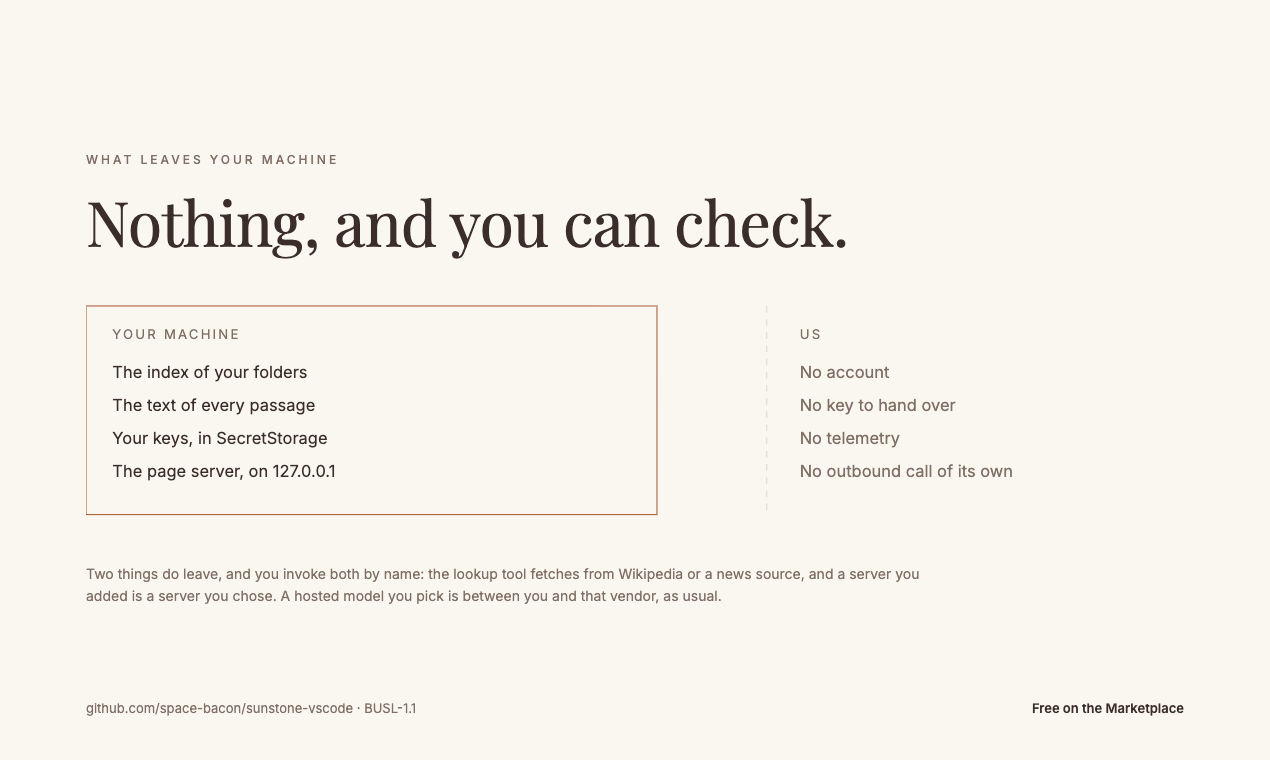
SunstoneYour coding agent already has your files. It greps, misses, and answers anyway. Sunstone indexes the folders you have open and gives whichever model you are already using, Copilot's Claude and GPT included, a proper way to search them. It also lets you put your own servers in VS Code's model picker, if you want to. Everything is indexed and held on your machine. There is no account and no key to hand over.
What it doesFive tools and a participant, in the chat you already have. Once you weave a folder, these are offered to every model in the picker, including the hosted ones.
Before each search, whatever changed since it was indexed is read again: a save, an unsaved buffer, a write from a terminal or a patch tool, a deleted or renamed directory, a branch switch. Paths the folder walk excludes stay excluded when they are written later. The same memory for agents outside the editor. Sunstone: Serve the Weave to MCP Clients lets
Claude Code, Cursor or any MCP client on this machine call Your own servers in the model picker. Anything serving the OpenAI-compatible API appears beside
the hosted models: A context window too small for the conversation is folded rather than hit. The older turns and the longest tool results move into the index and come back when they are the closest match to the question, so what leaves the window is the least relevant part rather than simply the oldest. What is measuredEvery figure carries the population it came from.
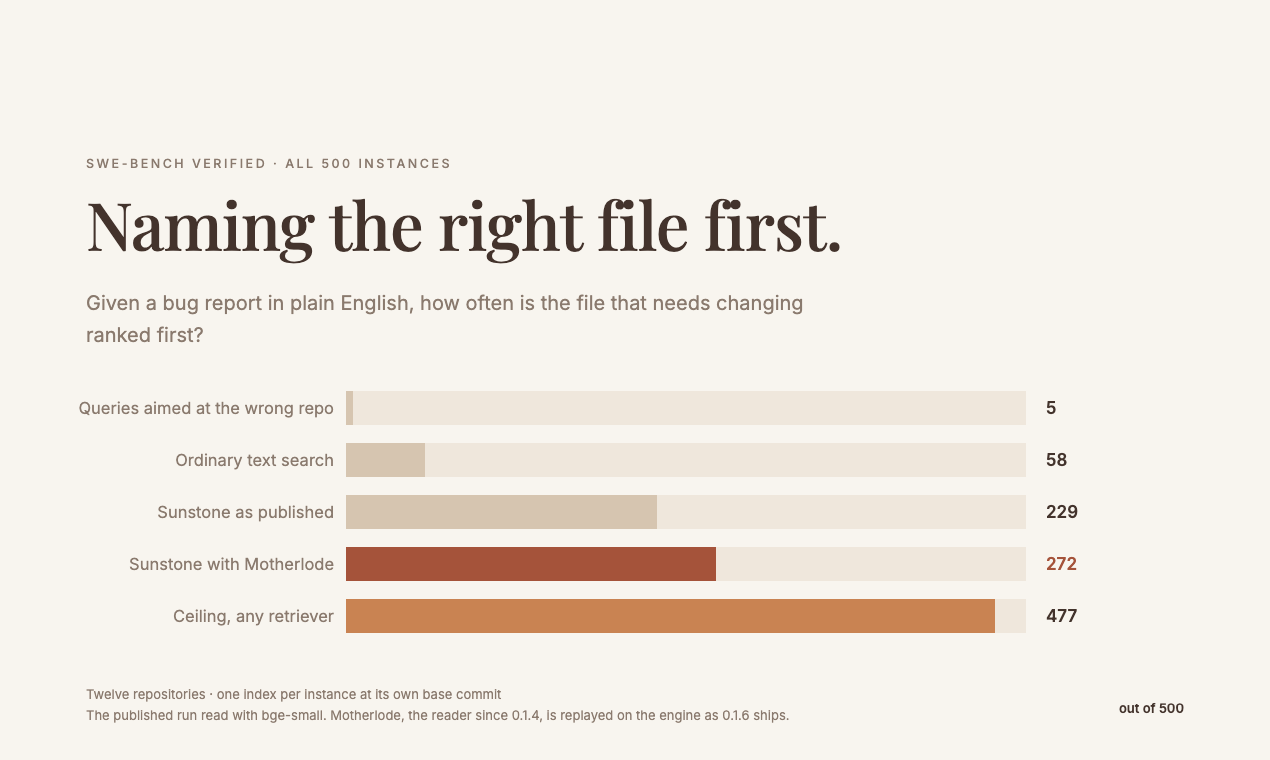
Four limits travel with that third row. The verdict tool answers from that register's ledger and does not ship in this extension, and the store's own share of the gain was not separated on these items. It is measured over a claims register rather than a codebase, so it is a document-retrieval result. The corpus is 130 lines, and the design predicts retrieval's advantage grows with corpus size, which is unmeasured. Both models are from one vendor. The first and last rows were measured with the reader before 0.1.4, bge-small-en-v1.5, and the first on the engine as it searched on 2026-09-15. Releases up to 0.1.5 shipped a later engine, whose search reranked a tool's candidates with a lexical bonus, and replayed on it bge-small places the file first for 197 of 500: that is what 0.1.3 and earlier did, not 229. The default reader is now motherlode-code-small-en-v0.1, and on that engine it places the file first for 255 of 500. From 0.1.6 the tool's search drops the bonus, and replayed that way Motherlode places the file first for 272 of 500, and for 221 of the 411 instances its contamination check leaves against 207 with the bonus (28 wins, 14 losses, sign p 0.044). On a replay of the published search path it places it first for 230 of the 411 instances its contamination check leaves, against 192 for bge-small (67 wins, 29 losses, sign p 0.00013). It weaves the folder behind the last row, which has since grown to 10 files and 626 passages, in 1.47 to 1.48 s over three runs, 426 passages a second, where bge-small takes 2.18 to 2.19 s, 286 a second, on the same machine, since it runs from a half-precision file. Getting started
To run your own model, add a place: Sunstone: Start llama-server on This Machine, or Sunstone: Add a Place and paste a pairing line. The full guide is Sunstone: Open the Guide in the command palette, or docs/GUIDE.md. It covers every command, every setting with its default, and what to do when a part misbehaves. What leaves your machine
The index, the passages and the text stay local. The page server binds to Two things do leave, and you invoke both by name. The extension host contains no non-loopback URL, which is a claim you can check rather than take on trust: the source is at space-bacon/sunstone-vscode, and SECURITY.md says where to report anything that contradicts it. ElsewhereSunstone is the VS Code surface of the Black Window suite. The same engine runs in a browser tab at blackwindow.xyz with no account and no install, and keeps working offline. Licence: BUSL-1.1, which is source-available rather than open source. Read LICENSE before building on it. The Additional Use Grant covers any internal use, including commercial development on your own or your employer's code, with no limit on seats. Publisher: Sunstone North Lab LLC. |