CRAYON-C4 for VS Code
Sketch the system — straight from your code. Generate a CRAYON-C4 architecture model from the workspace, explore it in an interactive C4 viewer inside VS Code, refine it with AI, and hand off to the web app for rich editing — where a non-destructive merge preserves your manual curation across re-runs.
Supported stacks: Next.js · React · .NET · Java (Maven & Gradle).
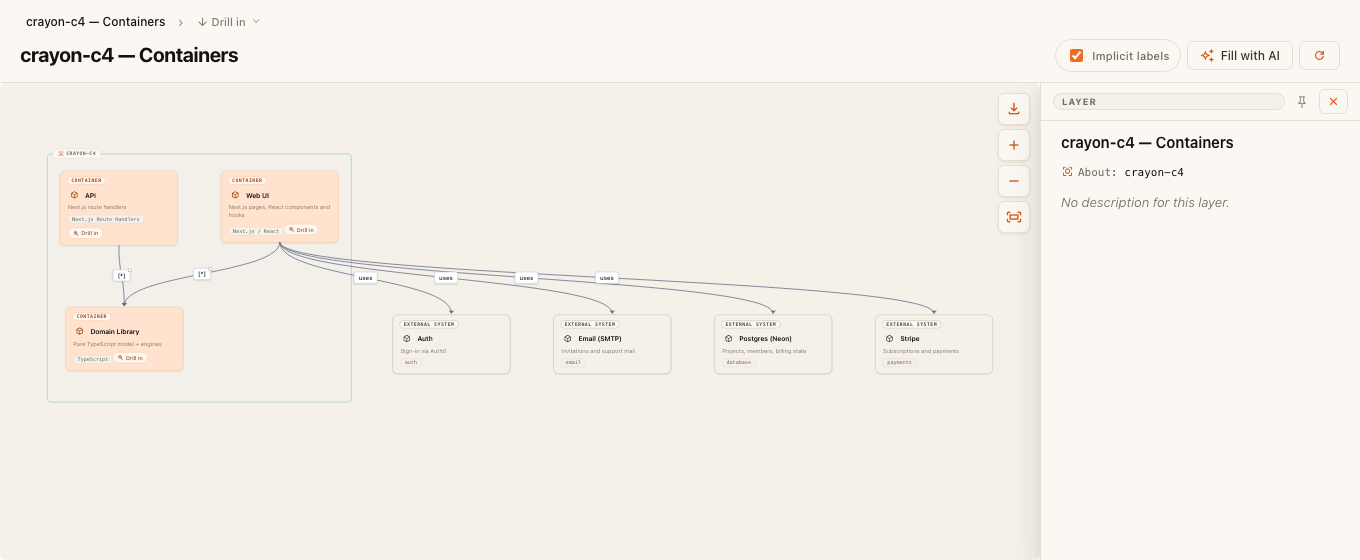
Commands
- CRAYON-C4: Generate Model — analyze the workspace (multi-project → pick which), choose the model depth (context / container / component / code), and write
crayon-c4-project.json + provenance + enrichment tasks into each project's own folder.
- CRAYON-C4: Open Architecture Viewer — interactive C4 diagram in a panel: drill between levels, select elements, read details. The same viewer component the web app uses.
- CRAYON-C4: Regenerate — re-run and refresh the viewer. Re-runs are merge-safe: renames, descriptions, colours, and layout you curated are preserved.
- CRAYON-C4: Enrich Descriptions with AI — launch your AI agent CLI (default
claude) in a terminal, seeded with a prompt that fills the empty description fields from the real source files. The viewer's Fill with AI button does the same for just the elements on screen.
- CRAYON-C4: Extract Decisions with AI — recovers the architecture decisions the codebase already embodies into the
.adr slice: the why is it like this the diagrams cannot show. It transcribes what the repo has already written down (docs/adr, RFCs, design notes) before inferring anything, and marks anything it reconstructed as proposed so nobody mistakes it for a decision a human confirmed.
- CRAYON-C4: Generate Model with AI — builds the whole model (
.c4 + .deployCanvas) by having an AI agent read the repository, with no static extraction at all. For stacks the scanners do not cover. Deployment is grounded in Dockerfiles / compose / K8s / IaC; no .f4 slice is produced; the result must validate against the published schema.
- CRAYON-C4: Open Web App — opens the web import page with the model's path on your clipboard; you pick the file there (nothing is uploaded, and your edits stay protected by the merge).
Per-project settings — .crayon/config.json
Put a .crayon/config.json in the analyzed repo to control generation per project (it travels with the repo — every machine and editor behaves the same):
{
  "schema": 1,
  "prompts": { "append": "Describe everything in payments-domain terms." },
  "projects": {
    "exclude": ["*.Tests", "packages/*"],
    "bundles": [{ "name": "Shared packages", "match": ["Acme.Common*"] }]
  },
  "flows": {
    "entryPoints": [
      { "match": "src/app/api/checkout/**", "name": "Checkout endpoint" },
      { "match": "PaymentController" }
    ]
  }
}
prompts — project-scoped instructions for every AI pass (the crayonC4.promptAppend user setting is appended after these).projects.exclude / projects.bundles — keep clutter projects off the diagrams, or collapse many small projects into one container. The run report always says what was excluded or bundled.flows.entryPoints — API endpoints, UI components, or classes that deserve a fully traced F4 flow diagram, at method level (BuyButton → HTTP POST /api/checkout → chargeOrder() → taxFor()), with error boundary events where the code actually catches.
The full reference lives in the crayon-c4 CLI docs on npm — the extension and the CLI share one engine, so the config means the same thing everywhere.
Extension settings
| Setting |
Default |
Meaning |
crayonC4.webAppUrl |
https://crayon-c4.com/projects |
Web import entry opened by Open Web App. |
crayonC4.agentCommand |
claude |
CLI launched for the AI passes. Supports a {prompt} placeholder; otherwise the quoted prompt is appended. |
crayonC4.promptAppend |
— |
Extra user-level instructions appended to every AI prompt (after the repo's own .crayon prompts). |
crayonC4.modelDepth |
component |
Default depth for Generate Model. |
Requirements
- The AI commands need an agent CLI on your
PATH (default Claude Code; point crayonC4.agentCommand at Codex, Aider, or any other CLI). Everything else — generate, viewer, send to web — is fully offline and needs nothing.
License
Free to use, for commercial and non-commercial work — see the bundled LICENSE (also shown on this extension's License tab). The source code is proprietary (not open source). The standalone CLI (npx crayon-c4 .) is the same engine; the web app offers a free tier with a subset of its functionality.

