中文文档
Without changing your source files, attach durable notes and bookmarks to code in VS Code: Markdown, Mermaid, LaTeX, tag declarations, jump-to navigation, and tag relation graphs.
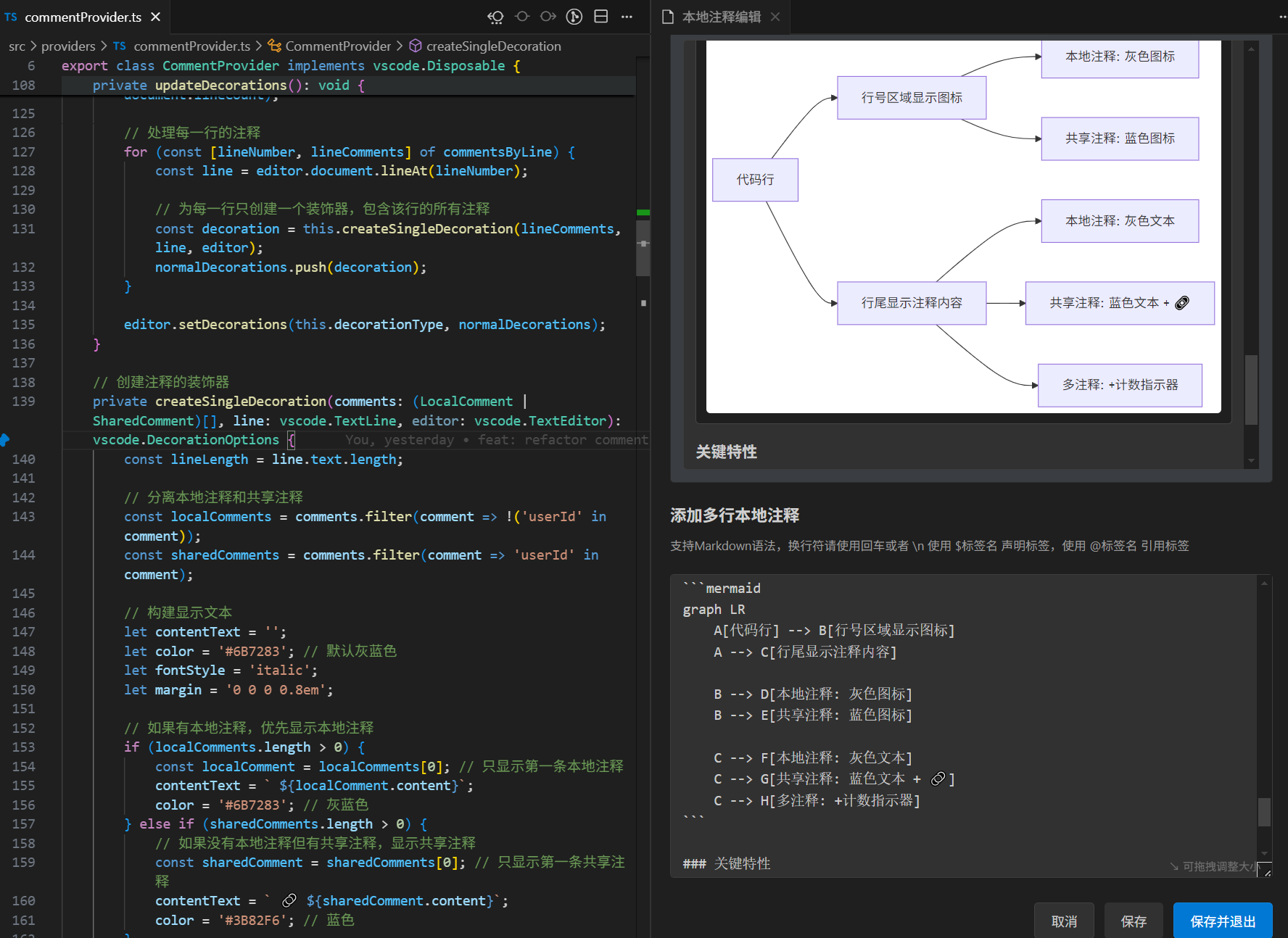
Not just a code annotation tool — starting from v2.0, Local Comment is also your Markdown knowledge management assistant. Link docs to code with @tags, generate tag relation graphs with one click, organize knowledge like Obsidian, but jump directly into code implementations.
Documentation site: https://sangliang.github.io/vscode-local-comment/
What it does
| Capability |
Description |
| Local comments |
Stored in separate data; not written into source files; does not clutter Git commits with notes. |
| Markdown knowledge management |
Write in .md files, link to code with @tags, click to jump — documents and code seamlessly connected. |
| Tag relation graph |
New in v2.0: Generate a visual graph of tag references with one click; organize knowledge like Obsidian with zoom, pan, and click-to-view details. |
| Activity Bar groups |
Dedicated Activity Bar view to manage comment groups—create, switch, rename, and batch-move comments to other groups from the manage panel. |
| AI Assist |
Built-in Skill and prompt for Copilot, Cursor, and other AI agents to write comments into separate groups without touching source files. |
| Tag jumps |
Declare with ${tagName}, reference with @tagName, jump between comments, Markdown docs, and code; Chinese tag names supported. |
| Smart anchoring |
Tries to follow lines as code moves; anchor on meaningful code lines (see best practices below). |
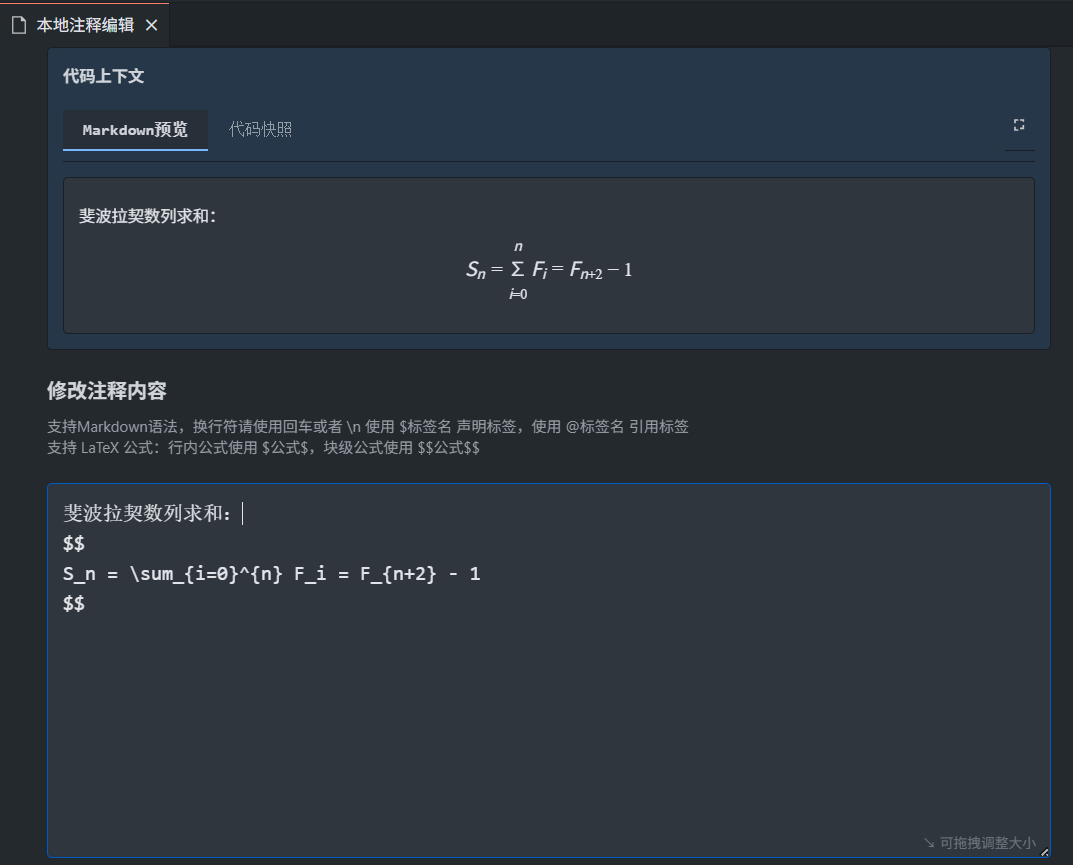
| Mermaid / LaTeX |
Diagrams and formulas render in preview for technical explanations. |
| Bookmarks |
Mark lines across files and navigate in order—pairs well with comments as a reading path. |
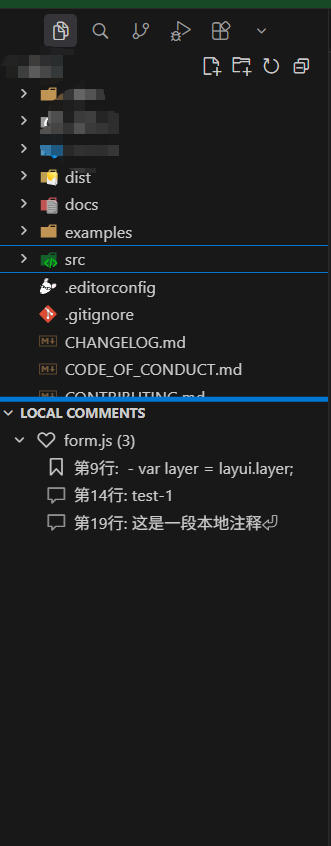
| Sidebar tree |
Browse comments and bookmarks for the project and jump back to code. |
| Projects / groups |
Multiple independent comment groups per project: switch between several configs under .vscode/local-comment/ (e.g. notes for one branch vs another). |
| Markdown preview & export |
Preview .md files (diagrams, formulas, Ctrl+F search); Alt+click to jump back to the matching source line; one-click export to self-contained HTML for sharing and offline viewing. |
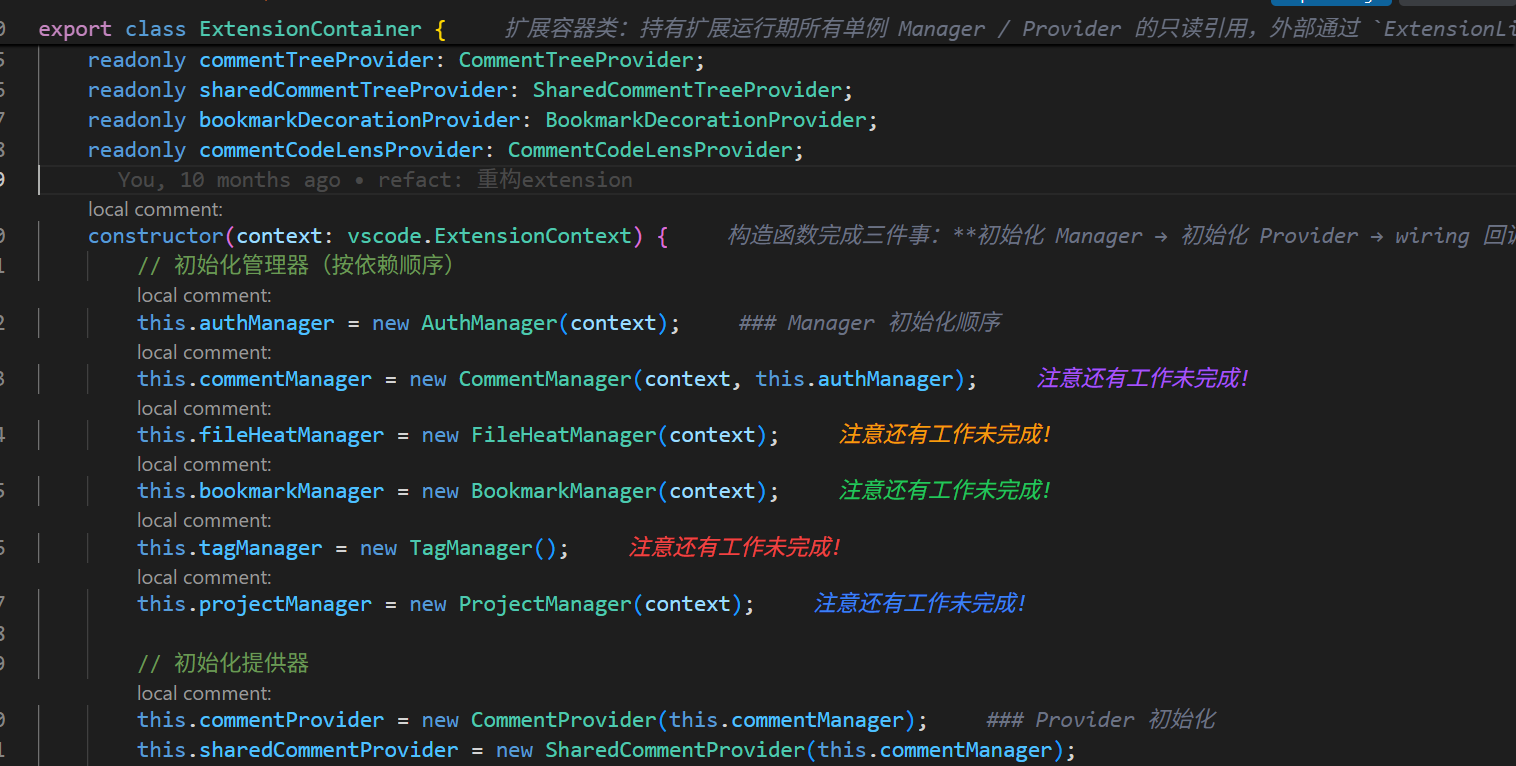
| Custom comment colors |
New in v2.2: Assign a color to a comment based on its importance, making notable comments stand out in the editor. |
In short: keep “how you read the code” in VS Code, local and private by default.
30-second start
- Put the cursor on a line of code and press
Ctrl+Shift+M to write a Markdown local comment (the shortcut to remember).
- Click the Local Comment icon in the Activity Bar and use Comment Groups to view, switch, or manage multiple comment groups.
- You can also open the Local Comments tree in the Explorer sidebar to browse and jump back to code.
- For quick landmarks,
Ctrl+Alt+K toggles a bookmark; Ctrl+Alt+J / Ctrl+Alt+Shift+J moves between bookmarks.
Full shortcut tables are at the end of this file.
Feature demos
Tag navigation
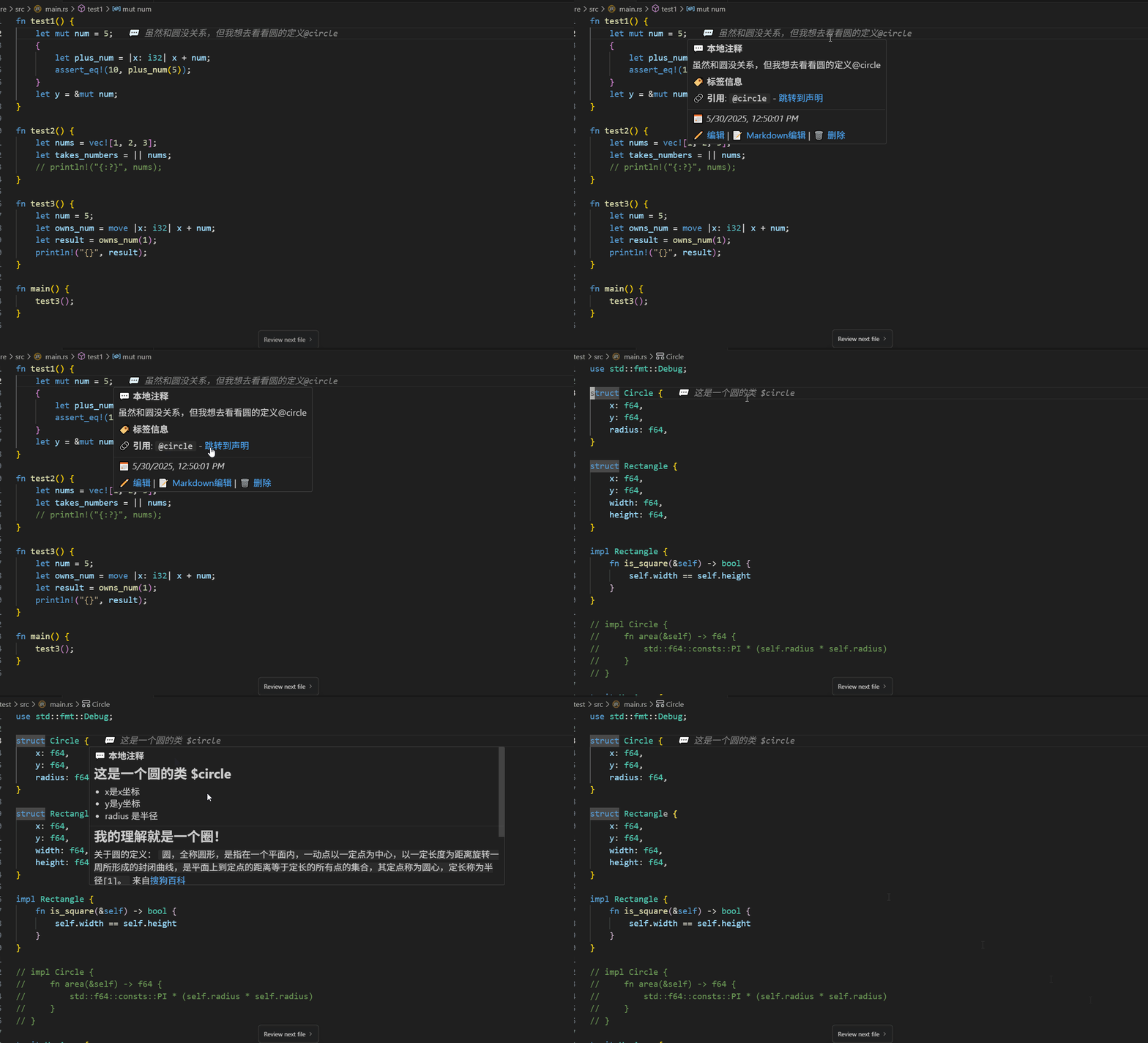
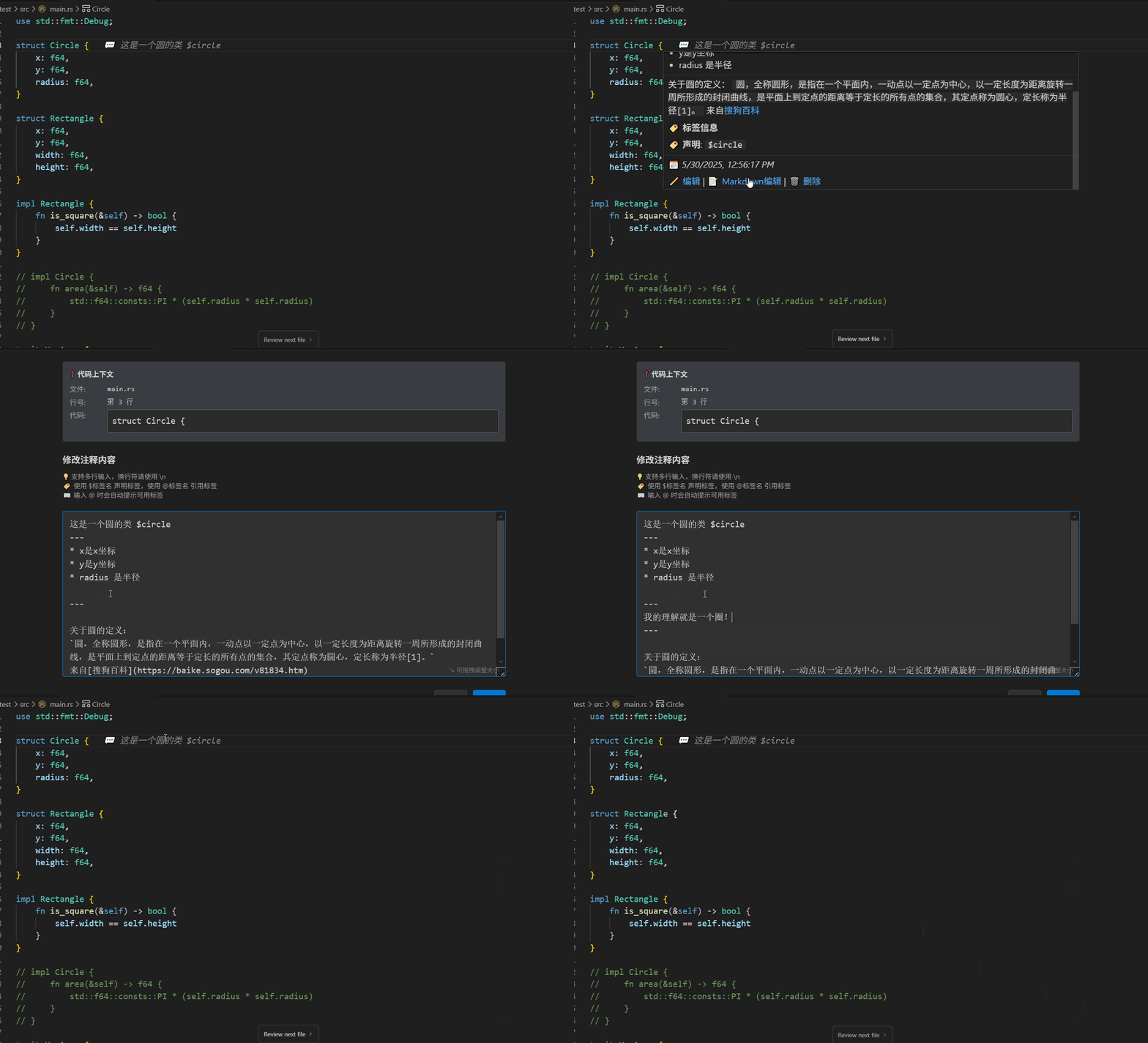
Mermaid diagrams
You can embed LaTeX in local comments and render it in preview.
Color-code your comments by importance level so the notable ones stand out at a glance in the editor.
Multi-user collaboration (optional)
Distinguish your local notes from shared online annotations (similar to highlights in a shared book).
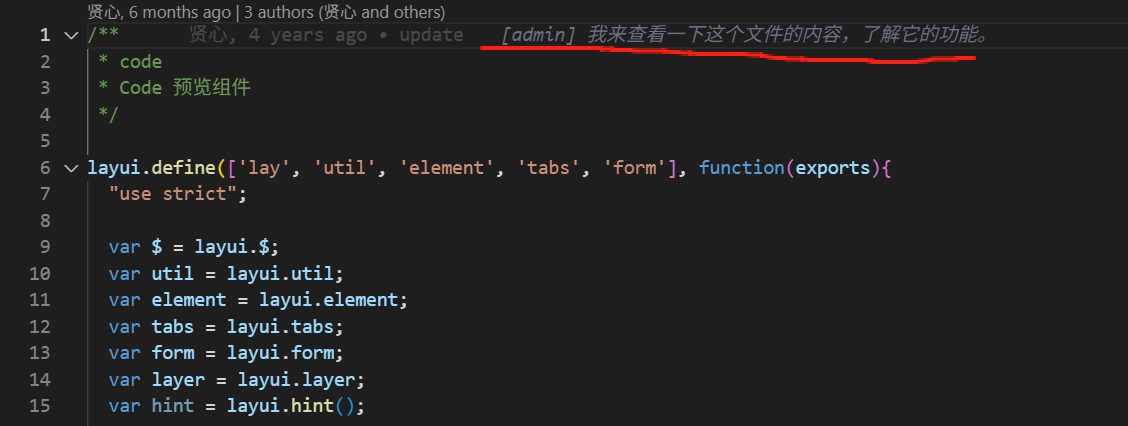
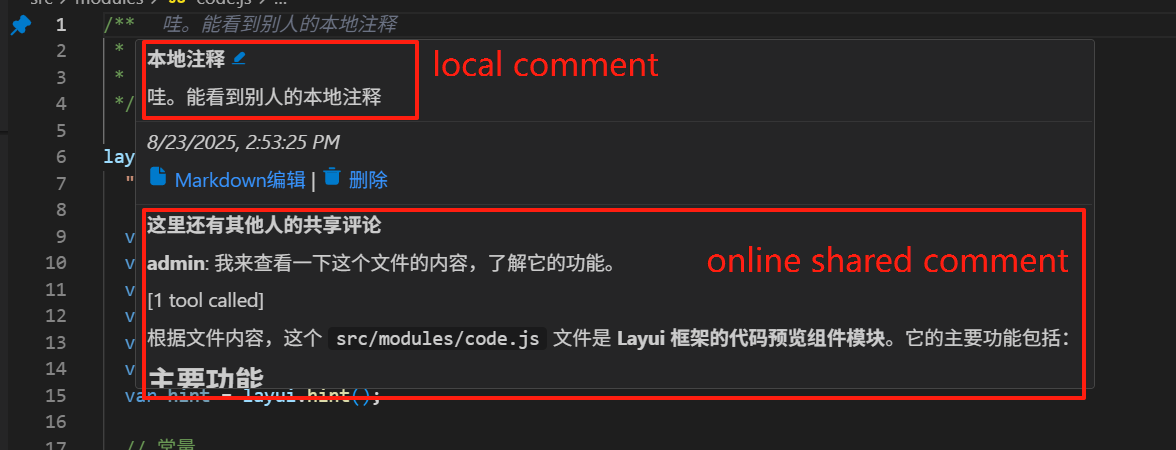
Manage comments you have shared from the web UI:
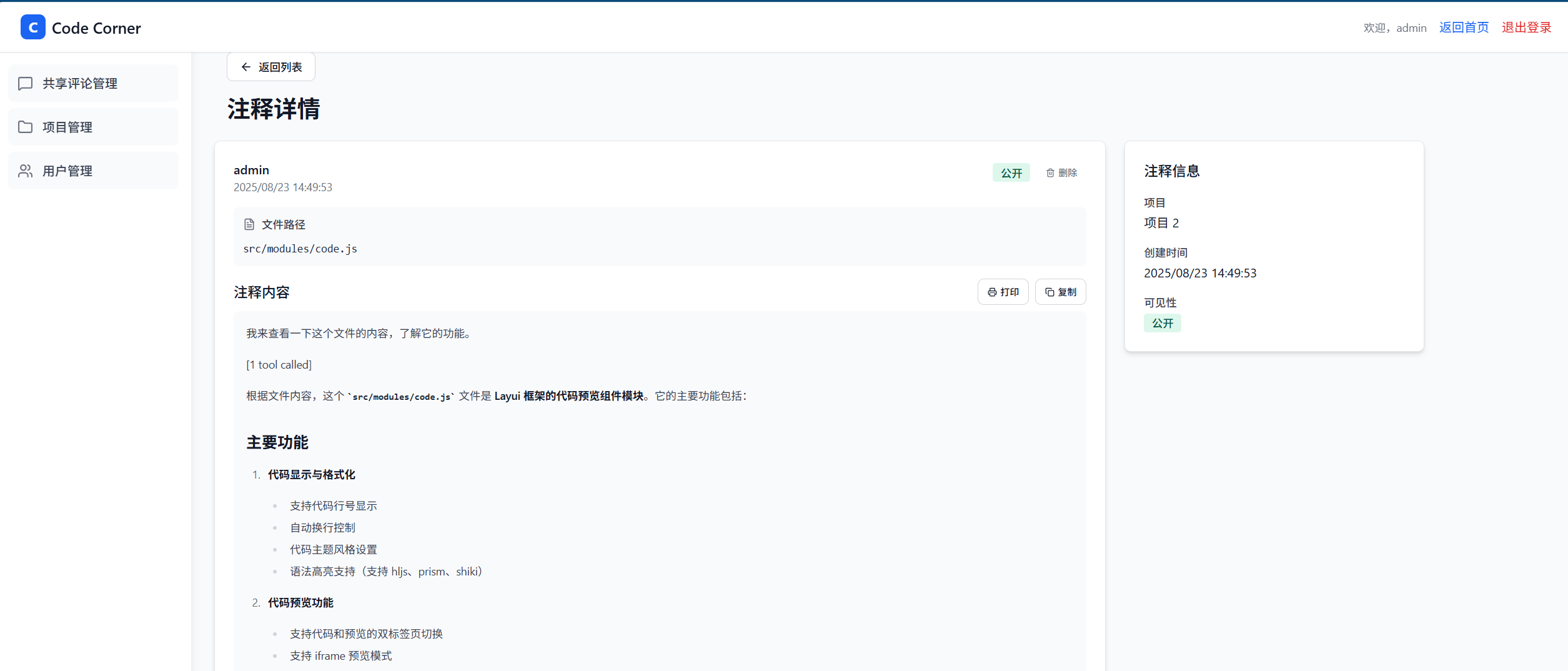
Note: The multi-user collaboration offering is not currently available as a free public product.
Typical cases: researching a codebase, design notes that should not land in the repo, recording how a bug was fixed, linking logic across files, study notes while reading others’ code, capturing scattered takeaways after AI-assisted edits.
Compared with common alternatives
- Comments in source: Pollutes the repo and code review; poor fit for long or private write-ups.
- External docs / note apps: Detached from the exact file and line; Markdown, Mermaid, and sync often mean extra tooling or cost.
- Separated from source: Data lives in its own storage; files stay clean.
- Per-project isolation: Projects do not mix.
- Persistent across sessions: Survives restarting VS Code.
- Tracks edits when possible: Reduces “comment still there, code unrecognizable” drift.
- Private by default: Local data; optional team sharing is described under Multi-user collaboration above.
Core features
1. Markdown knowledge management (v2.0 core)
Seamlessly connect Markdown documents to code:
- Reference code tags in Markdown: In any
.md file, right-click and select "Insert tag reference" to insert @tagName. When previewing, click these references to jump directly to the tag definition in code.
- Tags as links: Declare with
${tagName} in code, reference with @tagName in Markdown — documents and code form a two-way connection.
- Preview and export: In a
.md file press Ctrl+Alt+V (or right-click "Preview Markdown") for Mermaid diagrams, LaTeX formulas, and syntax-highlighted code; Ctrl+F to search in the preview; Alt+click a preview block to jump to the matching line in the .md source; click "Export HTML" to generate a self-contained file for offline viewing.
💡 Use cases: Write architecture docs referencing key code implementations with @; take notes while reading source, then jump back to code with one click.
2. Tag relation graph (New in v2.0)
Generate a knowledge graph of your project with one click:
- Visual connections: Run
Local Comment: Show Tag Relation Graph from the Command Palette to generate a force-directed graph showing all tag declarations and references.
- Interactive exploration: Supports zoom, drag to pan, click nodes to view tag details — quickly understand how modules reference each other.
- Knowledge network: Organize your project knowledge like Obsidian, but with the ability to jump directly into code implementations.
💡 Use cases: When onboarding to a large codebase, use the relation graph to quickly understand core module dependencies; when writing technical specs, verify all related features are covered.
- Quick add:
Ctrl+Shift+C adds a simple comment on the current line.
- Markdown:
Ctrl+Shift+M opens the multi-line editor (recommended main entry).
- Edit:
Ctrl+Shift+E edits the comment bound to the current line.
- Delete:
Ctrl+Shift+D removes the comment on the current line.
- Selection to comment:
Ctrl+Shift+T turns the selection into a comment.
- Colors (New in v2.2): Choose a color for a comment to reflect its importance—for example mark critical notes in red so they stand out from routine ones.
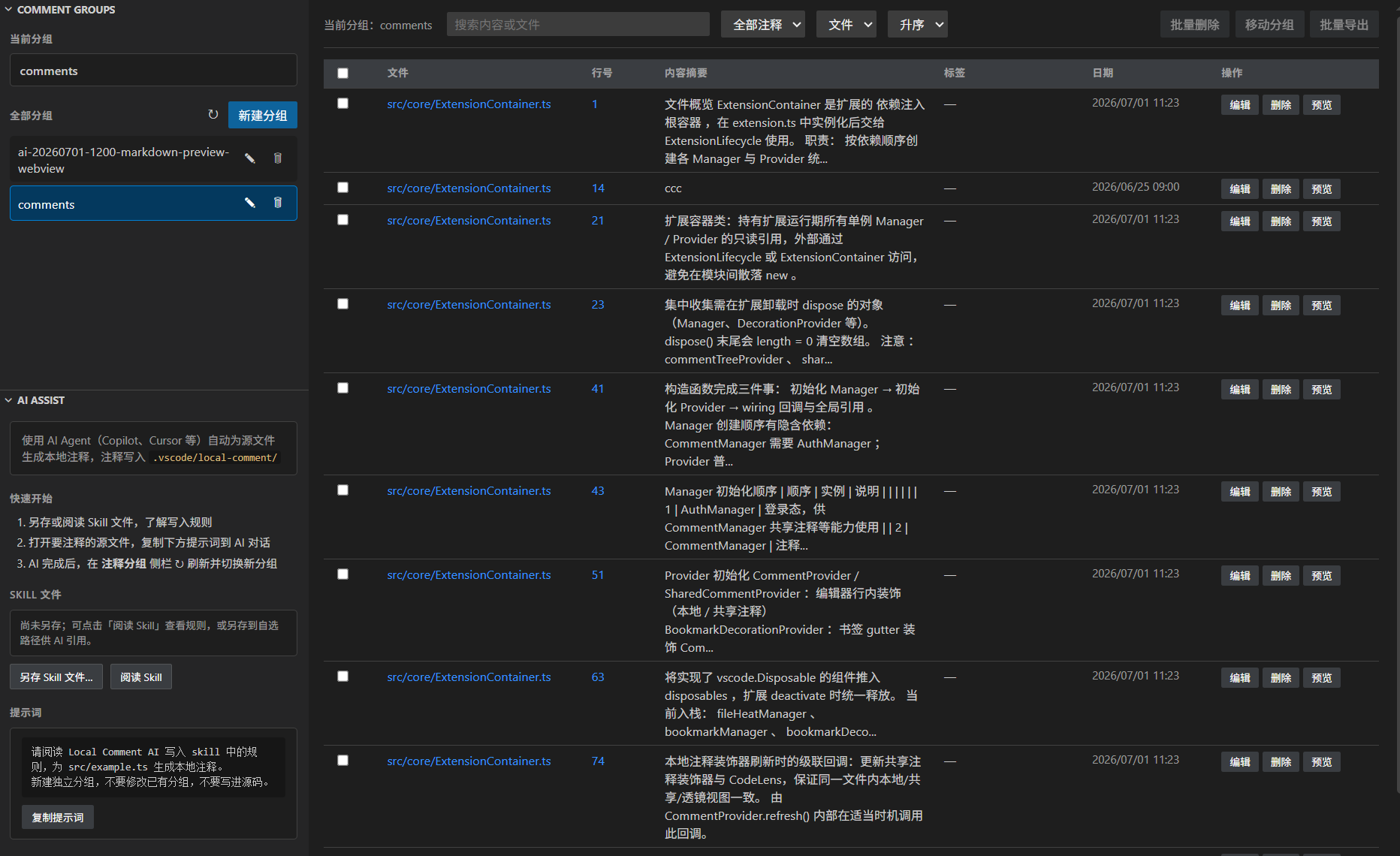
Manage multiple comment groups from the Activity Bar:
- Entry: Click the Local Comment icon in the Activity Bar → Comment Groups view.
- Group actions: See the active group and list all groups; create, rename, or delete groups; click a group name to open the manage panel.
- Switch groups: Click Apply in the list to switch the active comment configuration.
- Move across groups: In the manage panel, select comments and use Move to group to batch-migrate them to another group.
- Refresh list: Click ↻ to refresh (common after AI generates a new group).
5. AI Assist
Let AI write local comments without changing source files:
- Entry: Activity Bar Local Comment → AI Assist view.
- Built-in Skill: Explains how to write AI-generated comments into a new group under
.vscode/local-comment/ (without overwriting existing groups).
- Workflow: Save or read the Skill → open the target source file → copy the prompt into Cursor, Copilot, or another AI chat → after AI finishes, ↻ refresh in Comment Groups and switch to the new group.
6. Bookmarks
- Toggle:
Ctrl+Alt+K adds or removes a bookmark on the current line.
- Visuals: Gutter icons, scrollbar markers, hover details.
- Navigate:
Ctrl+Alt+J next, Ctrl+Alt+Shift+J previous, cross-file, wraps end-to-start.
Best practices (very important)
Prefer attaching comments to meaningful code lines (e.g. the same line as a function declaration). Avoid empty lines or lines that are only punctuation:
function test() { // local comment: this line is a stable anchor
  // ...
}
That makes it easier to stay aligned after branch switches or large refactors.
Shortcuts
| Shortcut |
Action |
Notes |
Ctrl+Shift+C |
Add local comment |
Simple one-line comment |
Ctrl+Shift+M |
Add Markdown comment |
Core: multi-line rich text |
Ctrl+Shift+E |
Edit comment |
Quick edit for current line |
Ctrl+Shift+D |
Delete comment |
Remove comment on current line |
Ctrl+Shift+T |
Selection to comment |
Convert selection |
Markdown preview
| Shortcut |
Action |
Notes |
Ctrl+Alt+V |
Open Markdown preview |
Markdown files only; does not take VS Code's native Ctrl+Shift+V |
Ctrl+F |
Search in preview |
Find text in the Markdown preview panel |
Alt+left click |
Jump to source |
Click a preview block to open the matching line in the .md file |
Bookmarks
| Shortcut |
Action |
Ctrl+Alt+K |
Toggle bookmark |
Ctrl+Alt+J |
Next bookmark |
Ctrl+Alt+Shift+J |
Previous bookmark |
Tags are the core concept of Local Comment, connecting code and documents.
Two marking patterns:
- Declaration:
${tagName} — mark a code location, indicating "something worth noting here"
- Reference:
@tagName — reference a declared tag in Markdown documents or comments
// Declare tag in code
let userConfig = {};  // local comment: ${userConfig} user config definition

function loadConfig() {
    // implementation...
}
<!-- Reference tags in Markdown documents -->
## Configuration Loading Flow

On startup, the system loads @userConfig, see source code for implementation.

Related features: @errorHandling @permissionCheck
Naming rules: letters (any script), digits, underscores; must start with a letter or underscore; mixing scripts is allowed, e.g. ${bug修复}.
Insert tag reference:
- Right-click in Markdown file → "Insert tag reference"
- Select a tag from the list (shows all declared tags in the project)
- Or type
@ to trigger auto-completion
Click to jump:
- When previewing Markdown, all
@tagName are displayed with special styling
- Click to jump directly to the code definition — documents and code seamlessly connected
Tag relation graph:
Run Local Comment: Show Tag Relation Graph from the Command Palette to visualize the reference network of all tags, helping you discover hidden connections between knowledge.
FAQ
Q: Do comments go into Git?
A: By default data lives in local storage and is not written into source files. If you use .vscode/local-comment/ under the project, whether it is committed depends on whether you track that folder in version control.
Q: Do I lose comments when I switch branches?
A: Comment data is independent of Git branches; it is not cleared when you switch (still best to anchor on stable lines).
Q: How do I back up?
A: Use Export comment data from the Command Palette, or back up the .vscode/local-comment/ directory when you use project-local storage.
Q: Can others see my comments?
A: Not by default; data stays local. Sharing follows the product design only if you enable the multi-user collaboration features.
Data storage
Locations
Inside the project (recommended, v1.4.0+): .vscode/local-comment/
Migrating legacy data: use the migrate action in the project prompt, or open the Command Palette (F1), search for local comment, and run the migrate command.
Global base directory (legacy / compatibility)
- Windows:
%APPDATA%/Code/User/globalStorage/vscode-local-comment/projects/
- macOS:
~/Library/Application Support/Code/User/globalStorage/vscode-local-comment/projects/
- Linux:
~/.config/Code/User/globalStorage/vscode-local-comment/projects/
Per-project file naming
Each project can have its own file shaped like: [project-name]-[hash].json.
With .vscode/local-comment/, you usually do not need frequent import/export—copy that folder to another machine or project to move data.
- Comments:
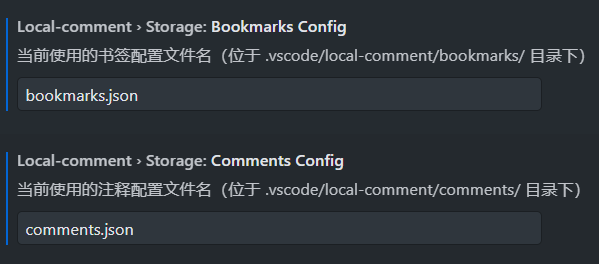
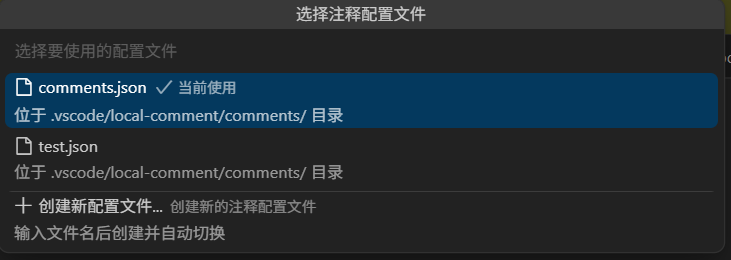
.vscode/local-comment/comments/, default comments.json; add more JSON files (e.g. work.json, study.json).
- Bookmarks:
.vscode/local-comment/bookmarks/, default bookmarks.json; same pattern for multiple files.
- Switching: Prefer the Activity Bar Comment Groups view for one-click switching; or VS Code Settings → search local comment → under Local Comment: Storage, change the active comments or bookmarks config file name; or run
switch comments config from F1.
Data characteristics
- Stored per project
- Does not automatically pollute application source
- Backup and restore supported
- Persists across VS Code sessions
Contributing and feedback
Changelog
See CHANGELOG.md. Chinese notes: CHANGELOG.zh-CN.md.
Support the author
This may sound silly, but chipping in for a bit of AI usage or buying the author a coffee goes a long way toward keeping the extension maintained.

License
MIT License

