VS Code Chat Manager
Find, delete, archive and queue prompts for your local AI chats - Claude Code,
Codex and GitHub Copilot Chat - from PowerShell, and see every running chat at
a glance. This extension installs those PowerShell commands, keeps them up to
date, and does the part only VS Code can: showing a chat up to date after a
queued prompt ran into it.
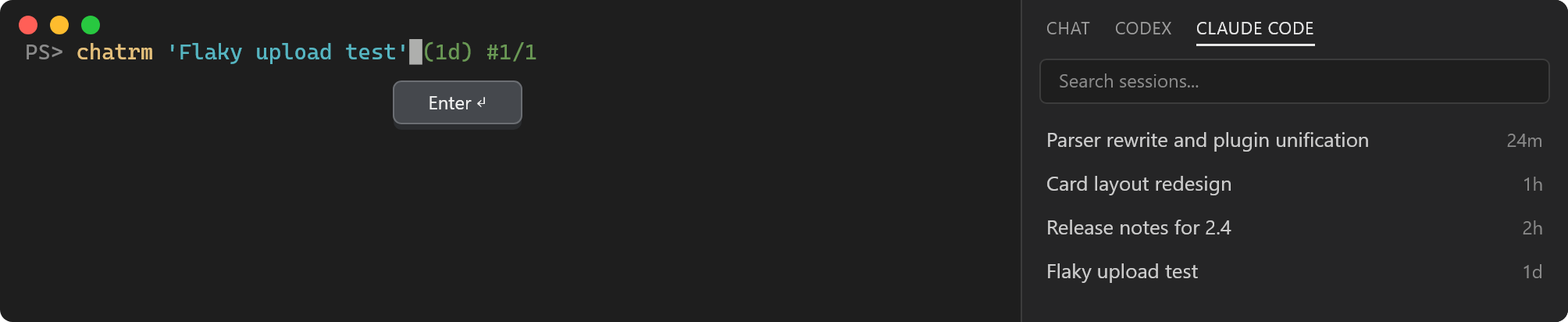
- Find any chat by part of its title and Tab-complete it:
chatfind, chatrm, chatq.
- Delete one chat and everything it leaves on disk, or archive it and bring it back later.
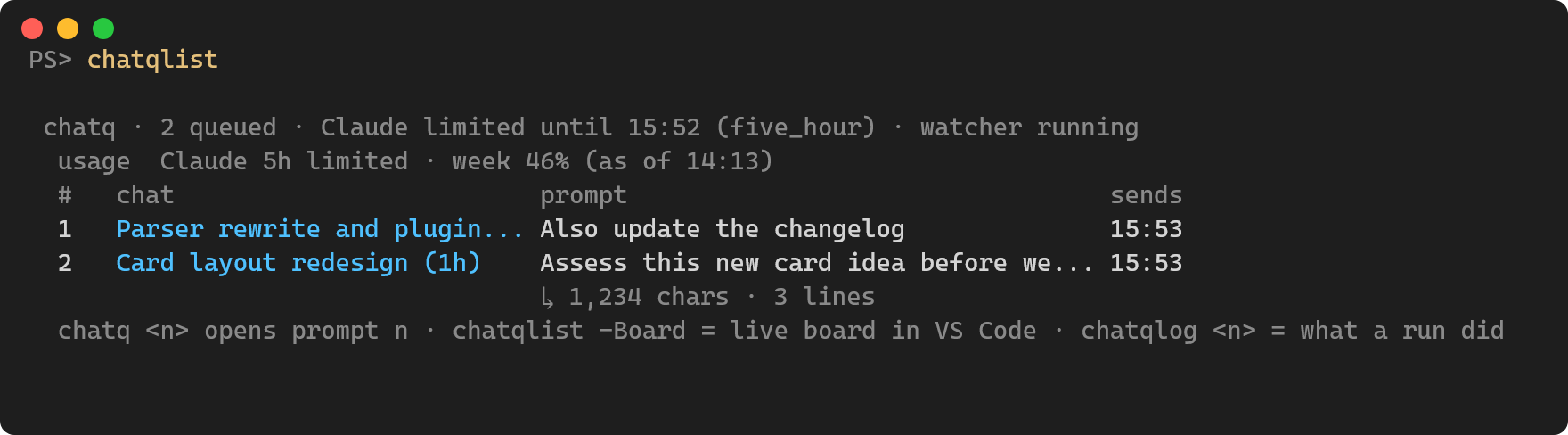
- Queue prompts while the usage limit is hit. At the reset each chat is resumed in turn, sent its prompt, and run to the end - with VS Code closed, too.
- Tells you how it went: a desktop toast, your phone through Join or ntfy, or a command of your own.
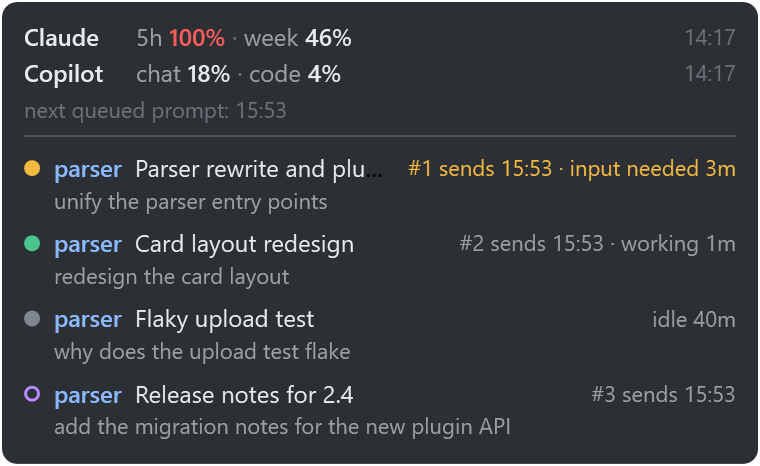
- Shows every running chat at a glance:
chatoverlay keeps a small panel above every app.
- After a queued run, the window shows that chat up to date, without a reload when nothing else in it is working.

What it does on first start
- It puts the PowerShell scripts in
~/Tools/VS-code-chat-manager
(chatManager.folder moves it). Everything the tool writes goes in data/
there - nothing in AppData.
- It asks once before adding one line to your PowerShell profile, which loads
the commands in every new terminal. The profile is backed up first.
Never is remembered; Chat Manager: Install terminal commands asks
again whenever you like.
- If PowerShell's execution policy would stop that line from running, it
offers to allow local scripts for your user (
RemoteSigned), and changes
nothing unless you click.
Updates come through VS Code. A window starts running a new version once
you click Restart Extensions or reload. The first to do so replaces
the scripts in the tool folder and moves a running watcher and overlay
onto the new copy. Terminals already open keep the old commands until
they are reopened. A folder that is a git checkout is never written to.
If you installed the extension from a .vsix file, it is pinned and never
updates by itself: right-click it in the Extensions view and turn on
Auto Update.
Then open a new terminal and type chat for the list of commands.
Requirements
- Windows, with Windows PowerShell 5.1 (every Windows has it) or PowerShell 7.
macOS and Linux need PowerShell 7 and are untested.
- Claude Code 2.1.259 or later for the queue; the Claude Code extension for
showing a chat fresh.
Settings
| setting |
|
chatManager.folder |
where the scripts and data/ live; empty means ~/Tools/VS-code-chat-manager |
chatManager.showFresh |
after a queued run, redraw the chat instead of reloading the window (on) |
chatManager.autoReloadAfterRun |
do that without asking when you are away and nothing else works (on) |
chatManager.autoReload |
reload without asking after a delete (off) |
Settings under chatManagerReload.*, from the extension this one replaces,
are still read where the new ones are unset.
Uninstalling
Uninstalling the extension leaves the PowerShell commands working. To remove
them as well, run chatuninstall in a terminal (-All also deletes the tool
folder and its data/).
More
The full guide - every command, the overlay, the console, alerts, and how a
queued prompt is sent - is in the
README on GitHub.

