Oracle JDK License GateOracle JDK 21 updates turn OTN (not free for production) at the 2026-10-20 CPU. Shows which Java every part of your project pulls (CI, Docker, Gradle, SDKMAN, dev container), counts down to that date and gives the free Temurin or Corretto line for each. Installation Launch VS Code Quick Open ( Ctrl+P), paste the following command, and press enter.Copied to clipboard |

Oracle JDK License GateOn 20 October 2026, new Oracle JDK 21 updates stop being free for production. From that day's Critical Patch Update, new Oracle JDK 21 updates are under the Java SE OTN license, and Oracle bills Java SE on the company's whole headcount. Any CI job, Dockerfile or script that pulls "the latest" Oracle JDK 21 switches licence that day without anyone editing it. This extension finds those lines, gives the free OpenJDK line for each, and writes the dated record your company can keep. (Sources: Oracle JDK licence FAQ; Oracle Java blog "JDK 21 approaches end-of-permissive license", 2026-08-14; Oracle Critical Patch Update calendar.) Moving to Temurin, Corretto or another free OpenJDK build? Run
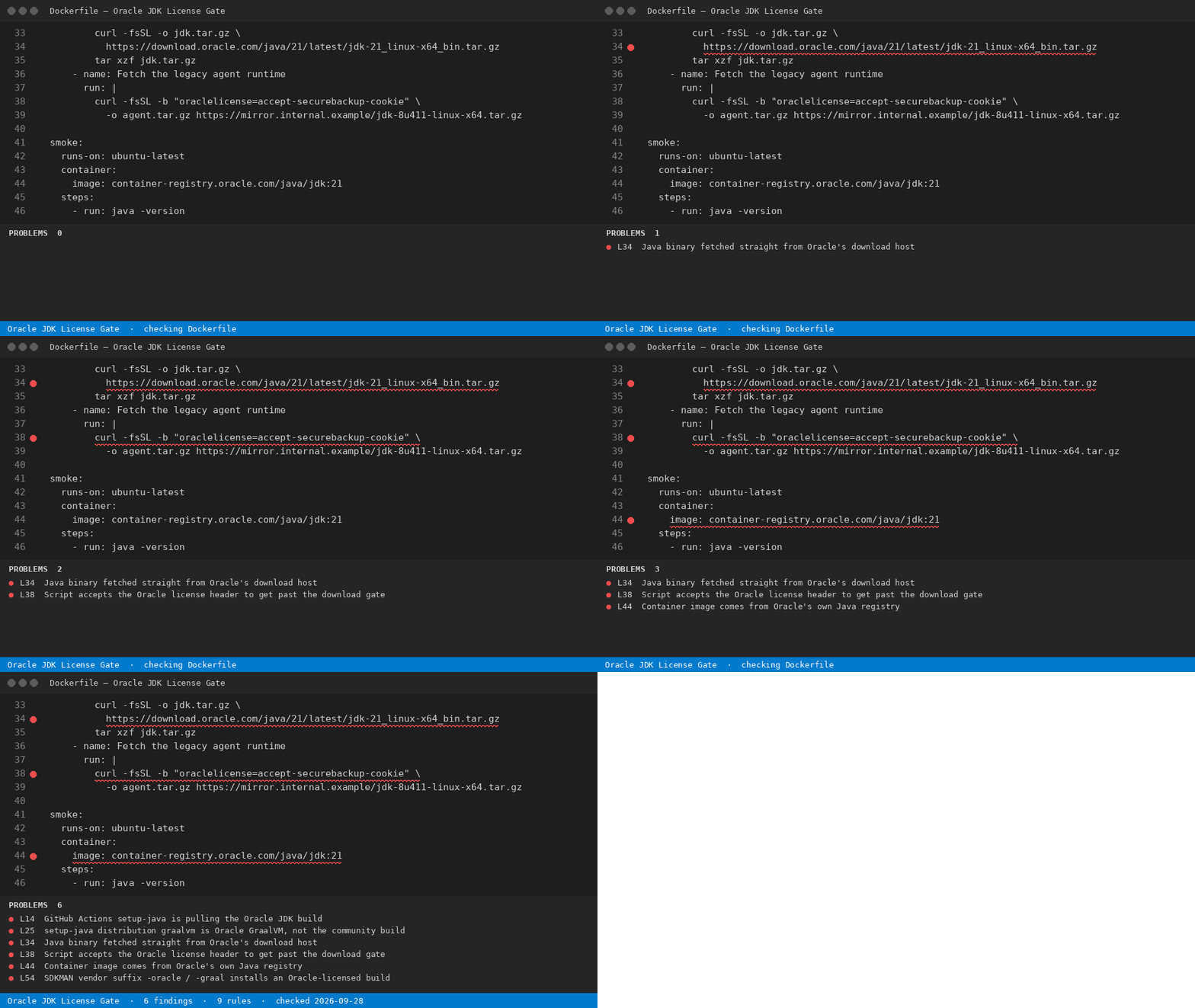
Oracle JDK 21 builds released through September 2026 are under Oracle's No-Fee Terms. From the Critical Patch Update of 2026-10-20, new Oracle JDK 21 updates are under the Java SE OTN license, which is not free for production. If a Dockerfile, a CI workflow or a provisioning script in your repository pulls the latest Oracle build of Java 21, it pulls a paid-licence build from that day, and nothing in your build will say so. The job still goes green. A pinned older build stays under the No-Fee Terms, but it gets no free security fixes after that date. This extension reads the file you have open and names every Oracle-licensed Java runtime in it, with the line number, the license basis, the free-window status on today's date, and the OpenJDK line that replaces it. Why the date matters more than the versionOracle keeps a Java LTS release under the No-Fee Terms for one year after the next LTS ships. JDK 25 shipped in September 2025, so Oracle JDK 21 releases through September 2026 are No-Fee, and updates from the October 2026 Critical Patch Update (2026-10-20) are under the OTN license. JDK 17 made the same switch in October 2024 (17.0.13 and later are OTN). Java 8 and Java 11 never had a No-Fee window at all: those are Oracle Technology Network builds, free for development and test only. Oracle JDK 17 leaves Premier Support at the end of September 2026. For subscribers Oracle waives the Extended Support fee from October 2026 to September 2029 (Oracle Java SE Support Roadmap), so the date that costs money is not the end of September: it is the day an Oracle build runs in production without a subscription behind it. That is why a text search does not answer the question. What it costs to be wrongOracle Java SE Universal Subscription is list-priced at $15 per employee per month, counting every employee in the company, not every Java install. 250 employees x $15 per employee per month x 12 months = $45,000 a year. The unit is the payroll, not the container. The 18 rules
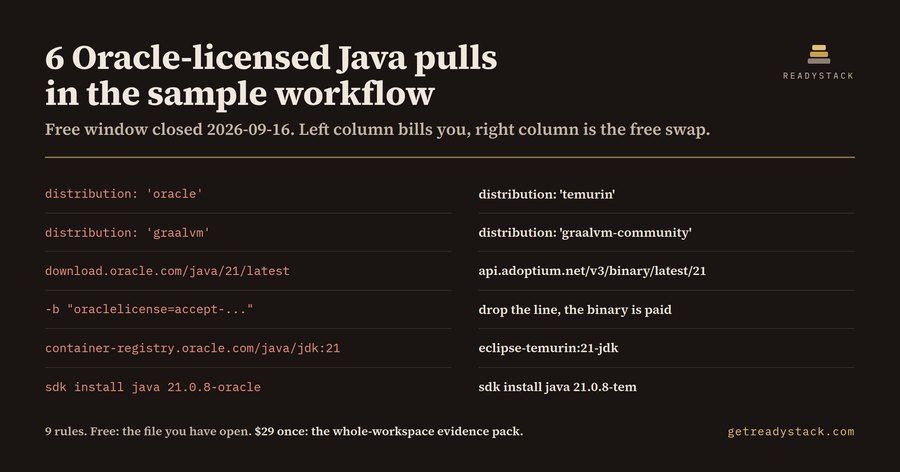
Each finding carries the drop-in swap: The Java map (free)The map lists, for the whole workspace: the Oracle-licensed pulls with file and line, every place a Java vendor is
named (so you can see Measured on the bundled sample
YardstickReading the Java provisioning lines of a repository by hand and checking each one against Oracle's current terms is the same work a license-compliance reviewer does at an hourly rate; the difference is that this gate re-runs it on every file, on every day, for free. Free and fullFree: the file you have open, all 18 rules, every finding with its swap - and a Quick Fix (the light bulb)
that rewrites the line under the cursor where the swap is mechanical: Full version: Fix all - every mechanical swap in every file of the workspace in one click, with a preview first and a dated record of each change (file, line, before, after, SHA-256 of the file after). Lines that need a human choice (SDKMAN / asdf version ids, Maven toolchains, download scripts, an Oracle Linux image that the same Dockerfile then builds on with yum / dnf) are left untouched and listed with the how-to. Plus the workspace sweep and the dated evidence pack you can hand to procurement or to an Oracle audit. $29 once. https://getreadystack.com/api/buy/cl/polar_cl_0qxUalAkf4ad9kwGZmCwgbKANSqawgoJq6rVf2ZeWRh For a team: every repository, every pull requestOracle prices Java SE by every employee, not by every install, so one repository nobody opened is enough to put the whole payroll in scope. A clean folder on one laptop does not answer that. The team key runs this same gate in CI on each repository and pull request, and fails the job when an Oracle-licensed Java line appears: Team key: $149 once, 5 seats, every ReadyStack linter. https://getreadystack.com/api/buy/cl/polar_cl_l6iN1uWt0FwWu7tBsczD0jWpP2vxFM54Wdwqb3KPi1G Hub: https://getreadystack.com/tools/oracle-jdk-license-gate Not legal advice. The dates above are Oracle's published license terms; your own agreement with Oracle, if you have one, is what governs. |