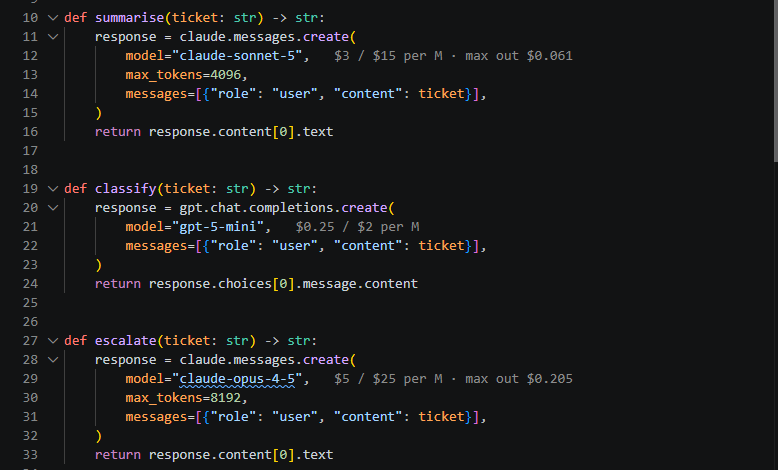
PromptSpend — LLM prices in your editorWhat the model on this line costs, and when that price was last confirmed. Installation Launch VS Code Quick Open ( Ctrl+P), paste the following command, and press enter.Copied to clipboard |

PromptSpend for VS CodeWhat the model on this line costs, and when that price was last confirmed. A linter for model choice, not a calculator in a sidebar. Write a model id and the price appears beside it, carrying the date it was verified and the vendor page it came from.
The middle call is the one worth looking at: no InstallOr search PromptSpend in the Extensions pane ( Cursor, Windsurf and VSCodium install it from Open VSX, which carries the same build. Nothing to configure, and no account. The first annotations appear a moment after the window opens, once the catalog has been fetched. What it doesPrices where the decision is made. Every model id in your code is annotated with its input and output rates. Hover for the full rate card: cached-input and cache-write rates, the context window, the output ceiling, long-context tiers, batch discounts, and a link to the vendor page the number was read from. The output ceiling in money. A Impossible requests are named, not priced. A cap above what the model can
emit shows Model-choice diagnostics. Deprecated, legacy, disputed and stale models are
flagged in the Problems panel. Optionally ( Cost a prompt. Select some text, right-click → Estimate selection. It prices the selection against the models already named in that file, cheapest first, saying for each whether the token count was measured exactly or estimated from a calibrated ratio. See the whole repository. The LLM models in use view in the Explorer lists every model the codebase calls, most expensive first, with the files and lines that call it. Where the prices come fromThe catalog is fetched from
There is deliberately no bundled fallback. An extension sitting in the Marketplace for three months with prices baked into it would be the purest possible version of the problem this project exists to prevent, so if the catalog cannot be reached the extension says so and shows nothing rather than showing a number it cannot stand behind. Cached prices are used for up to a day when a refresh fails; past that they are withheld. The status bar shows the date the catalog was generated, always. That is what makes the six-hour refresh interval honest rather than lax — you can see how current the data is without taking anyone's word for it. PrivacyNothing is sent anywhere. The extension makes exactly one network request — a
Settings
Commands
Things it deliberately does not do
Related
LicenceMIT — see
LICENSE.
Source at
github.com/AndrewAvery7/promptspend,
in |