Skip to content
| Marketplace
Sign in
Visual Studio Code>Visualization>Visibility in ExplorerNew to Visual Studio Code? Get it now.
Visibility in Explorer

Visibility in Explorer

Olivier Cuenot

|
13 installs
| (0) | Free
Toggle the visibility of files and folders excluded by your workspace settings
Installation
Launch VS Code Quick Open (Ctrl+P), paste the following command, and press enter.
Copied to clipboard
More Info

Visibility in Explorer

Show, hide, and spot excluded files and folders — without ever leaving the Explorer.


files.exclude keeps your Explorer clean — until you actually need one of the files it hides. This extension adds a single toggle to the Explorer title bar so you can reveal everything, do your work, then tuck it all away again.

  • One-click toggle — reveal or hide excluded items instantly.
  • Visual cues — badges and faded colors show what is normally hidden.
  • Right-click to hide — edit files.exclude straight from the context menu.
  • Zero config — works out of the box with your existing workspace settings.

Features

Show or hide excluded files and folders

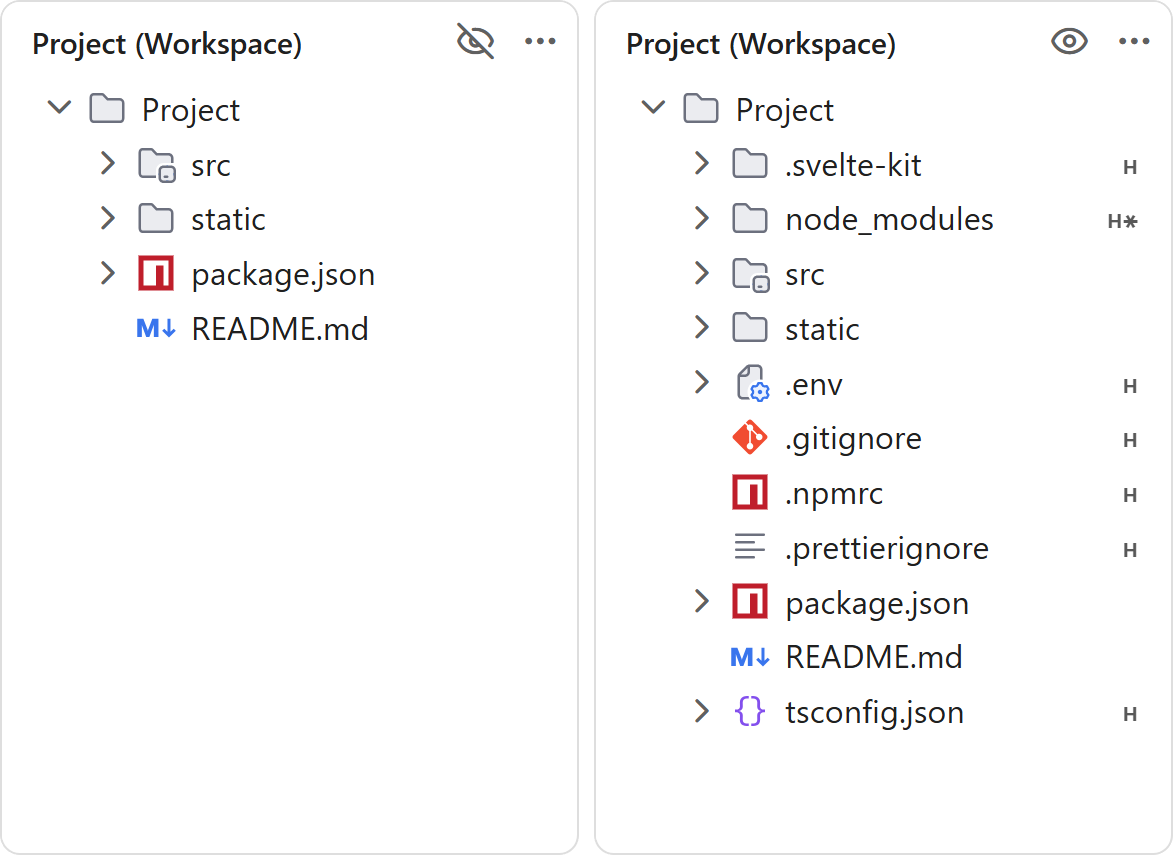
Click the eye icon in the Explorer title bar to instantly show or hide the items normally hidden by your files.exclude setting.

Toggle visibility from the Explorer title bar

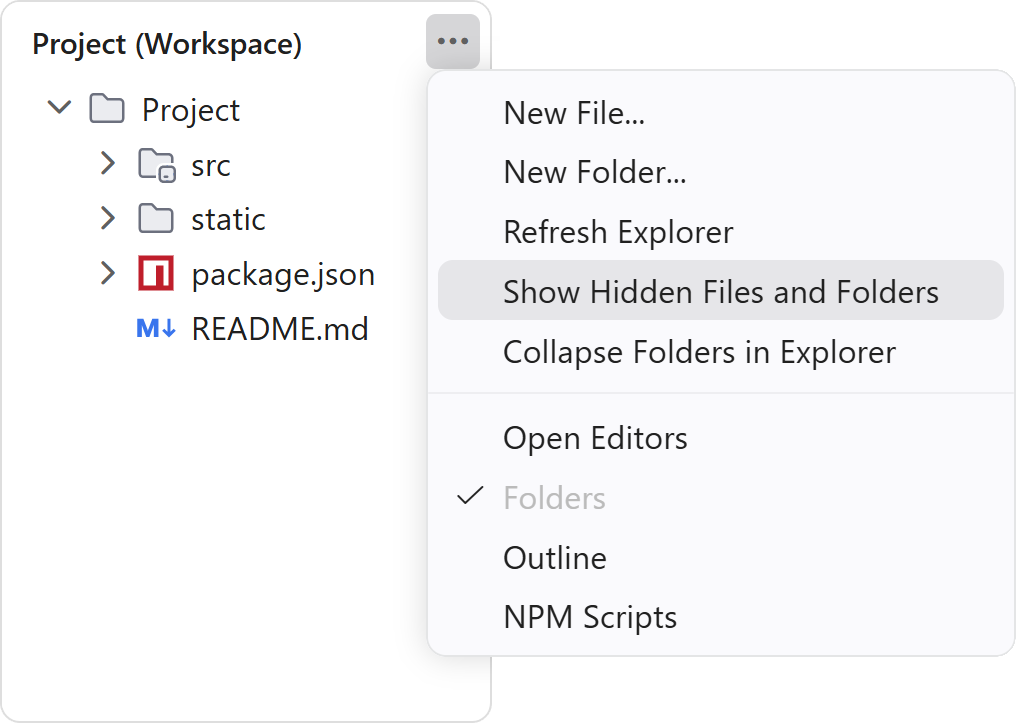
The same action is also available from the Explorer view's More Actions (...) menu, so it still works even when the title bar icon isn't visible.

Show Hidden Files and Folders entry in the Explorer "..." menu

Spot hidden items at a glance

While hidden items are shown, each one gets a badge:

Badge Meaning
•h The item is explicitly excluded
h The item is excluded by a matching pattern (e.g. node_modules, .git)

Hidden items are also faded, so they never get confused with the rest of your project. Both cues can be turned off independently — see Settings.

Hide or unhide from the context menu

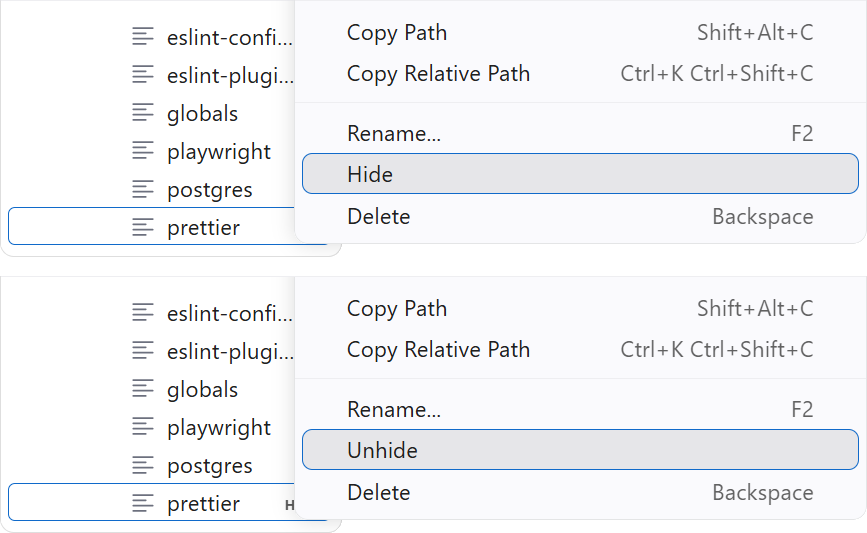
Right-click any item in the Explorer and use Hide / Unhide to add or remove it from files.exclude without leaving the Explorer.

Hide and Unhide entries in the Explorer context menu

Unhide is disabled for items hidden by a matching pattern rule, since removing the rule would affect every item it matches.

Commands

Available from the Command Palette (Ctrl+Shift+P / Cmd+Shift+P):

Command ID Description
Hidden Files and Folders > Show toggleVisibilityInExplorer.show Reveal everything hidden by files.exclude.
Hidden Files and Folders > Hide toggleVisibilityInExplorer.hide Hide them again and restore files.exclude.
Hidden Files and Folders > Toggle Visibility toggleVisibilityInExplorer.toggle Switch between the two.

Show and Hide only appear when they apply, so the palette never offers the state you are already in.

Settings

Setting Default Description
visibilityInExplorer.badges true Add badges to hidden files and folders in the Explorer view.
visibilityInExplorer.colors true Use colors to indicate hidden items in the Explorer view.

Badges require explorer.decorations.badges to be enabled, and colors require explorer.decorations.colors.

Under the hood

Nothing is hidden behind your back: the extension drives the very same files.exclude setting VS Code already uses.

Showing saves the effective excludes — user, workspace and folder scopes combined — then flips every pattern to false in the workspace scope. Your patterns stay exactly where they are, they are just switched off, so the Explorer lists the files again.

Hiding puts the saved values back and drops anything already provided by VS Code's defaults or your user settings, so no redundant entry piles up in your workspace file. When nothing workspace-specific remains, the files.exclude key is removed altogether — a .code-workspace file is rewritten with a JSONC-aware editor, so comments and formatting survive. The saved state lives per workspace, and deactivating the extension restores your settings if you left hidden items visible.

Badges and colors come from a file decoration provider that answers per resource as the Explorer paints rows, so nothing is precomputed for files you never scroll to.

Commands come in two flavors: the palette ones above, and dedicated ids for the Explorer surfaces — showFromMenu / hideFromMenu for the title bar and More Actions (...) menu, excludeFile / excludeFolder and unexcludeFile / unexcludeFolder for the context menu. The latter act on the item they are invoked on, so they are kept out of the palette.

Installation

Search for Visibility in Explorer in the Extensions view (Ctrl+Shift+X / Cmd+Shift+X), or run:

ext install oub.toggle-visibility-in-explorer

Feedback

Found a bug or have an idea? Open an issue.

License

MIT © Olivier Cuenot

  • Contact us
  • Jobs
  • Privacy
  • Manage cookies
  • Terms of use
  • Trademarks
  • Your Privacy Choices
  • Consumer Health Privacy
© 2026 Microsoft