OpenSpec Workbench for VS Code
OpenSpec Workbench brings the complete OpenSpec change workflow into VS Code.
It uses native tree views, markdown editors, diffs, Source Control, Chat, and
notifications while keeping lifecycle and security behavior in
@openspec-ui/core.
Project site: https://openspec-ui.dev.
Screenshots
Workbench overview
Every view, with something in it
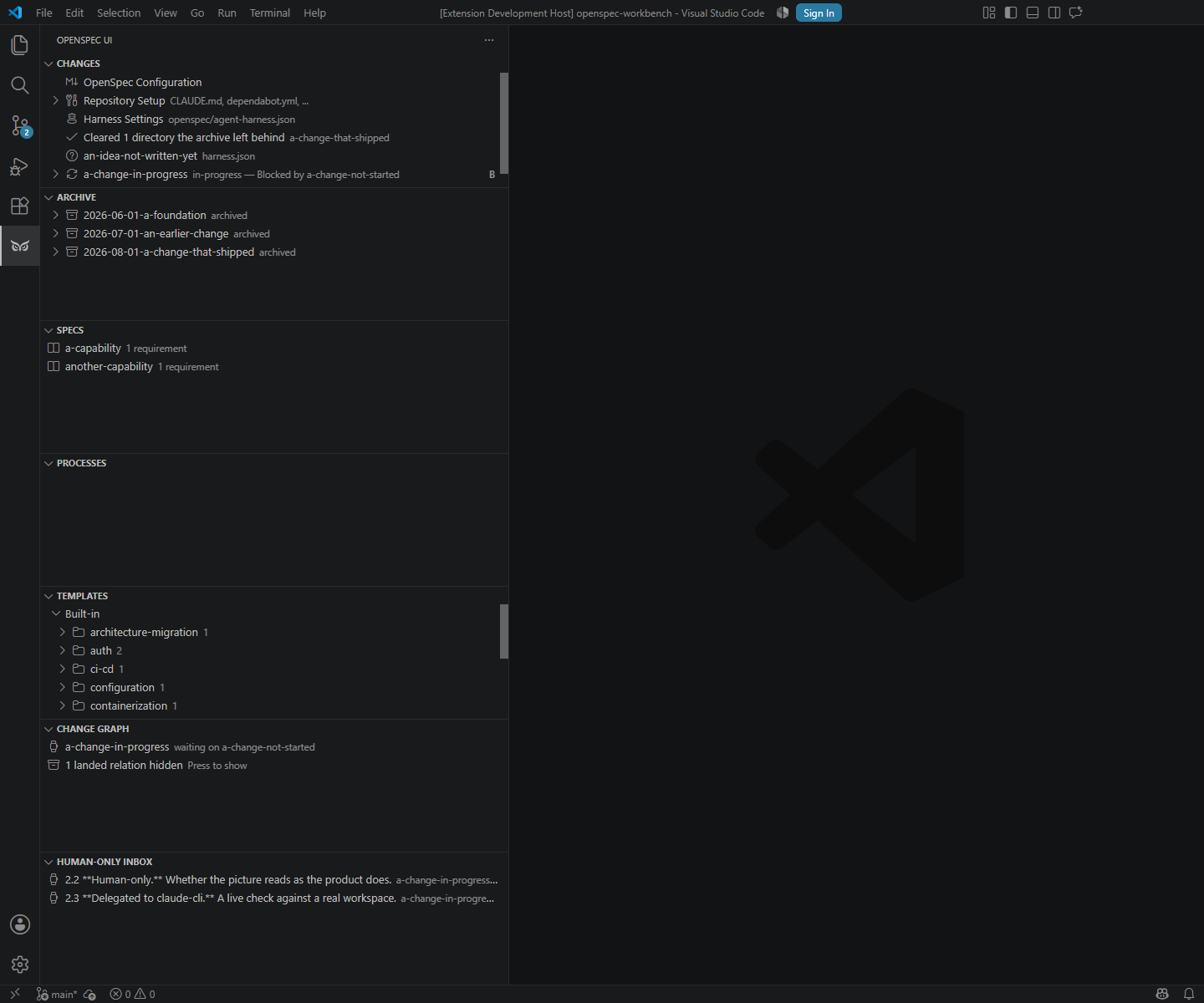
Compact repository overview
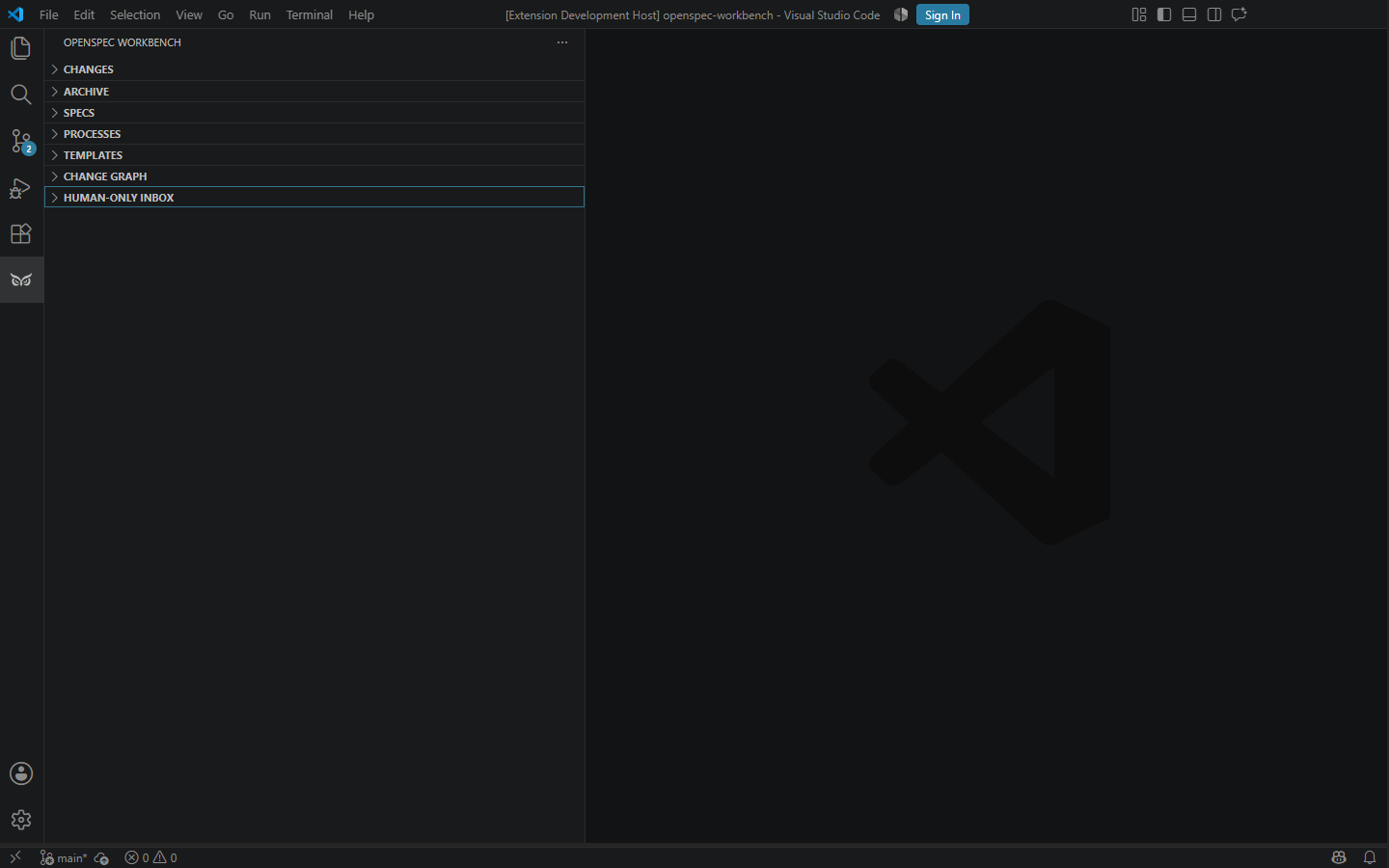
Changes and archive
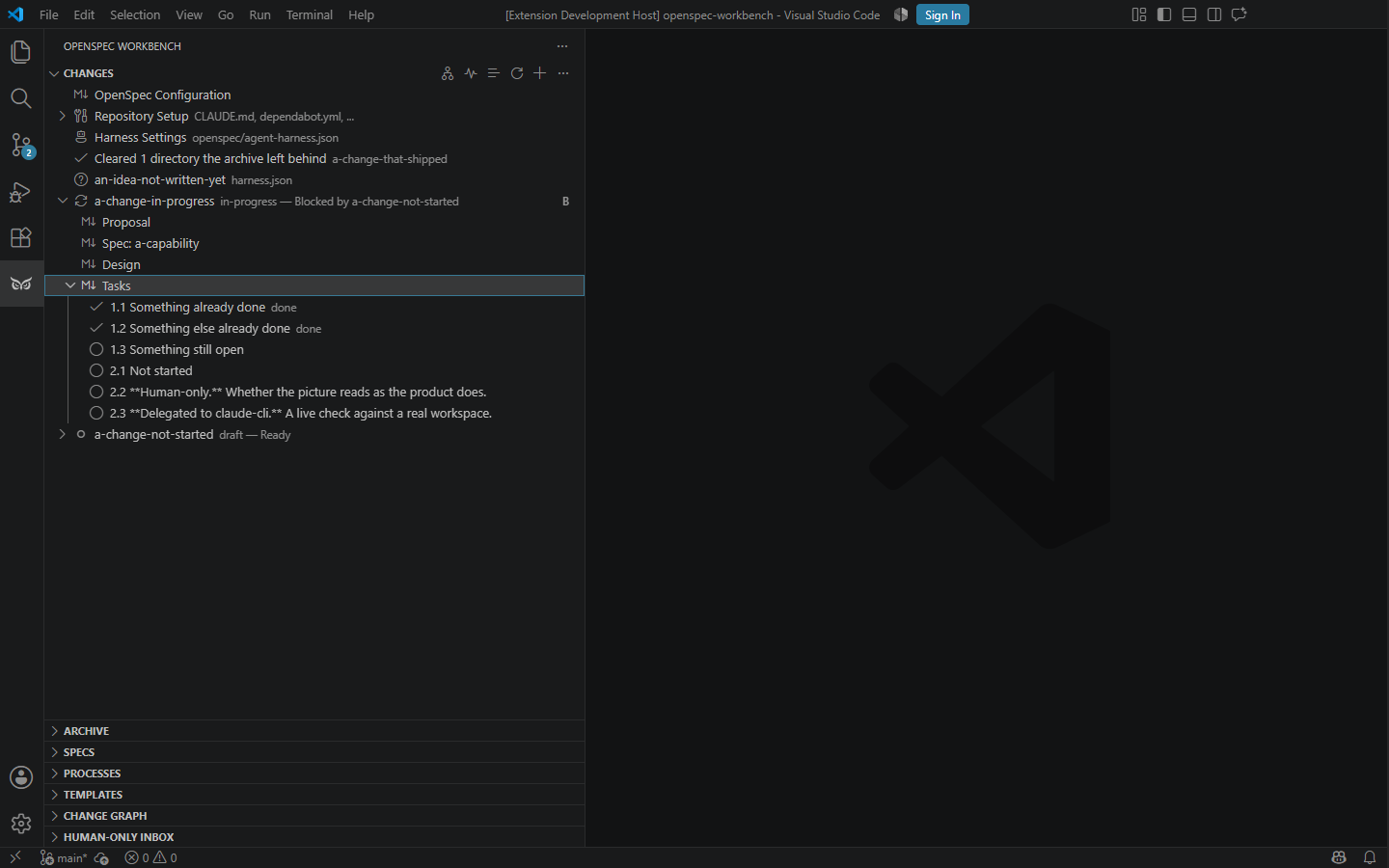
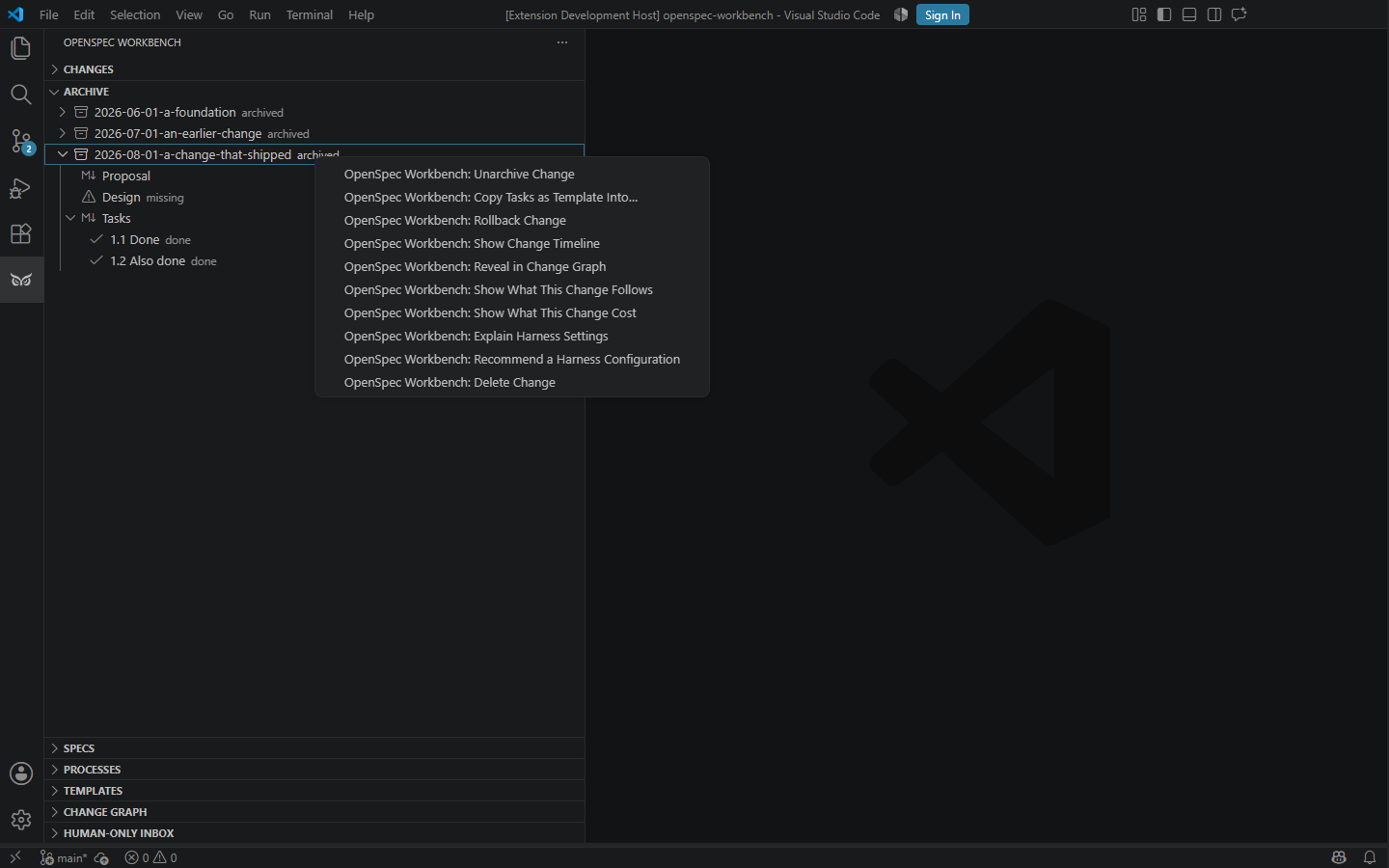
Individual checklist entries remain nested under their tasks.md artifact,
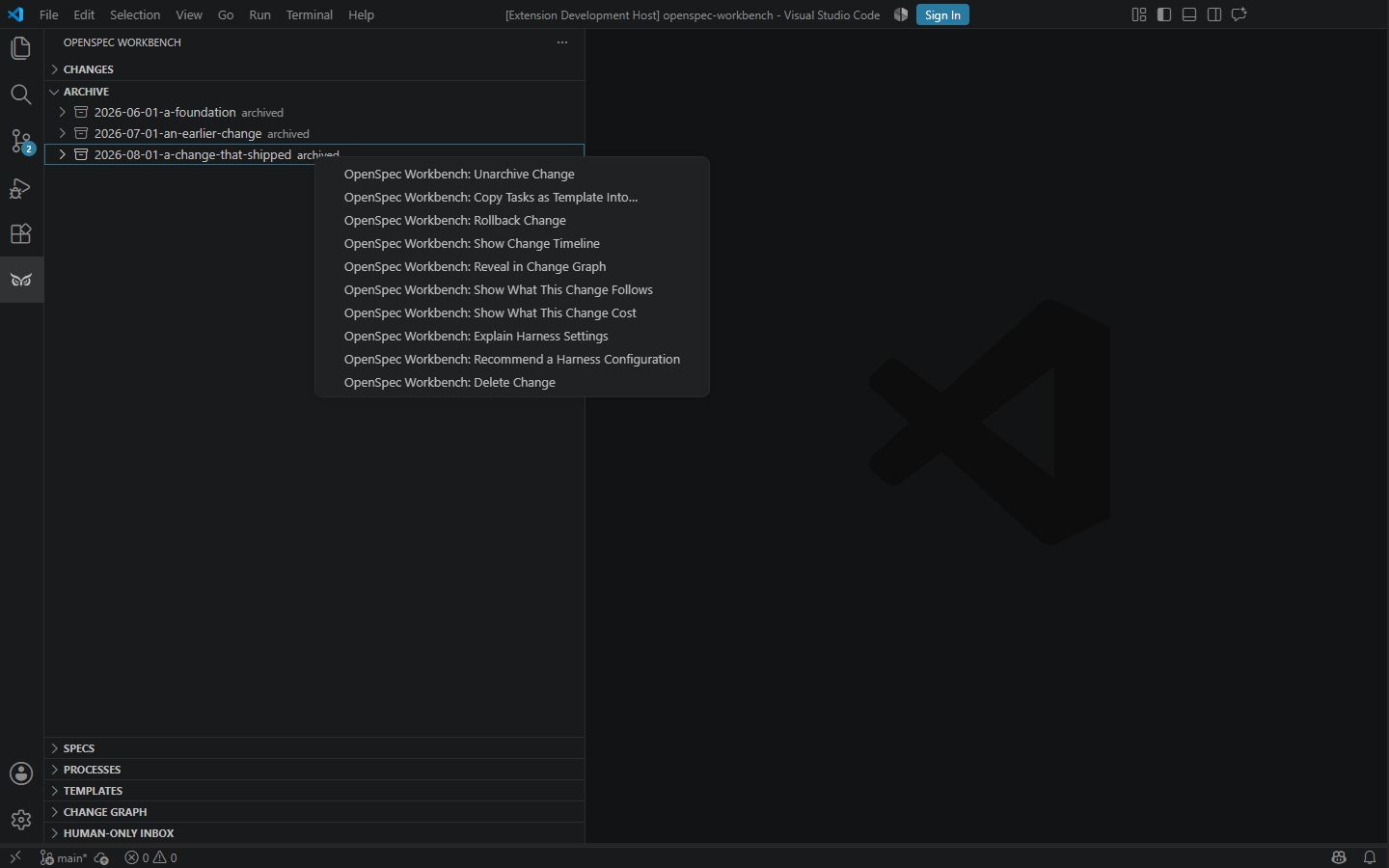
while archived changes expose lifecycle and template actions from the native
context menu.
Nested tasks
Archive actions
Archived task history
Where each change stands, and the Pipeline
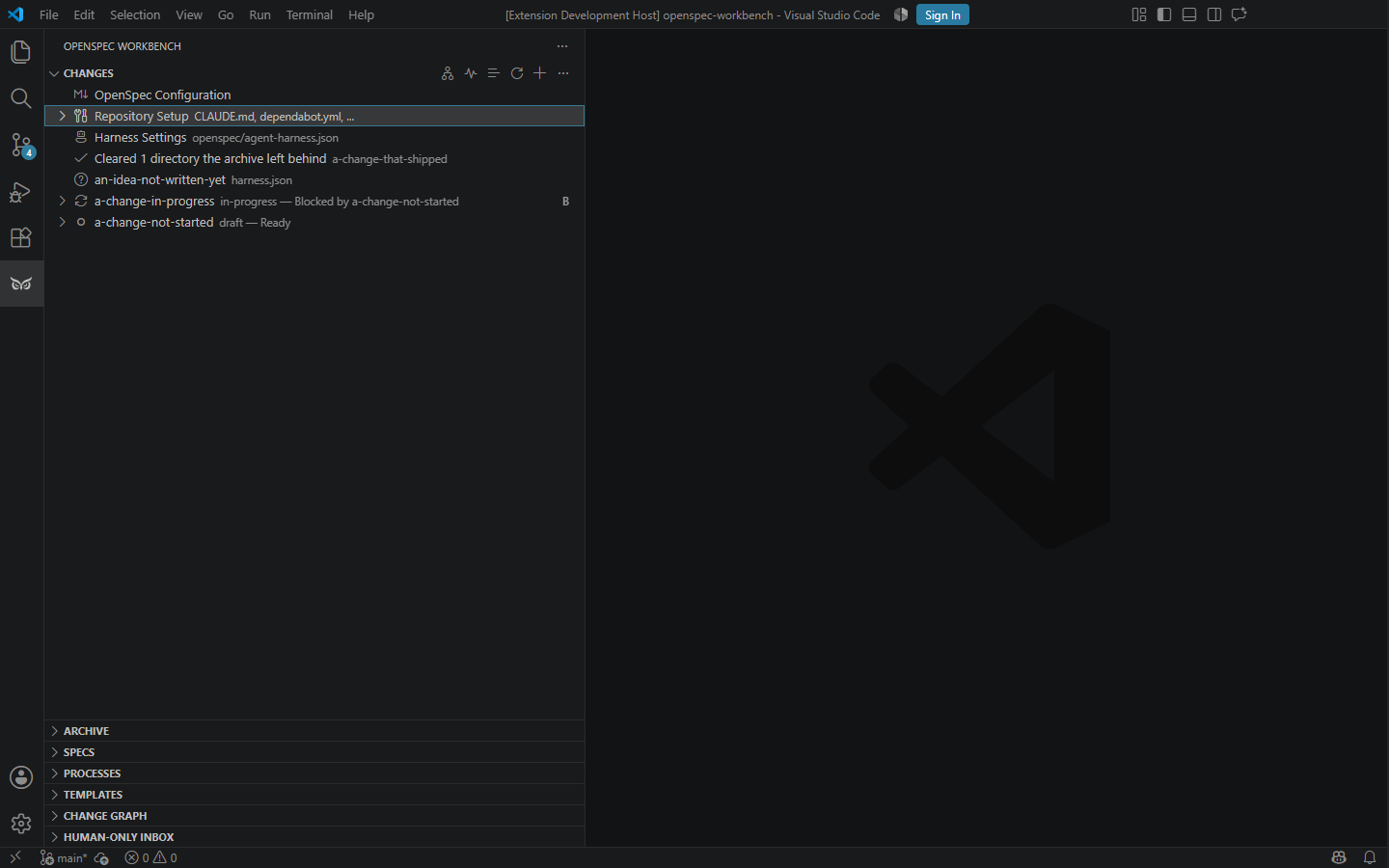
The Changes tree states each change's standing beside its name, in the
same word every surface uses. The words are:
- Running, or Running in another working directory;
- Waiting for you, or Waiting in another working directory;
- Failed or Stopped at a stage;
- Blocked, Ready or Done;
- Further along in another copy;
- Merged in #N, Archived on main, or Deleted on main.
Hovering a change shows where each part of that word was read from.
The word follows a run: it says Running within a few seconds of a run
starting on the change, and stops saying it when the run ends, with no
Refresh. Only the run records are read for that, never git.
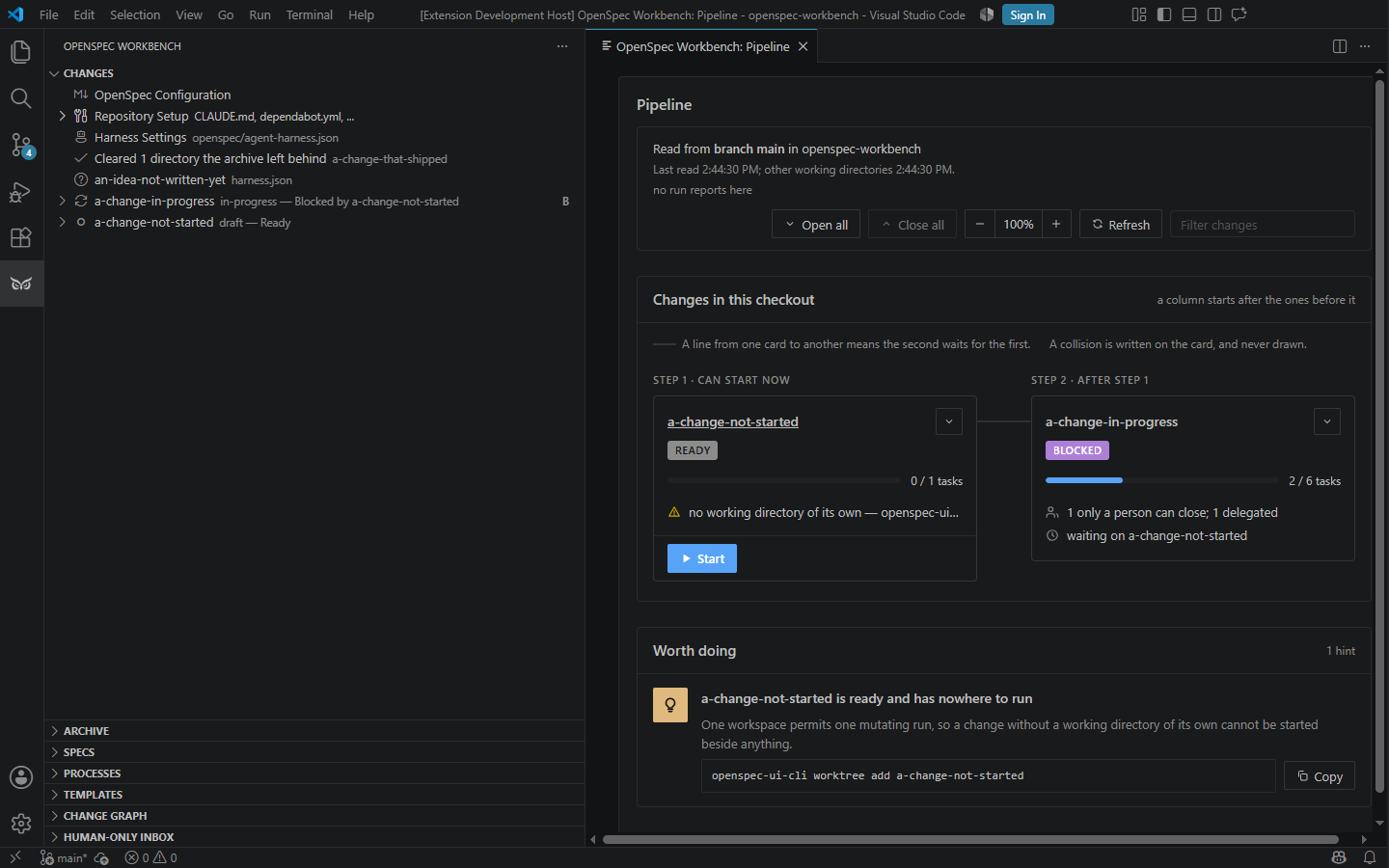
OpenSpec Workbench: Open Pipeline, also in the Changes view's title bar,
opens the Pipeline in a panel of its own. It is the same picture the
standalone app draws: every change as a card in the order the changes
declare, with its state, its tasks, what a live run last said, and what
can start alongside what.
A card's Start opens the run dialog for that change. On a run this
editor holds, the card answers a checkpoint or a permission, and Stop
asks the run to stop, with a reason. See
stopping a run.
Finding one change, and hiding what has landed
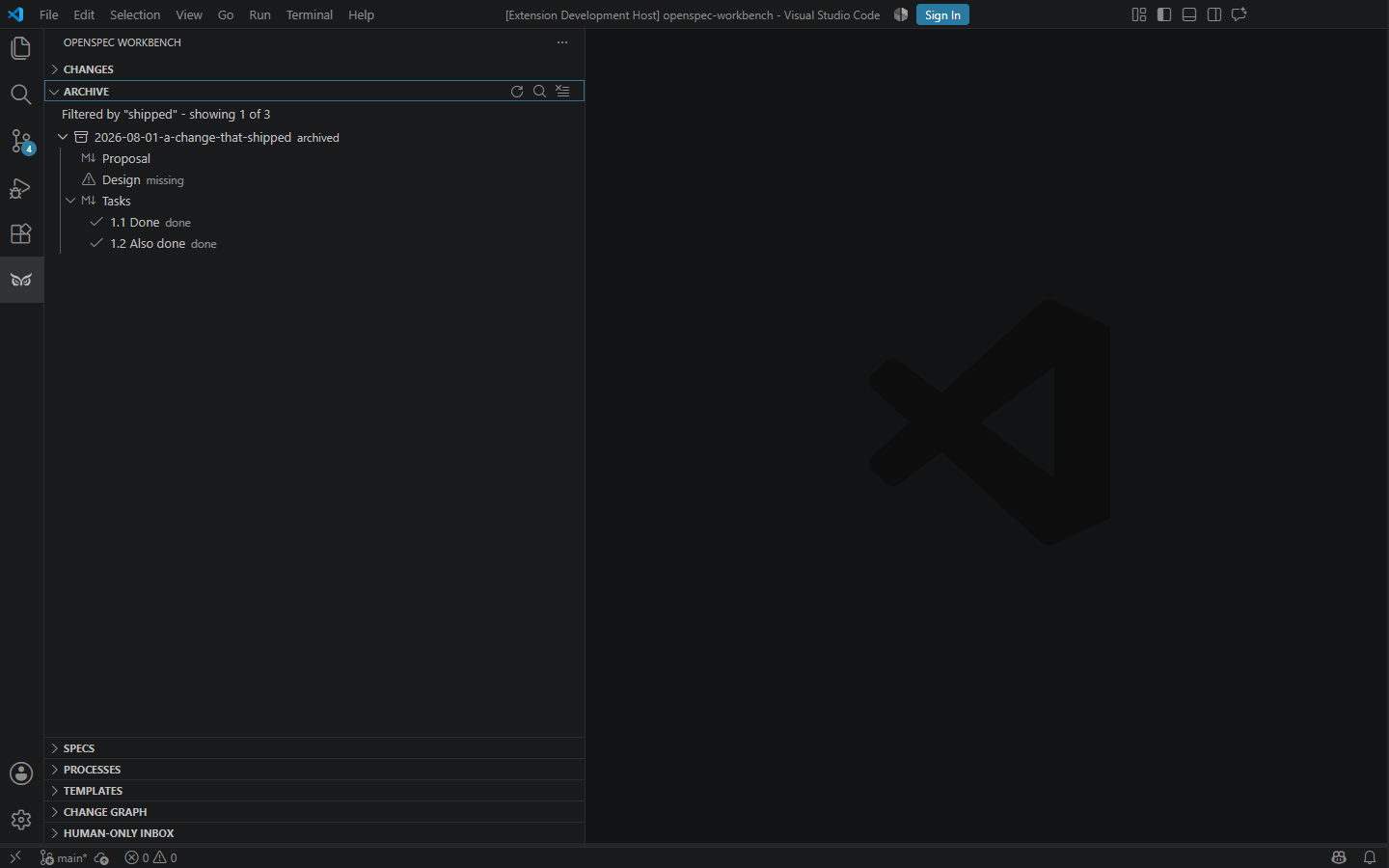
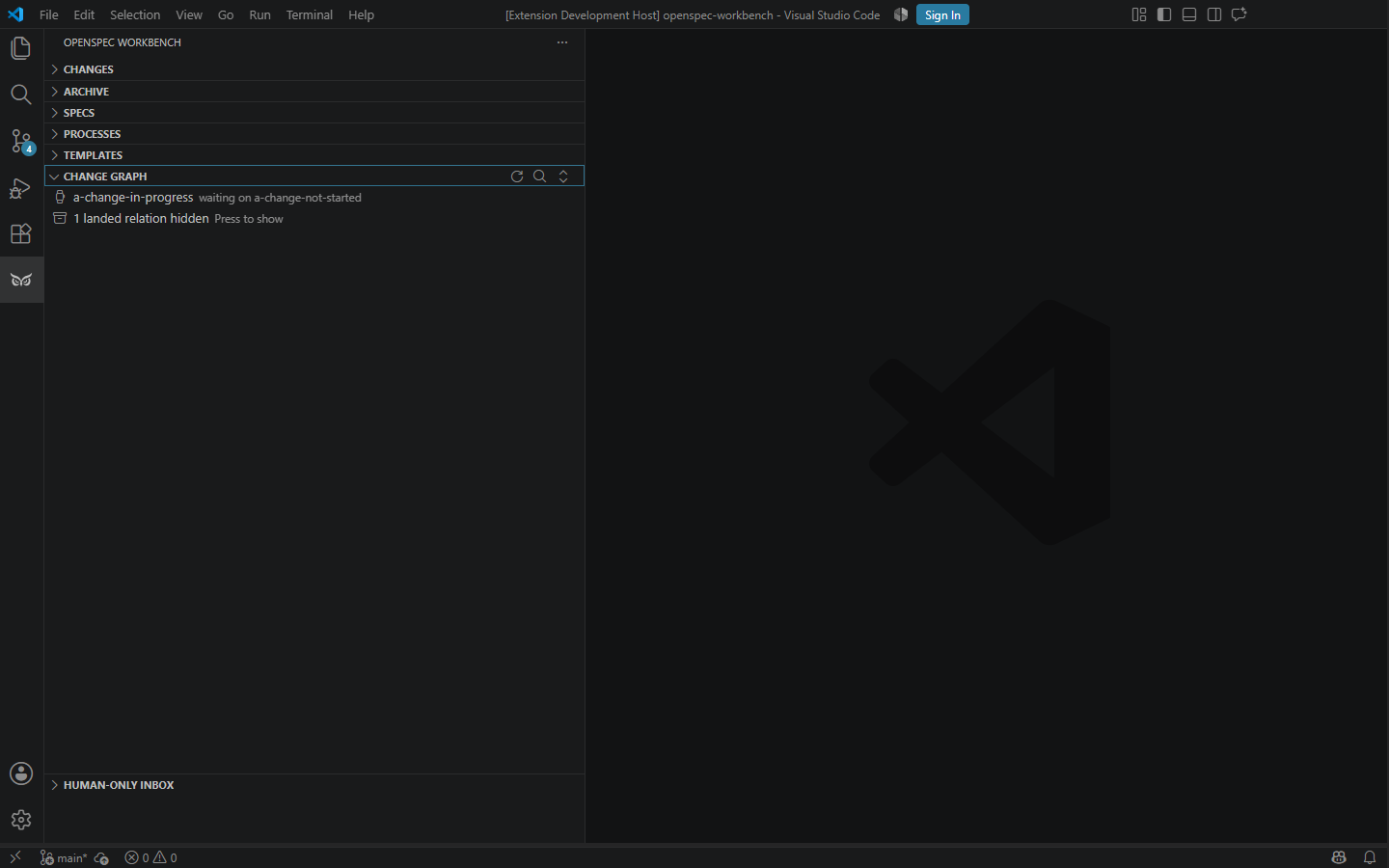
The Archive, Specs and Change Graph views each take a filter from their
title bar. Every word typed has to appear somewhere in the row, so
"pipeline blocked" finds the blocked pipeline change rather than
everything called pipeline. A narrowed view says what it is narrowed by
and how much of itself it is showing, and a view that matches nothing
says so with the words it was given.
The Change Graph folds away every branch whose root and every change
under it are archived, and ends its rows with the count it is hiding.
One press shows them again; a filter that finds something inside a folded
branch opens that branch for the reading. A branch a live change follows,
or is waiting on, is never folded.
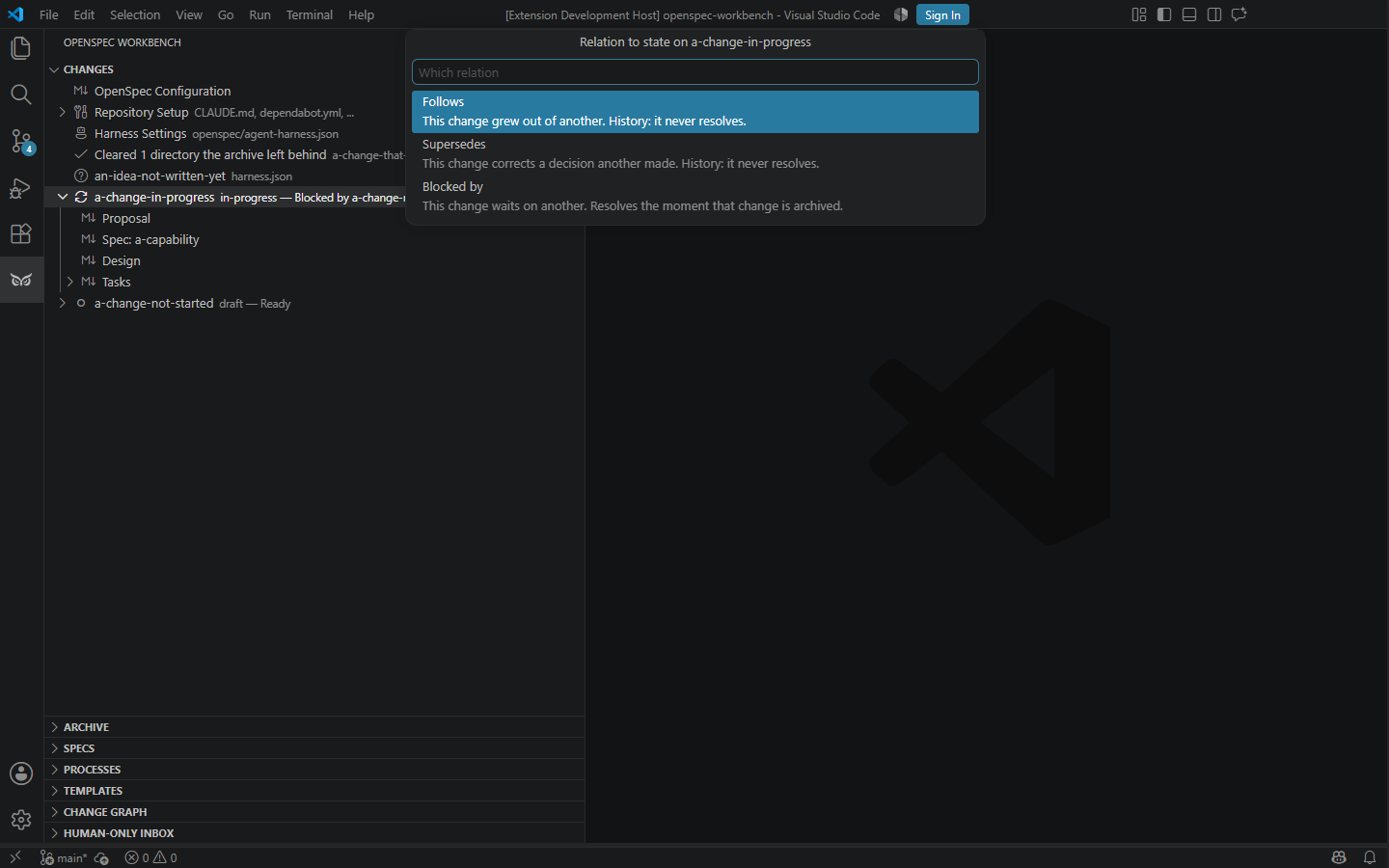
Stating a relation without opening a file
Add Relation and Remove Relation sit on a change's row, in the
Changes view and in the Change Graph. Adding asks which relation - Follows,
Supersedes or Blocked by, each with the sentence that says what it means -
and then which change, from the ones the workspace has. Removing offers
only the relations that change actually states.
An edit that names a change the workspace does not have, a change naming
itself, or one that would close a cycle is refused before anything is
written, naming the changes in the cycle.
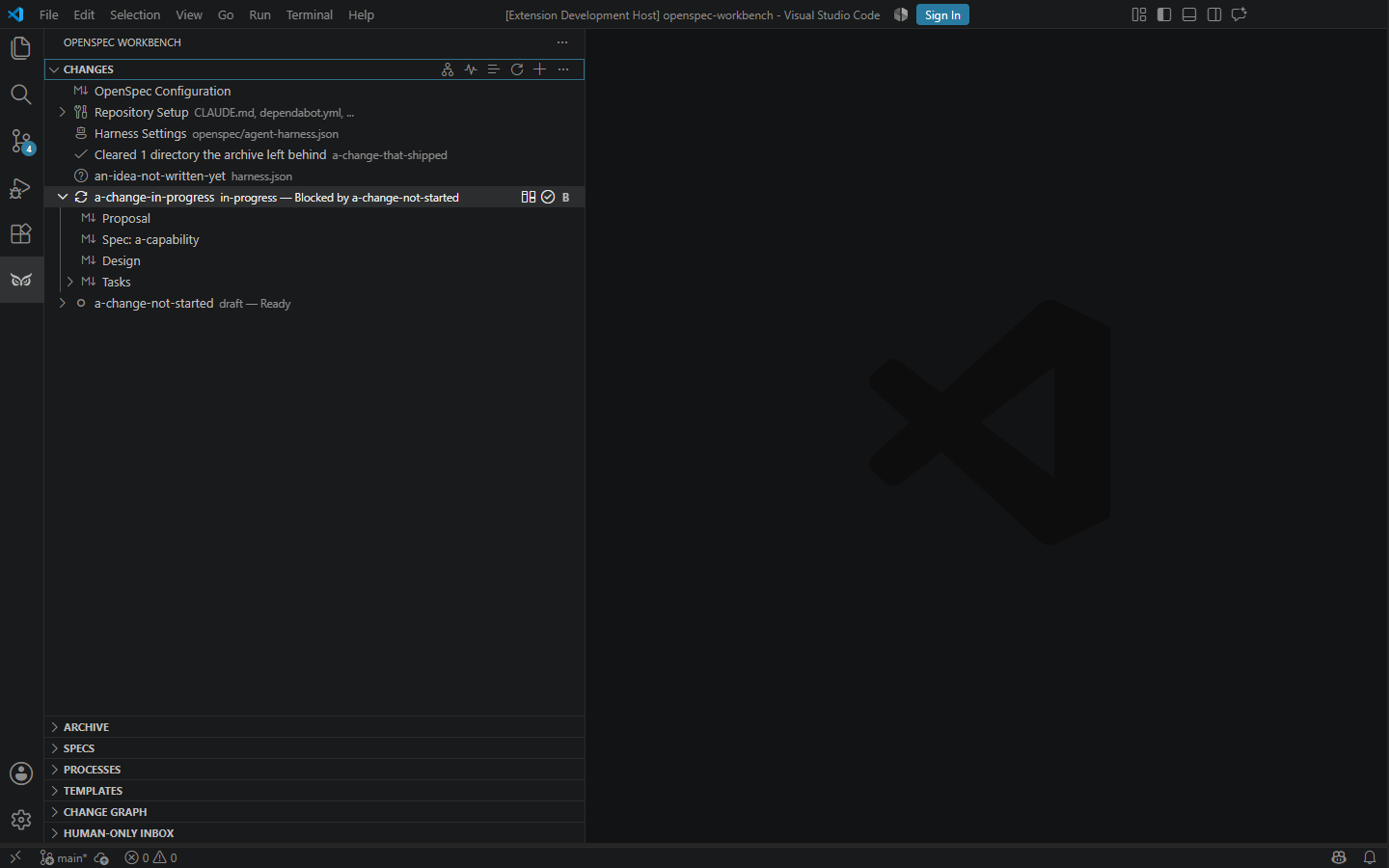
What the archive left behind
Archiving can leave a directory holding nothing but a file this product
wrote, and that directory used to be listed as a change with no tasks. It
is cleared now, on activation and on an interval, and the Changes view
says what went. A directory holding something this product did not write,
or one whose name is nowhere in the archive, is shown rather than removed:
it may be a change you have not written yet.
Specs, templates, and repository setup
Canonical spec editor
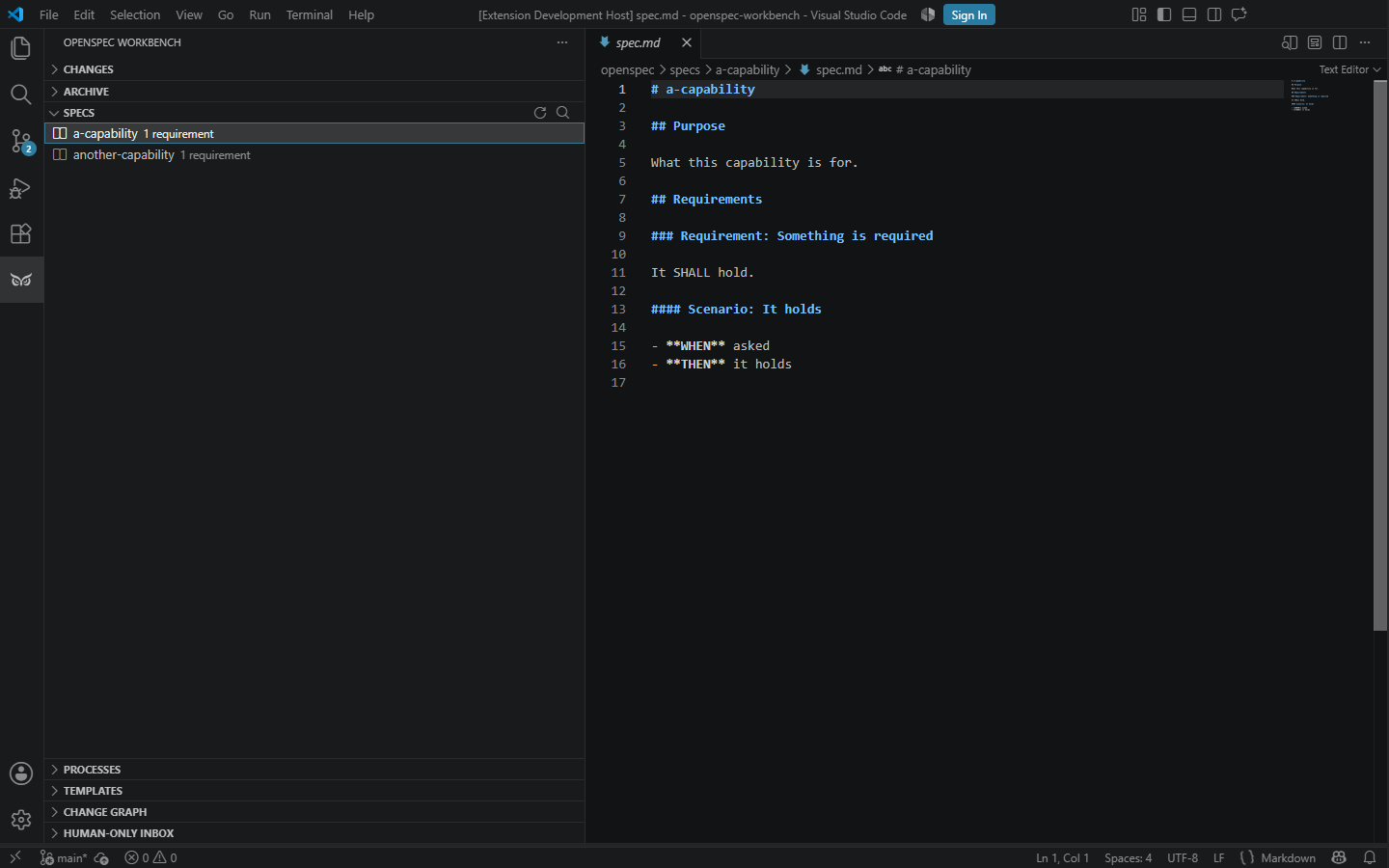
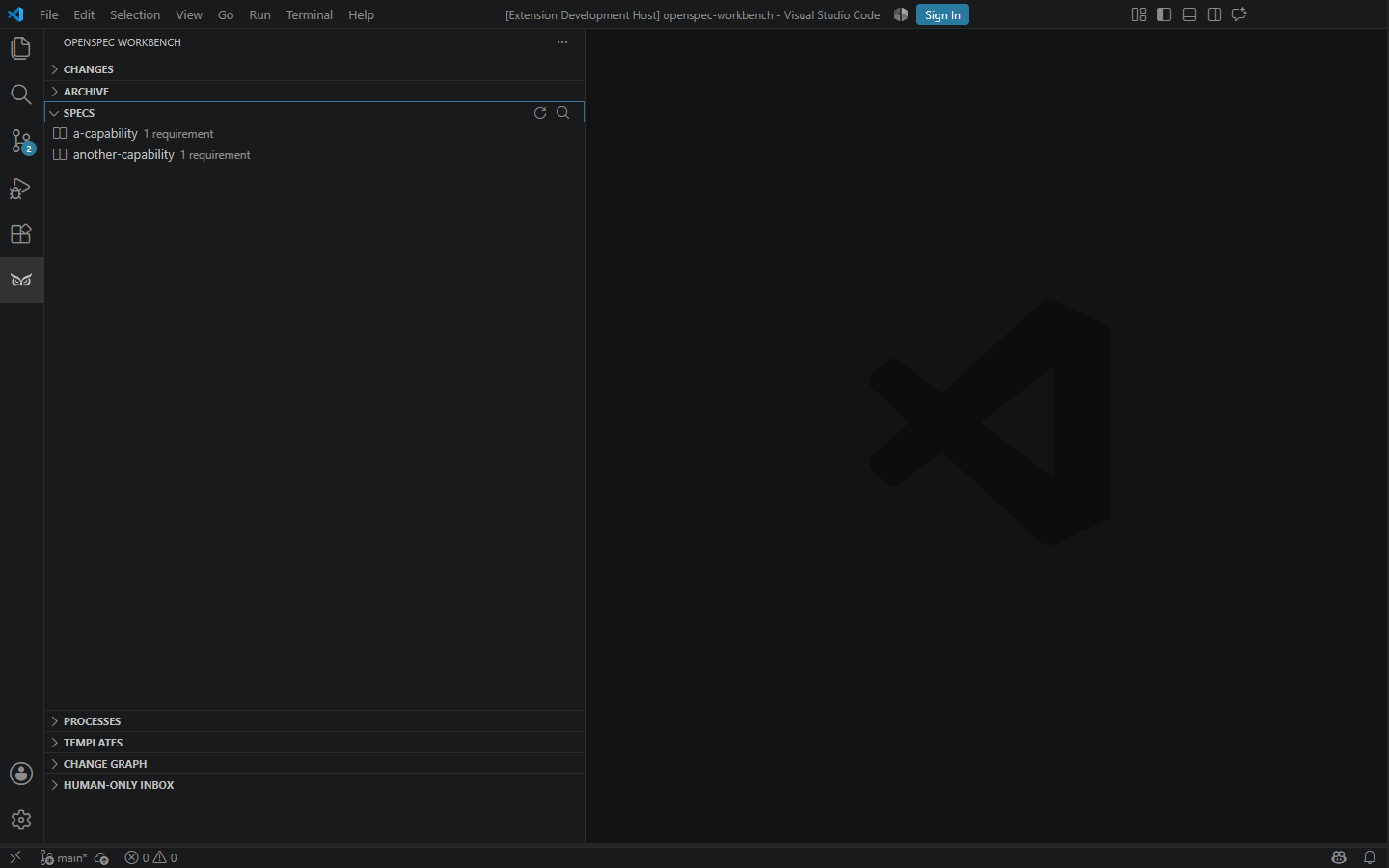
Requirement counts
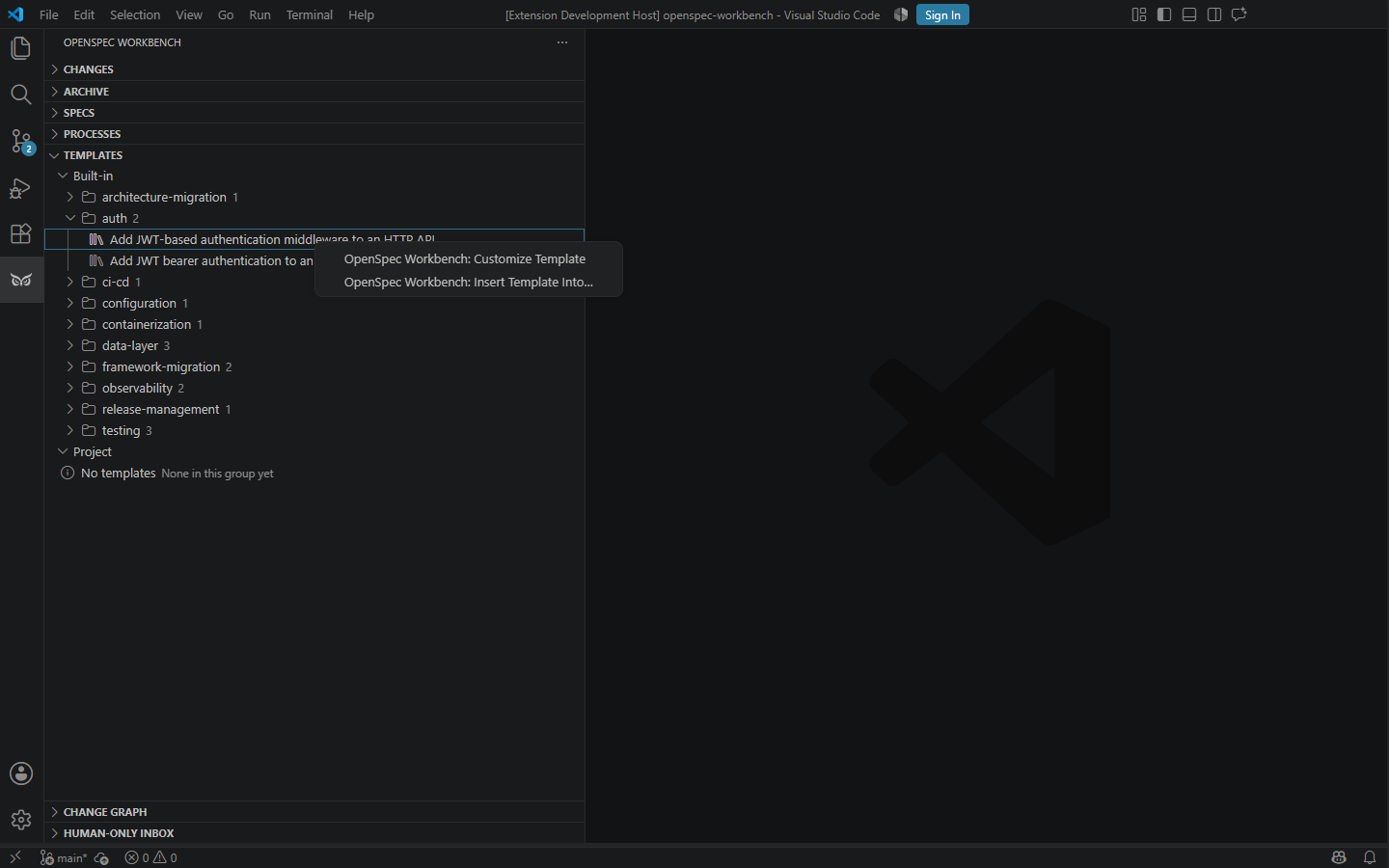
Template actions
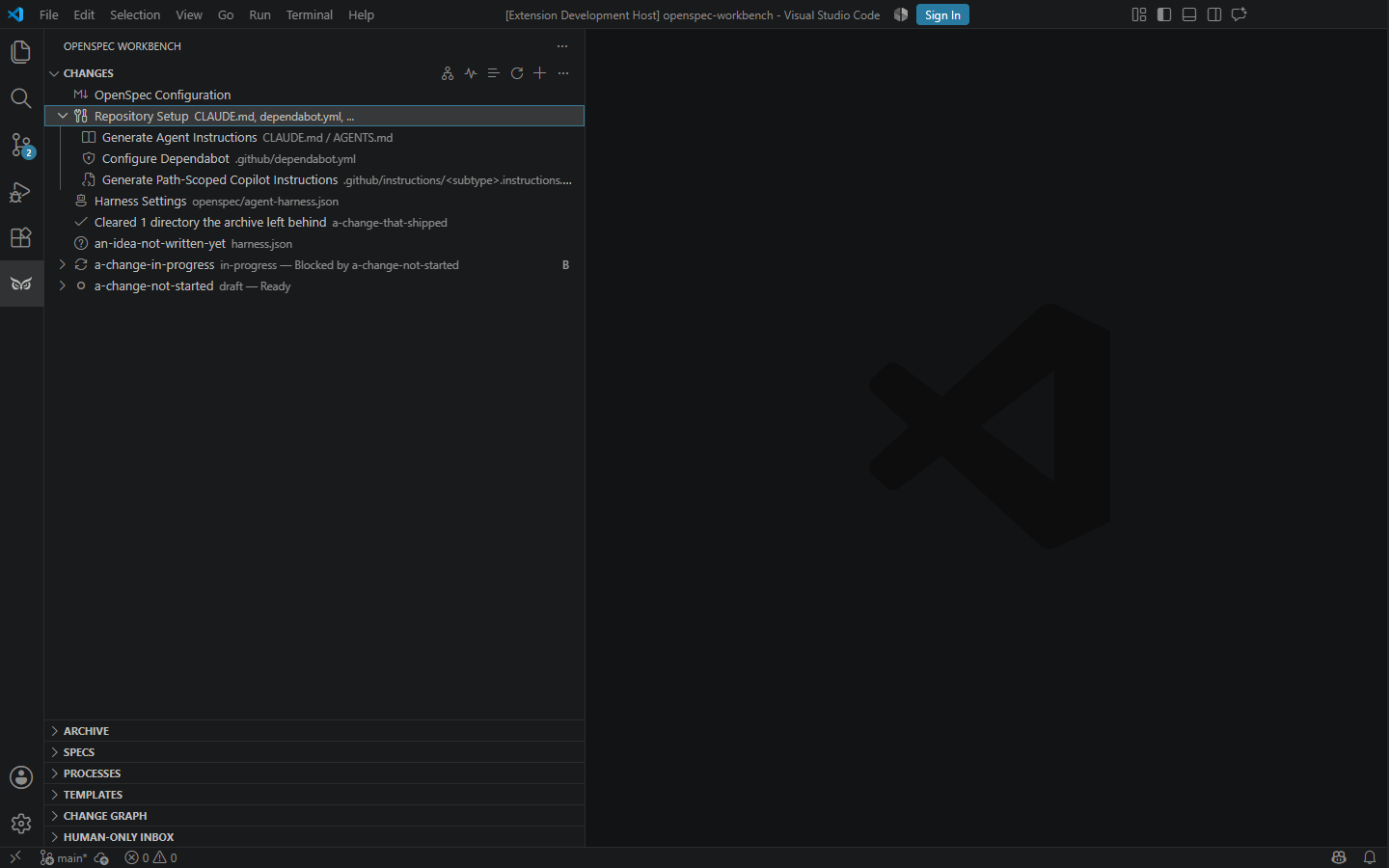
Repository bootstrap
Features
- Navigate
config.yaml, active changes, archived changes, canonical specs,
and every proposal, design, task list, and delta spec.
- Create, validate, archive, unarchive, and delete changes from contextual
actions with confirmation for destructive operations. Expand a change,
then expand its collapsible "Tasks" entry to see the individual
tasks.md checklist items nested under it; select one to jump to it
in the editor, or delete it (active changes only, and only if not yet
done) with confirmation.
- See queued, running, completed, failed, cancelled, interrupted, and
rolled-back operations in the Processes view. Read-only work can run in
parallel; workspace mutations are serialized to keep checkpoints isolated.
- See what a run spent, where the agent reports it. A recorded cost
appears beside the run, and a chain stops at a stage boundary when a
configured ceiling is reached — naming the budget rather than failing a
stage. A run whose agent reported nothing says so; it never shows
$0.00, because unreported is not the same as free. Which agents
report what, and which ceiling can act on each, is in
LIMITS.md.
- Read the Change Graph view: each change nested under the ones it
follows, archived ones marked, and any waiting on a change that has not
landed shown as waiting — so what can be started now is answerable
without opening a file. It is read-only on purpose; a change with two
parents appears under each, and every action stays in the Changes and
Archive trees where a change appears exactly once.
- Open the Human-Only Inbox to see every open item that is waiting on
a person, across all active changes, each naming the change it belongs
to and opening it when selected. When nothing is waiting the view says
so rather than showing an empty list. It offers no way to mark an item
done: those items are reported by a person after observing the thing
they name, and a button on a surface that cannot observe it would turn
that rule into a formality.
- Open the Pipeline in a panel ("OpenSpec Workbench: Open Pipeline"): every
active change as a card with its state, its tasks and what a live run
last said, and every other working directory beneath. A card starts its
change, answers a run's checkpoint or permission, and asks a run to stop
with a reason. A run held elsewhere offers Stop only when it is signed by
the same enrolled person as this machine's key.
- See each change's standing word beside it in the Changes tree — the same
word the Pipeline, the standalone app and
openspec-ui-cli ready use —
with where each part of it was read from on hover.
- Say that a run signed by an unenrolled key was yours with It was me in
the Human-Only Inbox; its runs then read as signed by you.
- Ask a change what it follows — "Show What This Change Follows" walks
back to the changes it grew out of and opens any of them. This is how a
decision is traced to the reason for it once the change that made it is
archived.
- Move between the Changes/Archive trees and the Change Graph on request.
"Reveal in Change Graph", on a change in either tree, expands and selects
every row it occupies (a change following more than one other change has
one row per parent) and reports the count when there is more than one; if
the change states no relation it says so rather than appearing to do
nothing — most changes are not in the graph, since it shows only what
states a relation. "Reveal in Changes", on a graph row, opens the Archive
tree for an archived change and Changes otherwise. Both are off unless
invoked:
openspec-ui.followSelectionInChangeGraph (default false)
turns on following the Changes/Archive selection into the graph
automatically, without stealing focus from the list being browsed.
- Use
@openspec in VS Code Chat with /plan, /implement, /review,
/status, and /validate.
- Or run
plan/implement/review directly from the Process Dashboard's
own agent picker (Claude CLI, GitHub Copilot CLI, Codex CLI, Gemini CLI,
or a local OpenAI-compatible LLM) — a separate mechanism from VS Code
Chat, see "Agents" below.
- Recover process history and checkpointed runs after extension reload. Start
VS Code Agent implementation sessions, finish them for review, and roll back
only files changed by a run. Rollback refuses to overwrite later edits and
discloses files omitted by checkpoint size limits.
- "Rollback Change" on a Change item (in either the Changes or Archive tree)
rolls back every process ever run against that Change, restoring every
touched file to its state before the earliest of those runs — works
identically for active and archived changes. Same fail-closed behavior as
single-process rollback: any file changed outside what the system knows
about refuses the entire restore, not just that one file.
- Open the Process Dashboard with Workspace root and Change directory filled
from the current VS Code workspace. The default message-bridge dashboard
follows the active VS Code color theme, including dark and high-contrast
themes.
- Open native markdown and diff editors instead of custom replacements.
- Browse built-in and project-level change templates in the Templates
view, grouped first by origin (Built-in / Project) and then by
category. Customize a built-in template into your project (keeping a
backlink to the version it was forked from), insert a rendered
template into any active change, or delete a project-level template
with confirmation — built-in templates ship as part of the extension
and are never deletable through the UI. 17 built-in templates across 10
categories (data-layer, framework-migration, architecture-migration,
testing, ci-cd, auth, containerization, observability, configuration,
release-management), covering Python, Node.js/TypeScript, ASP.NET Core,
and language-agnostic patterns.
- Bootstrap repository files for a picked project type (Node.js/
TypeScript or Python): agent instructions (
CLAUDE.md/AGENTS.md),
.github/dependabot.yml, and path-scoped .github/instructions/ <subtype>.instructions.md. Reachable either from the Command Palette
or from the "Repository Setup" node at the top of the Changes
tree. Any of these commands leaves an existing file alone (and tells
you so) if it wasn't created by this extension — never overwrites
hand-written content.
Requirements
- VS Code 1.90 or newer.
- OpenSpec CLI available as
openspec on PATH.
- A workspace containing
openspec/config.yaml, or initialize OpenSpec from
the CLI before using the Workbench.
- VS Code Chat and an available language model for
/plan, /implement, and
/review. Deterministic lifecycle, status, and validation actions do not
require AI.
Workflow
- Open the OpenSpec activity-bar container.
- Create or expand a change in Changes.
- Edit Proposal, Design, Tasks, and delta Specs in native editors.
- Run Validate, then choose Implement with VS Code Agent — this runs
through VS Code's own Copilot Chat, using whatever model is selected
in Chat's own model picker. If you specifically want a particular CLI
agent (e.g. the real Anthropic Claude Code CLI, not Claude via
Copilot) to make the change instead, use OpenSpec Workbench: Open Process
Dashboard and its own agent picker instead — see "Agents" below.
- Follow the run in Processes. When Agent work is done, choose
Finish Implementation & Review.
- Review native diffs, roll back the checkpoint if needed, or archive the
completed change. Archiving creates or updates canonical specs.
Chat
Enter @openspec and choose a slash command. The first argument must be an
active change id:
@openspec /review openspec-workbench focus on rollback safety
Agents
To run plan/implement/review through a specific CLI agent (Claude
CLI, GitHub Copilot CLI, Codex CLI, Gemini CLI, or a local
OpenAI-compatible LLM) instead of VS Code's native Chat/Agent handoff:
- Run OpenSpec Workbench: Open Process Dashboard from the Command Palette
(or the toolbar button on a change in Changes).
- In the panel, pick
implement (or plan/review) from the command
dropdown.
- Pick the agent you want from the agent dropdown next to it — each
option shows a best-effort detected/not-detected badge.
- Click Run.
This picker is independent of VS Code Chat: it runs the command through
this extension's own CLI-agent protocol (@openspec-ui/core's
buildDefaultAgentRunners), resolved at activation from the open
workspace. Each listed CLI tool (claude/copilot/codex/gemini)
must already be installed and authenticated on the machine separately —
the extension never handles API keys itself. If a tool is missing, the
run fails immediately with a clear error instead of hanging. This works
the same way in both the default message-bridge dashboard and the
optional local-server mode
(openspec-ui.transport.localServer.enabled). None of these tools need a
VS Code extension or any VS Code-specific setup — a plain CLI login is
enough, the same as using it from a terminal. See the root repository
README.md's "Agent Selection" section for the full picture, including
how this differs from the @openspec Chat Participant above.
Agentic Harness
OpenSpec Workbench: Configure Harness Settings and OpenSpec Workbench: Configure
Harness for this Change set the per-stage agent, autonomy level, and
review gate the commands above (and a chain run) use by default. Each opens
a panel of its own: the first for the workspace's global file, the second
for the one change it was run on, titled Harness: <change>, already
loaded;
OpenSpec Workbench: Run with Agentic Harness starts a single-stage run or a
chain depending on the resolved autonomy level. See the root repository's
HARNESS.md for every setting these commands can and
cannot reach, and LIMITS.md for what actually caps a
run's spending.
A chain run can be answered mid-stage: when a stage's agent asks for
permission before a sensitive action, the chain view offers an Allow/Deny
control naming the request, and the answer reaches that stage's own run.
Under autonomous there is no confirmation channel, so a permission
request there ends the run with a stated reason instead of waiting.
Settings
openspec-ui.transport.localServer.enabled: use the optional standalone
REST/WS shell inside the dashboard, for both the AI panel and the Pipeline
panel. The default extension path imports core directly and uses an
in-process message bridge. Because the optional localhost shell is a
cross-origin iframe, it retains the standalone palette instead of
inheriting VS Code theme variables. With this on, the Pipeline panel's
cards are read by the server's own process instead of the editor's, so
they keep answering while a harness chain runs in this editor.
openspec-ui.checkpointRetentionDays: days to keep process/checkpoint
history before it's pruned, once, on the next window reload. Defaults to
0, which keeps everything forever — unchanged from every prior version.
A positive number prunes anything older than that many days.
Warning: once a process is pruned this way, both single-process
Rollback and "Rollback Change" become permanently unavailable for it —
pruning itself cannot be undone. Leave this at 0 (the default) unless
you specifically want bounded history growth and have accepted that
trade-off.
Development
npm run typecheck --workspace openspec-ui-vscode
npm run lint --workspace openspec-ui-vscode
npm run test --workspace openspec-ui-vscode
npm run build --workspace openspec-ui-vscode
npm run test:integration --workspace openspec-ui-vscode
To try a local change in your own VS Code instead of just building:
npm run reinstall:local --workspace openspec-ui-vscode
Unlike npm run package (which only produces the .vsix), this also
force-installs it — the extension's version in package.json often
does not change between local iterations, and code --install-extension
silently does nothing when the target version is already installed, so a
plain reinstall without --force can leave you testing stale code. You
still need to run "Developer: Reload Window" yourself afterward — that
step is not automated.
| |

