Modelglass Cost-Aware Router
A VS Code extension that routes a task to the cheapest LLM that clears a
confirmed benchmark bar, using the live Modelglass
pricing and capability feed. Since v0.3.0 it can also execute the call
directly against your own provider key — a fully client-side, BYOK
(bring-your-own-key) router: no Modelglass proxy in the request path, ever.
Since v0.6.0, it also generates video (via Runway) and audio (via
ElevenLabs) the same way — your own keys, no proxy — see
Generate Video and
Generate Audio below.
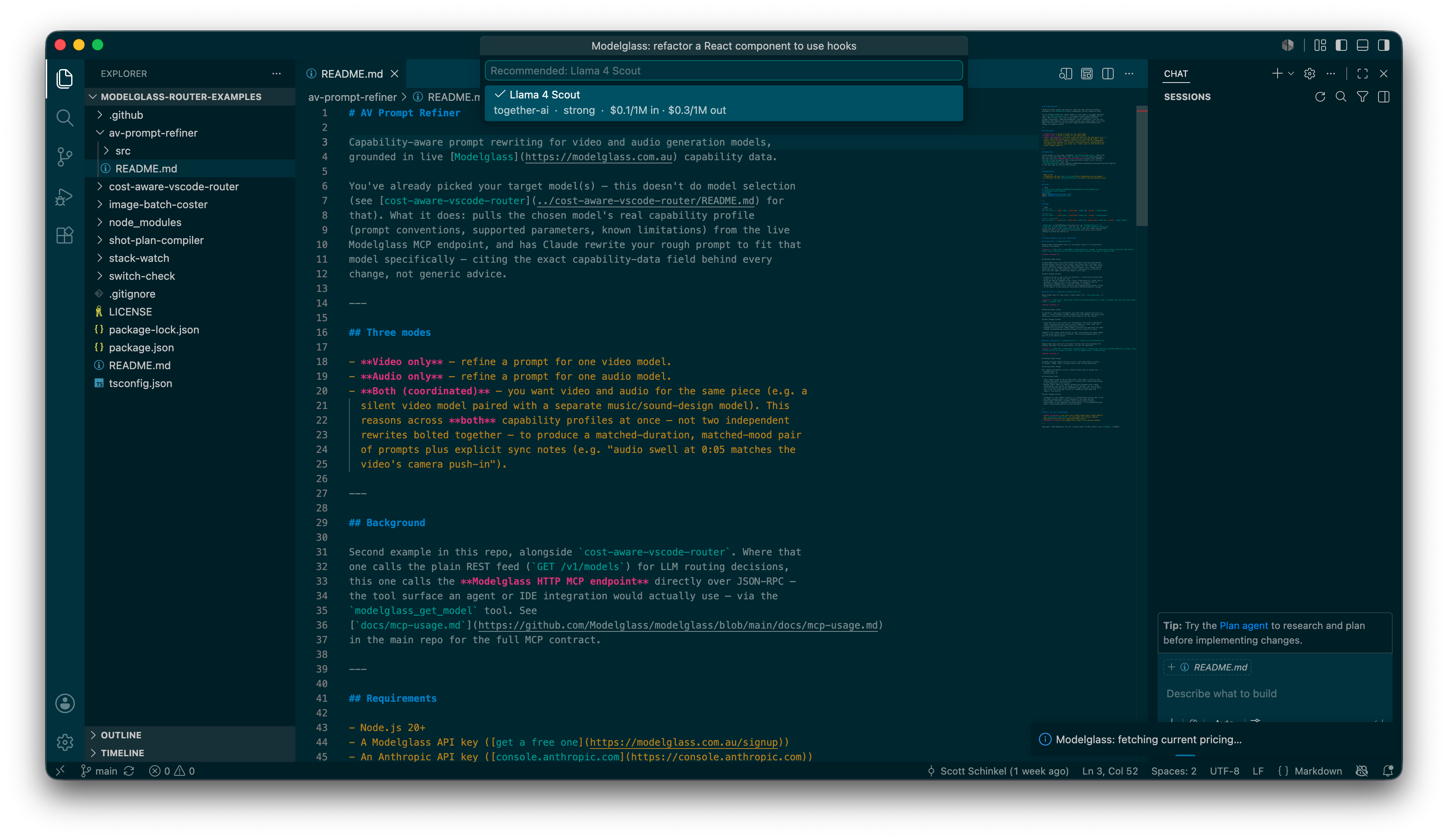
There are two distinct routing commands in this extension — see
Commands below for exactly how they differ. Route Task (the
original MVP command) only recommends a model; it never calls any provider
API. Run Task (new in v0.3.0) executes the call, using a provider key
you supply. Since v0.4.0, the router is also available directly inside
Copilot Chat — see Use inside Copilot Chat
below.
Table of contents
Use inside Copilot Chat
What it does
Brings Run Task's routing directly into Copilot Chat's model picker
(Modelglass Router, new in v0.4.0) — 9 selectable models, one per Run
Task's existing task category (Bug fix / debug, New code generation,
Terminal/CLI/DevOps, Library-aware feature work, Refactor, Test generation,
Documentation generation, Chat/explain, Autocomplete). Every message routes
through the exact same ranking, Pro/Starter fallback chain, and
.modelglass/routing-rules.json support as Run Task, using your own
configured key(s), with no Modelglass proxy in the request path (ADR-0012,
unchanged). Deliberately no automatic task-classifier: nine explicit models,
not one smart one, matching this extension's "explicit choice over hidden
magic" philosophy for Run Task's own category picker.
How to use it
- Configure a provider key first (see Provider API keys
below).
- Open Copilot Chat's model picker and select Modelglass Router.
- Pick the model matching what you're doing and chat normally.
A model whose category has no routable model for your configured provider(s)
right now still appears in the picker (never hidden — see
Provider API keys below for the same principle applied
to key setup) and responds with a clear explanation instead of a routed
answer.
Requires VS Code 1.104 or newer. On an older VS Code, this integration
silently doesn't register — every other command in this extension is
unaffected.
Route Task to Cheapest Capable Model
What it does
Recommends the cheapest LLM that clears a confirmed benchmark bar for your
task, using the live Modelglass pricing/capability feed — coding tasks
ranked by SWE-bench Verified, writing/general tasks by instruction-following
rating. Recommendation only — nothing is executed, no provider key
needed.
How to use it
- Run Modelglass: Route Task to Cheapest Capable Model from the Command
Palette.
- Describe what you're about to do. The extension infers a starting task
type (coding / writing / general) from your active file's language —
always overridable.
Run Task on Cheapest Capable Model
What it does
Executes a task against your own configured provider key(s) — a fully
client-side, BYOK router with no Modelglass proxy in the request path. Ranks
your configured provider's models against Modelglass's live
benchmark/capability feed (SWE-bench Pro/Verified, Terminal-Bench 2.1, Aider
Polyglot/LiveCodeBench, or BigCodeBench, depending on category — with a
qualitative capability-rating fallback for categories no benchmark covers
well) and calls the cheapest model that still clears a quality bar, using
your own key — not simply the highest-scoring one regardless of price,
matching this command's own name. Supports OpenAI, Anthropic, DeepSeek, xAI,
Mistral, Groq, Together AI, and OpenRouter.
Each of the five benchmark-scored categories has its own default bar
(calibrated to that benchmark's real score range — e.g. 60% on SWE-bench
Verified, 50% on Aider Polyglot); if every model in your configured
provider(s) happens to fall below it, that's a sign the bar doesn't fit
today's pool and the extension falls back to the highest-scoring model
instead of reporting nothing. The feed is cached locally for ~5 minutes, so a
brief Modelglass API blip doesn't block a Run Task call — a fetch failure
past that window falls back to the last known-good feed instead of failing
the run.
How to use it
- Configure a provider key first — Modelglass: Set Provider API Key (see
Provider API keys below).
- Run Modelglass: Run Task on Cheapest Capable Model, pick one of nine
task categories (bug fix/debug, new code generation, terminal/CLI/DevOps,
library-aware feature work, refactor, test generation, documentation
generation, chat/explain, autocomplete), and describe the task. If you
have an editor open, your current selection (or the whole file, if
nothing's selected) is automatically attached as context — the model sees
the code you're actually working on, not just your description of it. No
open editor: the task runs on your typed description alone.
- The response opens in its own editor tab beside your code (not the Output
channel) — labeled with the category and model that produced it, and
flagged if the provider reports the response was cut off at its max
output token limit.
Starter vs. Pro
- Starter (one configured key): one execution attempt. A failure
(invalid key, rate limit, network/provider error, or a request that times
out after 60s with no response) is reported clearly — no automatic retry.
- Pro (multiple configured keys, via Modelglass: Add Provider API
Key): on a failure — including a timeout — automatically retries the
next-best-ranked model on a different configured provider (never the
same provider twice), up to one attempt per configured provider. Pro also
unlocks an optional
.modelglass/routing-rules.json file in your
workspace to override the default ranking per category — exclude a
provider, force cheapest-first ignoring quality entirely, set an exact
model priority order, or set your own minScore (0–1) quality bar in
place of the built-in per-benchmark default described above.
minScore/strategy/priority only apply to the five benchmark-scored
categories (bug fix, new code generation, terminal/CLI, library-aware
feature work, refactor); minScore specifically is a no-op for the four
categories that fall back to a qualitative capability rating (those
already land on cheapest-among-the-top-rating-tier by default, since a
coarse rating scale ties far more often than a continuous benchmark
score). A Starter user with a routing-rules.json present, or attempting
to configure more than one provider key, gets a clear upgrade prompt
rather than a silent failure.
Compare Two Models
What it does
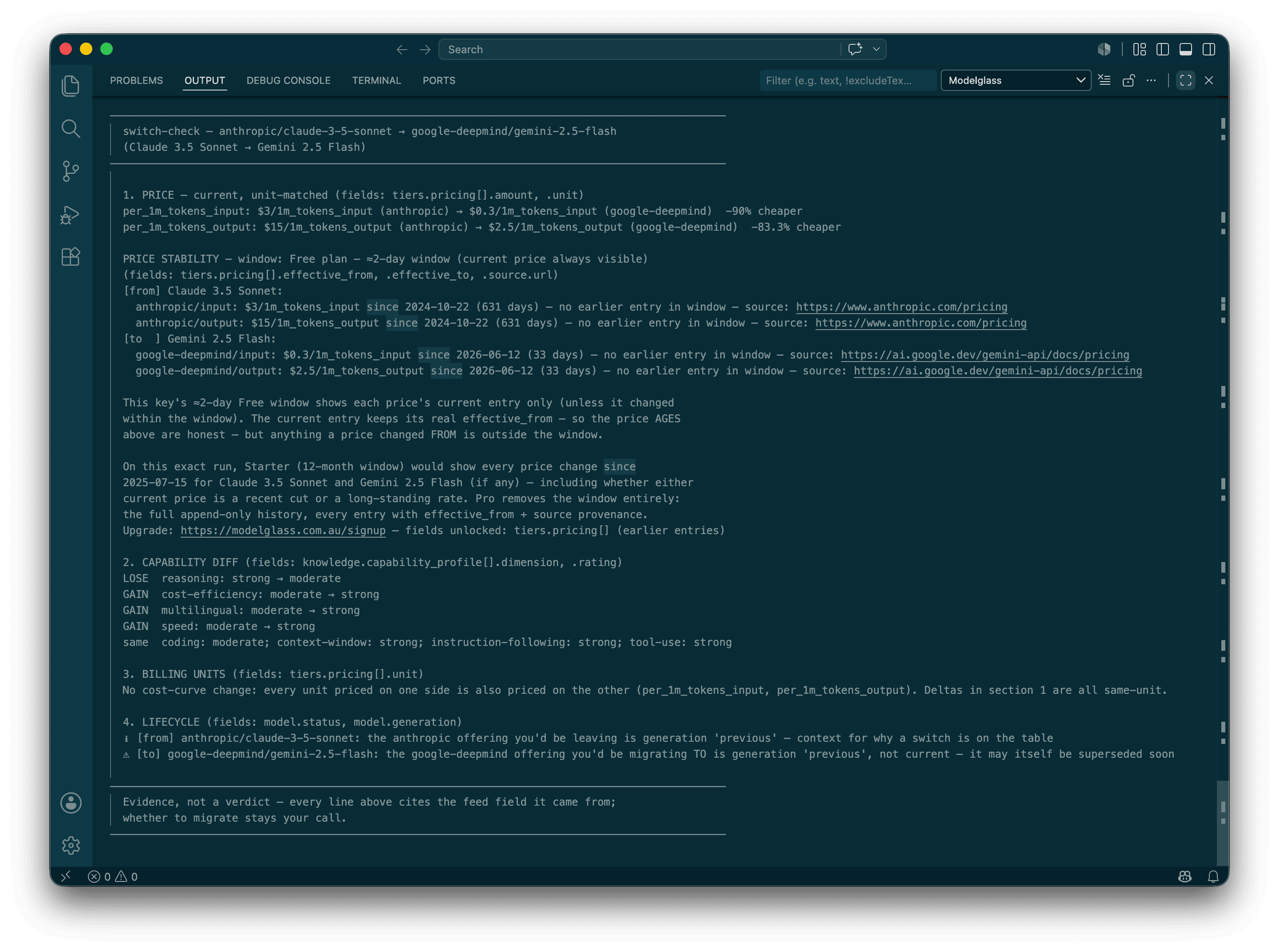
A grounded migration diff between two models — reports the unit-matched
price delta and price stability (from the append-only price history), a
per-dimension capability diff, billing-unit change warnings, and lifecycle
checks. Works across image/LLM/video/audio, and on every plan tier including
Free.
How to use it
- Run Modelglass: Compare Two Models from the Command Palette.
- Pick a "from" model, then a "to" model — or accept one of the feed's own
suggested competitors.
- Read the diff in the Modelglass Output panel.
Generate Video (Runway)
What it does
Generates video via Runway, using your own Runway API key (BYOK, no proxy)
— ranks Runway's video models cheapest-first from the live Modelglass feed.
5 of the registry's 7 Runway entries are offered (see
Known limitations). Output ratio is a fixed 1280:720
landscape default, not yet user-selectable. Starter/Pro only, same BYOK
tiering as Run Task.
How to use it
- Configure a Runway provider key (see Provider API keys
below).
- Run Modelglass: Generate Video (Runway).
- Pick a model, then describe what you want — plus an input image/video
file, if the model needs one.
- The job submits and polls to completion with a cancellable progress
notification. The result saves to
.modelglass/generated/ and reveals
itself in the OS file explorer.
Generate Audio (ElevenLabs)
What it does
Generates or transforms audio via ElevenLabs, using your own ElevenLabs API
key (BYOK, no proxy). Starter/Pro only, same BYOK tiering as Run Task.
How to use it
- Configure an ElevenLabs provider key (see
Provider API keys below).
- Run Modelglass: Generate Audio (ElevenLabs).
- Choose a mode: Text to Speech (synchronous), Dub Audio/Video
(async, polled with a cancellable progress notification), or Clone a
Voice (Instant Voice Cloning, synchronous).
- TTS/dubbing results save to
.modelglass/generated/ and reveal
themselves in the OS file explorer; voice cloning reports the new voice
ID instead (it produces no file).
ElevenLabs has no confirmed dubbing-cancel endpoint, so canceling a dubbing
job only stops this extension from waiting — see
Known limitations.
Install and Setup
From the Marketplace: search Modelglass Cost-Aware Router in VS Code's
Extensions view, or run:
code --install-extension modelglass.cost-aware-router
From a .vsix file directly (e.g. for testing a pre-release build):
code --install-extension path/to/cost-aware-router-0.1.0.vsix
First run
No account or setup needed: the extension silently provisions its own free
Modelglass API key the first time you run a command, stored in VS Code's
SecretStorage — never in a settings file or anything synced elsewhere.
Look in the Modelglass output channel (View → Output) to confirm it
provisioned successfully. If the API is unreachable, it offers to retry or
let you enter a key manually instead. This free Modelglass key is what
Run Task also checks against to determine Pro vs Starter access — it's
the same key, not a separate credential.
Provider API keys
Run Task needs a key from whichever LLM provider(s) you want it to call
— these are entirely separate from the free Modelglass key above, and are
never sent to Modelglass, only to the provider itself.
- Modelglass: Set Provider API Key — the Starter flow: pick a provider,
paste its key. Exclusive — setting a new provider's key replaces
whichever one was configured before (with a confirmation warning).
- Modelglass: Add Provider API Key — the Pro flow: pick a provider,
paste its key, alongside any other already-configured provider(s) —
this is what builds the fallback chain. Adding a first key, or rotating
an already-configured provider's own key, is never gated; adding a
second simultaneous provider requires Pro.
Both store into VS Code's SecretStorage, same mechanism as the free
Modelglass key.
Right after a key is saved, the extension previews which of the nine task
categories that provider actually has routable models for — registry
benchmark coverage is sparse enough that some providers/categories resolve
to zero models today, and this makes that gap visible immediately (Output
channel breakdown, plus a notification if coverage is partial or zero)
instead of discovered mid-task. Since v0.4.0, both the Set and Add
provider pickers show this same coverage (e.g. "7/9 categories routable
today") right on each provider option, before you even paste a key.
Commands
| Command |
What it does |
| Modelglass: Route Task to Cheapest Capable Model |
Prompts for a task description, then recommends the cheapest LLM that clears the relevant quality bar for it. Coding/writing/general only. Never calls a provider API. |
| Modelglass: Run Task on Cheapest Capable Model |
Prompts for a task category and description, then executes the call against the top-ranked model using your own configured provider key(s). See Run Task above. |
| Modelglass: Compare Two Models |
Grounded migration diff between two models — pick a "from" model, then a "to" model (or the feed's own suggested competitors). Reports the unit-matched price delta and price stability (from the append-only price history), a per-dimension capability diff, billing-unit change warnings, and lifecycle checks, in the Modelglass Output panel. Works across image/llm/video/audio, and on every plan tier including Free. See Compare Two Models above. |
| Modelglass: Set API Key |
Enter an existing free Modelglass API key, or clear the stored one (forcing re-provisioning on next use). |
| Modelglass: Set Provider API Key |
Starter: store a single provider key (LLM execution), replacing any previous one. |
| Modelglass: Add Provider API Key |
Pro: store an additional provider key alongside existing ones, for fallback chains. |
| Modelglass: Generate Video (Runway) |
Starter/Pro. Picks a Runway video model (ranked cheapest-first from the Modelglass feed), prompts for a text description (plus an input image/video file when the model needs one), submits the job, and polls to completion with a cancellable progress notification. See Generate Video above. |
| Modelglass: Generate Audio (ElevenLabs) |
Starter/Pro. Choose Text to Speech (sync), Dub Audio/Video (async, polled with a cancellable progress notification), or Clone a Voice (Instant Voice Cloning, sync). See Generate Audio above. |
Scope
- Route Task is LLM routing only (coding + writing/general), recommendation
only, no execution — the original MVP command, unchanged since v0.1.0.
Run Task (BYOK router, v0.3.0+) is also LLM-only, but ranks across nine
finer-grained task categories and actually executes. Neither routes
image/video/audio.
- Generate Video/Generate Audio (BYOK, Starter/Pro) route video
(Runway) and audio (ElevenLabs TTS/dubbing/IVC) generation specifically —
a separate, much simpler price-only ranking (
src/media-routing-lib.ts)
from Run Task's nine-category benchmark ranking, since this registry has
no capability-benchmark data for video/audio generation to rank on.
Image generation is explicitly out of scope for now (fal.ai, the likely
provider, isn't confirmed yet — a separate future addition). No fallback
chain for either command, on any tier — one attempt per invocation, same
as Route Task/Run Task, but deliberately with no same-provider retry
either (ADR-0012 Amendment 2). Compare Two Models remains the only
command that's cross-modality (image/llm/video/audio) in the sense of
comparing pricing across any of them; Generate Video/Audio only
execute against Runway/ElevenLabs specifically.
- Run Task doesn't offer the composite "agentic multi-step" category —
that needs its own subtask-decomposition UI, not built yet. It routes one
task to one category per invocation, same "once per invocation" scope as
Route Task.
- Only eight providers have a working execution adapter today: OpenAI,
Anthropic, DeepSeek, xAI, Mistral, Groq, Together AI, OpenRouter. A
provider-API model-identifier heuristic is used (documented in
src/provider-execute.ts) since Modelglass's registry doesn't carry a
dedicated field for a provider's literal model string — OpenRouter and
Together AI are the two providers where this heuristic is least reliable.
- No MCP exposure yet — Run Task's routing/execution is VS Code-only for now;
exposing it as an MCP tool for agent frameworks outside VS Code is a
possible future direction, not built.
- No escalation/usage-logging (the CLI's
report command's feature set) — out
of scope for this extension.
- Copilot Chat integration (v0.4.0) is v1-scoped: text-only (no image
input, no tool calling — a message containing only non-text parts is
answered as if it were empty rather than erroring), non-streaming (one
complete response per turn, not token-by-token — VS Code's own official
sample extension does the same, so this isn't a stopgap), and no deep
cancellation into the underlying provider call once it's started. All
three are real, separately-scoped follow-ups, not silently dropped.
Known limitations
Specific to Generate Video/Generate Audio (SCO-430), called out here
rather than left implicit:
- Video output ratio is a fixed 1280:720 landscape default — Runway
requires an explicit ratio for some models (Gen-4.5, Gen-4 Turbo) with no
server-side default of its own, and this release always supplies the same
one rather than offering a picker. Portrait/square output isn't reachable
yet.
- Gen-3 Alpha is not offered — it was retired from Runway's API
(2026-07-30) and no longer has a working model identifier, even though it
may still show as available on modelglass.com.au
itself (a separate registry-data staleness issue, tracked independently).
- Act-Two is not offered — it requires a different Runway endpoint
(Character Performance, a reference-video-plus-character-image input
shape) than this release's adapter supports.
- ElevenLabs dubbing has no confirmed cancel endpoint. Canceling a
dubbing job stops this extension from polling it, but the job may keep
running (and billing) on ElevenLabs' side regardless — disclosed in the
progress notification, not silently assumed away.
Relationship to cost-aware-vscode-router
The core selection logic behind Route Task (src/lib.ts) is vendored from
modelglass-router-examples/cost-aware-vscode-router/src/lib.ts —
same pricing/quality-bar logic, same tests. There's no published shared
package to depend on instead, so this is a deliberate copy, kept in sync by
hand. requireApiKey() (that repo's CLI-only key handling, which calls
process.exit(1) on failure — not safe inside an Extension Host) is replaced
entirely by src/auth.ts.
Run Task (src/routing-engine.ts, src/run-task*.ts,
src/provider-*.ts, src/routing-rules*.ts, src/pro-gate*.ts) is original
code written for this extension — not vendored from anywhere.
Development
npm install
npm run typecheck
npm test
npm run build      # bundles src/extension.ts -> dist/extension.cjs via esbuild
npm run watch       # same, rebuilding on change
npm run package     # builds + bundles a .vsix via vsce
Press F5 in VS Code (with this folder open) to launch an Extension
Development Host for manual testing.
License
MIT — see LICENSE. Consistent with modelglass-router-examples
(SCO-170) — this extension is meant to be installed, read, and adapted.