DBML Studio
A DBML workbench for VS Code: read a schema as an entity-relationship diagram, import one from a live PostgreSQL database, and diff a .dbml file against the database it describes.
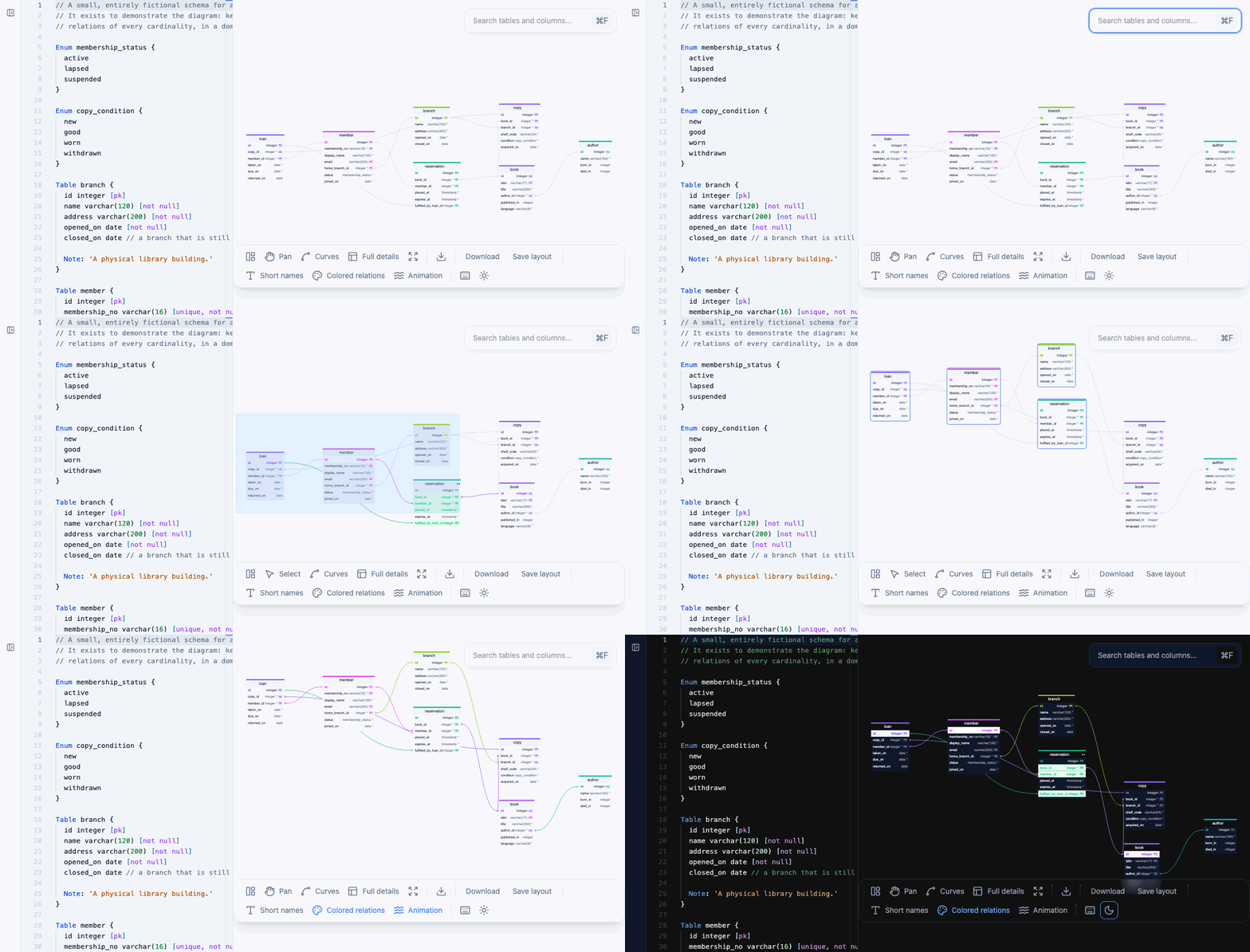
A fictional library schema — the model is in examples/library.dbml.
Unofficial fork. Not affiliated with, or endorsed by, the authors of the original project. Based on BOCOVO/db-schema-visualizer (MIT License); maintained independently by AKonyshev. This is a separate extension with its own identifier, commands, and settings — installing it leaves the original alone.
What this fork adds
- Import from PostgreSQL — command palette → DBML: Import from database. A saved connection stands for a whole server: the side bar opens it into its databases and their schemas, and one import can take several databases at once, writing one
.dbml file per database with every schema you picked inside it. Connections live in the DBML side bar and their credentials go to the VS Code secret store.
- Compare with a live database — open a
.dbml file, then DBML: Compare with database, and see where the file and the database have drifted apart.
- A layout that lives in the file — drag tables about and the positions are written into a
MetaInfo block in the DBML itself, one arrangement per detail level, so the diagram opens as you left it on any machine.
- Export the diagram as PNG, SVG, AsciiDoc, or Markdown.
- Interface in English, Russian, and Simplified Chinese, following your VS Code display language.
- Keyboard shortcuts for every view action, with a built-in legend (
?).
Diagram
- Entity-relationship diagram from your DBML file
- Light and dark themes
- Display modes: all columns, relational columns only, or table headers only
- Hide/show relations per table via the icon in the table header, or H for the table under the pointer; it is a view preference and nothing is written to the file
- Bring every hidden relation back at once, from the toolbar button or R
- Colored relations: either one neutral colour for all of them, or each relation painted in its source table's colour
- Relation animation: the relations of the table under the cursor animate to show their direction
Keyboard shortcuts
Every view action is a command, so the keys below are defaults rather than fixtures: rebind any of them in Preferences: Open Keyboard Shortcuts by searching for DBML, and run any of them from the command palette. They apply while the diagram has focus and nowhere else.
| Key |
Command |
C |
Colored relations |
A |
Relation animation |
S |
Short table names |
D |
Cycle detail level |
V |
Switch between pan and select |
L |
Auto-arrange |
F |
Fit to view |
H |
Hide/show the hovered table's relations |
R |
Show all hidden relations |
T |
Cycle the hovered table's detail level |
U |
Give every table the shared level back |
? |
Show the shortcuts legend |
Two keys belong to the diagram itself and are not commands: Esc closes the legend, and Ctrl/Cmd+F opens the table search.
None of these keys fires while you are typing, in the diagram's own search box or anywhere else in the editor.
? is where a US layout puts it. On a layout that puts it elsewhere, use the keyboard button in the toolbar or rebind the command.
Every command is also in the palette, with one exception: hiding the hovered table's relations acts on whatever the pointer is over, and opening the palette takes the pointer away, so it would always find nothing. Use the key for that one, or rebind it.
The same list is available in the app: press ? or use the keyboard button in the toolbar. It shows the defaults, not a key you have rebound.
Languages
The interface follows your VS Code display language: English, Russian (ru) and Simplified Chinese (zh-cn). Any other display language falls back to English — including Traditional Chinese (zh-tw), because mainland and Taiwan terminology differ enough that showing Simplified would be misleading.
The Chinese translation is a community contribution and has not been reviewed by a native speaker. Corrections are welcome — the catalogs live in packages/json-table-schema-visualizer/src/i18n/locales/ and packages/dbml-vs-code-extension/l10n/.
Extension settings
dbmlStudio.preferredTheme — light or dark (default: dark)dbmlStudio.scrollDirection — up-out or up-in (default: up-out)
Release notes
CHANGELOG.md
Attribution
Licensed under the MIT License.

