

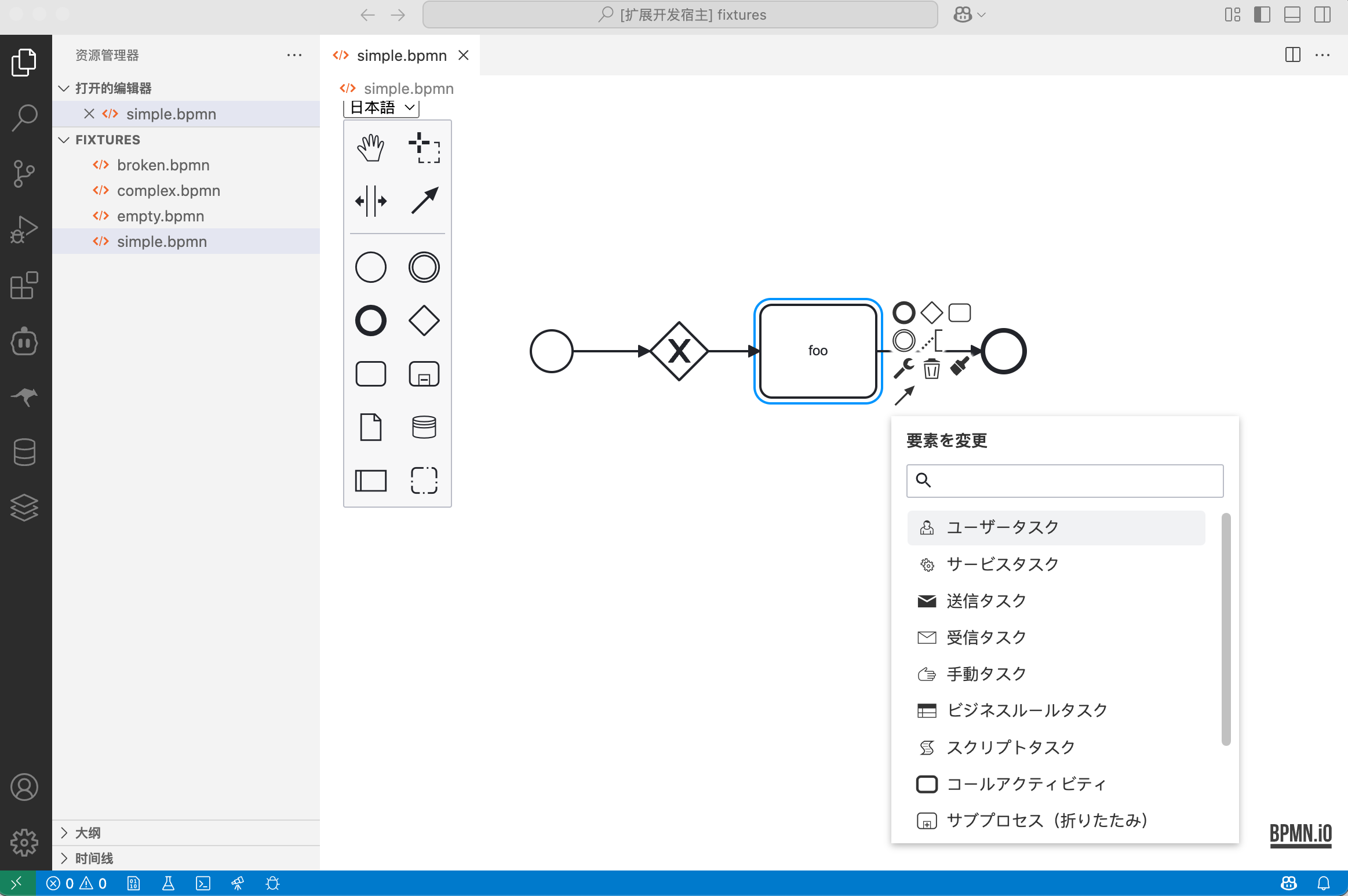
BPMN.flex EditorView and edit BPMN diagrams in VS Code.
Features
Custom Properties ConfigurationYou can define custom editable properties for any BPMN element type in your VS Code Property Definition Fields
Path SyntaxThe
Source Types
|
| Control | UI Widget | Notes |
|---|---|---|
text |
<input type="text"> |
Single-line text |
textarea |
<textarea> |
Multi-line text, 4 rows |
number |
<input type="number"> |
Numeric, supports min/max/step |
boolean |
<select> True/False |
Coerces "true"/"1" → true, "false"/"0" → false |
date |
<input type="date"> |
Validates YYYY-MM-DD format |
select |
<select> dropdown |
Requires options array |
code |
<textarea> monospace |
Multi-line with monospace font, 8 rows. Use for YAML/JSON editing |
Full Configuration Example
{
  // Properties shown for ALL BPMN elements
  "bpmn-flex.commonProperties": [
    {
      "label": "Element ID",
      "path": "@id",
      "source": "attribute",
      "control": "text",
      "group": "General",
      "order": 1,
      "description": "Unique identifier for this element"
    },
    {
      "label": "Name",
      "path": "@name",
      "source": "attribute",
      "control": "text",
      "group": "General",
      "order": 2
    },
    {
      "label": "Documentation",
      "path": "bpmn:documentation",
      "source": "text",
      "control": "textarea",
      "group": "General",
      "order": 3
    }
  ],

  // Properties for specific element types
  "bpmn-flex.elementSpecificProperties": {
    "bpmn:Process": [
      {
        "label": "Process Type",
        "path": "@processType",
        "source": "attribute",
        "control": "select",
        "options": [
          { "label": "None", "value": "None" },
          { "label": "Public", "value": "Public" },
          { "label": "Private", "value": "Private" }
        ],
        "group": "Process"
      },
      {
        "label": "Executable",
        "path": "@isExecutable",
        "source": "attribute",
        "control": "boolean",
        "group": "Process"
      }
    ],

    "bpmn:ServiceTask": [
      {
        "label": "Implementation",
        "path": "@implementation",
        "source": "attribute",
        "control": "select",
        "options": [
          { "label": "WebService", "value": "##WebService" },
          { "label": "External", "value": "##External" },
          { "label": "Expression", "value": "##Expression" }
        ],
        "group": "Service"
      },
      {
        "label": "Delegate Expression",
        "path": "@camunda:delegateExpression",
        "source": "attribute",
        "control": "text",
        "group": "Engine"
      }
    ],

    "bpmn:ScriptTask": [
      {
        "label": "Script Format",
        "path": "@scriptFormat",
        "source": "attribute",
        "control": "select",
        "options": [
          { "label": "JavaScript", "value": "javascript" },
          { "label": "Groovy", "value": "groovy" },
          { "label": "Python", "value": "python" },
          { "label": "FEEL", "value": "feel" }
        ],
        "group": "Script"
      }
    ],

    "bpmn:CallActivity": [
      {
        "label": "Called Element",
        "path": "@calledElement",
        "source": "attribute",
        "control": "text",
        "group": "Call",
        "description": "Expression or ID of the called process"
      }
    ],

    "bpmn:ExclusiveGateway": [
      {
        "label": "Default Flow",
        "path": "@default",
        "source": "attribute",
        "control": "text",
        "group": "Gateway"
      }
    ],

    "bpmn:SequenceFlow": [
      {
        "label": "Source",
        "path": "@sourceRef",
        "source": "attribute",
        "control": "text",
        "group": "Flow",
        "order": 1
      },
      {
        "label": "Target",
        "path": "@targetRef",
        "source": "attribute",
        "control": "text",
        "group": "Flow",
        "order": 2
      }
    ],

    "bpmn:Error": [
      {
        "label": "Error Code",
        "path": "@errorCode",
        "source": "attribute",
        "control": "text",
        "group": "Error"
      },
      {
        "label": "Error Message",
        "path": "@camunda:errorMessage",
        "source": "attribute",
        "control": "text",
        "group": "Error"
      }
    ]
  }
}
YAML Embedded Content
When source is "embedded" and format is "yaml", the extension parses and serializes a practical subset of YAML:
- Scalars: strings, numbers (
42,3.14), booleans (true/false), null - Mappings: nested key-value pairs
- Sequences: arrays (e.g.,
- item1) - Comments: lines starting with
#are preserved
Note: Anchors (
&), aliases (*), tags (!), block scalars (|,>), and multi-document (---) YAML features are NOT supported. For complex YAML, usecontrol: "code"to edit the raw text directly.
Installation
Download it from the VS Code Marketplace, search for vs-code-bpmn-flex directly inside VS Code.
Build and Run
First step, clone this project to your local machine and open it with VS Code:
git clone https://github.com/yougikou/vs-code-bpmn-flex.git
cd ./vs-code-bpmn-flex
npm install
code .
Press F5 to load and debug the extension in a new VS Code instance. To execute the tests choose the Extension Tests in the Debug mode.
You can build the extension from the command line, too:
# execute the test suite
npm run test

# execute all scripts
npm run all
CI / CD
CI Pipeline (CI.yml)
Runs on every push and pull request across macOS, Ubuntu, and Windows:
| Step | Description |
|---|---|
| Install deps | npm install with cache |
| Lint + Test | npm run all (ESLint + Mocha tests) |
| UI Screenshots | Linux only: captures screenshots in EN/ZH/JA + sidebar states, uploaded as artifacts |
| PR Comment | Linux only: auto-posts screenshot summary on PRs |
| Dry-run package | npx @vscode/vsce ls to verify packaging |
Release Pipeline (release.yml)
The release workflow enforces a strict relationship between the VSIX version and the Git tag:
package.json version = "0.20.0"    ← single source of truth
                     │
                     ▼
            Tag = "v0.20.0"         ← MUST match, validated on every release
                     │
                     ▼
        VSIX = vs-code-bpmn-flex-0.20.0.vsix
How to Release
Primary path — trigger from the GitHub Actions UI (no CLI needed):
1. Update CHANGELOG.md with release notes
2. Go to GitHub → Actions → Release → "Run workflow"
3. Choose bump type: patch / minor / major / none
4. Click "Run workflow"
| Bump choice | package.json before |
package.json after |
Tag created |
|---|---|---|---|
patch |
0.20.0 | 0.20.1 | v0.20.1 |
minor |
0.20.0 | 0.21.0 | v0.21.0 |
major |
0.20.0 | 1.0.0 | v1.0.0 |
none |
0.20.0 | 0.20.0 (unchanged) | v0.20.0 |
All of the following happen automatically:
- Bump
package.json(patch/minor/major) - Commit the version bump to
main - Create and push a
v{version}tag - Extract the release notes from
CHANGELOG.md - Build the
.vsixpackage - Create a GitHub Release with the VSIX attached
You can also mark a release as pre-release by checking the checkbox in the workflow form.
Fallback: Manual Tag Push
If you manually push a v* tag (e.g., git tag v0.20.1 && git push origin v0.20.1), the workflow will still:
- Validate that the tag matches
package.jsonversion (fails with a clear error if not) - Build the
.vsixand create the GitHub Release
This ensures the VSIX and the release are always in sync, regardless of how the tag was created.
Helper Scripts
npm run changelog 0.20.0     # Extract release notes for a specific version from CHANGELOG.md
npm run version:patch         # Bump version locally (patch)
npm run version:minor         # Bump version locally (minor)
npm run version:major         # Bump version locally (major)
License
MIT
Contains parts (bpmn-js) released under the bpmn.io license.