ERD Editor
Entity-Relationship Diagram Editor for Visual Studio Code
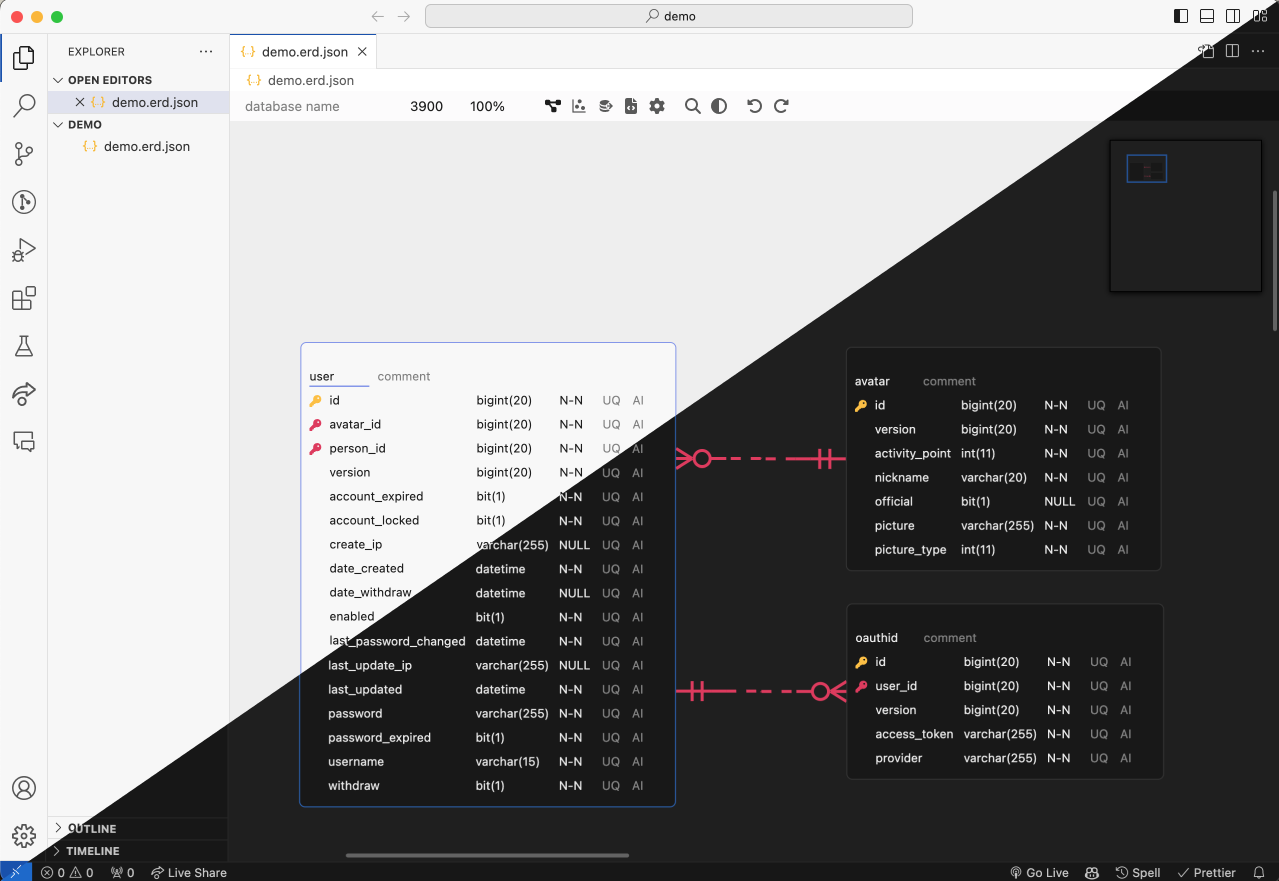
Design a database schema visually, right next to your code. Diagrams are plain JSON files in
your repository, so they diff and review like any other source file.
The editor never connects to a database — it reads and writes files only. You bring a schema
in from a .sql dump or a GraphQL SDL file, and take one back out as DDL.
Getting started
Create an empty file with a .erd.json extension and open it in VS Code. The
diagram opens in the ERD Editor by default.
Editing marks the tab dirty like any other file; the diagram is written to disk when you save.
Undo and redo are the diagram editor's own history, not VS Code's.
On the empty canvas, Alt+N adds a table and Alt+Enter adds a column to it. To start
from a schema you already have, right-click the canvas and choose Import → Schema SQL
for a .sql dump, or Import → GraphQL for a .graphql, .gql or .graphqls file.
Either one replaces the diagram in one undoable step.
Use the icon in the editor title bar to switch between the diagram and its JSON source — hold
Alt while clicking to open the other view to the side instead. These are title-bar actions
only; they do not appear in the Command Palette.
Features
- Visual schema design — tables, columns, memos, and four relationship cardinalities
(zero-one, zero-N, one-only, one-N)
- SQL DDL import — bring in a
.sql dump from any of the seven vendors below. The parser
reads CREATE TABLE, CREATE INDEX and ALTER TABLE constraints and skips what it does
not recognize, so an awkward dump imports partially rather than failing outright
- GraphQL SDL import — bring in a schema from any tool that emits SDL. Object types
become tables, scalars map to the diagram's own dialect, and the fields pointing at another
type become the relationships; the generated types an API layer wraps its rows in are left
out rather than drawn as tables
- DBML import — bring in a
.dbml file written for dbdiagram.io or dbdocs.io, or emitted
by sql2dbml or prisma-dbml-generator. Tables, columns, indexes, enums and every Ref
spelling arrive; a Project, TableGroup or sticky Note is skipped rather than refused
- AML import — bring in an
.aml file written for Azimutt, in either
the v2 or the legacy v1 spelling. Entities, attributes, indexes, enums and every relation
arrow arrive; a check, a struct type and a view are skipped rather than refused
- SQL DDL export — Databricks, MariaDB, MSSQL, MySQL, Oracle, PostgreSQL, Snowflake, SQLite
- Code generation — TypeScript, GraphQL, C#, Java, JPA, Kotlin, Scala, Go,
SQLAlchemy, TypeORM, Sequelize, Drizzle, DBML, AML
- Visualization — a force-directed view of how the tables actually relate
- Export —
.erd.json, .sql, .png
- Quick search —
Ctrl/Cmd+K to jump to any table, or run any editor command
- Time travel — replay this editing session's history on the canvas and jump to any point in it
- Undo / redo and a built-in theme builder
Keeping diffs clean
By default the document also stores the canvas scroll position and zoom level, so panning
around shows up in git diff. Turn off Save Scroll Information and Save Zoom
Information in the editor's settings to keep diffs limited to schema changes.
Multiple editors per document
The same document can be open in several editors at once, and they stay in sync.
Coding agents
A coding agent such as Claude Code or Codex can edit the diagrams open in this window through the
@dineug/erd-editor-mcp
MCP server. The agent joins the editor like a collaborator: each change shows up on the canvas as
it happens and stays unsaved until the agent or you save, and the agent's undo reverts only its
own edits.

Install the MCP server
The server needs Node.js 22.12 or later. npx downloads it the first time the agent starts it, so
there is nothing else to install.
Claude Code — run in your project folder:
claude mcp add --transport stdio erd-editor -- npx -y @dineug/erd-editor-mcp
Codex — add to ~/.codex/config.toml, or to .codex/config.toml in a trusted project:
[mcp_servers.erd-editor]
command = "npx"
args = ["-y", "@dineug/erd-editor-mcp"]
Any other MCP client — run npx -y @dineug/erd-editor-mcp as a stdio server. Start it in your
project folder: it resolves relative document paths against its working directory.
Edit with an agent
- Open the project folder in VS Code and trust the workspace.
- Start the agent in the same folder and ask in plain words, for example "Add a reviews table to
schema.erd.json, related to users and products".
- Watch the change land on the canvas, then save with
Ctrl/Cmd+S, or ask the agent to save.
A diagram that is not open yet opens in the ERD Editor on the agent's first edit. With no VS Code
window on the document's folder, the agent edits the file on disk instead.
The agent connects only in a trusted workspace, and the dineug.erd-editor.agentHub.enabled
setting turns it off for the window. Either way it can still read the diagrams from disk, but it
never writes one behind the editor, where your next save would overwrite the change. The
MCP server's README
lists every tool.
Settings
| Setting |
Default |
Values |
dineug.erd-editor.theme.appearance |
dark |
auto, light, dark |
dineug.erd-editor.theme.grayColor |
slate |
gray, mauve, slate, sage, olive, sand |
dineug.erd-editor.theme.accentColor |
indigo |
26 Radix accents — gray, gold, bronze, brown, yellow, amber, orange, tomato, red, ruby, crimson, pink, plum, purple, violet, iris, indigo, blue, cyan, teal, jade, green, grass, lime, mint, sky |
dineug.erd-editor.agentHub.enabled |
true |
true, false |
Changing any of the three theme settings re-themes every open diagram immediately. auto
follows your VS Code color theme and switches with it; note that the default is dark whichever
theme you use.
The theme builder inside the editor changes these same three values and writes them back
here, so a theme you pick on the canvas persists.
Documentation
Also available
Issues
Found a bug or want a feature? Open an issue.
License
MIT © SeungHwan-Lee
| |

