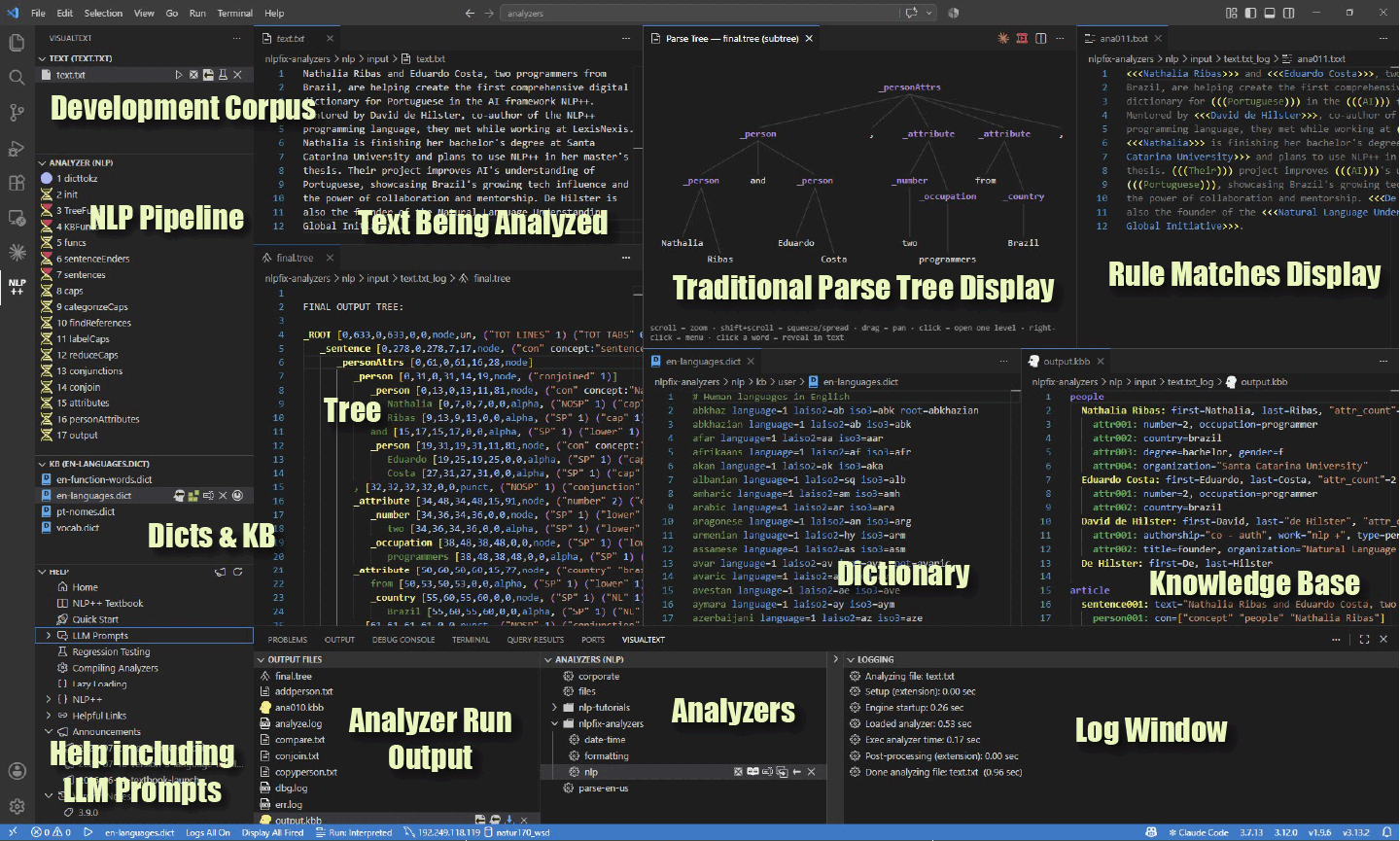
NLP++ Language Extension
Build, debug, and ship glass-box text analyzers in Visual Studio Code.

Click the screenshot for a full-size view.
NLP++ is the only programming language built exclusively for text and natural language processing. This extension brings the full VisualText development environment — which ran on Windows for two decades — into VS Code on Windows, Linux, and macOS, and bundles the NLP-ENGINE that runs it. Build up a parse tree, consult your dictionaries and knowledge bases, watch every rule fire, then compile the whole analyzer to a native library you can ship.
Why NLP++
NLP++ analyzers are deterministic: the same input always produces the same output, from code a human wrote and any human can read. There is no model, no training, and no inference — just linguistic and world knowledge you encode and can correct. That makes NLP++ the right tool where the other two options run out:
|
Regex |
LLMs |
NLP++ |
| Deterministic |
yes |
no |
yes |
| Auditable — you can see why |
barely |
no |
yes |
| Linguistic structure |
none |
mimicked, never represented |
an explicit parse tree |
| Carries world knowledge |
no |
associations, not knowledge |
yes — dictionaries and a KB you edit |
| Fixable when it's wrong |
rewrite the pattern |
no guarantee it can be fixed |
go to the code that did it and change it |
| Cost per document |
free |
per token, forever |
free if you curate it yourself — far below token prices if you don't |
Regex has no notion of language at all and shatters on real text. LLMs are subtler: they emit text that is consistent with linguistic structure without ever building any. The fluency is real; the analysis is not. There is no tree inside, no constituent, no labeled node — nothing to point at, query, or correct, because nothing was ever represented. What looks like understanding is a very good imitation of its output. The same goes for what a model appears to know: statistical association over a corpus yields true statements often and false ones with identical confidence, and there is no concept to look up and no assertion to correct. NLP++ builds both the structure and the knowledge explicitly, which is why you can inspect them — and why you cannot pin an LLM down, audit it, or hold it to a spec.
The difference that matters most is fixability. In a statistical system there is no guarantee a known error can be corrected at all. You can re-prompt or retrain and hope; nothing in the machinery promises the specific failure goes away, nothing tells you why it happened, and a change that fixes it may silently break something that already worked. You are negotiating with a distribution. In NLP++, a wrong answer came from somewhere specific — a rule, a dictionary entry, a concept in the knowledge base, a line of code — and you can go there, read it, and change it. The fix stays fixed. That is why NLP++ belongs on the critical path of real software products, where a wrong answer has a cost and "the model said so" isn't an answer.
Then there is the bill. A compiled NLP++ analyzer is native code running on hardware you already have — no tokens, no per-call metering, nothing that scales with your traffic. Curation is the only real cost in NLP++, and you get to choose how you pay it:
- Write and curate it yourself, and it is free. The analyzer, its dictionaries, and its knowledge bases are yours outright — reusable across projects, improving as you go, costing nothing per document at any volume.
- Or use an analyzer someone already curated. NLPfix.ai offers ready-made NLP++ extractors as MCPs and APIs for the routine extraction work now handed to LLMs — deterministic, fixable, and on the order of 100× cheaper than the tokens they replace.
Neither path is LLM pricing.
What an NLP++ Analyzer Is Made Of
NLP++ is often called "rule-based," which undersells it badly. Rules are one of four things you write, and they are the least interesting on their own. An analyzer is a sequence of passes over a text, and each pass has all four available to it. All four are visible in the screenshot at the top of this page:
The parse tree. Not an output artifact — the working data structure. Each pass reads the tree left by the pass before it and builds on it, tokens becoming words, words becoming phrases, phrases becoming whatever your domain calls for. Nodes carry attributes you set and read. You can watch the tree grow pass by pass, and graph any part of it.
Rules. Patterns in @RULES regions that match a sequence of nodes and reduce them into a new one, with modifiers like [min=0 max=2], [opt], and [layer=...] controlling how they apply. This is the pattern-matching layer — and only that layer.
Dictionaries and knowledge bases. This is where NLP++ departs from every regex-shaped tool. Dictionaries carry word-level knowledge — part of speech, stem, inflection, semantic category — for as many words as you care to describe. The knowledge base is a hierarchy of concepts with attributes and relationships: the world knowledge your analyzer reasons with. Both are yours to author, inspect, edit, and version, and both can be built at run time by the analyzer itself. A concept added in pass 12 is there in pass 30.
Functions and code. @CODE, @CHECK, and @POST regions hold real procedural code — variables, control flow, arithmetic, string handling, file and database I/O — plus several hundred built-in functions whose whole purpose is reaching into the other three. N("attr") and S("attr") read numeric and string attributes off matched nodes; findnode, pnvar, and addnode walk and modify the tree; dictfindword and dictgetword consult the dictionaries; findconcept, addconcept, addstrval, getstrval, and conceptpath query and grow the knowledge base. A rule can fire, its @POST code can look the matched word up in a dictionary, check a concept in the KB, decide the match was wrong, and fail() it.
That last sentence is the point. The four parts are one system, and the accompanying functions are what make them one — a rule that consults world knowledge before it commits, code that reshapes the tree based on what a dictionary said. Statistical systems get that interplay by burying it in weights nobody can read. NLP++ gets it in code you wrote, and every part of it is glass-box: readable, testable, diffable, and fixable.
NLP++ and LLMs
Using a probabilistic black box to build a deterministic glass box turns out to be an excellent trade. An LLM writes the NLP++; the NLP++ is what ships, and it never hallucinates. Version 3 of this extension was itself built that way — see 8 Weeks with Claude and NLP++.
The extension ships an LLM prompt library to make that workflow concrete. Open the Help view and pick a prompt — it is filled in with your machine's paths, opened in an editor, and copied to your clipboard, ready to paste into Claude or any other assistant:
- Prime Claude for NLP++ — points the assistant at the local function help and NLP++ reference so it stops guessing signatures
- General pointers: Claude + NLP++ — how to work with an analyzer productively
- From scratch: chemical formulas — a worked example of building an extractor
- Harden analyzer — generate more test text and close the gaps it exposes
- Create Dictionaries & KBs — bulk-build lexicons and knowledge bases
- Add missing words to the English dictionary
Start with Using Claude with NLP++ for the step-by-step walkthrough.
Getting Started
- Install the extension from the Marketplace. The NLP-ENGINE comes with it — there is nothing else to download, and it keeps itself up to date.
- Open (or create) a folder to hold your analyzers. Use New Analyzer in the Analyzer view and pick a template.
- Drop a text file into the analyzer's
input folder, select it in the Text view, and run the analyzer.
- Open the resulting
.tree file, or right-click it and choose Graph Entire Tree, to see exactly what matched and why.
New to NLP++? The hello-world video and the tutorial videos cover this ground in a few minutes.
What's in the Extension
Version 4 adds a debugger — breakpoints, stepping, variables and a call stack inside a running analyzer. Version 3, the chapter before it, made analyzers compilable and cloud-buildable; Everything New in Version 3 tells that story. In brief:
Write
IntelliSense that knows where the cursor is — region markers, built-in functions, or rule elements
Signature help for function calls, across passes
Hover documentation, rendered as markdown right in the editor
Go to definition, find references, rename, and workspace symbol search for rules, functions, and KB concepts — across every pass in the analyzer
Diagnostics as you type: structural linting plus real engine errors mapped back to the line that caused them
Semantic highlighting — identifiers colored by what they actually are — plus quick fixes for misspelled function names
Code folding for regions and rules, a document formatter for .nlp/.pat files that reflows rules without touching your strings or comments, extensive snippets, and rule auto-generation from selected text
Full Unicode (UTF-8) support, emojis included

See what happened
- Parse-tree graphics — the syntax tree drawn as a linguistic tree, opening on the root and drilling down one node at a time. Right-click any node to reveal its text in the input file, expand or collapse a subtree, or graph just the phrase under the cursor.
- Rule-match highlighting — see which rules fired on which text, in every pass
- Knowledge-base display at any point in the analyzer sequence
- A regression-test runner with streaming pass/fail, and blessing of new expected output
- Drag-and-drop editing of the pass sequence and the texts being analyzed
Debug
New in Version 4. Press F5 and your analyzer runs under a debugger — not a log, not a dump, a debugger.
- Breakpoints on a rule — click any line inside it and it snaps to the rule the engine reports — or on a line of ordinary code inside an
@POST, @CODE or @DECL. Start with a breakpoint set and the session runs straight to it.
- Stepping that follows where you are. At a rule: Step Over is the next rule tried, Step Into the next rule that matches, Step Out the next pass. Inside a statement body the same three buttons step by statement, and Step Into enters a function call.
- Every NLP++ variable kind at the moment you stopped —
G() globals, L() locals, S() suggested, X() context, and N() matched elements. A stop happens before the line runs, so what you read is the state that line is about to act on.
- A call stack through your
@DECL functions: each frame names its function and opens at the line the call was written on. Stop inside a function and its parameters read back as locals, in the file the function was written in.
- Nodes in play — at a match, exactly the nodes the rule took, labelled
N(1), N(2)… the same names you would write in the rule. At an attempt, the current node and the candidates after it. The whole document tree is still one row away.
- A failed rule says how far it got before it stopped agreeing with the text, which is usually the entire question. A rule that never fired says that too, instead of leaving you staring at a breakpoint that silently never hits.
- Step backwards. A second replay mode walks the per-pass parse trees a finished run already wrote to disk. Because the run is recorded rather than generated as you go, Step Back and reverse-continue cost nothing — walk a node's history in either direction instead of re-running to get back where you were. Its granularity is the pass; the live mode's is the individual rule attempt.
- Stop on rule failure to watch every rule that did not match, and attach to an engine someone else started with
nlp ... -DEBUG <port>.
Needs NLP++ engine 4.0.0, which ships with the extension. The extension asks the engine what it supports rather than guessing from a version, so against an older engine a breakpoint it cannot honour is withdrawn with the reason instead of silently never firing.
Configuring it
You do not need a launch.json. Press F5 with an analyzer open and the extension fills in the analyzer directory, the text file selected in the Text view, the bundled engine and a free port. Most people never write one.
Write one when you want to pin a particular analyzer or input, keep several setups side by side, or turn on something that is off by default. VS Code's Add Configuration… offers all three shapes as snippets; in full they are:
{
  "version": "0.2.0",
  "configurations": [
    {
      // Step a finished run's parse trees. Steps BACKWARD as well as forward.
      "type": "nlpxx",
      "request": "launch",
      "name": "NLP++: debug (replay)",
      "mode": "replay",
      "analyzer": "${command:nlp.currentAnalyzerDir}",
      "stopOnEntry": true
    },
    {
      // Run the analyzer under the engine's debugger: breakpoints, variables,
      // call stack. Forward-only -- a live engine cannot un-run.
      "type": "nlpxx",
      "request": "launch",
      "name": "NLP++: debug (live)",
      "mode": "live",
      "analyzer": "${command:nlp.currentAnalyzerDir}",
      "input": "${command:nlp.currentTextFile}",
      "stopOnEntry": true,
      "stopOnRuleFailure": false
    },
    {
      // Attach to an engine someone already started:
      //   nlp -ANA <analyzer> -IN <text> -WORK <dir> -DEBUG 9777
      "type": "nlpxx",
      "request": "attach",
      "name": "NLP++: attach (live)",
      "mode": "live",
      "analyzer": "${command:nlp.currentAnalyzerDir}",
      "port": 9777
    }
  ]
}
analyzer is the only required field for a launch (analyzer and port for an attach); everything else has a default.
| field |
|
default |
mode |
"replay" or "live" |
"replay" |
analyzer |
the analyzer folder, the one holding spec/ |
the current analyzer |
input |
the text file to run |
the file selected in the Text view |
stopOnEntry |
stop once there is something to look at. With breakpoints set, the session runs to them instead |
true |
stopOnRuleFailure |
also stop on every rule that fails, not just the ones that match |
false |
treeDepth |
how many levels of parse tree to fetch at each stop, and so how deep the panes can be expanded |
5 |
enginePath, workDir |
override the bundled engine and its working directory |
the bundled engine |
port |
the debug port; required when attaching |
a free one |
engineArgs |
extra arguments passed through to the engine |
none |
The two ${command:…} values resolve as you'd expect: nlp.currentAnalyzerDir is the analyzer you have selected, nlp.currentTextFile the text file. Using them keeps one configuration working across every analyzer in the folder.
Ship
- Compile Analyzer and KB turns an analyzer and its knowledge base into a native shared library (
.dll / .so / .dylib) in one command. Two things follow: faster execution, and protection of your NLP++ source — customers get a library, not your rules.
- Granular targets so you only rebuild what changed: the whole analyzer, Compile KB alone, or Compile Analyzer Only against an already-compiled KB.
- Run modes you toggle from the status bar — Interpreted, Compiled, Compiled KB, Compiled Analyzer — with compiled mode running natively on all three platforms.
- Cloud compile is the default (
compile.mode = "cloud"): the extension ships your generated C++ to the nlp-compile-service, which builds for Windows, Linux, and macOS on hosted runners and downloads the finished library. No local C++ toolchain, CMake, or Visual Studio required. Set compile.mode = "local" to build on your own machine instead (needs CMake ≥ 3.16 and a platform toolchain).
- Deploy Compiled Analyzer to Folder exports a runnable, stripped-down analyzer — the native library, the lazy dictionaries and KBs, and any python-pass scripts — while leaving the
.nlp source behind.
Scale
- Lazy dictionaries and knowledge bases:
*-full.dict / *-full.kbb files are binary-searched on disk one word at a time instead of being loaded whole, cutting memory and startup cost dramatically. They stay data files, never compiled in, so they behave identically interpreted or compiled.
- Python passes anywhere in the sequence — even before the tokenizer, to build a KB from a JSON file before analysis starts — and they run from the compiled library too, not just when interpreted.
Beyond the Editor
An analyzer you build here doesn't have to run here. The same engine is available as:
- NLPPlus — Python package with native bindings, running in-process. For production Python.
- nlpplus — the Node.js peer, a Node-API addon rather than a subprocess. For production Node.
NLPEngine classes for Python and TypeScript — lightweight wrappers that shell out to nlp.exe, fine for scripting.- Command-line engine bundles per OS, from the nlp-engine repository.
All of them run analyzers interpreted or compiled. Every Way to Run an NLP++ Analyzer compares them.
Example Analyzers
Example analyzers — including a full English parser — ship in the analyzers folder of the NLP-ENGINE.

Common uses: entity extraction, tagging, full NLP parsing, pulling emails/dates/addresses out of unstructured text, sentiment analysis, OCR cleanup, extraction from messy data, and autogenerating snippets from documentation.
Learn NLP++
NLP++ is 100% open source and coordinated by two organizations:
The NLP Foundation pursues complete symbolic understanding of human language — deterministic, inspectable systems whose knowledge humans author rather than scrape. Its roadmap runs from domain-specific applications, through governed dictionaries and knowledge bases for major languages, to general linguistic parsers written in NLP++.
The Natural Language Understanding Global Initiative, born in November 2023, coordinates the growing efforts of students, faculty, and researchers in the open-source NLU community.

Further Reading
Telemetry
This extension can send anonymous usage data to help prioritize features and catch errors in the field. It records only counts and metadata. It never sends file contents, analyzer/KB/dictionary source, file names, paths, the names of analyzers you create, or any text being analyzed — and never the text of an error message, since those routinely quote paths and rule source.
The one exception is deliberate and narrow: when you run or create an analyzer that this extension shipped — one of the templates, or an analyzer from the public analyzers repository — its name is recorded, so we can see which examples are worth maintaining. Those names are already public, and they are matched against the folders the extension downloads: a name that is not one of them is left out entirely rather than replaced with a placeholder.
What is recorded:
- Environment, attached to every record: extension version, VS Code version, OS platform and CPU architecture, the NLP++ engine version once detected, and whether the window is local, remote (WSL/SSH), or web.
- Sessions: an activation record noting whether this was a fresh install, an upgrade (and from which version), or an ordinary relaunch.
- Feature usage: which extension commands and language features (hover, go-to-definition, find references, rename, completion, signature help) were used, as periodic counts. Command identifiers are fixed strings from this extension — never anything you typed.
- Analyzer runs: run mode, dev mode, whether the target was a file or a folder, and the timing breakdown already shown in the log view (setup, engine startup, KB load, analyzer load, exec, post-processing). On failure, only whether it was a syntax or execution error. If the analyzer is one this extension shipped, its name — see the exception above.
- New analyzers: which shipped template you started from, and how many blocks you combined. Template names only; the name you give the analyzer is not recorded.
- Compiles: target and route (local or cloud), success or failure, elapsed time, and for failures a fixed stage name such as
no-cmake, codegen, or release-not-found. For cloud compiles: the platform key, whether the build was a cache hit, runner wait time, and the payload size in KB. Deploying a compiled analyzer records how many lazy KB files and python scripts were copied — never the destination or any file name.
- Engine updates: which component was downloaded or unzipped, its public release tag, elapsed time, and whether it succeeded.
- Regression runs: number of files, and how many passed, failed, were missing, or were blessed.
Telemetry respects two independent opt-outs, and sends nothing if either is off:
- VS Code's global
telemetry.telemetryLevel setting (off disables all extension telemetry), and
- the extension's own
nlp.telemetry.enable setting.
Known Issues and Release Notes
Known issues live in the issue tracker. Every release is documented in the changelog.
Development
The extension's TextMate grammars live in a submodule, so clone with --recurse-submodules:
git clone --recurse-submodules https://github.com/VisualText/vscode-nlp.git
cd vscode-nlp
npm install
npm run watch
Then edit the sources and launch a debug session with F5 using the included launch configurations.
The NLP Engine (C++) is open source as well: VisualText/nlp-engine. The grammars are at VisualText/nlpplus-tmbundle, packaged separately so GitHub, Shiki, bat, and other tools can colorize NLP++ with exactly what this extension ships.
License
MIT