Pi Agent for VS Code
A VS Code auxiliary-sidebar client for pi, built on pi's
RPC protocol. It keeps the agent process in the extension host and renders the
conversation in a theme-aware Webview.
Source: https://github.com/dairycode/pi-agent-sidebar
Preview
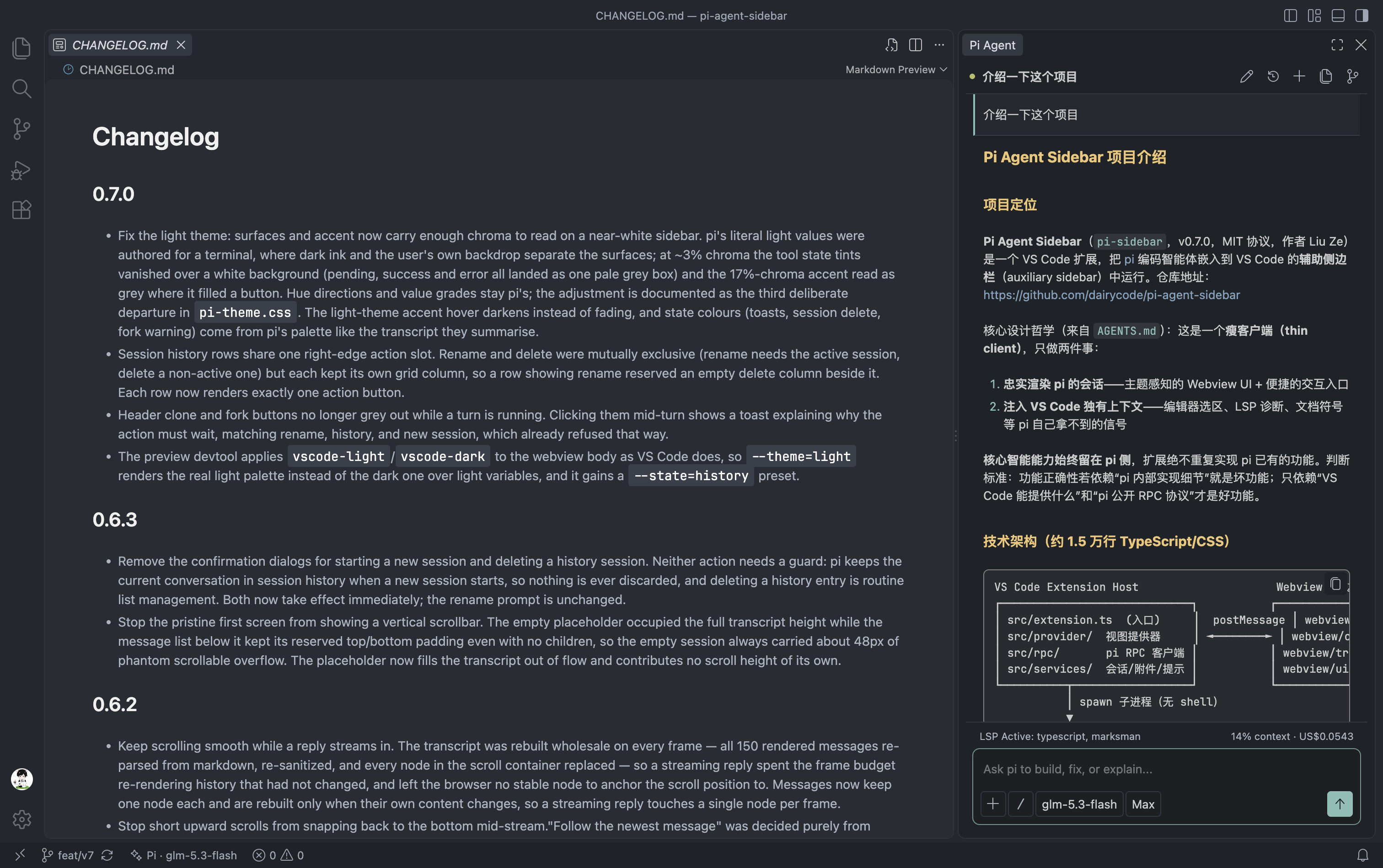
Features
- Streaming conversation — renders pi's text, reasoning, and tool
execution live in the auxiliary sidebar, fully themed to the VS Code
color scheme
- Session management — persistent session history with search, switching,
new sessions, delete, and rename; the last session in the workspace is
restored automatically after a VS Code reload
- Model and thinking level — switch among configured models and supported
thinking levels from themed pickers in the composer
- Conversation control — queue follow-up prompts while pi is working, or
abort the active run; transient provider errors (overload, rate limit, 5xx,
interrupted streams) are retried automatically
- Composer references — use Explorer's Pi Agent: Add Files or Folders to Input
action, or hold
Shift and drag files or folders from VS Code Explorer
anywhere over the Pi sidebar, to insert clickable inline @path references;
folder references pass only the directory path so pi can inspect it on demand
- Selection references — select code and press
Cmd+Esc / Ctrl+Esc to
insert an inline @path#line reference at the caret; Cmd/Ctrl-click or
F12 jumps back to either kind of source reference
- Attachments — use the composer's
+ button to attach files or images as
chips; pasted PNG, JPEG, GIF, and WebP images use the same attachment flow
- Editor integration — a right-click
Pi Agent submenu explains the
selection, adds it to the composer without a preset instruction, refactors
it, generates tests, explains reported problems, or explains the whole file,
plus a Fix with Pi quick fix for the diagnostic under the cursor
- Slash commands — type
/ in the composer to browse pi's extension
commands, prompt templates, and skills, grouped by source with live filtering
- File mentions — type
@ to browse one workspace level at a time; pick
a folder to enter it, then select a file with the arrow keys and Enter to
insert the same inline @path reference Explorer and drag-and-drop produce
- Tool timeline — tool calls run inline with file-edit diffs rendered as
added, removed, and context lines;
path/file.ts:42 references in responses
open the file at that line
- Diagrams —
mermaid code fences in pi's messages are drawn as diagrams in
the transcript, tinted by the current theme, with the source kept one click
away; the library loads only when a diagram appears. A fence in your own message
stays as source
- Commands — rename the current session, export a session to HTML, start a
new session, restart the runtime, and inspect logs from the command palette
- Status bar — shows the runtime phase and the active model
- Native dialogs — pi extension prompts and trusted-domain confirmation are
surfaced with native VS Code UI
- Security — gated on Workspace Trust, reads strict JSONL, sanitizes
Markdown before rendering, and ships a restrictive CSP
Editor Selection Shortcut
Select code in the editor, then press Cmd+Esc on macOS or Ctrl+Esc on
Windows and Linux. Pi Agent opens, focuses the composer, and inserts an
accent-colored inline reference such as @src/file.ts#10-14 at the caret while
retaining the exact selected text as code context. Delete the reference text
to detach it. To
reopen the source, Cmd/Ctrl-click the marker or place the caret inside it
and press F12. With no editor selection, the shortcut only focuses the
composer.
Other AI extensions may use the same shortcut. Reassign Pi Agent: Focus Input
with Selection in VS Code's Keyboard Shortcuts editor when needed.
Requirements
- VS Code 1.129 or newer
pi 0.81.0 or newer installed and authenticated- A trusted workspace folder
Install pi if needed:
npm install -g --ignore-scripts @earendil-works/pi-coding-agent
pi
/login
If VS Code cannot find pi, set piAgentSidebar.binaryPath to an absolute
path such as /opt/homebrew/bin/pi.
On Windows, npm installs pi as a .cmd shim that cannot be launched
directly. When binaryPath is left at its default, the extension first tries
pi and then automatically falls back to running node.exe with the globally
installed pi entry script as its first argument (equivalent to setting the
binary path to node.exe and passing that script in additionalArguments). The
entry script comes from the installed package's own bin field. Set
binaryPath to something other than pi to override this fallback.
piAgentSidebar.sessionDirectory accepts an absolute path or a path relative
to the active workspace folder; the same resolved directory is used for pi's
session storage and the sidebar's history, rename, and deletion.
Security Model
Pi's default coding tools can read, edit, and execute files with the extension
host user's permissions. This extension does not sandbox pi. It remains
disabled in untrusted workspaces, runs the configured binary without a shell,
and only passes --approve for project-local pi resources after VS Code has
established workspace trust.
Session files are managed by pi under ~/.pi/agent/sessions. They can contain
source code, tool output, and other sensitive conversation data.
Markdown in a transcript is sanitized before it reaches the DOM, and the webview
runs under a CSP that permits scripts only with the document's nonce. Mermaid
diagrams are the one addition the CSP makes room for: an inserted SVG carries its
own styles, so style-src also allows inline styles, and the SVG is inserted
with its scripts, event handler attributes, and executable href values removed.
The library is only fetched when a transcript actually contains a diagram.