Kelvin ClynePreviewAI coding agent and multi-agent orchestrator for PlanGraph missions, parallel sub-agents, local models, context control, and evidence-gated execution in VS Code. Installation Launch VS Code Quick Open ( Ctrl+P), paste the following command, and press enter.Copied to clipboard |

Kelvin Clyne
Turn intent into verified execution.
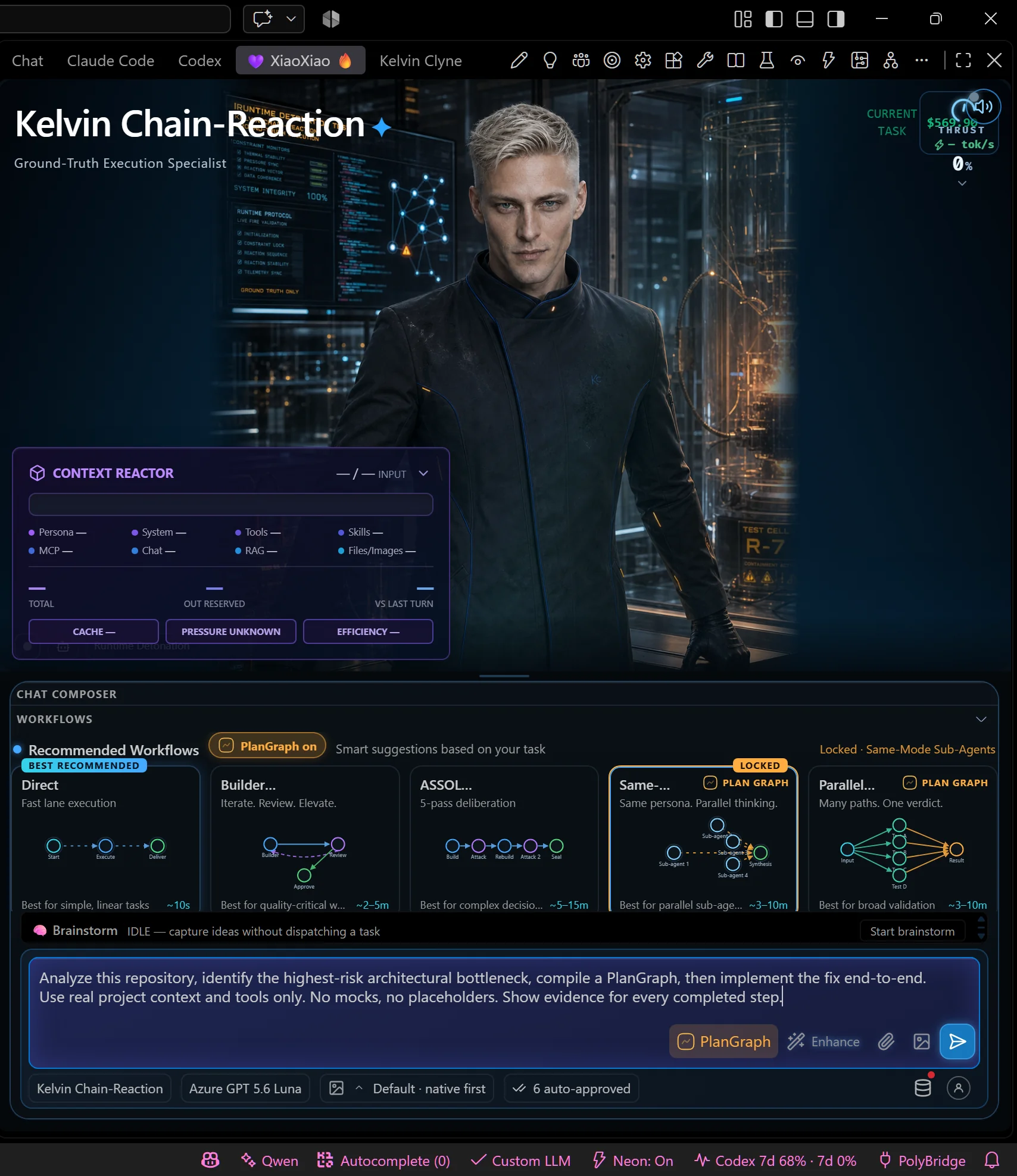
Kelvin Clyne is not another chat panel attached to an editor. It is an agentic operations layer for compiling high-level engineering intent into inspectable execution graphs, dispatching specialized sub-agents, controlling tools and context, and requiring evidence before work is declared complete. The extension is designed for the part of AI-assisted engineering where a plausible answer is insufficient: long-running repository changes, local inference, heterogeneous model backends, multimodal research, runtime qualification, adversarial testing, and workflows that must survive contact with real systems. One agent surface. Skills, workflows, sub-agents, tools, context routing, retrieval, artifacts, and runtime intelligence underneath. The operating principleMost coding assistants optimize the conversation. Kelvin Clyne optimizes the execution system. A model may produce convincing language while using stale context, selecting the wrong tool, silently losing intermediate state, or accepting a successful process exit as proof of correctness. Kelvin treats these as systems-engineering failures rather than prompting problems. Its execution model is built around four invariants:
From intent to executionMission Compiler and PlanGraphThe Mission Compiler transforms a proof-of-concept description, bug report, architectural objective, or implementation brief into a directed acyclic graph of executable work. Nodes represent bounded operations; edges encode real data, resource, and verification dependencies. This changes orchestration from "generate a list and execute it" into a scheduling problem:
The graph is not decorative planning output. It is the runtime contract between human intent, model reasoning, tools, and verification. Workflow selectionNot every task deserves a swarm. Kelvin exposes workflow topologies for direct execution, iterative build-review loops, structured deliberation, same-persona parallelism, and broad parallel validation. The selected topology controls scheduling, coordination cost, review depth, and the amount of evidence required before synthesis. Simple linear changes stay linear. Complex missions gain parallelism only where the dependency graph supports it. Architecture
Native drivers: capability before compatibilityOpenAI-compatible APIs are useful transport adapters, but they are a poor universal intermediate representation. They routinely flatten model-specific control grammars, tokenizer behavior, tool semantics, cache affordances, and long-horizon execution features into a least-common-denominator schema. Kelvin therefore prefers a native-first driver strategy:
For Qwen-family runtimes, this includes support for native control syntax and programmable tool execution rather than forcing every operation through sequential JSON tool calls. A supported model can construct a short program that schedules multiple independent tool operations in a single API turn; practical concurrency remains bounded by policy, runtime limits, and the safety profile of the tools involved. The result is not "one more provider integration." It is a protocol architecture that allows local models to retain the capabilities for which they were trained. Qwen 3.8 execution pathThe Qwen 3.8 path is the clearest example of the native-first design. Kelvin uses the model-native tokenizer and XML control grammar over the transport rather than treating an OpenAI-compatible gateway as the semantic authority. Tools are equipped for the active graph node and disposed after use instead of being permanently injected into every prompt. With PTC enabled, the current execution policy can schedule up to ten eligible tool operations in parallel within one API turn. The bound is deliberate: it creates meaningful round-trip compression while preserving validation, resource limits, and a comprehensible failure domain. Actual concurrency is further constrained by the selected tools and runtime. Context is memory bandwidth, not a scrapbookLarge context windows do not eliminate context engineering. They merely make inefficient context loading more expensive and less obvious. The Context Reactor treats the prompt as a finite working set. It measures and routes:
Tools are equipped when a graph node needs them and removed when the operation is complete. Repository context is selected through indexing, retrieval, and reranking rather than indiscriminate file injection. Intermediate results are written to artifact storage so that agents can reference stable products instead of repeatedly reconstructing them in the live prompt. This matters most for local inference, where every unnecessary token consumes memory, latency, cache capacity, and attention that could have been spent on the task itself. Idea Well: retrieval for code and unfamiliar domainsIdea Well is Kelvin's built-in retrieval layer for repository knowledge, technical research, and long-form engineering references. It is intended for work that extends beyond the model's training data: new libraries, source-only implementations, internal architectures, entire books, evolving APIs, and best-practice corpora. The retrieval pipeline combines:
Embedding recall finds plausible candidates. Reranking determines which candidates deserve scarce context. The distinction is critical: high recall without discrimination simply moves the context-overload problem downstream. During development, this retrieval and context path has been exercised with the BottleCap AI Qwen 3.6 runtime at a 96k context configuration with Multi-Token Prediction enabled. The point of that qualification was not to demonstrate that a large window can hold more text; it was to verify that routing, artifact reuse, and reranking leave more of that window available for actual reasoning and code generation. Programmable Tool CallsTraditional tool calling serializes an agent around repeated model round trips: With Programmable Tool Calls, a capable model can emit a bounded program that describes control flow and independent operations. Kelvin validates the program against tool policy, applies concurrency and resource limits, executes eligible operations in parallel, and returns structured results to the graph. This is particularly useful for operations such as:
PTC is not unrestricted arbitrary code execution. The program is an orchestration representation evaluated within the configured execution policy. Filesystem scope, command approval, network access, concurrency, timeouts, and tool availability remain explicit boundaries. Ground-truth executionKelvin separates three conditions that ordinary agent traces often conflate:
Field report: a silent OpenVINO GPU correctness failureWhile qualifying Qwen3-VL-8B on an Intel Xe iGPU, Kelvin localized a failure in the OpenVINO GPU plugin that did not crash, warn, or produce non-finite values. The dynamic-shape graph completed normally and returned plausible tensors, but the result was numerically wrong. The same model IR and inputs produced the following measurements against a CPU oracle:
Kelvin bisected 1,586 instrumentable operations, verified the direct inputs of the first divergent node, reduced the failure to a reproducible subgraph, ruled out several attractive but incorrect hypotheses, and produced a self-contained public reproducer. Intel independently reproduced the dynamic-versus-static divergence and escalated it to the OpenVINO development team.
The lesson is foundational:
Crash detection is easy. Ground truth is harder. Kelvin checks both. Local-first; cloud when it earns its placeKelvin is designed around local control rather than mandatory remote execution. Use local LLMs, VLMs, embedding models, rerankers, and developer tools on the hardware you own. Add cloud models or remote accelerators when they provide a measurable advantage in capability, context, latency, throughput, or economics. The runtime model accommodates heterogeneous backends, including:
Kelvin Clyne provides the VS Code control plane. Kelvin AI Workstation is the companion runtime layer for hardware intelligence, model management, secure execution, local services, and workstation orchestration. Cloud is optional. Evidence is not. Agentic Ops and RedTeam workKelvin is built for both construction and adversarial inspection:
Security research is treated as an evidence discipline. Findings should be scoped, reproducible, and connected to an observable mechanism. A dramatic narrative is not a substitute for a minimal reproducer. What Kelvin asks of an agentA Kelvin mission should be able to answer:
The intended end state is not autonomous activity. It is autonomous activity with inspectable causality. InstallationKelvin Clyne will initially be distributed as a public pre-release through the Microsoft Visual Studio Marketplace. From VS Code:
Or install from the command line: The Extensions view is the canonical way to opt into the pre-release channel.
Project statusThe public pre-release concentrates on the real vertical slice:
Some drivers, workflows, and RedTeam capabilities are experimental by design. Experimental does not mean unmeasured: behavior should be observable, failure should be containable, and every serious claim should be reproducible. Operations roomThe community lives on Kelvin Clyne | Agent Lab 🟩. It is the operations room for AI coding agents, local inference, RedTeam research, agent orchestration, and experimental developer infrastructure. Field reports are welcome:
Areas of active interest include RedTeam, exploit research, Agentic Ops, Mission Graphs, local models, Kelvin AI Workstation, Runtime Intel, and systems that probably should not work yet but somehow do. Reporting bugs and research findingsA useful report contains:
For security-sensitive reports, do not publish weaponized details before a responsible disclosure path has been established. Open a minimal issue that requests a private channel without disclosing the exploit chain. Research ethosKelvin Clyne is built around a simple hierarchy of confidence: The objective is not to make the agent sound certain. The objective is to make uncertainty visible, turn hypotheses into experiments, and drive the system toward independently reproducible evidence. Build it. Break it. Measure it. Make the agent prove it. |