CodeTrail
Find the shortest evidence-backed path through unfamiliar C code, without leaving VS Code.
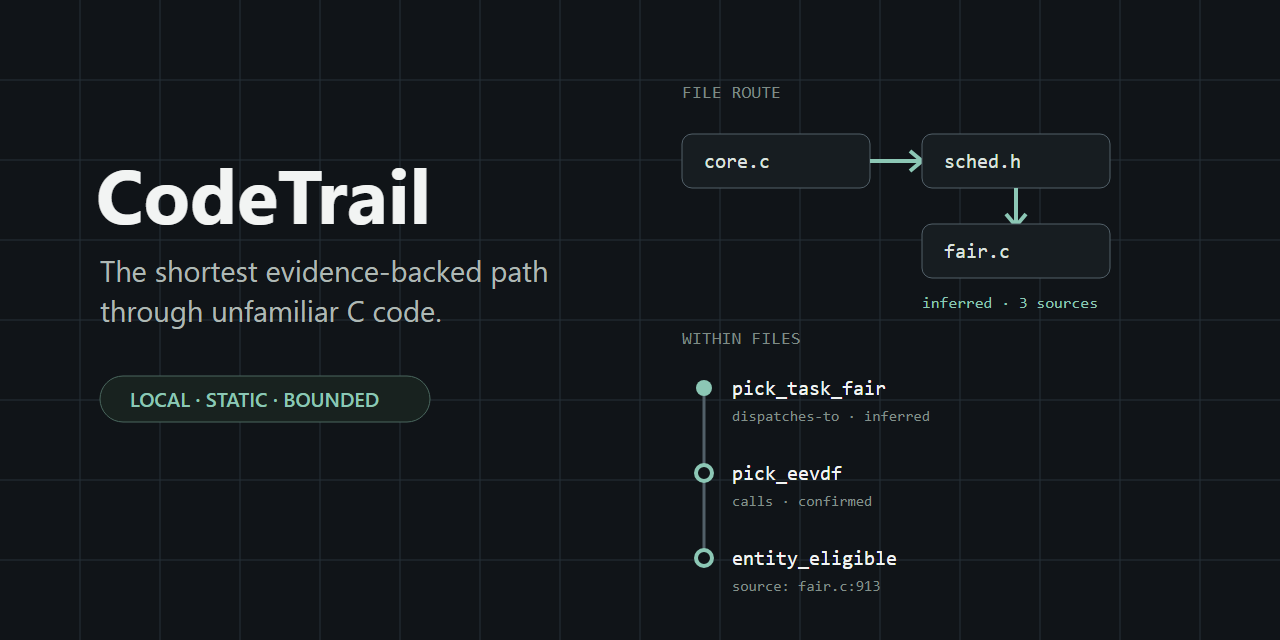
Search is good at finding names. It is much less helpful when behavior crosses headers, designated initializers, function pointers, preprocessor guards, and direct calls. CodeTrail turns those links into a compact reading order: files first, functions inside each file second.
CodeTrail is local and deterministic. It does not call an AI service at runtime, upload source, or claim that a static path is a runtime trace.
Contents
Install
CodeTrail requires VS Code 1.107 or newer.
Build and install the VSIX:
npm ci
npm run package
code --install-extension .\codetrail.vsix --force
Reload VS Code after installation. To run from source instead, open this repository in VS Code and press F5.
Try it in 60 seconds
- Open a folder containing
.c and .h files.
- Run
CodeTrail: Index Workspace from the Command Palette.
- Run
CodeTrail: Search Code and enter schedule.
- Pick a ranked function. Match reasons explain why it appeared.
- Read File route, then Within files.
- Select
Open on any step to jump to its source range.
The search field stays available while you inspect a trail, so a follow-up search does not reset the panel.
You can also start at a function definition:
- click
CodeTrail: discover links above the function;
- place the cursor on a symbol and press
Alt+Shift+T;
- right-click and choose
CodeTrail: Discover Symbol Links.
All four entry points use the same index and bounded discovery logic.
What CodeTrail finds
CodeTrail's first release targets GNU C, with special attention to systems code.
| Source pattern |
Relationship shown |
next = pick_next_task(rq) |
confirmed direct call |
.pick_task = pick_task_fair |
inferred registration |
class->pick_task(rq) |
inferred function-pointer dispatch |
#ifdef CONFIG_SCHED_CLASS_EXT |
configuration guard |
a link crossing sched.h and fair.c |
cross-file route with evidence count |
This is more useful than a full call-graph canvas for the question CodeTrail answers: "What should I read, and why?"
Proof on the Linux scheduler
The reproducible evaluation indexes 50 C/header files from kernel/sched at upstream Linux commit 7059bdf4f04a3e14f4fafb3ac35fdca913e3e21a.
| Search |
Required answer |
Observed rank |
schedule |
__schedule |
1 |
eevdf eligible |
entity_eligible |
2 |
register dispatch |
pick_task_fair |
10 |
The index contains 3,743 nodes and 33,099 typed edges across 2,049,984 bytes of source. The selected __schedule path reaches 12 symbols across 17 file sections before its visible trail budget stops it.
The machine-readable result records every top-20 candidate, score reason, warning, bound, confidence label, and source range. See the evaluation method and reproduction steps.
For a fast UI demo, open the small checked-in fixture:
code .\test-fixtures\kernel-mini
The fixture keeps the relationship chain short enough to show the full sched.h to fair.c route during a three-minute demo. The upstream report is the non-fixture proof.
How it works
C and header files
  -> Tree-sitter C structural parser
  -> kernel-aware relationship enrichment
  -> typed immutable workspace index
  -> deterministic lexical and relationship ranking
  -> bounded evidence subgraph
  -> file route, then within-file symbol path
Analysis runs in a worker so parsing does not block the extension host. Snapshots are gzip-compressed, size-limited, and schema-validated before reuse. Search normalizes identifier forms and a small code vocabulary, supports one bounded typo, and caps results at 20. Broad single-token searches reserve space for useful structural neighbors instead of returning one file's lexical matches exclusively.
Read the architecture for component boundaries and budgets.
Confidence and evidence
Every relationship carries a source path, range, reason, and confidence:
| Label |
Meaning |
confirmed |
The parser sees a direct structural fact, such as a function call. |
inferred |
Source syntax supports the link, but the link depends on a pattern such as registration or pointer dispatch. |
possible |
The evidence names plausible targets but cannot select one safely. |
Budget warnings remain visible. Every trail says Static reading order; not a runtime trace. CodeTrail would rather show an honest gap than turn an inference into a fact.
Editor commands
| Command |
Purpose |
CodeTrail: Index Workspace |
Build a fresh local index for the open folder. |
CodeTrail: Search Code |
Open the persistent search and discovery panel. |
CodeTrail: Discover Symbol Links |
Discover the symbol under the cursor. Also available from the context menu and Alt+Shift+T. |
CodeTrail: Discover Indexed Function |
Open an exact indexed function from CodeLens. |
CodeTrail: Open Evidence Source |
Open a validated source location from a result. |
codetrail.filesMax controls the maximum indexed C/header files. The default is 2,000 and the hard maximum is 10,000.
For coding agents
MCP is an optional adapter, not a second product. It gives a coding agent the same ranked symbols and evidence paths that a developer sees in VS Code.
Build the local stdio server:
npm ci
npm run build
node .\dist\mcp-server.cjs --workspace C:\absolute\path\to\c-workspace
Use the absolute paths from demo/mcp-config.example.json in an MCP client. The server exposes three read-only tools:
| Tool |
Use it for |
search_code |
Rank symbols for a keyword or identifier query. |
get_symbol |
Inspect direct source-backed relationships for one exact symbol ID. |
get_reading_path |
Retrieve the bounded file-first hierarchy for one exact symbol ID. |
There is also a codetrail://workspace/status resource. Responses are structured, capped at 256 KiB, and contain evidence rather than full source files.
On the pinned Linux scheduler tasks, two MCP calls retrieved the required answer and evidence while returning 97.33% to 99.34% fewer bytes than the indexed source. That is a context-volume result, not an LLM accuracy claim. The method and raw result spell out the boundary.
Privacy and security
- Runtime analysis and snapshots stay local.
- There is no telemetry, account, hosted inference, or source upload.
- CodeTrail never builds or executes workspace code.
- Indexing skips symlinks and excluded build/dependency directories.
- File count, bytes, queue depth, graph traversal, snapshots, operations, and MCP responses have explicit limits.
- Source navigation rejects destinations outside the indexed workspace.
- Webview and worker messages are schema-validated; source-derived text is never inserted as HTML.
Read PRIVACY.md and SECURITY.md for the complete boundaries. Support requests go through SUPPORT.md.
Known limits
- The release supports C structure, not full C++ semantics.
- It does not preprocess every kernel configuration.
- Macro-heavy GNU C can produce recoverable partial-parse warnings.
- Function-pointer links may remain inferred or possible.
- Search is lexical and explainable; it does not answer arbitrary natural-language questions.
- Whole-kernel indexing is intentionally bounded. Open the subsystem you need.
- Reindex after source changes; incremental indexing is not in this release.
- CodeTrail recommends an outgoing static reading path. It is not a whole-program impact analyzer or runtime profiler.
Development
The project uses npm and Node.js 24.
npm ci
npm run check
npm test
npm run test:coverage
npm audit --omit=dev --audit-level=high
npm run package
Useful evidence commands:
npm run test:mcp:e2e
npm run evaluate:linux -- --workspace .cache/linux-scheduler
npm run evaluate:mcp -- --workspace .cache/linux-scheduler/kernel/sched --output demo/mcp-evaluation-results.json --profile linux-7059
Codex was used across product planning, implementation, testing, debugging, visual verification, and release work. CodeTrail itself has no Codex/OpenAI runtime dependency. The development record separates human direction from Codex execution and points to the test and commit evidence.
License
MIT. See LICENSE.