KubeAstraPreviewAI root-cause analysis for Kubernetes, inside your editor. Investigate crashing pods and manifests against your own cluster, then review and approve the fix. Installation Launch VS Code Quick Open ( Ctrl+P), paste the following command, and press enter.Copied to clipboard |

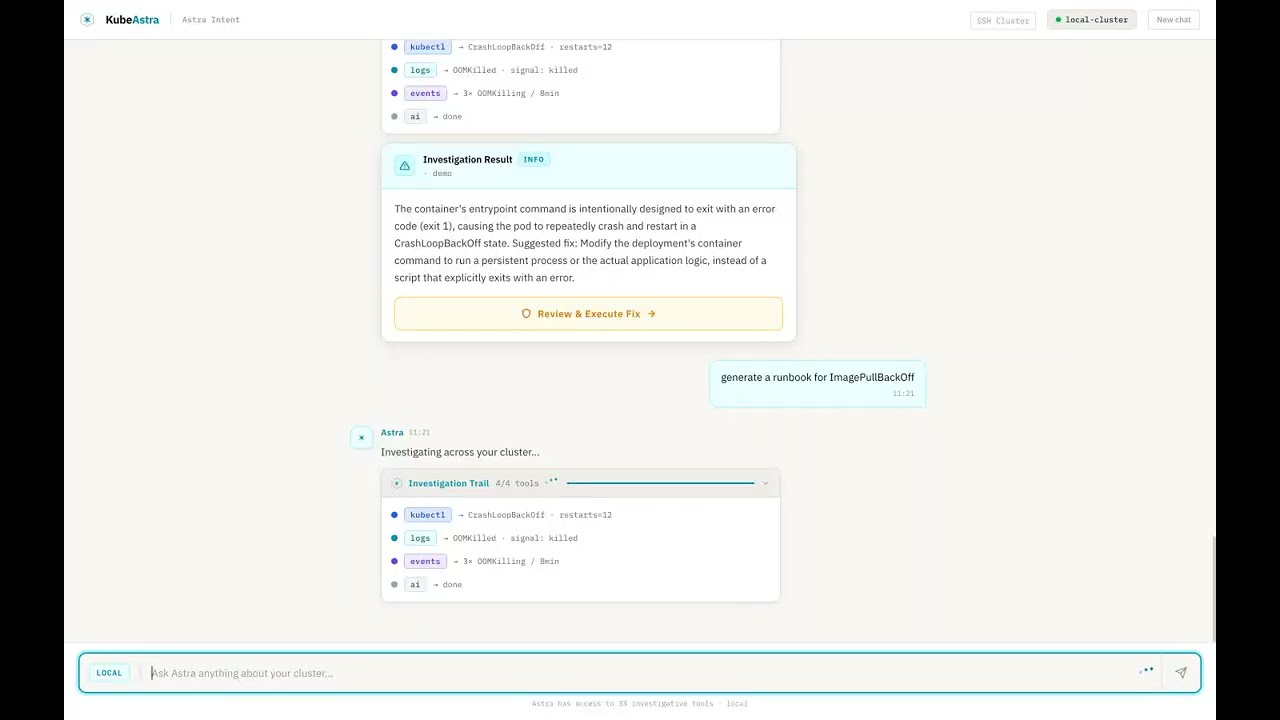
KubeAstra for VS CodeFind out why your Kubernetes workloads are broken without leaving your editor. Ask "why is checkout-service crashlooping in production?" and KubeAstra runs a live investigation against your cluster: it pulls pod status, events, logs and resource specs, reasons over what it finds, and returns a root-cause diagnosis with the evidence behind it and a fix you can review and run. KubeAstra runs on infrastructure you control. The extension connects to your own KubeAstra backend. There is no hosted service, and your cluster data never goes through a third party. See it in action
Watch the 90-second demo: the KubeAstra investigation engine, which powers this extension, works through seven real Kubernetes failures, including CrashLoopBackOff, OOMKilled, ImagePullBackOff, a stuck PVC and an unschedulable pod. FeaturesAgentic investigation, streamed liveEvery question starts a ReAct investigation on your backend, using 52 built-in Kubernetes tools. You watch it happen: each tool call, thought and observation streams into the investigation trail as it runs, not as a canned summary at the end. Root-cause diagnosis, not a log dumpInvestigations end in a diagnosis card: what's wrong, why, the evidence that proves it, and the commands that fix it. Common failures are covered by deterministic playbooks that answer quickly and consistently: CrashLoopBackOff, OOMKilled, ImagePullBackOff, Pending pods, stuck PVCs, stalled rollouts, DNS failures and node pressure. Fixes you approve, never fixes that just happenRead-only by default. Any command that changes the cluster, such as Investigate the manifest you're editing
Cluster status at a glanceThe status bar and the chat header show which cluster the backend is connected to, refreshed every 30 seconds. Click the status bar item to sign in or jump to the chat. Same engine as the KubeAstra web appThe chat panel is built from the same Mission Control components as the KubeAstra web UI, so what you see in the editor matches what your team sees in the browser, backed by the same investigation engine. Getting started1. Run a KubeAstra backendThe extension needs a KubeAstra backend in server mode. Choose one: On your machine (Docker Compose), using your local kubeconfig: In your cluster (Helm), shared by your team: See the deployment guide for ingress, secrets, and the optional features: RAG runbook cache, Alertmanager webhook and remediation plans. 2. Sign inOpen the Command Palette ( 3. AskOpen the KubeAstra view in the activity bar and describe the problem in plain English:
Commands
Settings
Security and privacy
Requirements
Known limitationsThis is a preview release.
Feedback and support
License |