GitHub Actions Cron Calendar
Read GitHub Actions cron schedules without leaving your editor. Open any file under
.github/workflows/, and every cron: entry gets a one-line summary above it — when it runs, in
which timezone, and how long until the next run. Click it for a calendar of the whole month.
No account, no GitHub token, no network calls. Everything is calculated locally.
What it does
Given a workflow like this:
name: Nightly checks

on:
  schedule:
    - cron: '0 4 * * 1-5'
    - cron: '30 2 * * 0'
      timezone: 'Asia/Yerevan'

jobs:
  build:
    runs-on: ubuntu-latest
    steps:
      - run: npm test
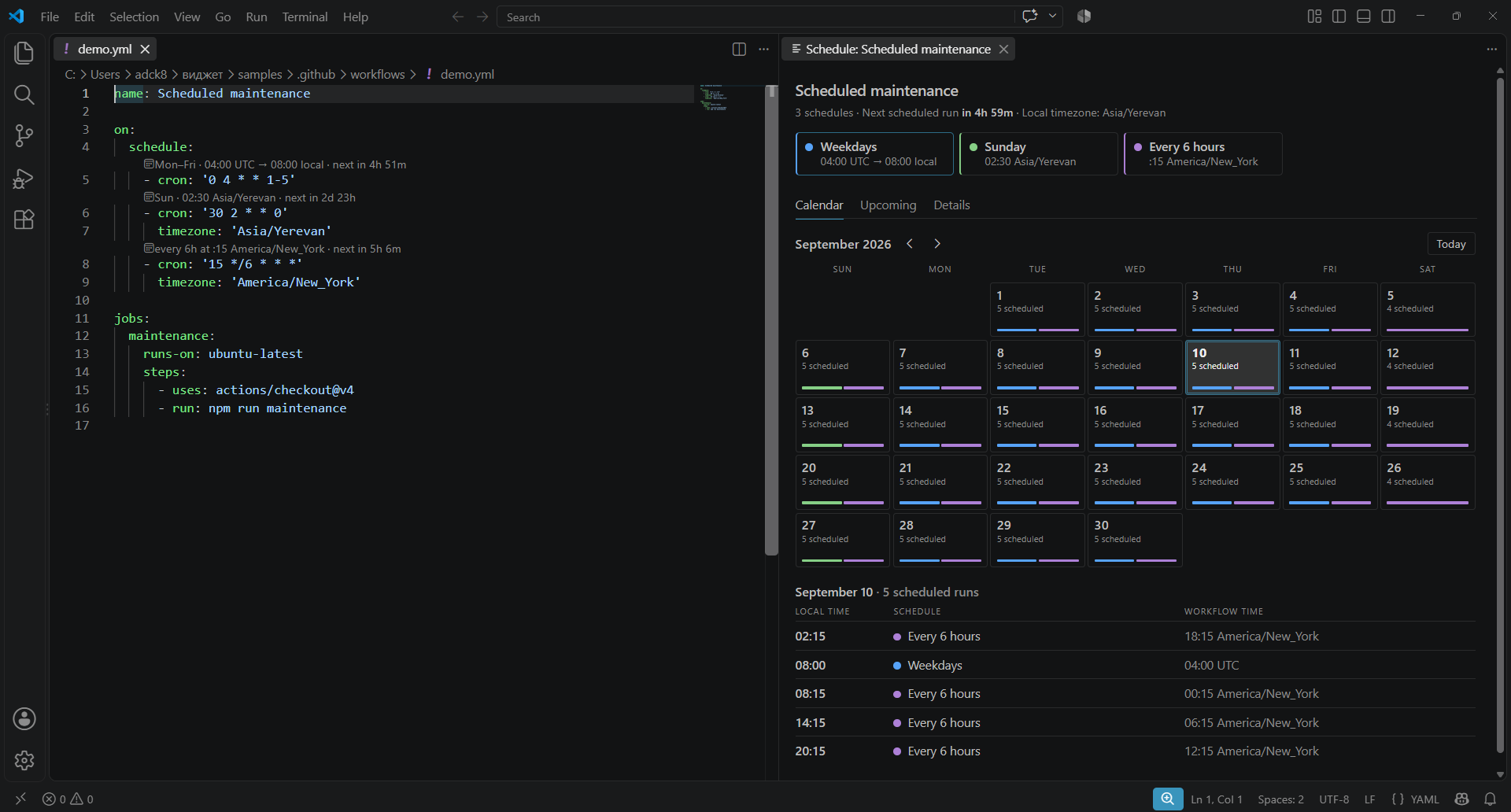
you see a short CodeLens above each schedule, not a wall of text:
📅 Mon–Fri · 04:00 UTC → 08:00 local · next in 6h 24m
   - cron: '0 4 * * 1-5'
Click it and the Schedule Calendar opens beside the file:
Nightly checks
3 schedules · Next scheduled run in 5h 37m · Local timezone: Asia/Yerevan

● Weekdays            ● Sunday             ● Every 6 hours
  04:00 UTC → 08:00     02:30 Asia/Yerevan    :15 America/New_York

[ Calendar ]  Upcoming   Details

September 2026  ‹ ›                              Today
  SUN     MON     TUE     WED     THU     FRI     SAT
                    1       2       3       4       5
                5 sched 5 sched 5 sched 5 sched 4 sched
                  ▄▄▄▄▄   ▄▄▄▄▄   ▄▄▄▄▄   ▄▄▄▄▄   ▄▄▄▄▄
    6       7       8       9      10      11      12
  ...

September 10 · 5 scheduled runs
LOCAL TIME  SCHEDULE          WORKFLOW TIME
02:15       ● Every 6 hours   18:15 America/New_York
08:00       ● Weekdays        04:00 UTC
08:15       ● Every 6 hours   00:15 America/New_York
14:15       ● Every 6 hours   06:15 America/New_York
20:15       ● Every 6 hours   12:15 America/New_York
Every schedule in the file is drawn on the same month, each with its own colour, so you can see
where two workflows collide. Click a day to see the exact times.
These are the runs GitHub would start from the cron expression — not a history of runs that
happened. The extension never calls the GitHub API.
Features
- Short CodeLens above every
cron: entry: Mon–Fri · 04:00 UTC → 08:00 local · next in 6h 24m.
The countdown refreshes while you work, and clicking anywhere on it opens the calendar.
- Schedule Calendar panel with three views:
- Calendar — a month grid with the run count and a colour bar per schedule on every day.
Days are your days: a run is drawn on the date it happens in your timezone. Selecting one lists
its runs underneath, sorted by your local time, next to the workflow time. Today is selected
automatically.
- Upcoming — the next scheduled runs of all schedules merged into one chronological list.
- Details — the cron expression, its full description, the timezone, the next scheduled runs, and the
GitHub-specific notes.
- Your local time next to the workflow time. A schedule declared as
04:00 UTC also shows as
08:00 Asia/Yerevan if that is where you are, everywhere times appear.
- Hover details on the cron value — description, timezone, next scheduled runs and notes, without opening
anything.
- Command Palette —
GitHub Actions: Open Schedule Calendar and
GitHub Actions: Preview Schedule (a Quick Pick breakdown, useful when you just want a glance).
- Validation in the Problems panel:
- invalid cron expressions, including the 5-field rule (
@daily and friends are not valid on
GitHub Actions);
- schedules that fire more often than the GitHub Actions minimum interval of 5 minutes;
- non-standard cron syntax (
L, W, #, ?) that GitHub does not support;
- unknown timezone names.
- GitHub-specific notes you would otherwise have to remember, shown as a separate block:
scheduled workflows only run on the default branch, scheduled runs can be delayed under load, and
XX:00 is the busiest minute to pick.
- Handles multiple schedules per workflow and multiple workflow files, and stays quiet on
workflows that have no
schedule trigger.
- Never modifies your YAML. It only reads the file.
Timezone support
GitHub Actions interprets cron schedules in UTC unless a timezone is declared next to the entry:
on:
  schedule:
    - cron: '0 4 * * 1-5'
      timezone: 'Asia/Yerevan'
The extension uses that timezone for every calculation and labels it everywhere. When no timezone
key is present, it falls back to UTC and tells you so. If the timezone name is not a valid IANA
identifier, you get a warning and UTC is used instead.
Alongside the workflow's own timezone, the panel shows the same instant in your local timezone:
Workflow    04:00  UTC (default)
Your time   08:00  Asia/Yerevan
Runs that land on a different calendar day locally are marked, so a 23:30 UTC job does not
silently look like it runs today.
Screenshots
Installation
Installation
- VS Code Marketplace — search for “GitHub Actions Cron Calendar” in the Extensions view
(
Ctrl+Shift+X / Cmd+Shift+X) and click Install.
- Open VSX (VSCodium, Gitpod, Cursor and friends) — search for the same name in the Extensions
view.
- From a
.vsix — code --install-extension github-actions-cron-viewer-0.4.0.vsix, or
Extensions → … → Install from VSIX…
Usage
- Open a repository that contains
.github/workflows/*.yml.
- Open a workflow that uses
on: schedule.
- The summary and the countdown appear above each
cron: line.
- Click the CodeLens — or run GitHub Actions: Open Schedule Calendar from the Command Palette
(
Ctrl+Shift+P / Cmd+Shift+P) — to open the calendar beside the file. It follows whichever
workflow you are editing and updates as you type.
Settings
| Setting |
Default |
Description |
githubActionsCron.enableCodeLens |
true |
Show the inline CodeLens above each cron schedule. |
githubActionsCron.nextRunsCount |
5 |
How many upcoming runs to calculate. |
githubActionsCron.use24HourFormat |
true |
Use a 24-hour clock instead of AM/PM. |
githubActionsCron.showDiagnostics |
true |
Report cron problems in the Problems panel. |
Limitations
- Only files matching
.github/workflows/*.yml and .github/workflows/*.yaml are analysed. That is
where GitHub Actions looks for workflows, and it keeps the extension out of the way in every other
YAML file.
- Next runs are computed from the cron expression alone. They are what GitHub would schedule —
actual runs can be delayed, and scheduled workflows are disabled automatically after 60 days of
repository inactivity.
- No workflow run history, no workflow monitoring, no GitHub API. This extension reads your files and
nothing else.
Privacy
The extension runs entirely offline. It does not collect telemetry, does not contact any server, does
not require authentication, and never writes to your workflow files.
Contributing
Issues and pull requests are welcome on
GitHub.
License
MIT

