Claude Control CenterBrowse, search and resume your Claude Code sessions from inside VS Code. Installation Launch VS Code Quick Open ( Ctrl+P), paste the following command, and press enter.Copied to clipboard |

Claude Control CenterBrowse, search, inspect, organize, and resume your Claude Code sessions directly from Visual Studio Code. Claude Control Center gives you a central place to explore your local Claude Code session history. Quickly find previous sessions, search complete transcripts, favorite important conversations, identify sessions approaching cleanup, and resume work without manually digging through Claude Code's local files. Everything stays local. Claude Control Center reads the session data created by Claude Code on your machine and does not upload your conversations to an external service.
Session management for Claude CodeClaude Code sessions can quickly accumulate across projects and directories. Claude Control Center brings that history into VS Code and makes it easier to navigate. Use it to:
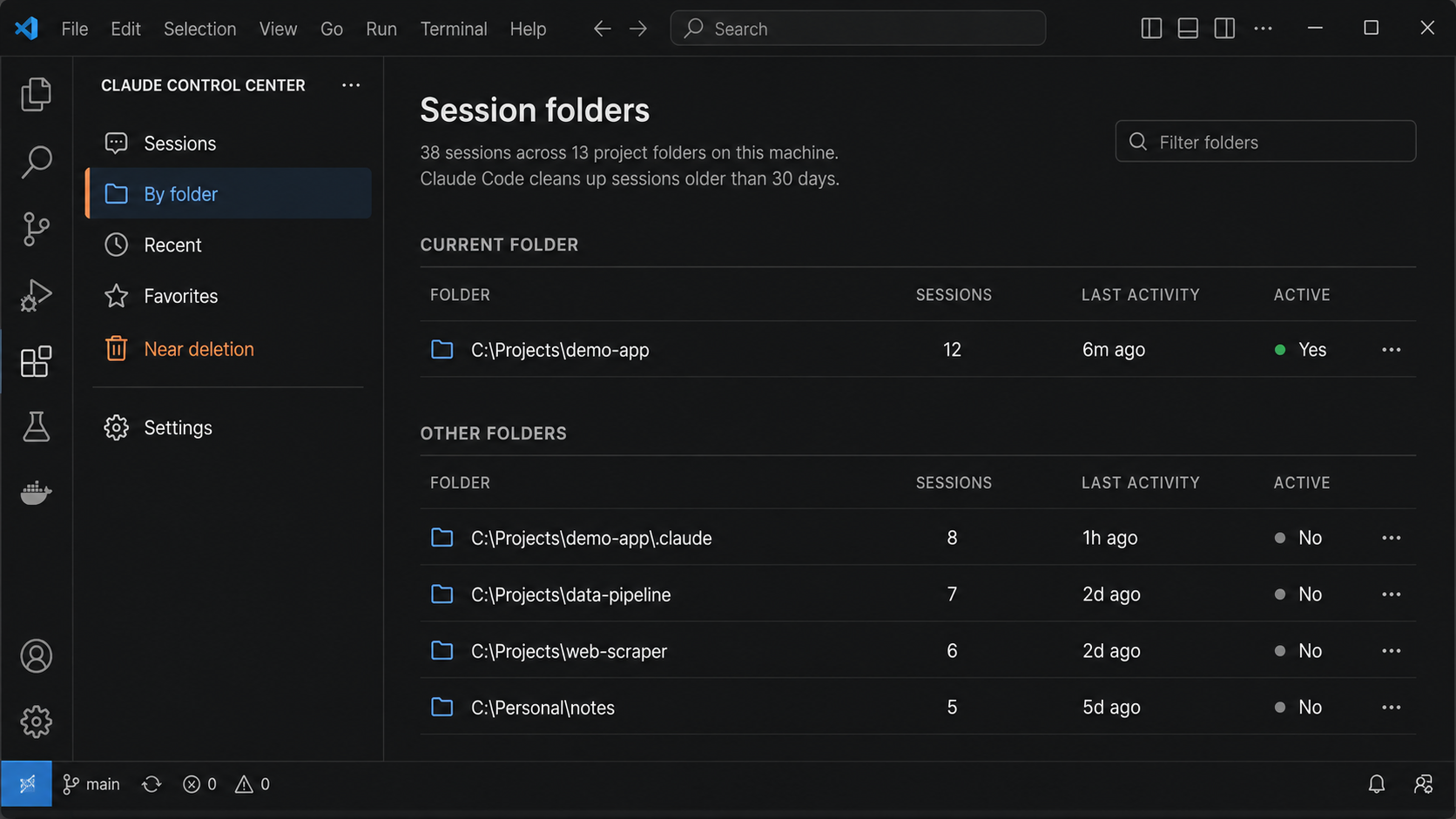
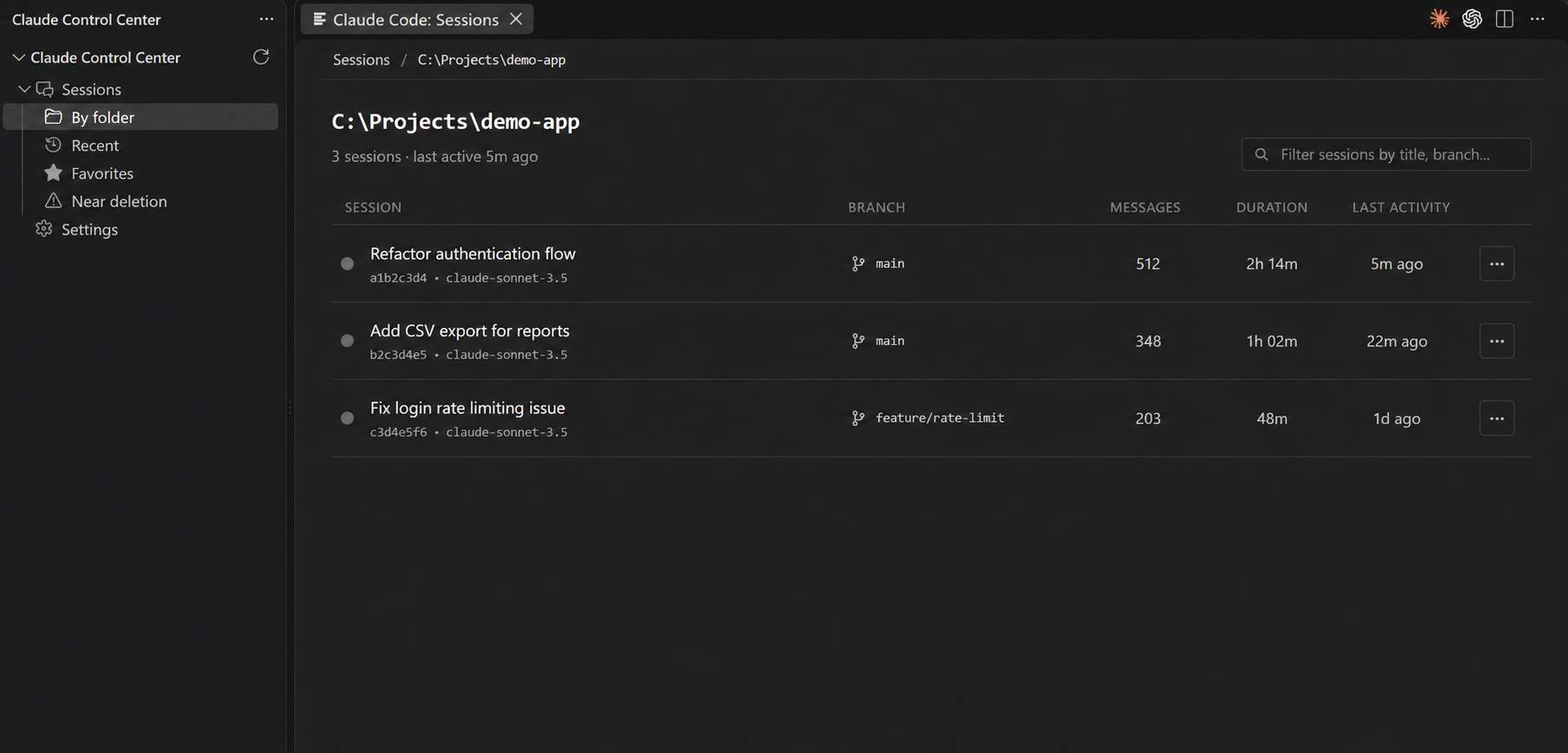
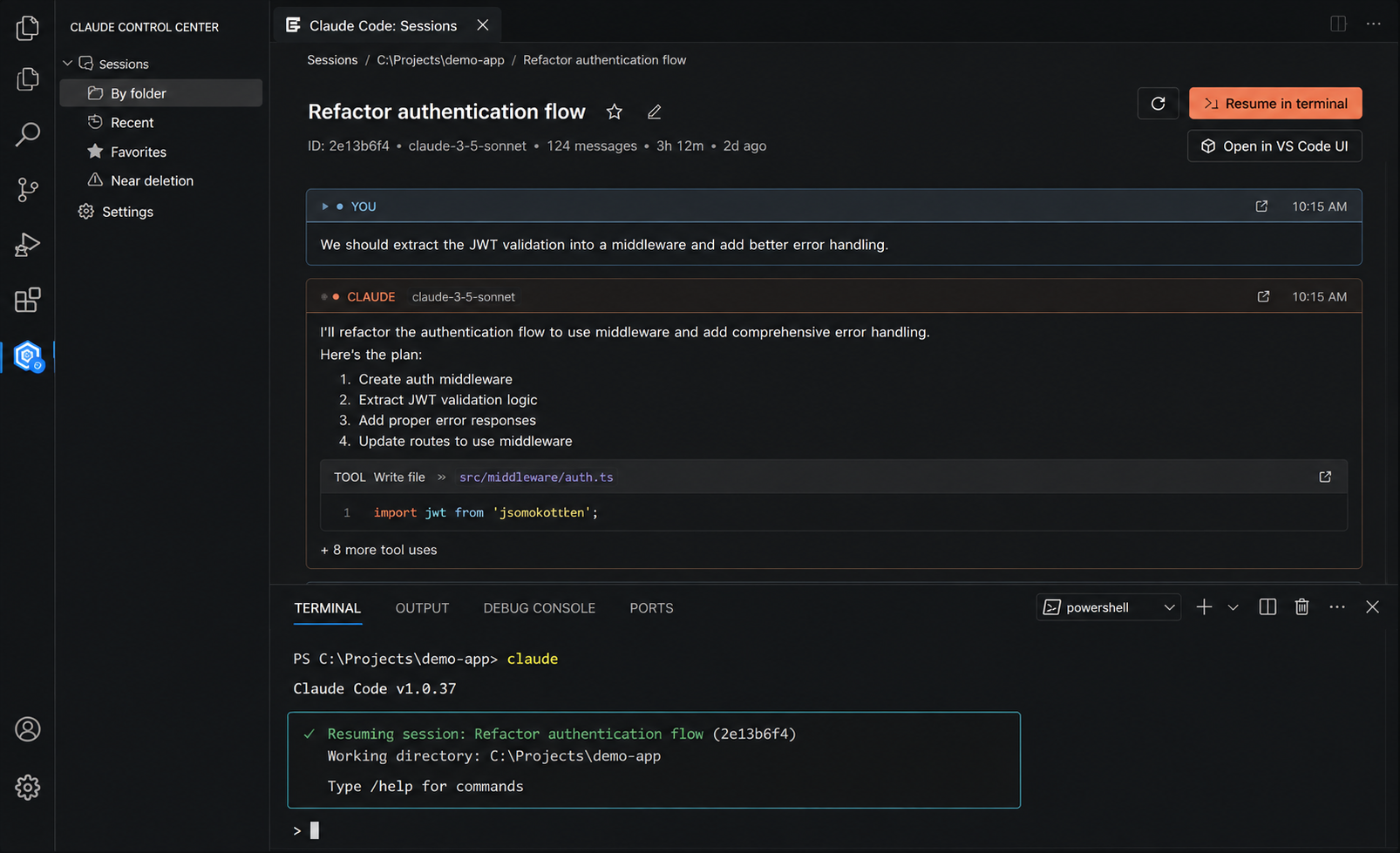
Browse all your Claude Code sessionsOpen the Claude Control Center icon in the Activity Bar and select Sessions. Your Claude Code history is automatically organized by project folder.
Current and other foldersProject folders are separated into two groups:
Folders are ordered by most recent activity and display useful information such as session count and latest activity. You can also filter folders by path to quickly narrow down larger session collections. Quickly find the session you needClaude Control Center provides several cross-project views directly from the session tree. RecentSee sessions from all folders ordered by their latest activity. Sessions whose latest message falls within your configured activity threshold are considered Active. FavoritesStar important sessions so you can return to them without searching through their project folder again. Favorites are useful for long-running tasks, frequently referenced conversations, and work you know you will revisit. Near deletionFind sessions whose last activity is approaching Claude Code's own session-log cleanup window. Claude Control Center can automatically derive this threshold from Claude Code's You can also configure the threshold manually. This helps surface older sessions before Claude Code removes their local logs.
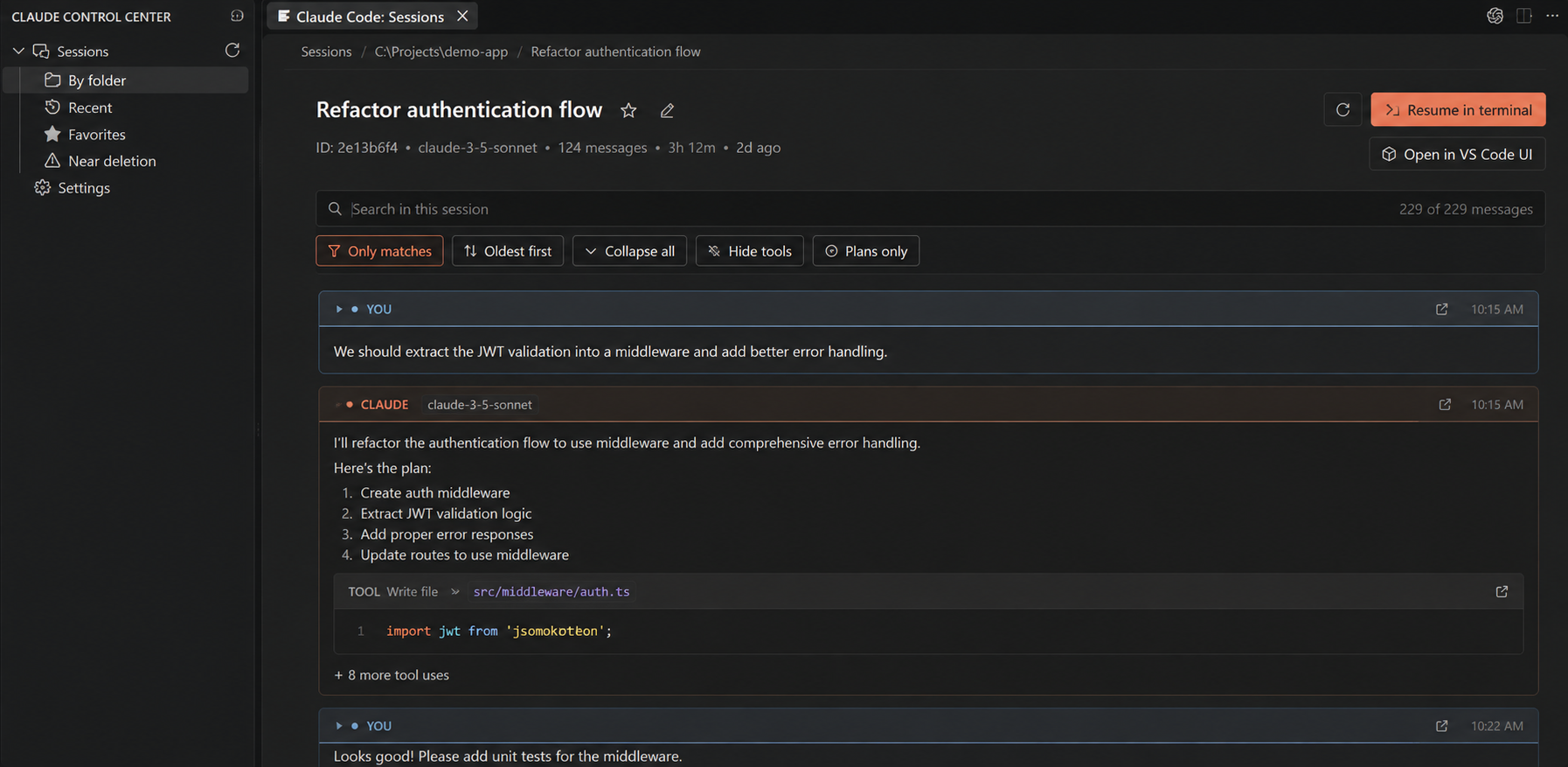
Inspect complete session transcriptsOpen any session to explore its full conversation in a dedicated editor.
Session messages can include:
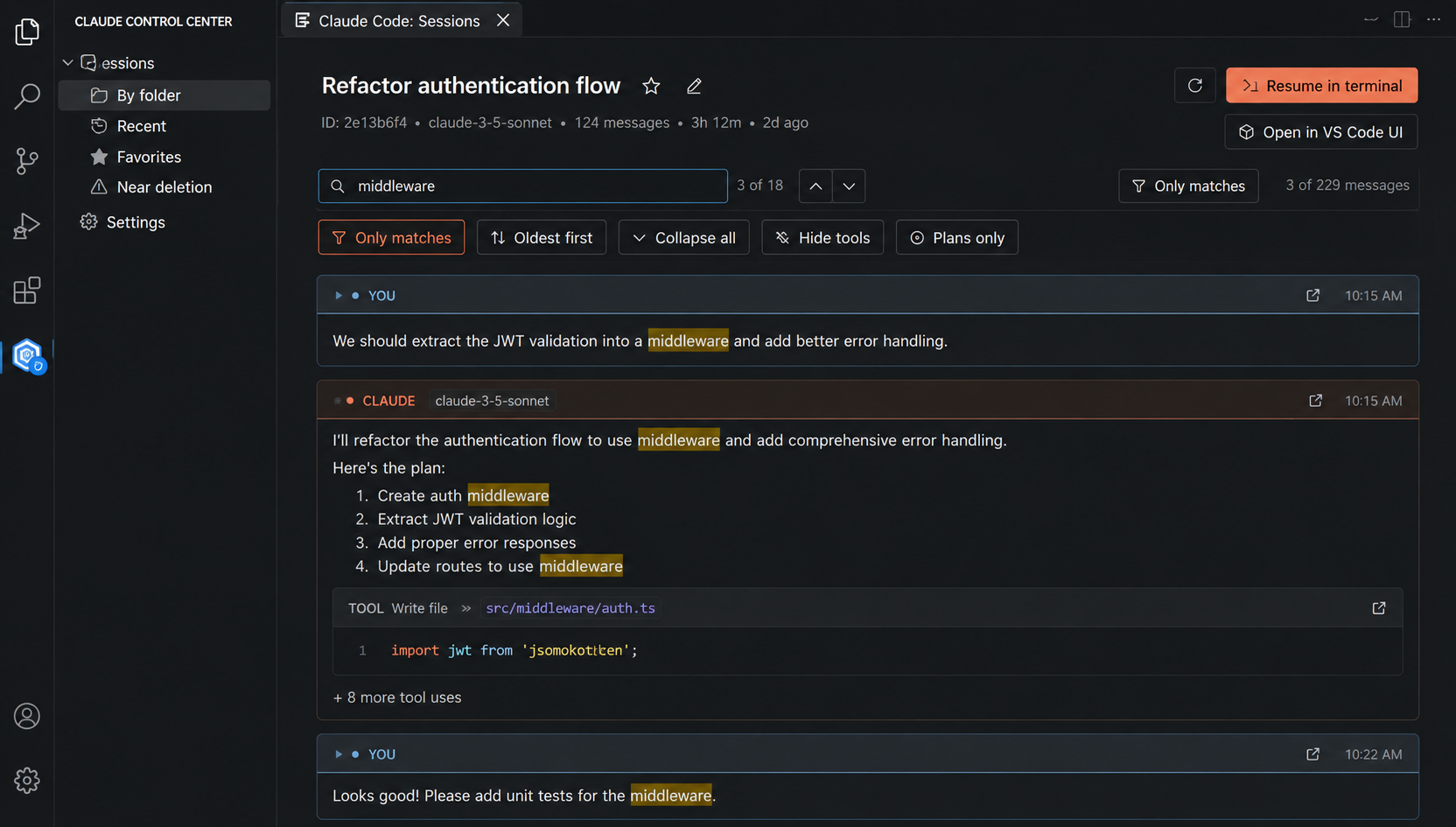
A tool call and the output it produced appear together on one card. The result starts collapsed behind a RESULT strip showing a short preview and a size hint, and expands in place when you want the full output. Claude Code wrapper markup such as slash-command tags, task notifications, and system reminders is removed from the displayed conversation so the transcript stays focused on the actual interaction. Search and filter conversationsLarge Claude Code sessions can contain a lot of information. Claude Control Center provides tools for narrowing the transcript down to what matters. Transcript searchSearch the complete conversation with:
Transcript filtersUse built-in controls to change what is visible:
The Plans only filter is useful when a long Claude Code session contains one or more planning phases and you want to focus only on those messages. Each combination of sort order and filters is treated as its own list, so switching between them always starts from the top of the result rather than leaving you somewhere in the middle of the previous one. Flag messagesUse the flag icon on any message to mark it. Flags are stored by Claude Control Center alongside your session titles and favorites — the original Claude Code logs are never modified. Flagged only then narrows the transcript to just those messages, which is useful for collecting the handful of decisions or snippets that matter out of a long conversation. Back to topOnce you have scrolled into a long transcript, a Back to top button appears over the message list and returns you to the first message in one click.
Open a single message in its own tabAny message in a transcript has an Open in editor tab action that opens just that message as a Markdown document, so you can read it full-width, copy from it, or keep it open beside your code. Because it opens as Markdown, VS Code's own Markdown preview works on it. Use the
The document is read-only and generated from the session log — nothing is written back to Claude Code's files. Live updatesAn open transcript follows its session as Claude Code writes to it. Start a session in the terminal and its messages appear in the panel as they are produced, without reopening the tab. Updates are incremental: only newly appended messages are read and sent to the panel, so following a long-running conversation stays responsive rather than re-reading the whole session log each time it changes. Your scroll position, collapsed cards, active search, and filters are all preserved across an update. The session's message count, status, and last-activity time in the header update alongside the transcript. Large sessionsLong conversations are loaded progressively. The transcript mounts the first chunk of messages immediately and adds more as you scroll, so opening a session with thousands of messages does not stall on the whole conversation at once. Search, filters, and match counts always operate on the complete conversation, not just the part currently rendered. Individual tool inputs and outputs are truncated for display once they exceed
Track usage and costA Usage item in VS Code's status bar (bottom right) keeps a running figure in view without opening the panel at all, and clicking it opens the Budget page. Claude Control Center tracks usage by tokens by default: your real
5-hour and 7-day quota utilization, read from Claude Code's own sign-in — the
same data the Live quota is never fetched automatically in the background unless you turn that on: checking it calls Anthropic's usage endpoint, so it only happens when you click Refresh in Settings or Budget, or if you enable Automatically refresh live quota in Settings (every 5 minutes). Claude Control Center never modifies your Claude Code sign-in to do this. A money mode also exists ( BudgetOpen Budget from the sidebar (or click the status bar Usage item) for a token-only view of your consumption:
Unlike the money figures above, nothing on this page is expressed as "percent of an allowance" — Anthropic's usage endpoint reports utilization percentages only, never an absolute token budget to divide local counts by, so the page shows real counts and real percentages side by side rather than guessing at one from the other. See what a session changedOpen any session whose conversation wrote or edited files, and a Transcript
/ Files changed switcher appears at the top of the session screen, with the
session's total Switch to Files changed for a flat table of every file touched, with its status, total lines added and removed, and edit count. Two actions per row:
You can also review a change from the message that made it: a message that edited files shows a small file chip in its header. Clicking it opens a popover listing just what that message changed, with its own diff button — scoped to that one edit, not the file's whole session footprint — and a Show in Files changed link back to the full table. The diff is reconstructed entirely from the session's own log — no git repository is required, and it reflects what the session actually did, which is not necessarily the file's current state on disk if it has changed since. Resume previous Claude Code sessionsClaude Control Center is not only a history viewer. You can continue working from an existing session. Resume in terminalSelect Resume in terminal to reopen the session with Claude Code in VS Code's integrated terminal. The terminal starts in the session's original working directory. If you resume the same session again, Claude Control Center reuses its existing terminal instead of opening a duplicate.
Open in Claude Code VS Code UIIf the official Claude Code VS Code extension is installed, supported sessions also show an Open in VS Code UI action. This hands the session to the Claude Code extension so you can continue the same conversation there. The action is available for sessions whose project directory exactly matches the workspace root currently open in VS Code. Session actionsEach session provides a ⋯ menu with actions including:
You can also middle-click a session to open it directly in its own editor tab. This makes it easy to keep the session you are inspecting open while navigating through other Claude Code history. Rename a sessionSession titles are derived from the first prompt in the conversation, which is not always a useful name. Use the pencil icon in the transcript header to give a session your own title. Renaming is stored by Claude Control Center, not written into Claude Code's session logs, so the original file is left exactly as Claude Code wrote it. Privacy firstClaude Control Center works with your existing local Claude Code data. The extension:
Custom titles, favorites, and message flags are stored separately in the extension's own storage, so none of Claude Code's append-only session logs are ever written to. By default, session history is read from: You can select a different directory in the extension settings. RequirementsClaude Code must already be installed and available through the: command. Claude Control Center expects Claude Code session logs to be available locally. By default, it looks in: Extension settingsClaude Control Center provides the following configuration options:
Getting started
No import or migration is required. Claude Control Center uses your existing local Claude Code history. Feedback & issuesFound a bug or have an idea for Claude Control Center? Please open an issue in the project repository. Feature requests and feedback are welcome. DisclaimerClaude Control Center is an independent project and is not affiliated with, endorsed by, or sponsored by Anthropic. Claude, Claude Code, and related names are trademarks of Anthropic. |