Skip to content
| Marketplace
Sign in
Visual Studio Code>Visualization>TectureNew to Visual Studio Code? Get it now.
Tecture

Tecture

Tecture

|
12 installs
| (0) | Free
AI-generated architecture diagrams for complex codebases — rendered inside VS Code.
Installation
Launch VS Code Quick Open (Ctrl+P), paste the following command, and press enter.
Copied to clipboard
More Info

Tecture

Navigate your codebase's architecture — right inside VS Code.

Tecture is an architecture documentation format (structured JSON and Markdown) that AI coding agents know how to write and maintain using a skill. This extension renders those files as interactive, navigable diagrams in your editor.

If your repo already has an architecture/ folder, the extension activates automatically. If not, the setup below takes a couple of minutes.

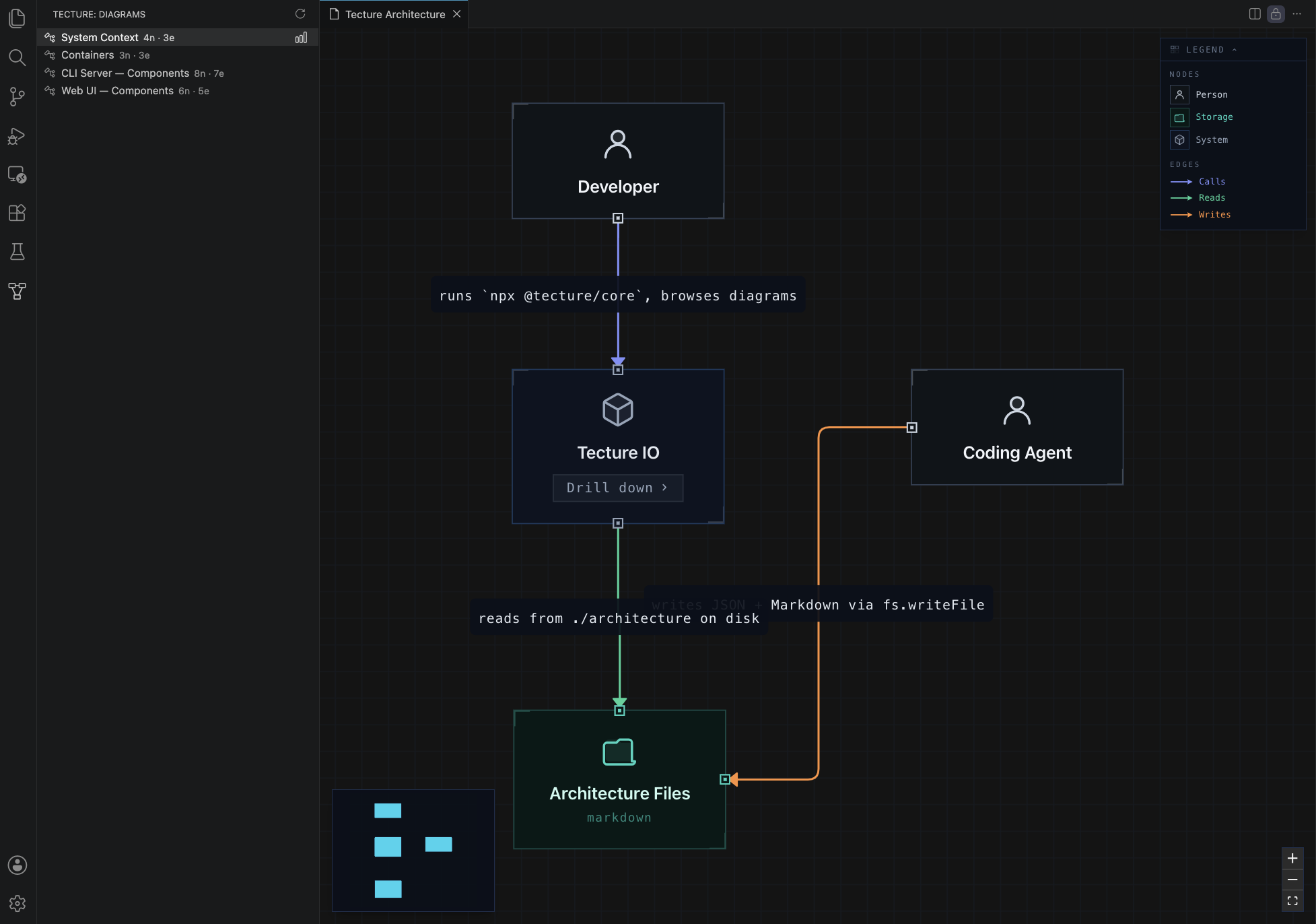
System Context diagram rendered in VS Code

Getting started

1. Install the architecture-docs skill into your coding agent

The skill teaches your agent how to read a codebase and write architecture files in the Tecture format. Works with Claude Code, Cursor, GitHub Copilot, Codex, Windsurf, and other major coding agents.

npx @tecture/skill@latest

This installs the skill into each agent's native skills directory (interactive — pick your agents). Re-run the same command anytime to update. Always use @latest so npx doesn't re-run a cached copy.

2. Generate the architecture map

From your project root, either:

  • 2.1 — run /architecture-docs in your agent's chat, or
  • 2.2 — ask it in plain language to document your architecture.

The agent writes the map into an architecture/ folder — a few minutes on a medium repo. Once the initial architecture exists, run a deep-dive on any component you want to explore further: /architecture-docs deep-dive <component>.

3. Open the diagrams

Once the architecture/ folder exists, the extension activates. Open the command palette (Cmd+Shift+P / Ctrl+Shift+P) and run Tecture: Open Architecture, or click any diagram in the Tecture sidebar.

Features

Multi-level diagram navigation

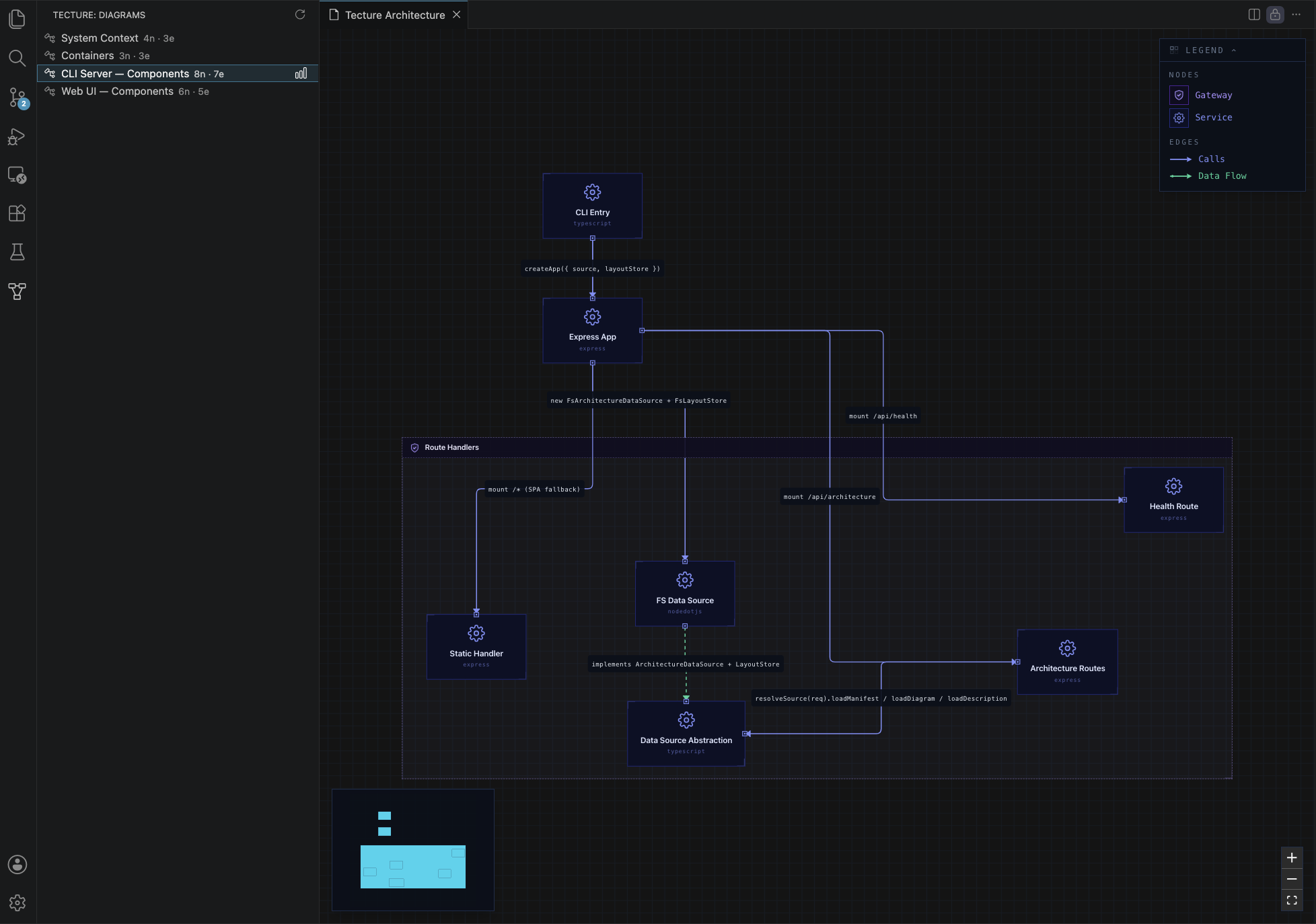
Browse system context, container, and component diagrams from the Tecture Activity Bar. Double-click a node to drill into its sub-diagram.

Component-level diagram with drill-down

Component descriptions

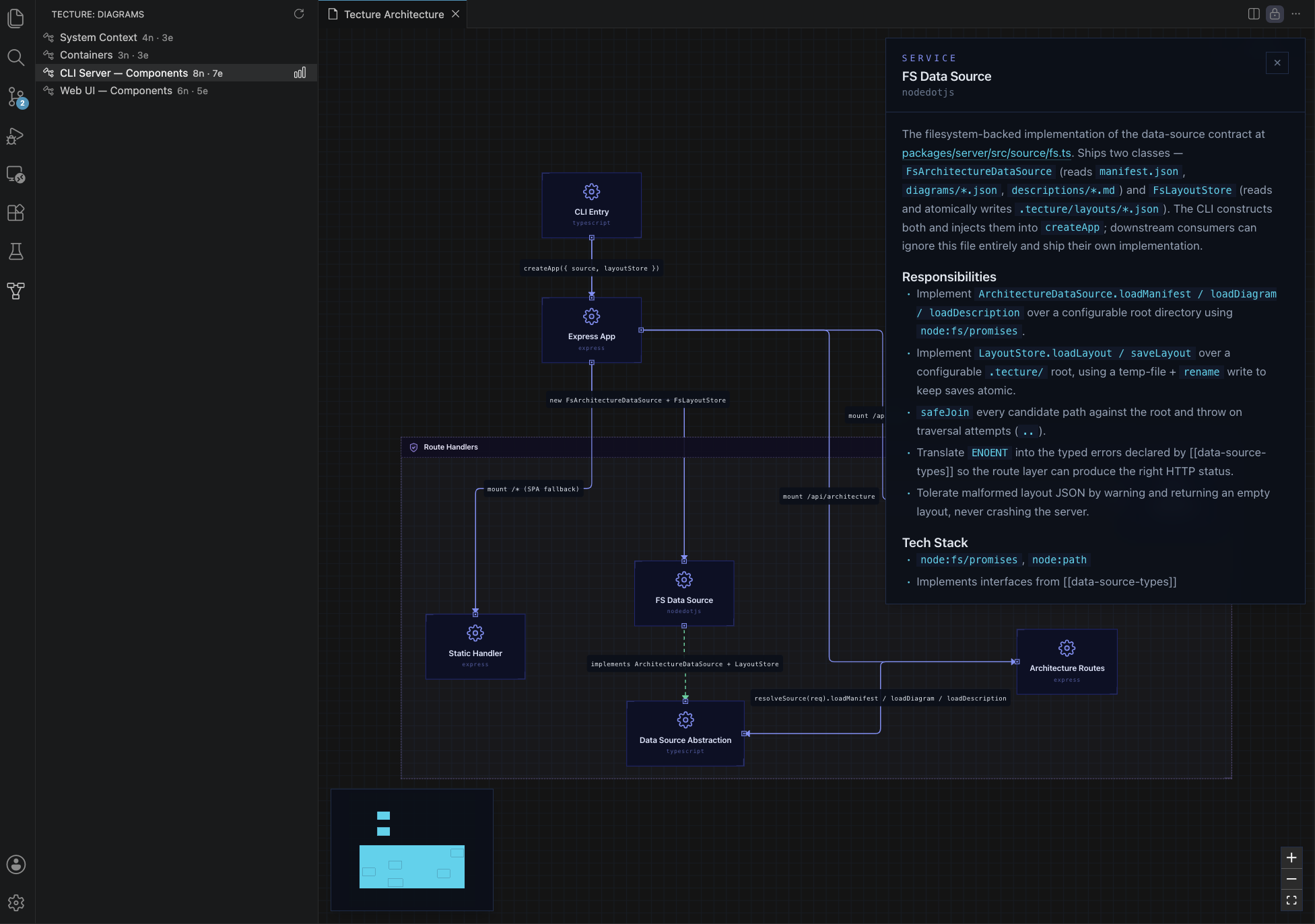
Select any node to open a detail panel showing its Markdown description, responsibilities, and tech stack — including rendered Mermaid diagrams.

Component description panel

Persistent layout

Drag nodes to rearrange the diagram. Positions are saved to architecture/.tecture/layouts/ in your workspace — version-controllable and shared across the team.

Live refresh

Edit any file under architecture/ (including architecture/.tecture/) and the panel reloads automatically. When the agent updates the map, you see the changes instantly.

Requirements

  • VS Code 1.90+ (or Cursor / Windsurf / VSCodium via Open VSX)
  • A workspace containing architecture/manifest.json

The extension stays completely inert in repos without architecture files.

Known limitations

  • Multi-root workspaces: only the first workspace folder is used.
  • Theme: the panel uses a dark color scheme. Light theme support is planned.

Telemetry

The extension sends anonymous usage events (e.g. opening the architecture view, viewing a diagram level) to help prioritize improvements. It records only the C4 level (1/2/3) and counts — never your diagram names, node names, file paths, or any repo content. Events are keyed to an anonymous machine id.

It fully respects VS Code's telemetry setting: if you set telemetry.telemetryLevel to off, nothing is sent. The standalone browser viewer and the CLI send nothing at all.

Resources

  • Tecture project — full documentation and browser-based viewer
  • Report an issue
  • Changelog
  • Discord community
  • Contact us
  • Jobs
  • Privacy
  • Manage cookies
  • Terms of use
  • Trademarks
© 2026 Microsoft