VS Code extension for Phenoscript language
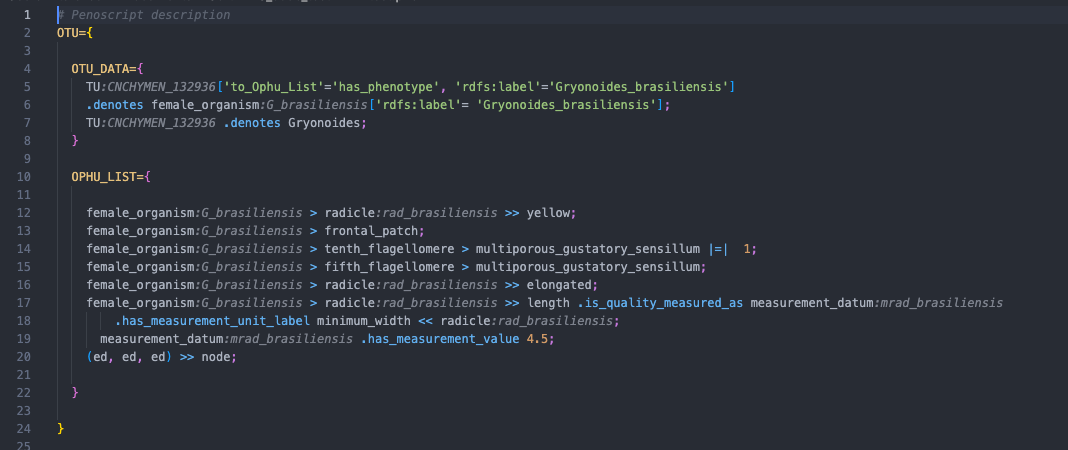
This is an extension for VS Code that provides syntax highlight and snippet viewer for Phenoscript language. It is available for free in the Visual Studio Code Marketplace.
Phenoscript is a computer language designed for describing species using ontologies for downstream automatic comparison of their traits. Such analyses can be performed using the Python package Phenospy available at PyPi repo. See also Phenospy GitHub repo.
Features
The sidebar guides you through three sequential steps:
Step 1 — Write & Convert
With a .yphs file open and active in the editor:
- Convert to OWL + Text — converts the file to OWL ontology and generates a natural-language description (HTML, Markdown, or both). Runs via Docker.
- Check Syntax — validates the active
.yphs file and reports issues in the Problems panel (no Docker needed).
- Text file format — choose HTML, Markdown, or Both for the natural-language output.
- Add GBIF taxonomy — enriches the output with GBIF taxonomic data.
Step 2 — Build Knowledge Base
- Get / Update Ontologies — downloads the ontologies declared in
phs-config.yaml and merges them into source_ontologies/tbox.owl. Runs via Docker.
- Make KB (OWL → KB) — materialises the ABox, infers axioms using the Whelk reasoner, and produces
output/kb/<project>-kb.ttl. Runs via Docker.
Step 3 — Submit (experimental)
- Prepare for Submission (experimental) — checks SHACL validation logs and consistency, then zips
phenotypes/ into submit/<project>.zip ready for repository upload.
Create New Project — scaffolds a new PhenoScript project with the correct directory structure:
my_project/
├── phenotypes/
│   ├── phs-config.yaml   ← fill in your name, ORCID, and project title
│   └── my_species.yphs   ← your phenotype description file
├── source_ontologies/
└── output/
    ├── owl_init/          ← converted OWL files
    ├── nl/                ← natural-language descriptions
    ├── abox/              ← materialised ABox files
    ├── kb/                ← final knowledge base
    └── log-shacl/         ← SHACL validation logs
Prerequisite: Docker Desktop must be installed and running for all Docker-based commands. The image sergeit215/phenoscript-docker is pulled automatically on first use.
Tips & Shortcuts
| Feature |
How to trigger |
| Term info lookup |
Place cursor on term → ⇧⌘E (Mac) / Shift+Ctrl+E (Win/Linux), or right-click → PHS: Show term info |
| YPHS → PHS preview |
Right-click a .yphs file → YPHS → PHS (preview) |
| Browse with Sparklis |
Right-click a .ttl or .owl file → Browse with Sparklis |
Project Setup & OWL Conversion (v0.0.24+)
The extension sidebar provides two commands:
Create Project — scaffolds a new PhenoScript project with the correct directory structure:
my_project/
├── phenotypes/
│   ├── phs-config.yaml   ← fill in your name, ORCID, and project title
│   └── my_species.yphs   ← your phenotype description file
├── source_ontologies/
└── output/
    └── owl_init/         ← converted OWL files appear here
Convert to OWL — converts the active .phs or .yphs file to OWL ontology (.owl + .xml) using the phenoscript-docker image.
Prerequisite: Docker Desktop must be installed and running. The Docker image is pulled automatically on first use — no manual setup required.
Documentation
See Wiki for details.
Funding
This project is supported by the Academy of Finland grants 339576 and 346294.
Installing
Install VS Code and launch it. Install the Phenoscript extension from the Visual Studio Code Marketplace by clicking on "Extensions" on the left hand side bar.
Usage
To activate the ontology term info lookup feature, follow these steps:
- Place your cursor on the focal term.
- Use the following hotkeys based on your platform:
- Windows: "Ctrl+Shift+E"
- macOS: "Cmd+Shift+E"
This will provide you with information about the ontology term you have selected.
Recommended Packages
To enhance your experience with PhenoScript, we recommend installing and using the following packages. For more information, please visit the Wiki.
Known Issues
n/a
Release Notes
This is the first release that is currently in the testing phase.
0.0.11
Syntax highlight, dark theme, snippets.
0.0.19
- Ontology Term info Lookup via Webview.
- Smart syntax error highlighting. When quality terms are linked using 'has_part' or 'part_of,' the statements are displayed with red highlighting.
- Integration with Highlight package: three types of colorful comments and bounding boxes for color terms.
0.0.20
0.0.21/0.0.22
- Improved highlight of erroneous syntax
0.0.23
- Snippets are added for markdown to insert ontology terms. Click ctrl+space if the snippets do not appear automatically.
Credits
The theme is based on One Dark Teme.

