Viz-Compiler is a custom-built native compiler for VizLang( .rv), a minimal C-like language designed as a complete, pedagogically clear compiler construction reference.
It compiles VizLang source through every classical stage:
Source (.rv)
→ Lexer (Flex)
→ Parser (Bison)
→ Semantic Analysis
→ IR Generation (Quads)
→ Optimization
→ x86-64 Assembly
⚠️ Important Rules (READ FIRST)
🔴 VizLang is NOT C
- ❌ Do NOT use
.c
- ❌ Do NOT use gcc
- ✔ Use
.rv
- ✔ Custom compiler only
🔴 main() is Mandatory
int main() {
return 0;
}
🔴 Negative Return Rule
❌ Wrong:
return -1;
✔ Correct:
return 0 - 1;
🔴 repeat Loop (Custom)
repeat(5 * 2) {
print("Runs 10 times");
}
🔴 for Loop Rule
✔ Correct:
for (int i = 0; i < 5; i = i + 1)
❌ Avoid:
int i;
for (i = 0; i < 5; i = i + 1)
Here is the corrected and clean professional version of your section:
⚙️ Usage
Create a Test Folder
mkdir tests
cd tests
Create a Test File
Create a file with any name (for example):
demo.rv
Start the Extension
Ctrl + Shift + P → Start Viz Container
Compile
make run FILE=demo.rv
Exit the Container
exit
Stop the Container
docker stop viz
📌 1. Project Goals & Architecture
Goals
- Full Pipeline Visibility
- Memory-to-Memory CodeGen
- Hardware Hooks (
sort())
Compiler Pipeline
Source → Lexer → Parser → AST → IR → Optimizer → Assembly
📌 2. VizLang Specification
Data Types
int x = 10;
Pointers
int *p = &x;
*p = 20;
Arrays
int arr[5];
Operators
| Category |
Operators |
|
|
| Arithmetic |
+ - * / |
|
|
| Relational |
== != < > <= >= |
|
|
| Logical |
&& |
|
|
| Memory |
& * |
|
|
📌 3. Functions & Recursion
Pass-by-Value
int factorial(int n) {
if (n <= 1) return 1;
return n * factorial(n - 1);
}
Pass-by-Reference
void inc(int *x) {
*x = *x + 1;
}
📌 4. Built-in Hooks
print(x);
input(x);
printarray(arr);
sort(arr,5);
📌 5. IR Instruction Set
IR_MOV, IR_ADD, IR_SUB, IR_MUL, IR_DIV, IR_SHL, IR_SHR, IR_IF_FALSE, IR_GOTO
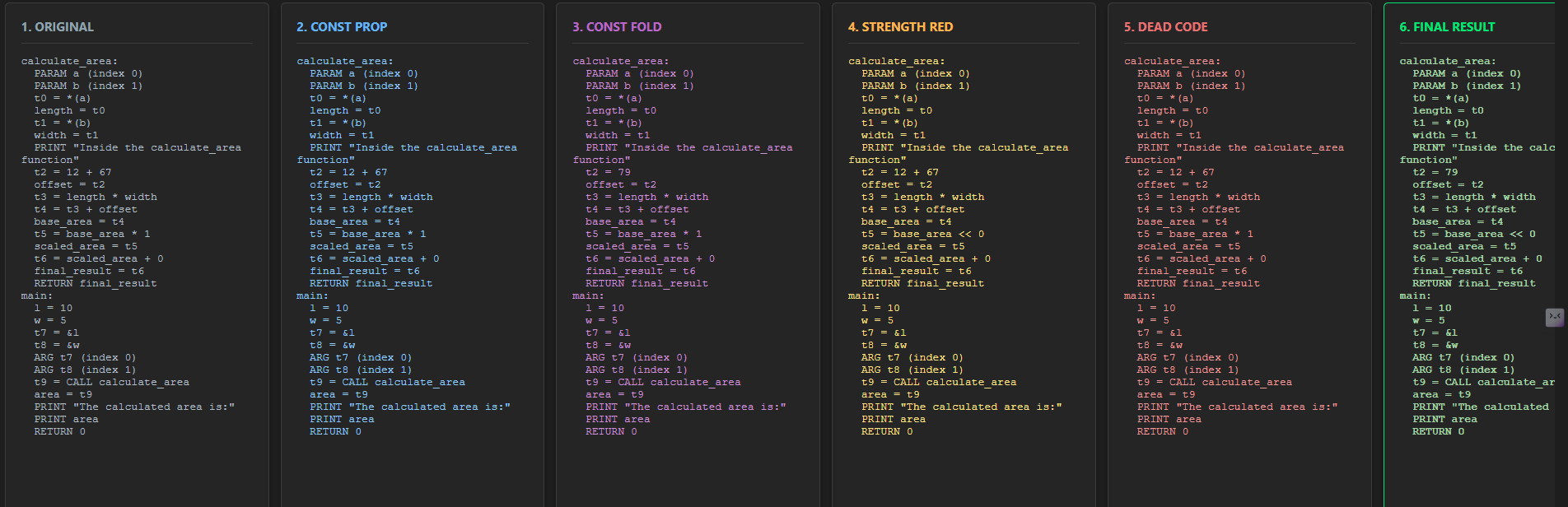
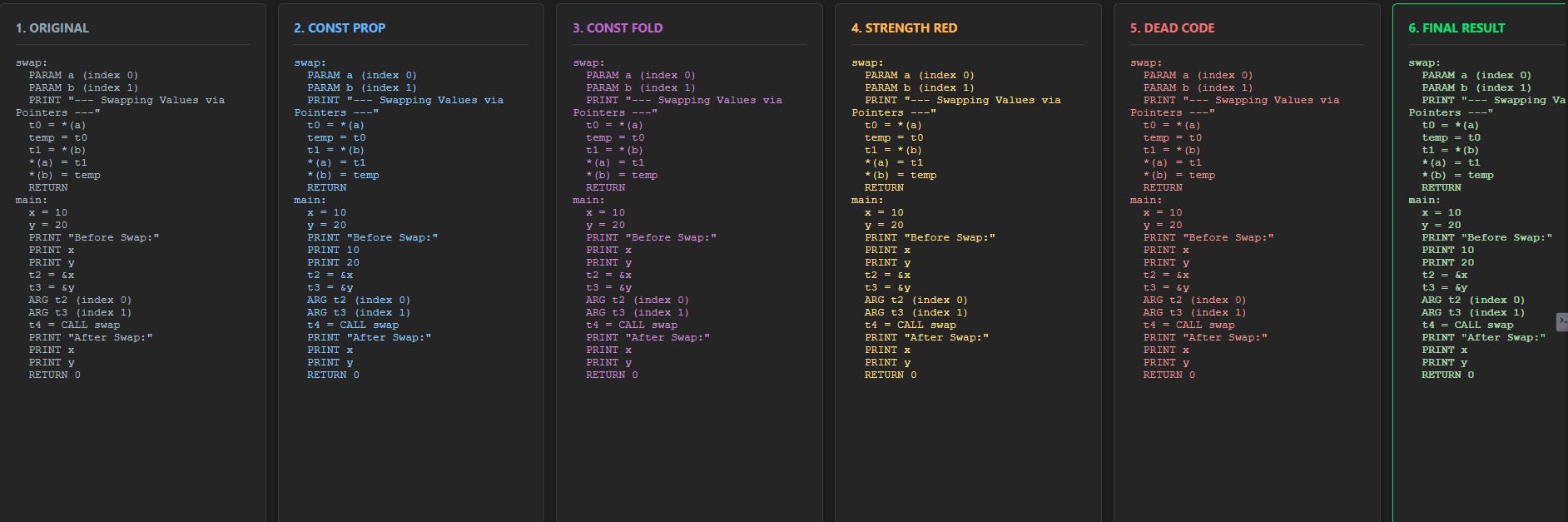
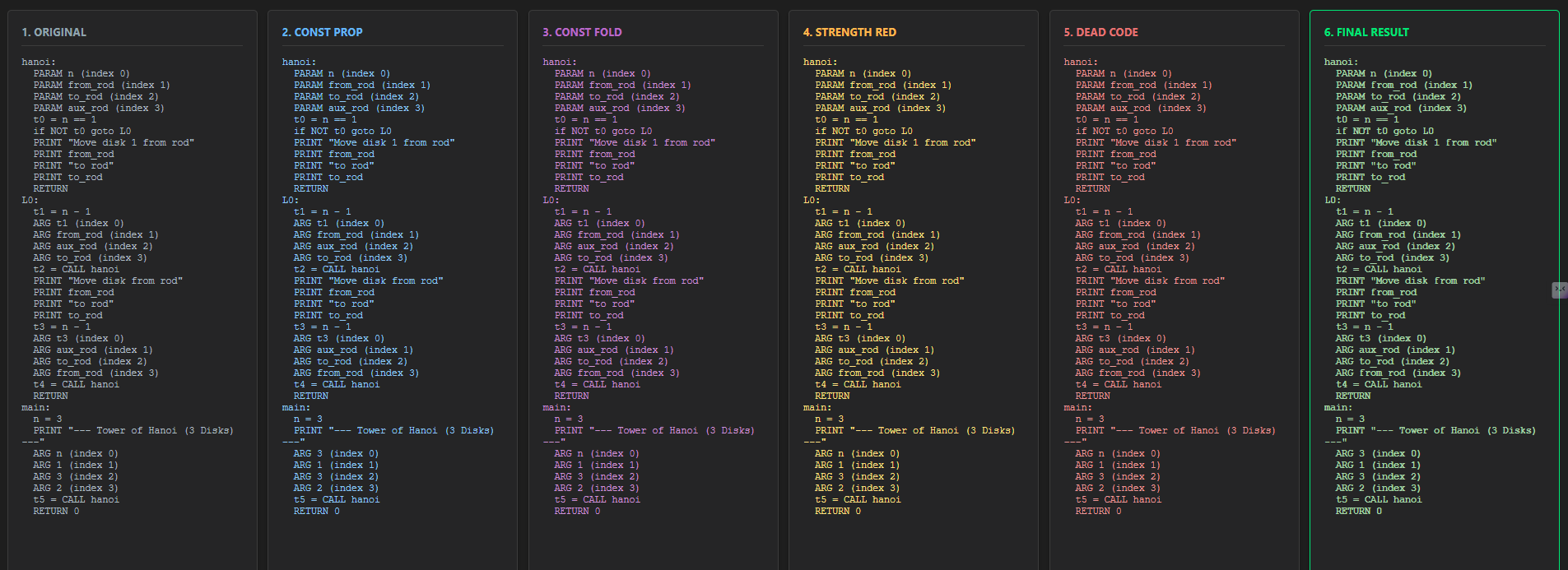
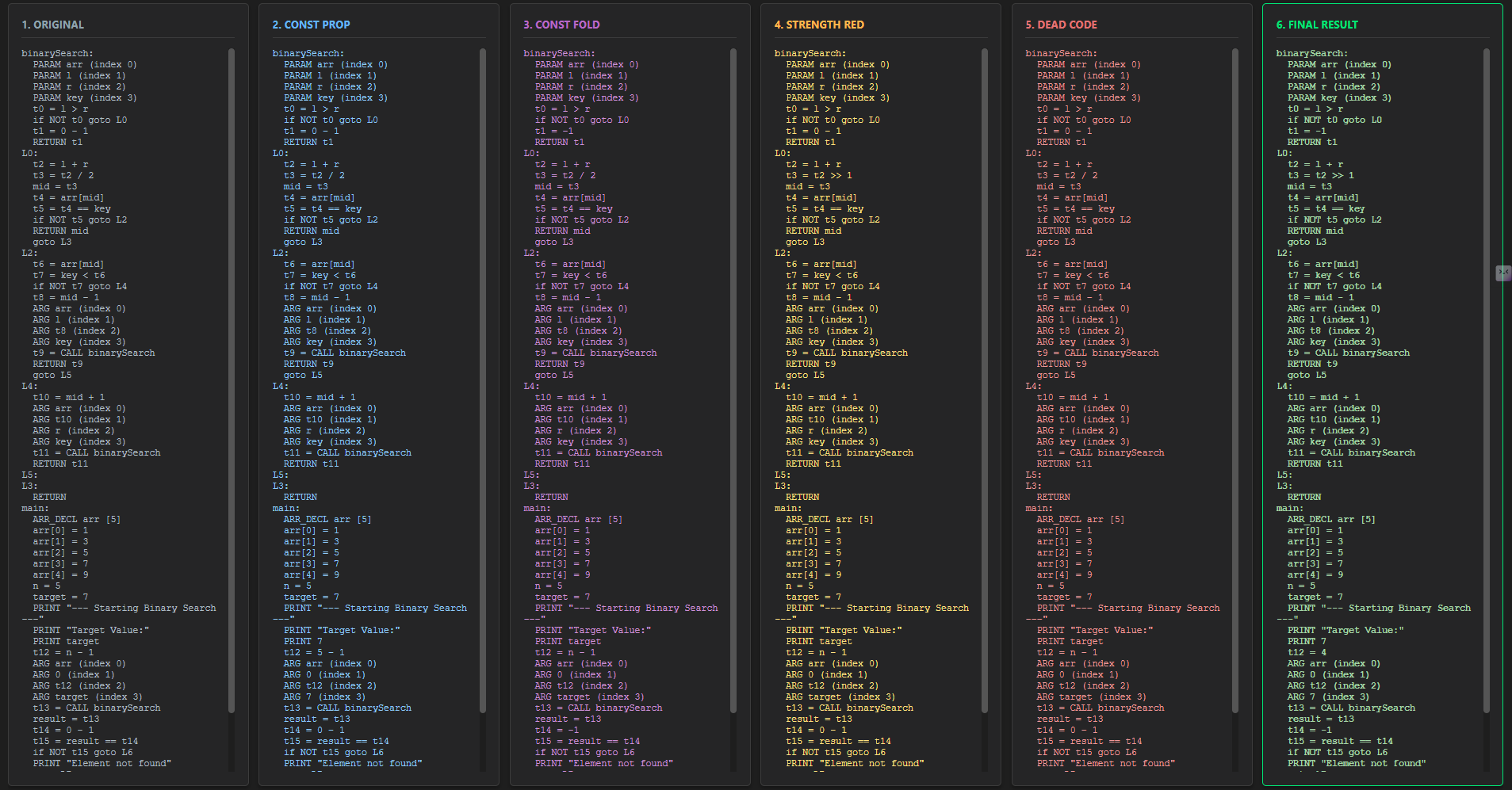
📌 6. Optimization
- Constant Propagation
- Constant Folding
- Strength Reduction
- Dead Code Elimination
📌 EXAMPLES + VISUALIZATION
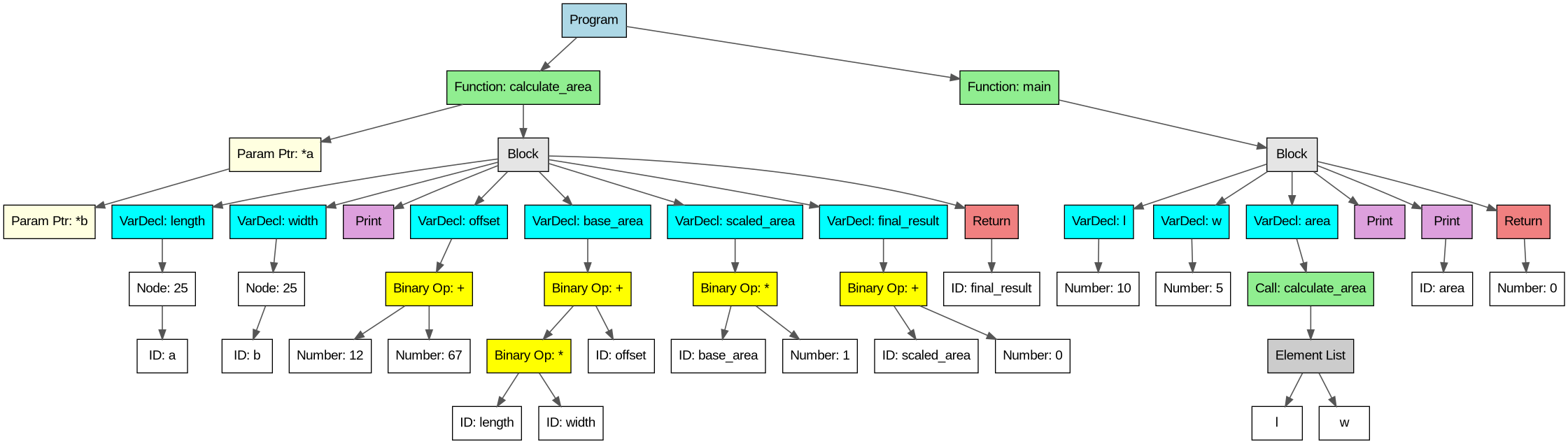
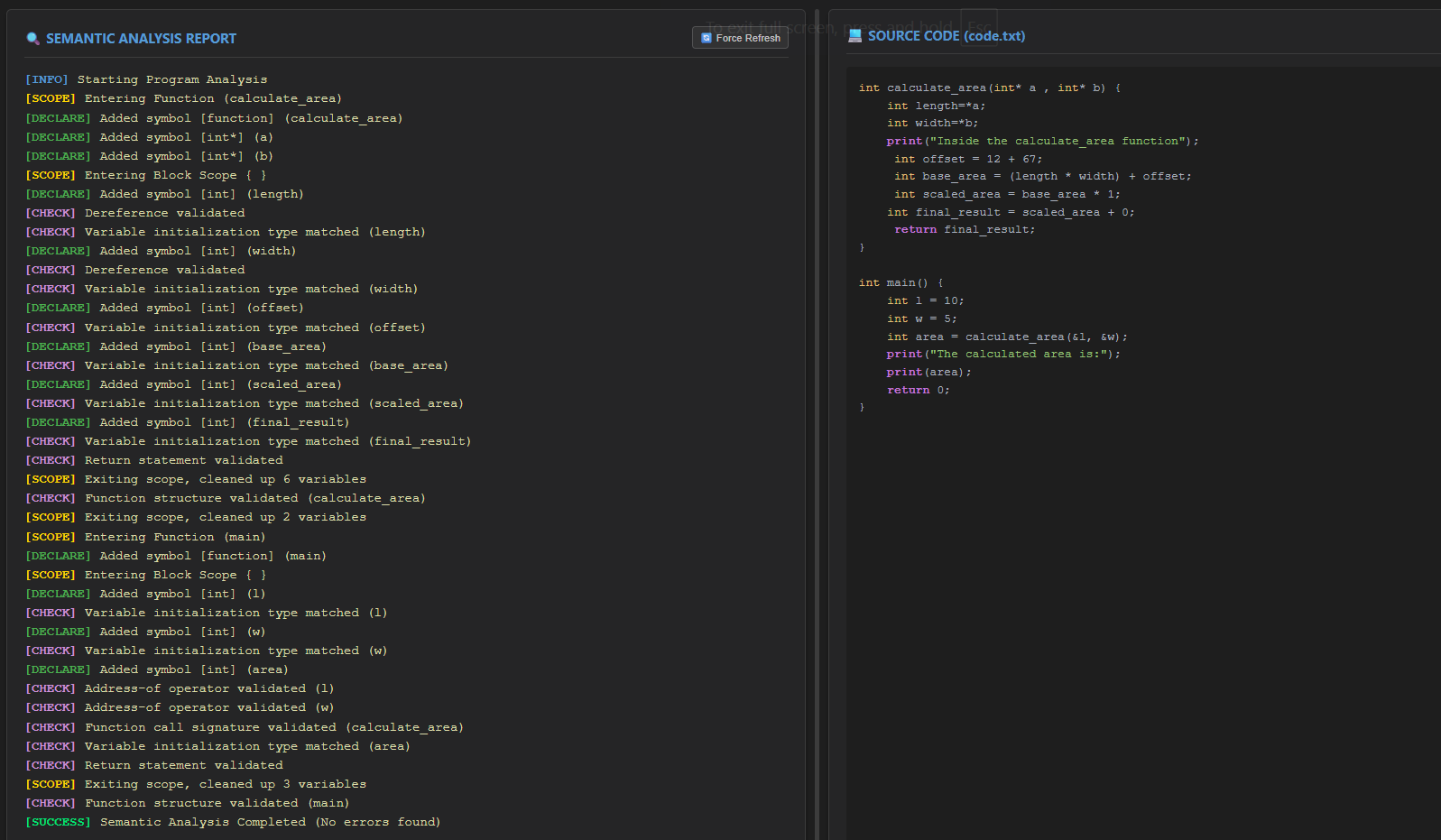
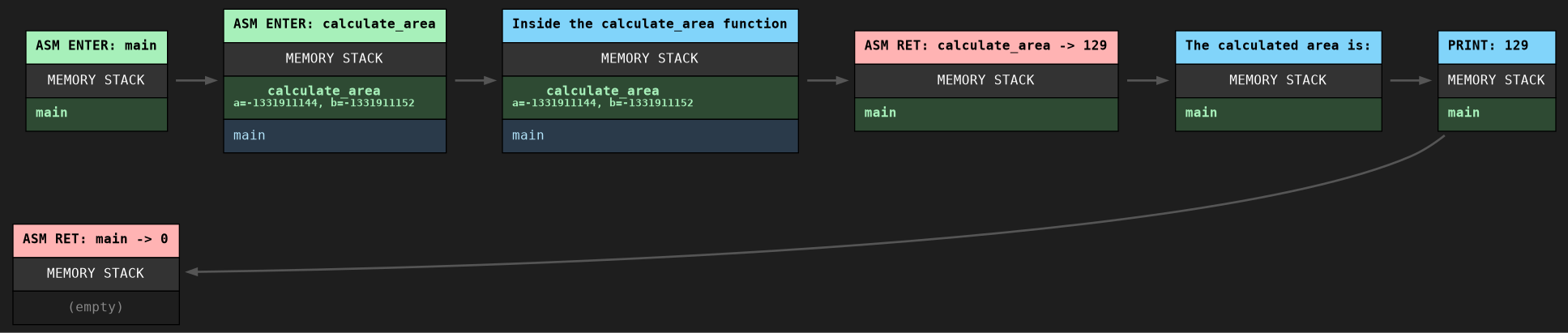
🔹 Area (Pointers)
int calculate_area(int* a , int* b) {
    int length=*a;
    int width=*b;
    print("Inside the calculate_area function");
     int offset = 12 + 67;
     int base_area = (length * width) + offset;
     int scaled_area = base_area * 1;
    int final_result = scaled_area + 0;
     return final_result;
}

int main() {
    int l = 10;
    int w = 5;
    int area = calculate_area(&l, &w);
    print("The calculated area is:");
    print(area);
    return 0;
}
🔹 Insertion Sort
void insertion_sort(int arr[], int n) {
  //  int i=0;
    /* Outer Loop: Iterate through the array */
    for ( int i = 1; i < n; i = i + 1) {

        print("--- Checking Index ---");
        print(i);

        /* Inner Loop: Bubble the element backwards into correct spot */
        /* Syntax: for ( int j=i; condition; update ) */
        for (int j = i; j > 0 ; j = j - 1) {
            if(arr[j-1] > arr[j]){
            /* Swap arr[j] and arr[j-1] */
            int temp = arr[j];
            arr[j] = arr[j-1];
            arr[j-1] = temp;

            print("<< Swapped Backwards");}
        }
    }
}

int main() {
    int my_arr[5] = {12, 11, 13, 5, 6};
    int b= 2+3;
    int z=100;

    print("--- Starting Insertion Sort (Nested For Loops) ---");
    insertion_sort(my_arr, 5);

    print("--- Final Sorted Array ---");
    for (int k = 0; k < 5; k = k + 1) {
        print(my_arr[k]);
    }

    return 0;
}
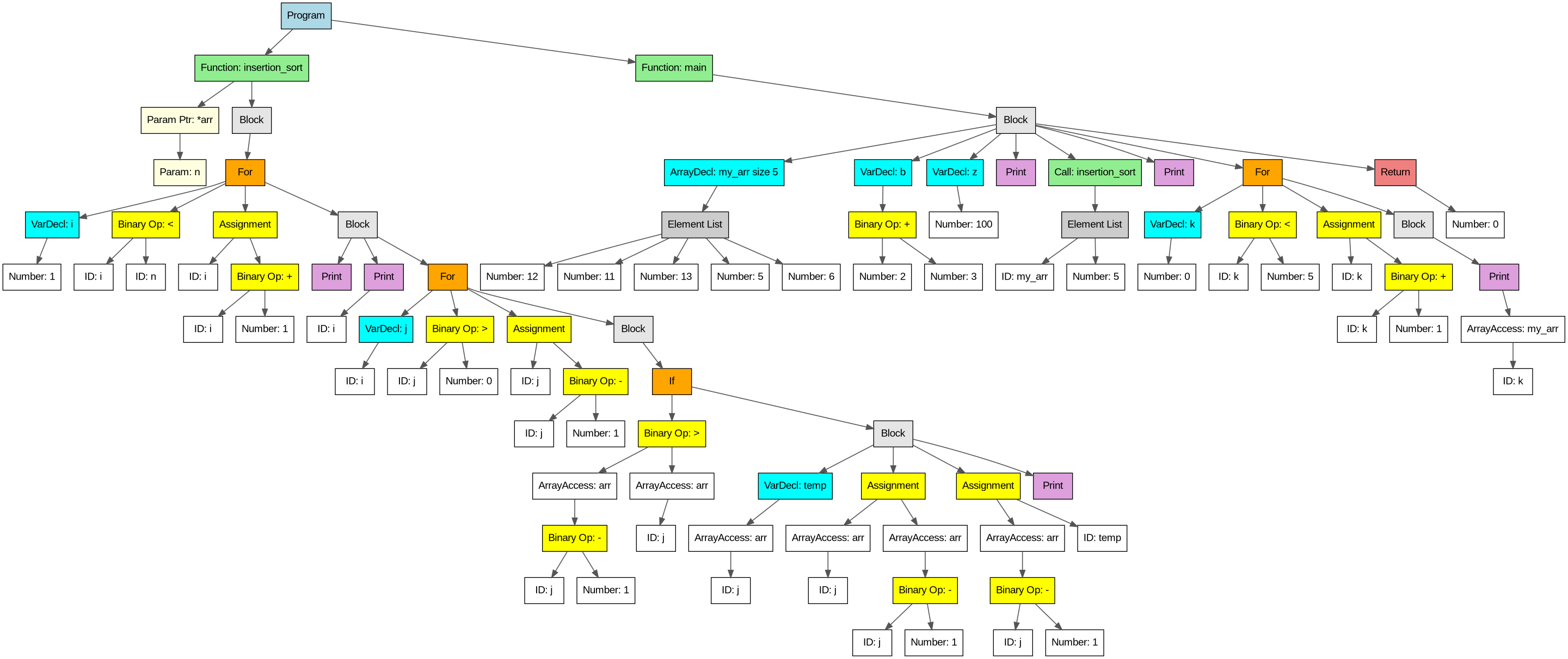
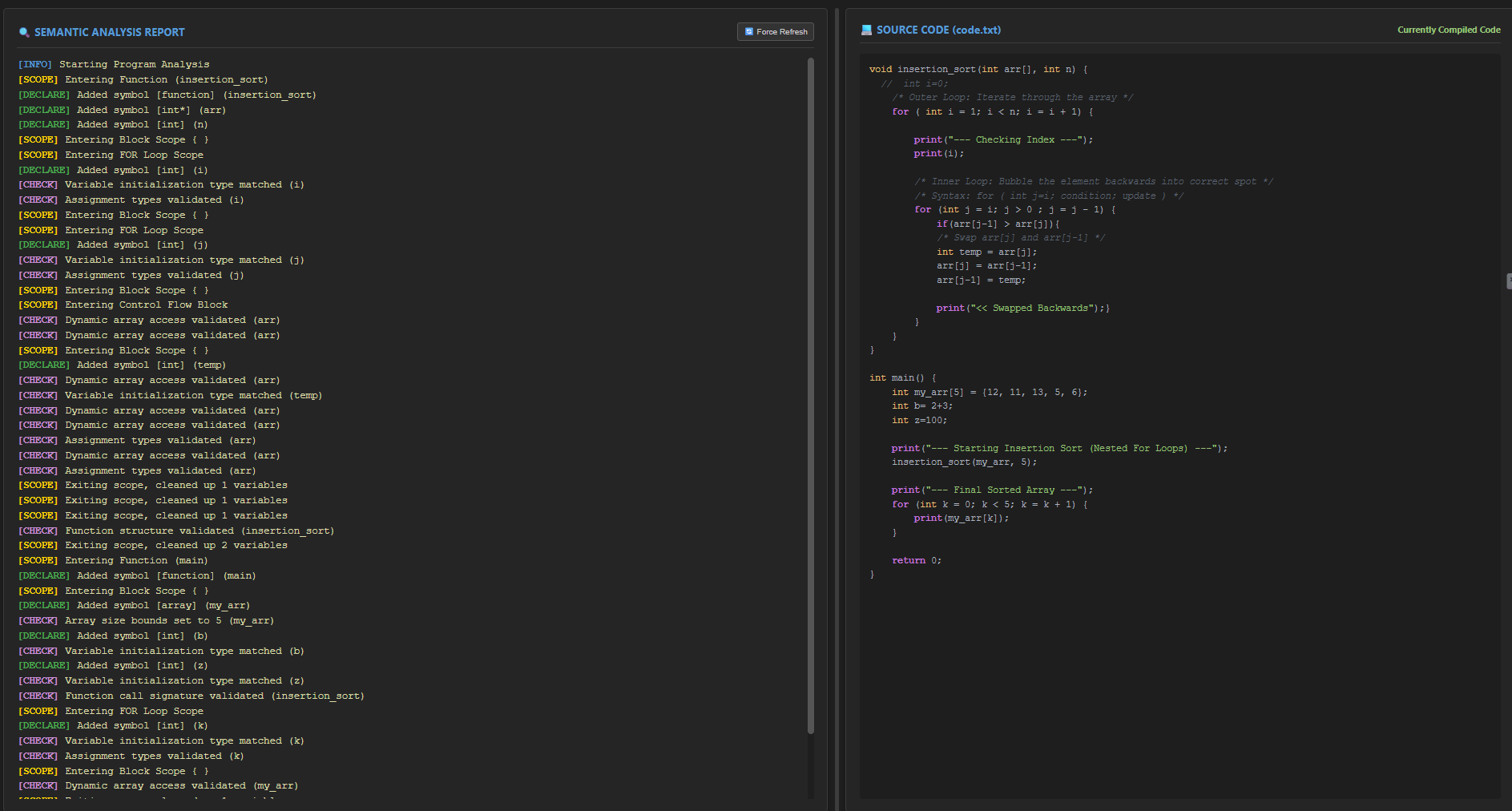
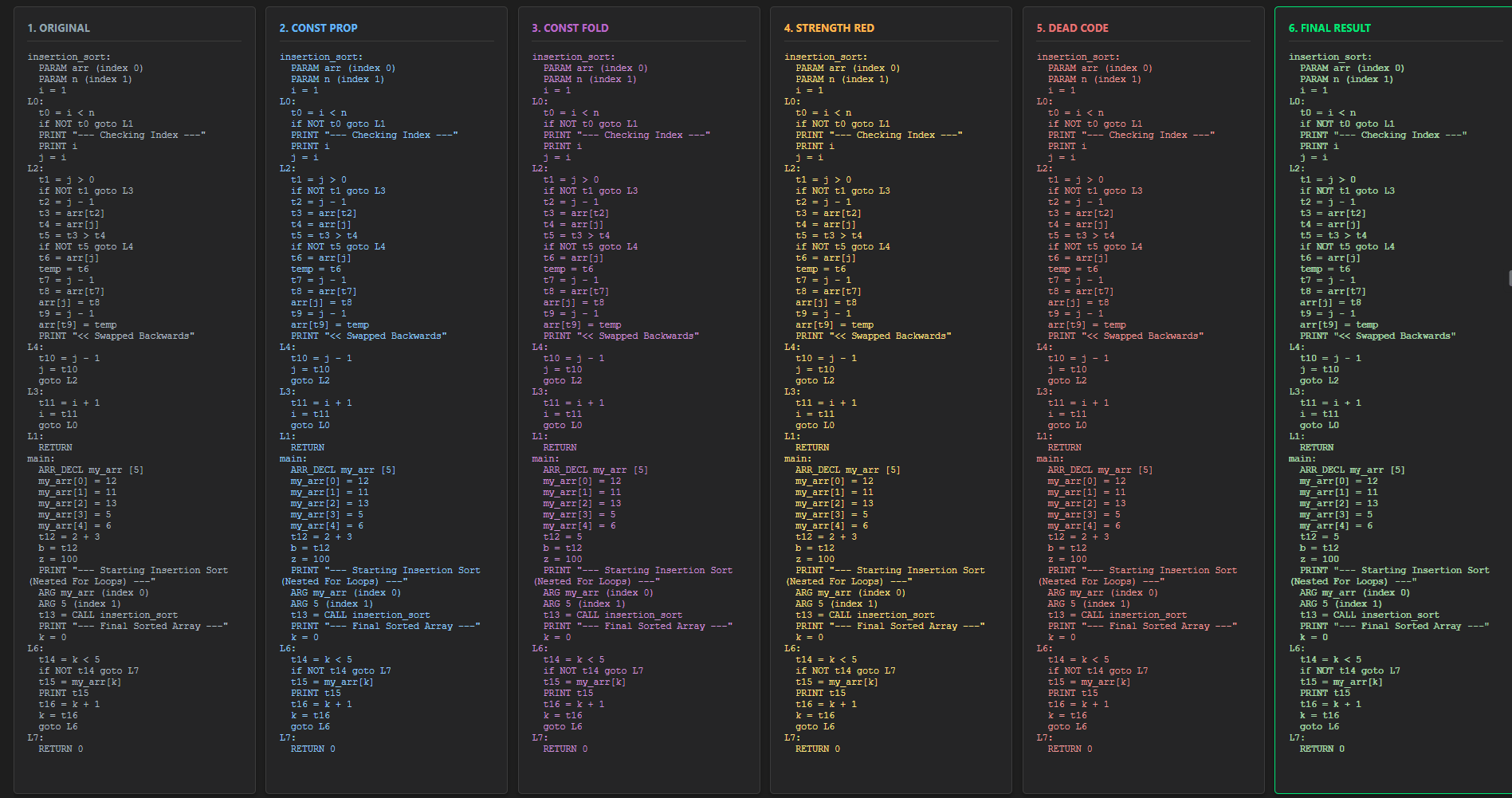
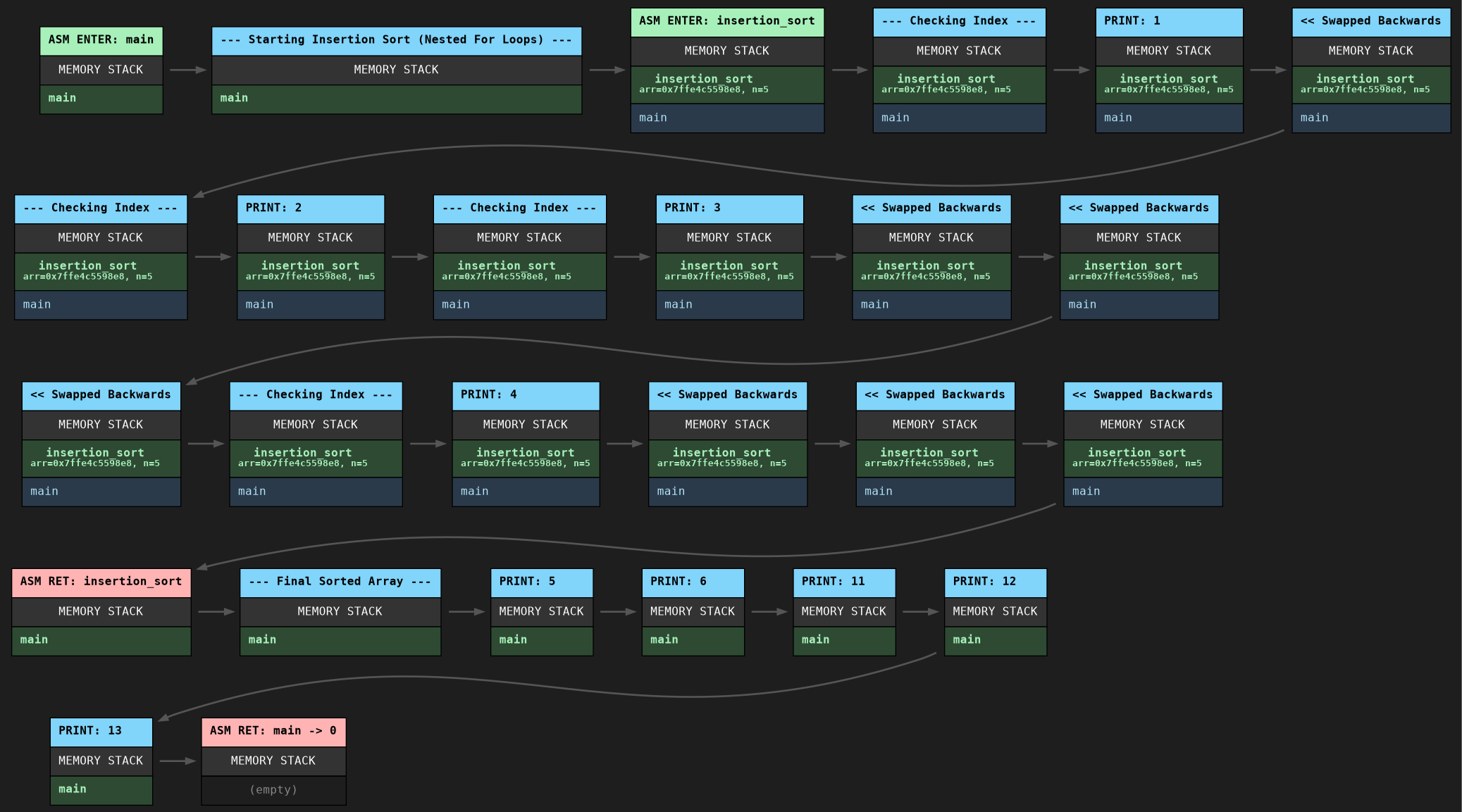
🔹 Recursive Sum
int sumArray(int arr[], int n) {
    /* Base Case: if size is 0, sum is 0 */
    if (n == 0) {
        return 0;
    }

    /* Recursive step: current element + sum of remaining */
    return arr[n - 1] + sumArray(arr, n - 1);
}

int main() {
    /* Define array with size 5 */
    int h=0;
    int arr[5] = {1, h, 3, 4, 5};
    int n = 5;

    print("--- Calculating Recursive Sum ---");

    int ans = sumArray(arr, n);

    print("Total Sum:");
    print(ans);

    return 0;
}
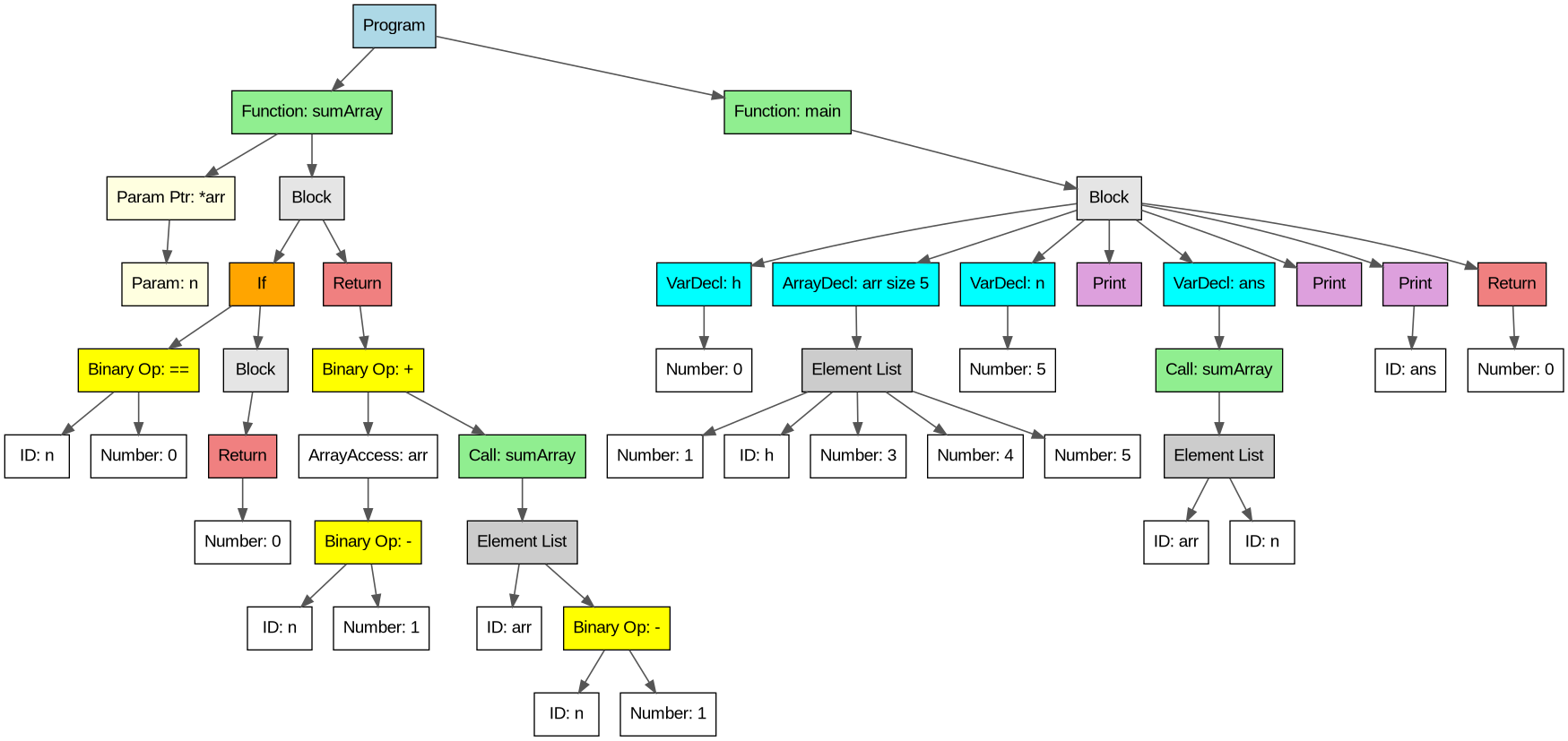
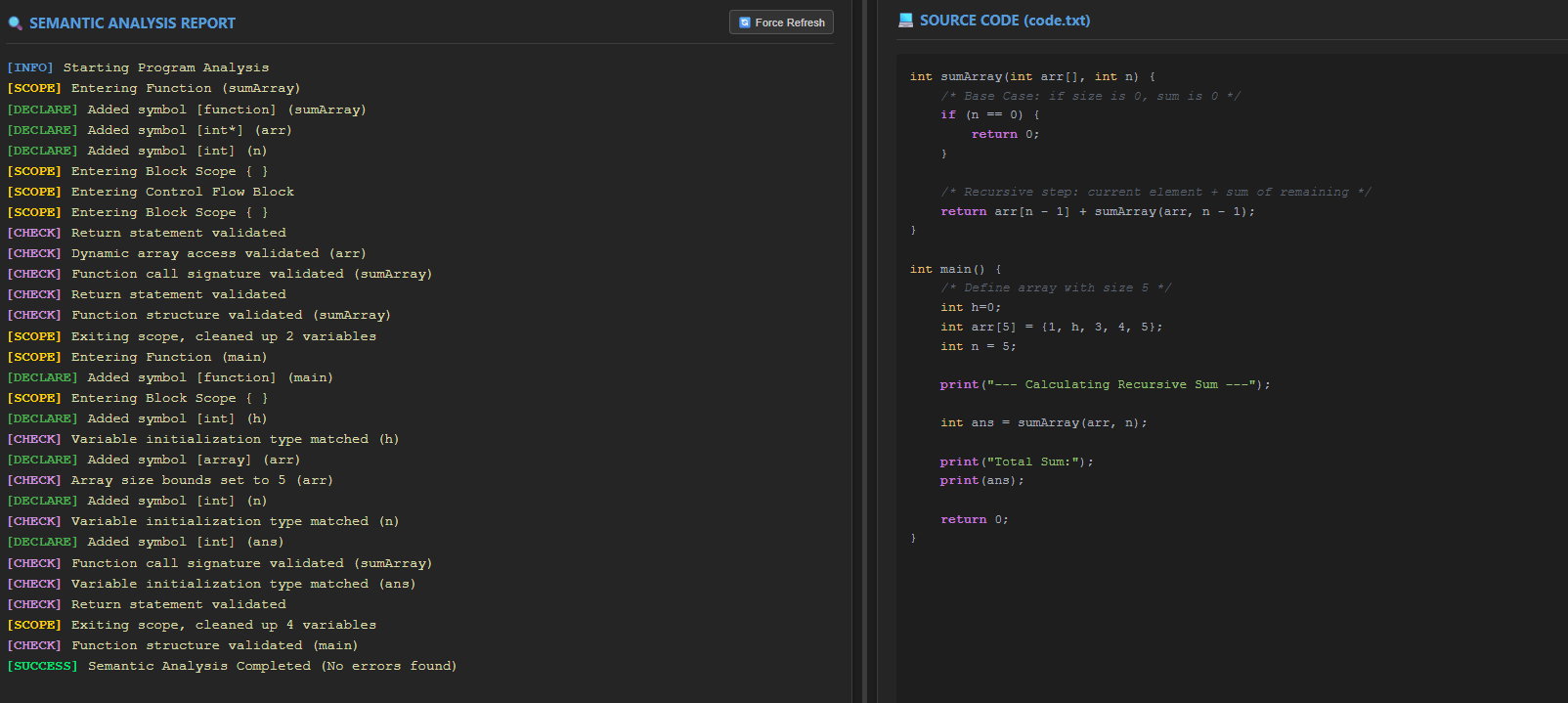
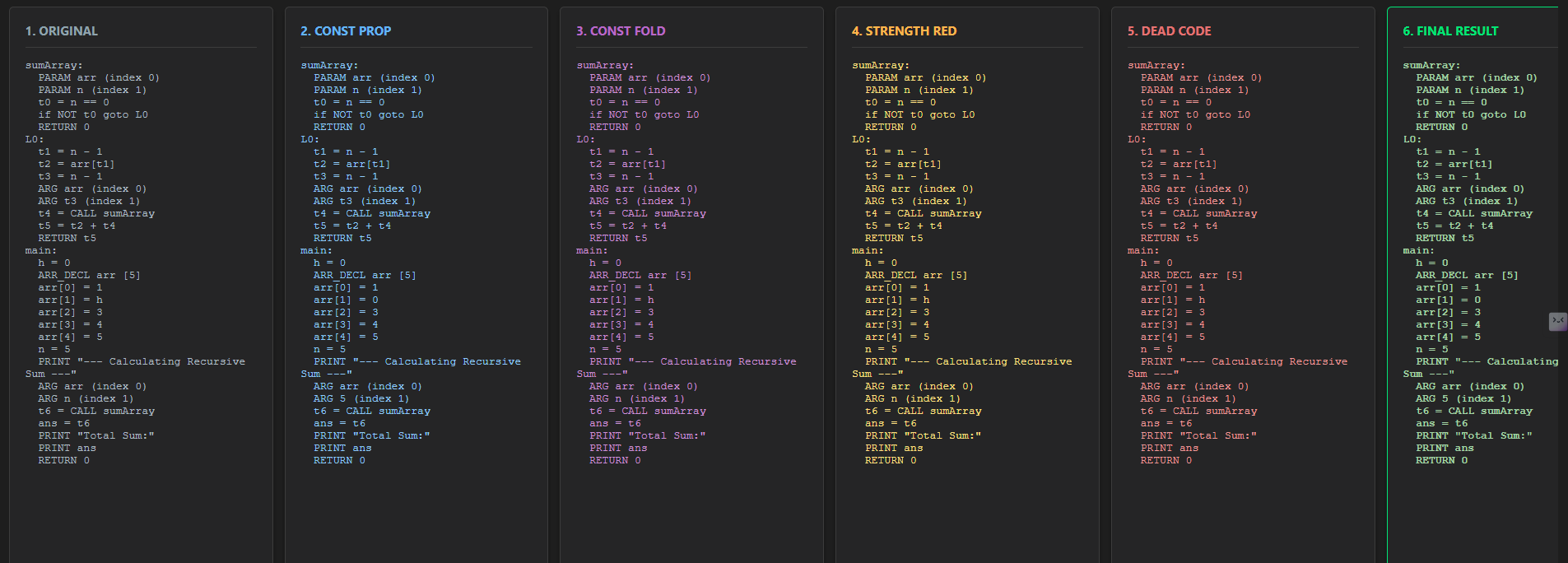
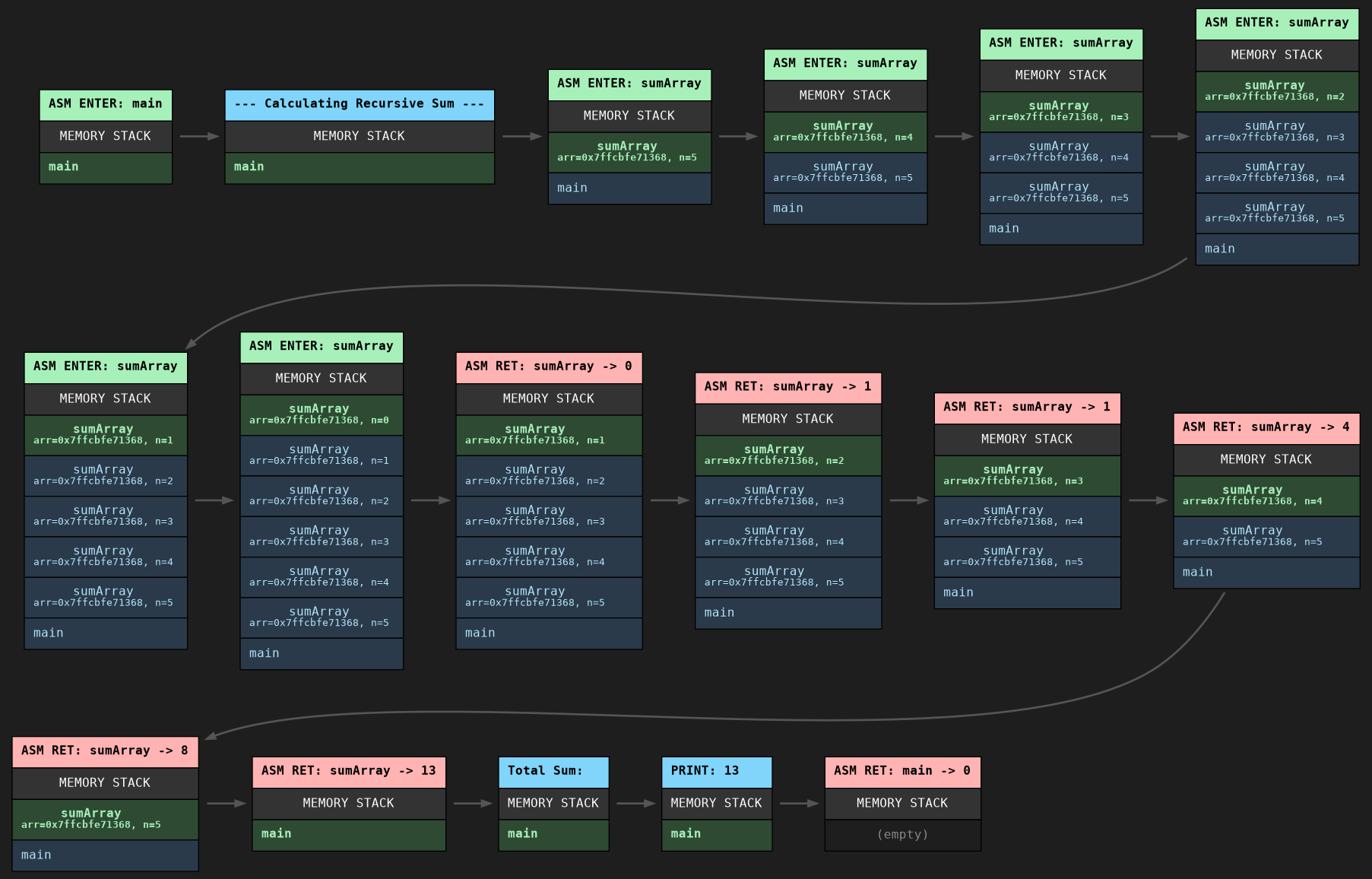
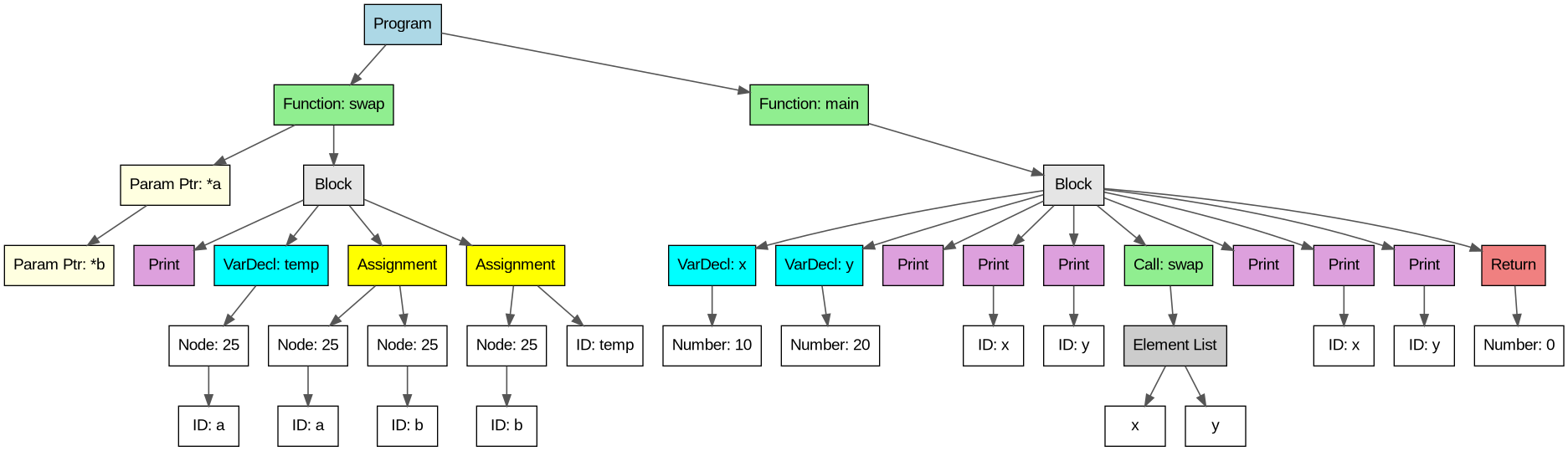
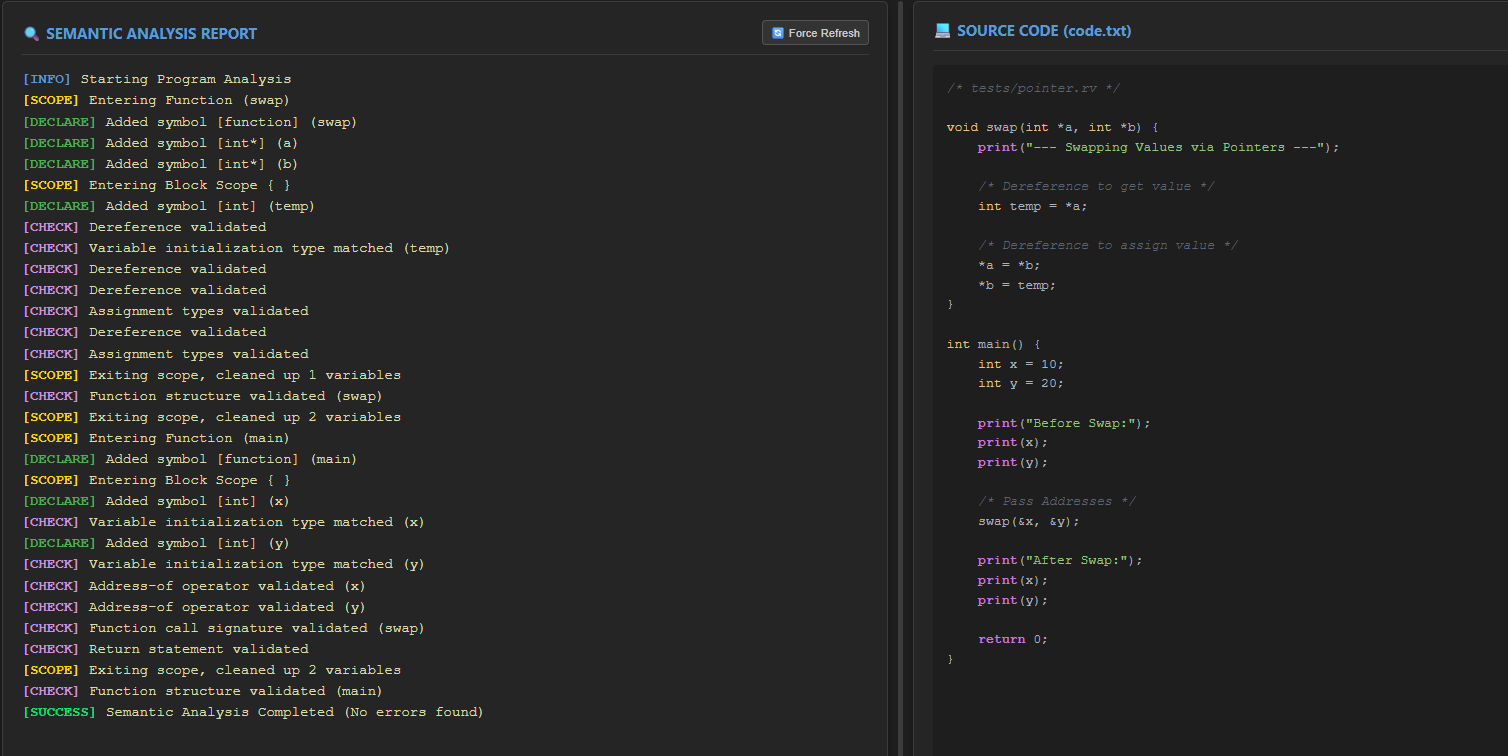
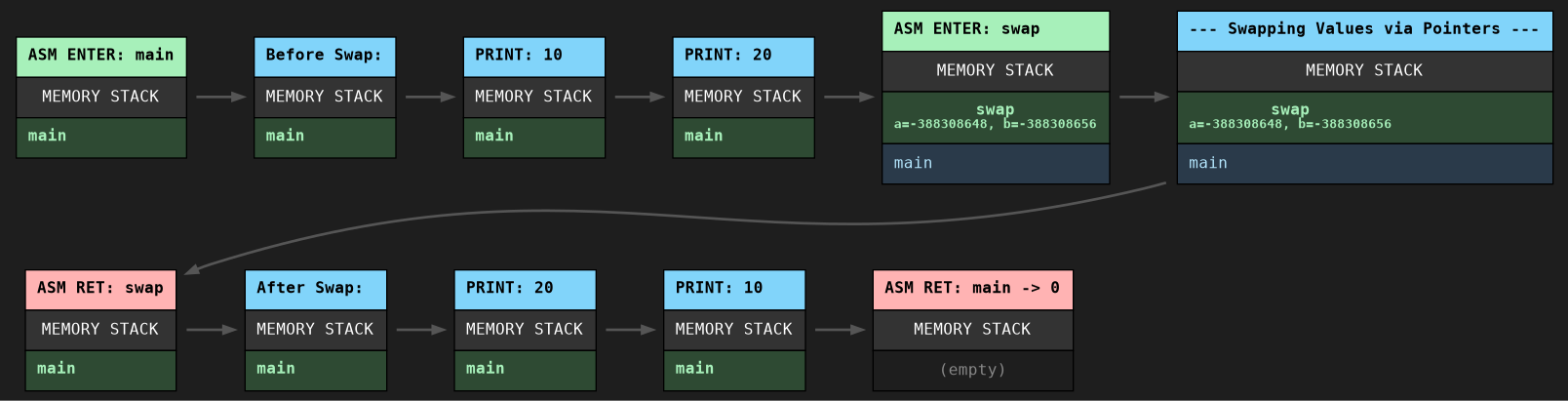
🔹 Pointer Swap
/* tests/pointer.rv */

void swap(int *a, int *b) {
    print("--- Swapping Values via Pointers ---");

    /* Dereference to get value */
    int temp = *a;

    /* Dereference to assign value */
    *a = *b;
    *b = temp;
}

int main() {
    int x = 10;
    int y = 20;

    print("Before Swap:");
    print(x);
    print(y);

    /* Pass Addresses */
    swap(&x, &y);

    print("After Swap:");
    print(x);
    print(y);

    return 0;
}
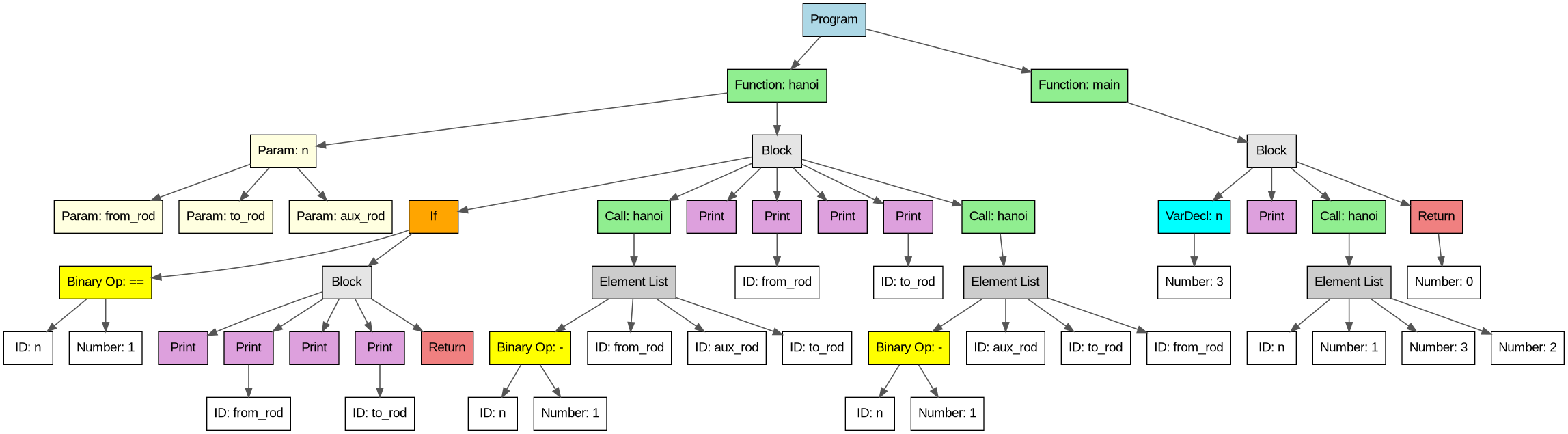
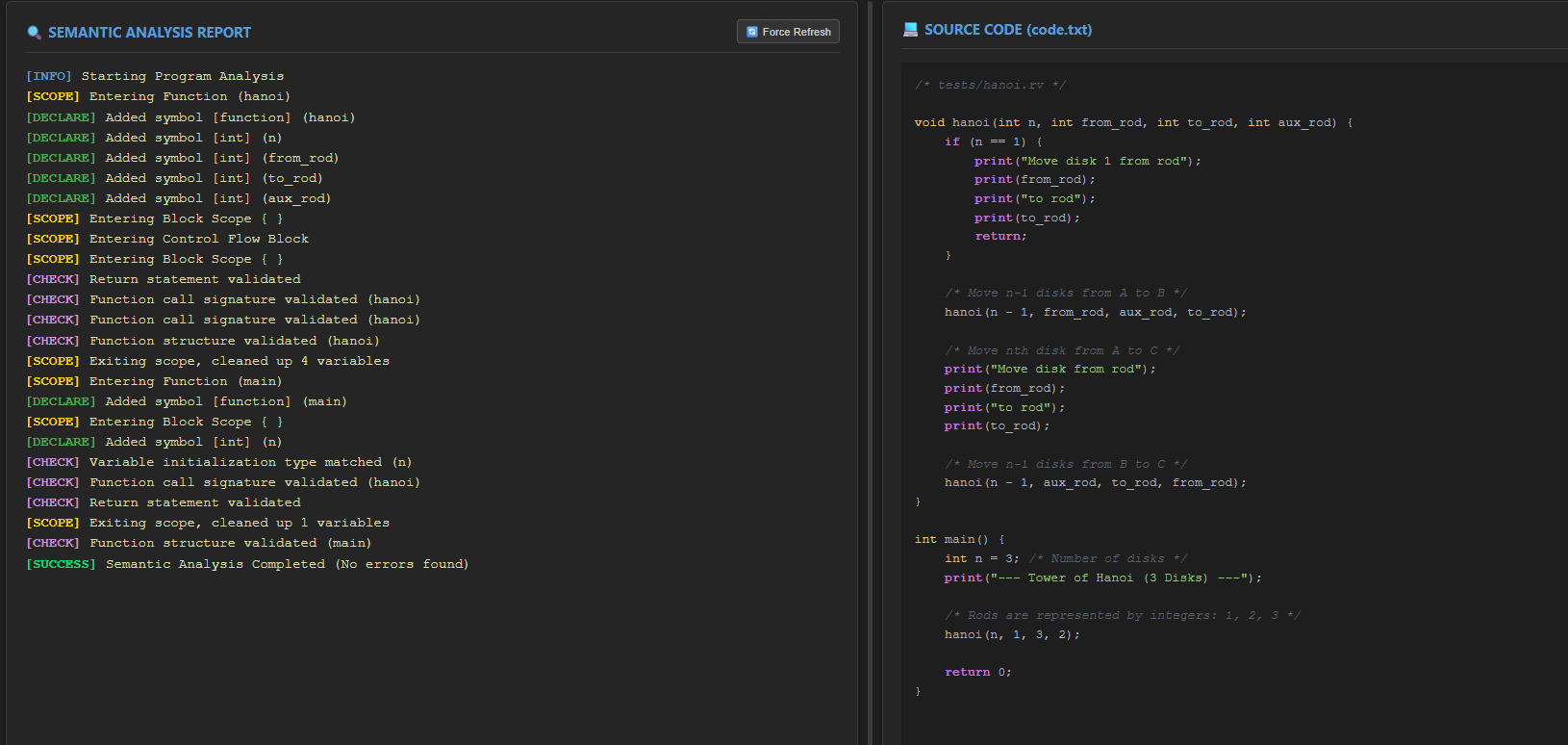
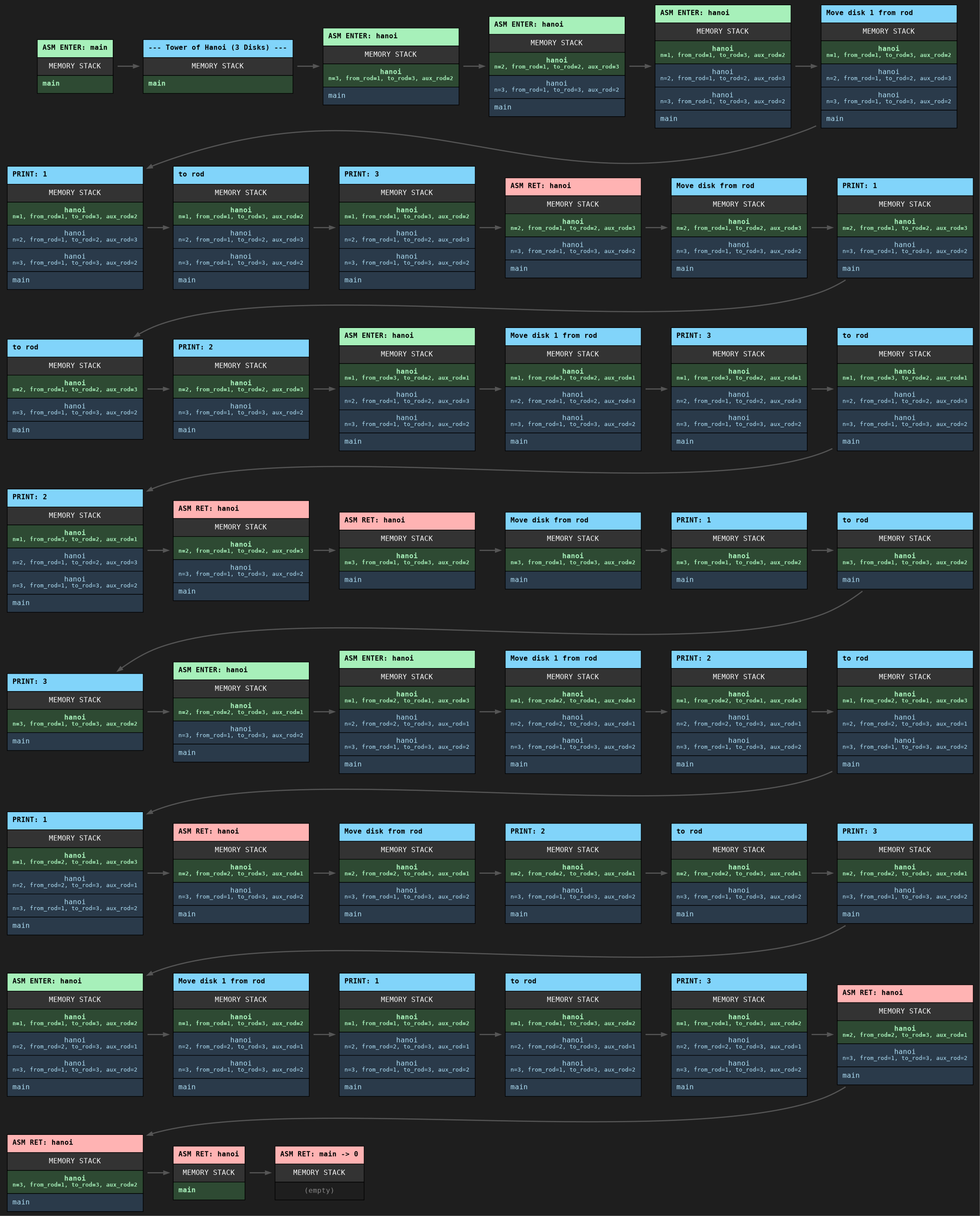
🔹 Tower of Hanoi
/* tests/hanoi.rv */

void hanoi(int n, int from_rod, int to_rod, int aux_rod) {
    if (n == 1) {
        print("Move disk 1 from rod");
        print(from_rod);
        print("to rod");
        print(to_rod);
        return;
    }

    /* Move n-1 disks from A to B */
    hanoi(n - 1, from_rod, aux_rod, to_rod);

    /* Move nth disk from A to C */
    print("Move disk from rod");
    print(from_rod);
    print("to rod");
    print(to_rod);

    /* Move n-1 disks from B to C */
    hanoi(n - 1, aux_rod, to_rod, from_rod);
}

int main() {
    int n = 3; /* Number of disks */
    print("--- Tower of Hanoi (3 Disks) ---");

    /* Rods are represented by integers: 1, 2, 3 */
    hanoi(n, 1, 3, 2);

    return 0;
}
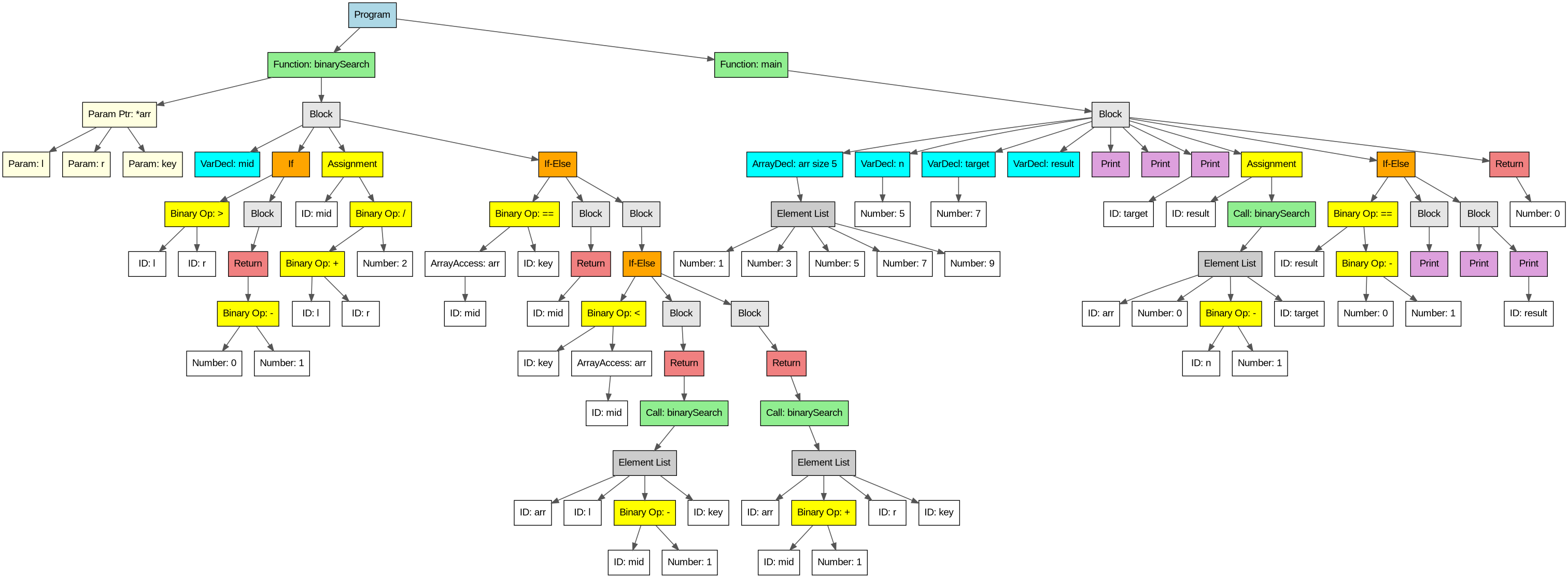
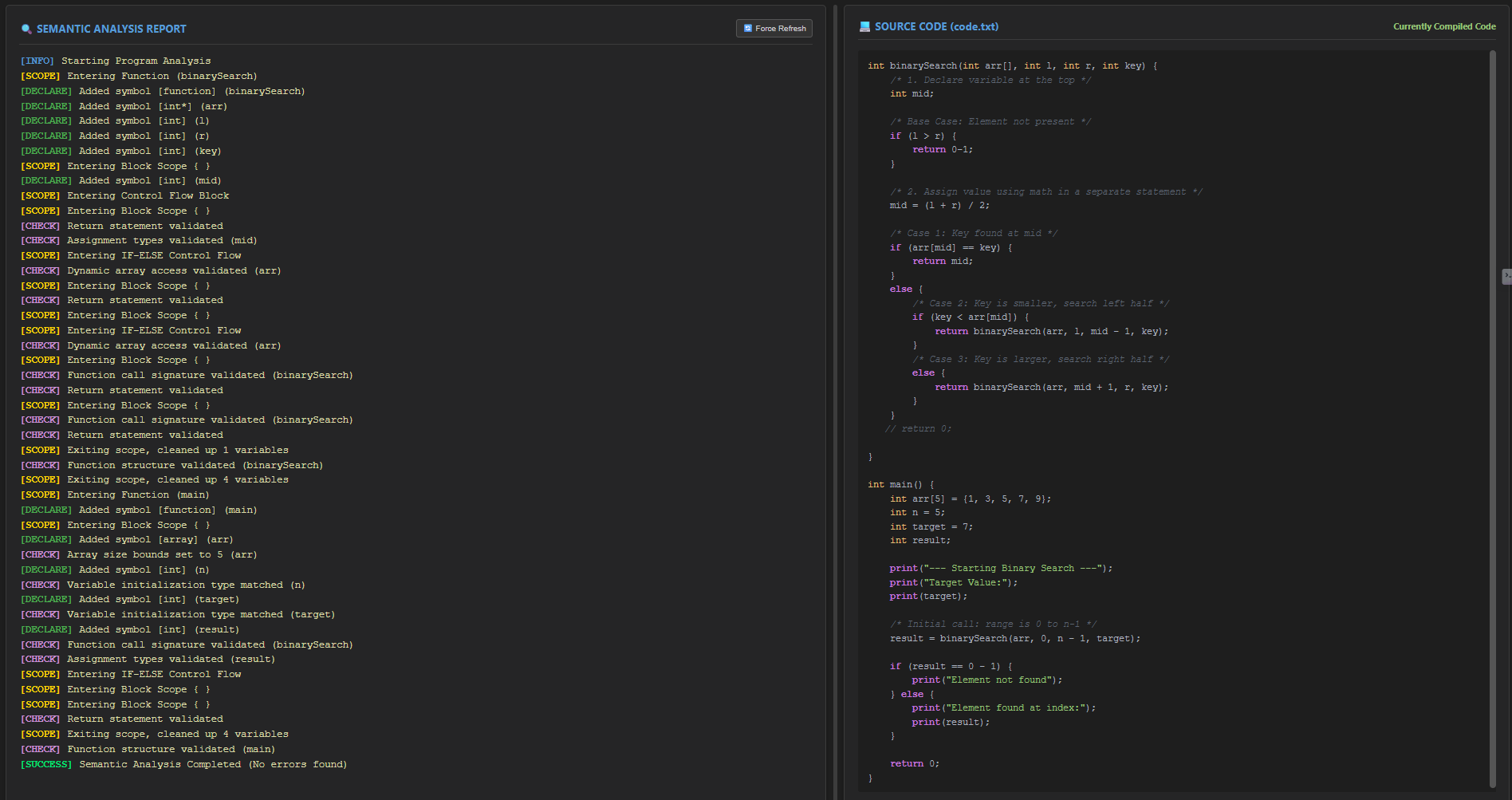
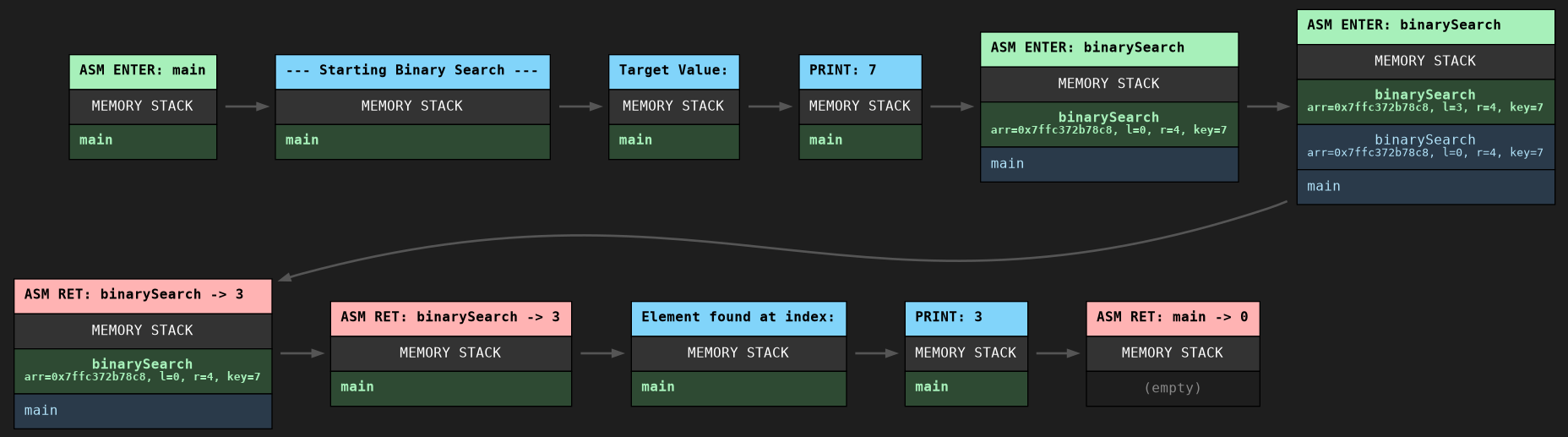
🔹 Binary Search
int binarySearch(int arr[], int l, int r, int key) {
    /* 1. Declare variable at the top */
    int mid;

    /* Base Case: Element not present */
    if (l > r) {
        return 0-1;
    }

    /* 2. Assign value using math in a separate statement */
    mid = (l + r) / 2;

    /* Case 1: Key found at mid */
    if (arr[mid] == key) {
        return mid;
    }
    else {
        /* Case 2: Key is smaller, search left half */
        if (key < arr[mid]) {
            return binarySearch(arr, l, mid - 1, key);
        }
        /* Case 3: Key is larger, search right half */
        else {
            return binarySearch(arr, mid + 1, r, key);
        }
    }
   // return 0;

}

int main() {
    int arr[5] = {1, 3, 5, 7, 9};
    int n = 5;
    int target = 7;
    int result;

    print("--- Starting Binary Search ---");
    print("Target Value:");
    print(target);

    /* Initial call: range is 0 to n-1 */
    result = binarySearch(arr, 0, n - 1, target);

    if (result == 0 - 1) {
        print("Element not found");
    } else {
        print("Element found at index:");
        print(result);
    }

    return 0;
}
🔹 Control Flow (Switch, Break, Continue)
/* tests/control_flow.rv */

int process_numbers() {
    int i = 0;

    print("Starting the loop...");

    while (i < 8) {
        i = i + 1;

        // 1. Testing 'continue'
        // This will skip the rest of the loop body when i is 3
        if (i == 3) {
            print("Skipping number 3 using continue!");
            continue;
        }

        // 2. Testing 'break' in a loop
        // This will completely exit the while loop when i reaches 6
        if (i == 6) {
            print("Reached 6, breaking out of the loop entirely!");
            break;
        }

        // 3. Testing 'switch', 'case', and 'default'
        switch (i) {
            case 1:
                print("Inside Switch: The number is ONE");
                break; // Breaks out of the switch, prevents falling through to case 2

            case 2:
                print("Inside Switch: The number is TWO");
                break;

            case 4:
                print("Inside Switch: The number is FOUR");
                break;

            case 5:
                print("Inside Switch: The number is FIVE");
                break;

            default:
                // If it's a number we didn't explicitly catch
                print("Inside Switch: Unrecognized number");
                break;
        }
    }

    print("Loop execution finished.");
    return 0;
}

int main() {
    print("--- Control Flow Test ---");
    int status = process_numbers();
    print("--- Test Complete ---");

    return status;
}

