SQL Visualizer
A Visual Studio Code extension that converts SQL schema files into rich SVG diagrams, making it easy to visualize database structures, table relationships and foreign key hierarchies directly in the editor.
Features
- Multi-dialect support — Parses both MySQL and PostgreSQL
CREATE TABLE statements, including dialect-specific syntax (TEMP, TEMPORARY, UNLOGGED modifiers for PostgreSQL, # line comments for MySQL).
- Intelligent layout — Tables are positioned automatically using a Sugiyama-style layered graph layout: referenced (root) tables appear on the left, dependent tables are placed to the right, and vertical ordering within each level minimizes relationship-line crossings via a barycenter heuristic.
- Relationship routing with arc jumps — Foreign key connections are drawn as orthogonal (H→V→H) paths with rounded corners. When two lines cross, a small semicircular "hop" is rendered at the intersection point so every relationship remains visually traceable.
- Schema statistics — The generated SVG includes a footer panel with aggregate metrics: total tables, total columns, primary keys, foreign keys, average columns per table, root tables, leaf tables and hierarchy depth.
- Color-coded legend — Each relationship line receives a unique color from a 12-color palette. A built-in legend maps colors to
sourceTable.sourceColumn → targetTable.targetColumn.
- Three ways to generate — Interactive command, right-click context menu, or fully automatic on-save via JSON settings.
- PK / FK badges — Columns are visually tagged with colored badges (orange for PK, blue for FK) inside each table card.
- File size guard — Input files larger than 5 MB are rejected before parsing, preventing the extension host from locking up on data dumps.
How to Use
- Open a
.sql file in Visual Studio Code.
- Right-click the file in the Explorer sidebar.
- Select Convert SQL to Diagram.
- Enter a name for the output file (or leave blank for the default
diagram.svg).
- Select the SQL dialect (MySQL or PostgreSQL).
- The SVG file is saved in the workspace root.
Option 2 — Command Palette
- Open the Command Palette (
Ctrl+Shift+P / Cmd+Shift+P).
- Search for Convert SQL to Diagram.
- If no file is selected, a file picker dialog will open.
- Follow the same name and dialect prompts as above.
Option 3 — Automatic Generation (JSON Settings)
Add the following configuration to your VS Code settings.json:
{
  "sqlVisualizer.autoGenerate": true,
  "sqlVisualizer.inputPath": "./database/schema.sql",
  "sqlVisualizer.outputName": "schema-diagram",
  "sqlVisualizer.outputDir": "./docs",
  "sqlVisualizer.sqlDialect": "mysql"   // "mysql" or "postgres"
}
With autoGenerate enabled, the extension watches the configured inputPath file. Every time you save it, the diagram is regenerated automatically — no manual command needed.
| Setting |
Type |
Default |
Description |
sqlVisualizer.inputPath |
string |
"" |
Path to the SQL file used to generate the diagram. |
sqlVisualizer.sqlDialect |
"mysql" | "postgres" |
"mysql" |
SQL dialect used to parse the input file. |
sqlVisualizer.outputName |
string |
"diagram" |
Name of the generated SVG file. |
sqlVisualizer.outputDir |
string |
"./" |
Directory relative to the workspace where the SVG file will be generated. |
sqlVisualizer.autoGenerate |
boolean |
false |
Automatically regenerate the SVG when the configured SQL file is saved. |
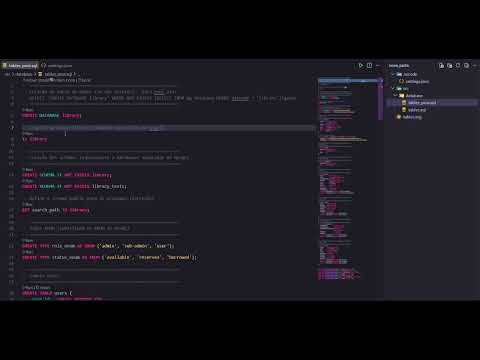
Demo
Architecture (v2.0)
The extension follows a clean, layered pipeline where each stage is independently testable:
SQL file
  │
  ▼
Normalize  ─────────────  Whitespace/encoding cleanup
  │
  ▼
Tokenize   ─────────────  Dialect-agnostic lexer → Token[]
  │
  ▼
State Machine  ──────────  Dialect-aware parser → Table[]
  │                        (uses SqlDialect for keywords,
  │                         modifiers and header validation)
  ▼
Enrich Tables  ──────────  Marks PK/FK flags on columns
  │
  ▼
Sugiyama Layout  ────────  assignLevels → minimizeCrossings
  │
  ▼
SVG Generator  ──────────  Position tables, route connections,
  │                        spread overlapping segments,
  │                        detect crossings → arc-jump hops
  ▼
Handlebars Templates  ───  Compile final SVG document
  │
  ▼
Output .svg file
Key modules
| Module |
Responsibility |
normalizer.ts |
Strips BOM, normalizes line endings and collapses redundant whitespace. |
tokenize.ts |
Generic SQL lexer. Produces Token[] with position data. Dialect-agnostic. |
dialect.ts |
Defines SqlDialect interface and ships mysqlDialect / postgresDialect. |
stateMachine.ts |
Consumes tokens, walks through states (Scanning → Header → Body → emit), produces Table[]. |
enrichTable.ts |
Annotates columns with isPK / isFK flags and resolves primaryKeyName. |
sugiyamaLayout.ts |
Layer assignment + barycenter crossing minimization. |
pathCrossings.ts |
Geometric intersection detection and arc-jump rendering for H-V-H elbows. |
svgGenerator.ts |
Orchestrator: positions tables, routes connections, spreads vertical segments, builds SVG paths. |
svgTemplates.ts |
Handlebars template strings and shared LAYOUT constants. |
configuration.ts |
Reads sqlVisualizer.* settings from VS Code. |
conversionSvg.ts |
Glue service: runs the full pipeline end-to-end (VS Code–agnostic). |
extension.ts |
VS Code activation: registers commands and the on-save listener. |
fileUtils.ts |
File-system I/O: reads SQL files, creates output directories, resolves available file names and writes SVG files. |
What Changed in 2.0
This is a ground-up rewrite of the parsing and rendering engine. The highlights:
- Tokenizer + State Machine replaces line-by-line parsing — The old inline parser read the SQL file line by line with regex. The new architecture splits the work into a proper lexer (
tokenize.ts) and a finite state machine (stateMachine.ts), making the parser more robust, testable and extensible.
- Dialect system — MySQL and PostgreSQL are now first-class citizens via the
SqlDialect interface. Adding a new dialect means implementing a single object — no changes to the tokenizer or state machine.
- Sugiyama layered layout — Tables are no longer positioned with a flat grid.
assignLevels builds a dependency-aware hierarchy, and minimizeCrossings runs a multi-pass barycenter heuristic to reduce visual noise.
- Arc-jump hop rendering — When two relationship lines cross, a small semicircular arc is drawn so the diagram remains readable even with complex schemas.
- Vertical segment spreading — Overlapping connection segments are detected and fanned out so parallel lines run side by side instead of on top of each other.
- Schema statistics footer — The SVG now includes aggregate data about the schema (tables, columns, keys, hierarchy depth).
- Auto-generate on save — A new JSON-configurable mode watches the input file and regenerates the diagram automatically.
- 225 tests, 98.88% statements, 90.35% branches, 100% functions, 99.43% lines — Comprehensive test suites cover the tokenizer, state machine (unit, integration, stability × dialect), layout engine, path crossings and SVG generator.
Test Coverage
All 225 tests pass. Core engine coverage:
| Module |
Statements |
Branches |
Functions |
Lines |
| All files |
98.88% |
90.35% |
100% |
99.43% |
| src |
99.03% |
91.49% |
100% |
99.68% |
dialect.ts |
100% |
100% |
100% |
100% |
pathCrossings.ts |
98.80% |
93.33% |
100% |
100% |
stateMachine.ts |
100% |
96.87% |
100% |
100% |
sugiyamaLayout.ts |
99.07% |
88.63% |
100% |
100% |
svgGenerator.ts |
98.06% |
86.90% |
100% |
98.89% |
svgTemplates.ts |
100% |
100% |
100% |
100% |
tokenize.ts |
99.18% |
95% |
100% |
100% |
| src/services |
100% |
100% |
100% |
100% |
conversionSvg.ts |
100% |
100% |
100% |
100% |
| src/utils |
97.01% |
79.31% |
100% |
96.61% |
enrichTable.ts |
100% |
80% |
100% |
100% |
fileUtils.ts |
94.73% |
75% |
100% |
94.28% |
normalizer.ts |
100% |
100% |
100% |
100% |
npm test # run all tests
Known Issues
No known issues at this time. If you encounter any problems, feel free to report them by opening an issue in the GitHub repository.
License
Apache License 2.0
| |

