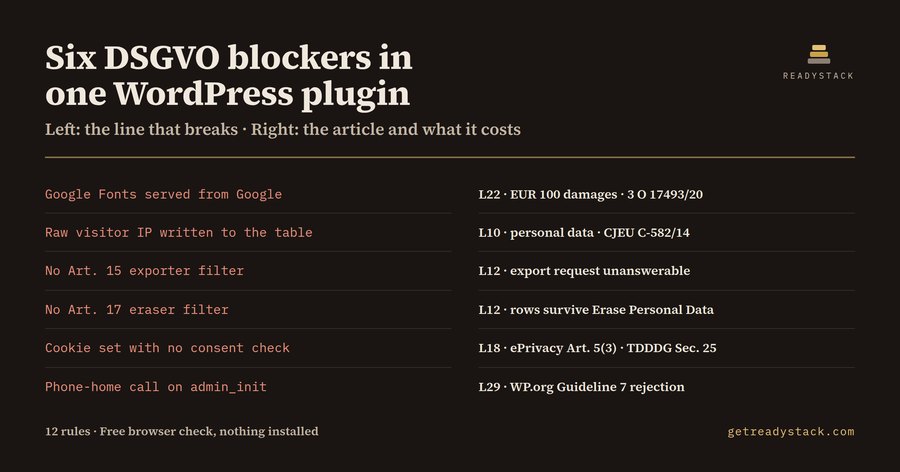
WordPress Privacy Lint (GDPR / DSGVO)Lints WordPress plugin PHP for the 12 privacy duties the plugin author owns: missing Art. 15/17 exporter and eraser hooks, raw IPs, Google Fonts, phone-home and pre-consent cookies. Installation Launch VS Code Quick Open ( Ctrl+P), paste the following command, and press enter.Copied to clipboard |

WordPress Privacy Lint (GDPR / DSGVO)
Your plugin's privacy duties are not the site owner's problem. When a WordPress site gets a
GDPR Art. 15 export request, WordPress walks every registered
This extension reads WordPress plugin and theme PHP and reports the 12 author-side rules below. It is a plain static check: a regex rule set, no network calls, no telemetry, nothing sent anywhere. The 12 rules
Measured on the bundled fixtures
Free scopeThe free check covers one file completely. Open any PHP file, run WordPress Privacy Lint: Check this file, and you get all 12 rules with the article and the fix for each hit. Nothing is hidden, watermarked, time-limited or counted down. The same 12 rules also run in the browser, with nothing installed: https://getreadystack.com/tools/wordpress-privacy-lint Full versionThe licence key adds a different axis, not a bigger slice of the same one: one run across every PHP file in the plugin, and a dated audit report (Markdown and JSON) that you keep — for the WordPress.org review reply and for your Art. 30 records. $29 once, one licence key per person or team seat, 7-day full refund. Yardstick: a DSGVO code review by a German IT-law firm is commonly billed at EUR 200 per hour. https://buy.polar.sh/polar_cl_sZ2Bgyx7lAEhKmhzceABGE3rRlKWXaJxUrjPm48Q1KV Not what this isIt is not legal advice, and it is not a consent-banner plugin. It reads your source and tells you which of the 12 duties the source does not meet. Whether your processing has a lawful basis under Art. 6 is a question for a lawyer, not a linter. |