Terraform writes back everything it sends to a provider. That is how it detects drift, and it is why terraform.tfstate is a plaintext copy of your infrastructure — including the values you never meant to persist.
This extension reads the .tf file you have open and names every place a secret value ends up in terraform.tfstate in cleartext, with the line number and what to do instead.
The 10 rules
| Rule |
Severity |
What it catches |
state_plaintext_attr |
error |
password, secret_string, private_key, client_secret, auth_token and 14 more attribute names, on any resource, provider or module block |
random_password_state |
error |
random_password / random_string / random_id — the generated value is stored in state forever |
tls_private_key_state |
error |
tls_private_key writes private_key_pem and private_key_openssh into state |
secret_data_source_state |
error |
aws_secretsmanager_secret_version, vault_generic_secret, azurerm_key_vault_secret and 4 more — data source results are persisted |
backend_s3_unencrypted |
error |
remote state object written with no encrypt = true / kms_key_id |
output_missing_sensitive |
error |
an output returning a secret-bearing value without sensitive = true |
hardcoded_secret_literal |
error |
an AWS access key id, PEM block, GitHub, Slack, OpenAI-style or Google key written into the source |
state_encryption_block_missing |
warn |
a terraform block with no encryption { } — state encryption has been available since Terraform 1.10 |
backend_local_state |
warn |
backend "local", or no backend at all — state is an unencrypted JSON file on disk |
variable_missing_sensitive |
warn |
a credential-named variable without sensitive = true |
What it reports
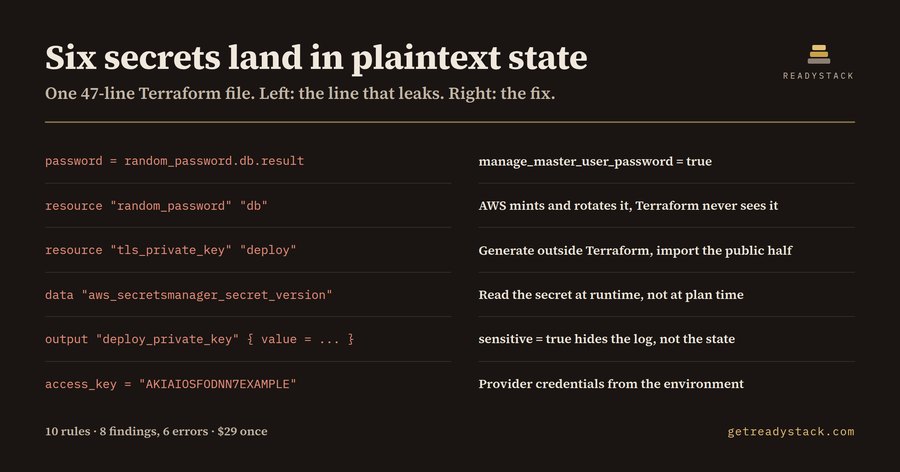
The repository ships two sample files. On the 47-line _fixtures/dirty.tf — ordinary Terraform that a code scanner passes — the extension returns 8 findings: 6 errors and 2 warnings. On _fixtures/clean.tf, the same stack rewritten so no secret reaches state, it returns 0.
ERROR  L23  random_password_state       random_password.db stores `result` in terraform.tfstate in cleartext forever
ERROR  L28  tls_private_key_state       tls_private_key.deploy writes private_key_pem into state
ERROR  L42  state_plaintext_attr        `password` on aws_db_instance.prod is stored verbatim in terraform.tfstate
WARN   L2   state_encryption_block_missing  terraform block has no encryption { }
Why a code scanner passes this file
Free scanners look for a secret written in the code. This looks for the values Terraform copies out of the code and into terraform.tfstate, which is a different list: random_password.result, tls_private_key.private_key_pem and every secret data source are clean HCL that still land in state in cleartext.
sensitive = true is part of that misunderstanding. It hides the value in plan output and in CI logs. It does not remove it from the state file.
Free, and what the licence key adds
Free, with no key: scan the file you have open against all 10 rules and read every finding with its line number and its fix. That is a complete job on one file.
The licence key adds a different axis — scope and ownership: the workspace sweep, which scans every .tf file in one pass, and the export that writes the findings to a dated Markdown or JSON file you keep as audit evidence.
Hand review runs about $150/hour. The licence is $29 once, one key per person or CI seat, with a 7-day full refund.
Workspace sweep + dated evidence file — $29 once
Commands
Terraform State Secret Leak Lint: Check This File — the open .tf file, freeTerraform State Secret Leak Lint: Sweep Workspace — every .tf file, licence keyTerraform State Secret Leak Lint: Export Evidence File — dated Markdown or JSON, licence key
Run it in a browser first
The same engine, byte for byte, runs as a single page with nothing uploaded: https://getreadystack.com/tools/tfstate-secret-leak-lint
Licence
Commercial licence, see LICENSE.txt. Nothing is sent anywhere except the licence key check against api.polar.sh.

