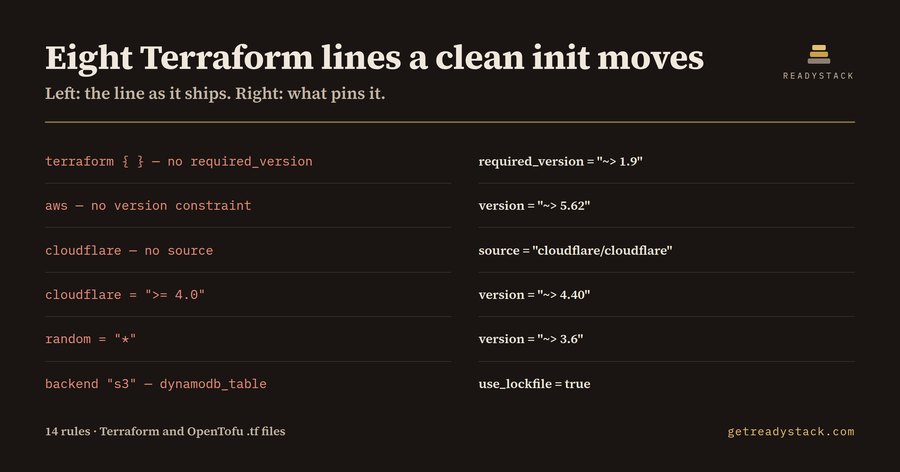
Your pipeline runs terraform init on an empty runner. Nothing carries over from the last job: every provider and every module is chosen again, from scratch, by whatever the constraint in your .tf file happens to allow. A constraint of >= 4.0 allows the next major. A required_providers entry with no version allows the newest release published this morning. A module block pointing at a git URL with no ?ref= follows the default branch wherever it went.
None of that is a syntax error, so nothing in the standard toolchain says a word about it. terraform fmt rewrites whitespace and alignment. terraform validate checks syntax and internal consistency against providers that terraform init has already installed — by the time it runs, the choice has been made. The line that moved is the line that both tools read without complaint.
This extension reads a .tf file as text and applies 14 rules to the parts that decide what gets installed.
What it checks
required_providers entries with no source — Terraform falls back to the hashicorp/ namespace, which is the wrong publisher for most third-party providersrequired_providers entries with no version- Constraints with no upper bound (
>= 5.0), wildcards (*), and constraints that track a 0.x provider, where the minor digit is still allowed to break
provider blocks configured but never declared in required_providers, and provider blocks in a file with no required_providers block at allterraform blocks with no required_version, or a required_version with no upper bound- Registry
module sources with no version argument
- Git
module sources with no ?ref=, or a ?ref= pointing at a branch name rather than a tag or commit SHA
module sources fetched over plain http://- An
s3 backend still locking through dynamodb_table — Terraform 1.10 added native S3 state locking via use_lockfile and marks the DynamoDB path deprecated
Every finding carries the line number and the pinned form to paste in its place.
Measured on the sample files
Two fixtures ship with the extension. On _fixtures/dirty.tf, a 41-line root module, the 14 rules report 8 findings — 6 high, 2 medium. On _fixtures/clean.tf, the same module with each of those lines pinned, the same 14 rules report 0.
Free and licensed
Linting the file you have open is free, permanently. No watermark, no trial counter, no findings held back behind a key — you open a .tf file, run Terraform Provider Pin Lint: Check this file, and the job is finished.
The licence key opens a different axis: scope and ownership. It scans every .tf file in the workspace in one pass — every environment folder, every module directory — and writes a dated Markdown report you keep, for the CI gate, the change ticket and the audit trail.
Yardstick
Doing this review by hand means opening the registry page for each provider and each module to see which majors the constraint admits. Contract platform and DevOps engineers list $75-150/hour on public freelance marketplaces.
Also runs in the browser
The same engine file — ext/engine.js, the same 14 rules — runs as a single web page with no install and no upload. Paste a .tf file, get the same findings.
More tools: https://getreadystack.com/tools/terraform-provider-pin-lint
Licence
Commercial licence, one key per person or team seat. See LICENSE.txt.

