SSDF Attestation Audit for GitHub ActionsAudit a GitHub Actions workflow against the four CISA secure software development attestation sections and the NIST SSDF practices behind them. Installation Launch VS Code Quick Open ( Ctrl+P), paste the following command, and press enter.Copied to clipboard |

SSDF Attestation Audit for GitHub Actions
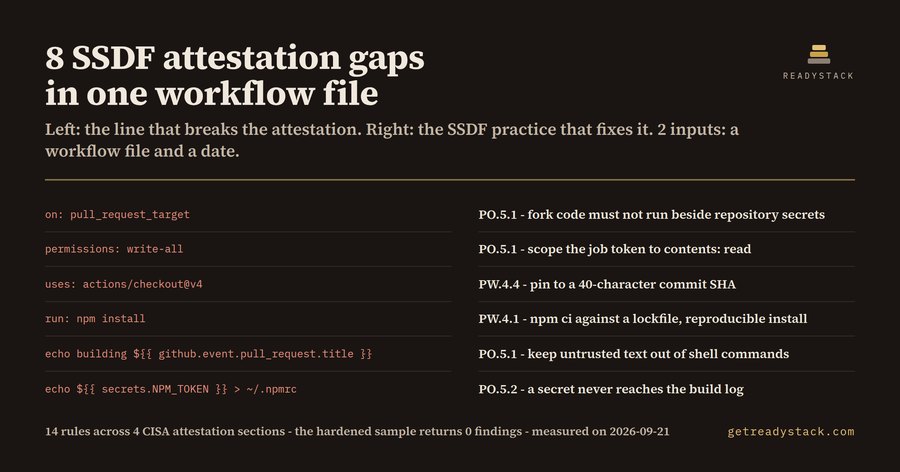
An AI assistant will happily write you a GitHub Actions workflow that looks professional and still cannot survive the attestation your executive signs. This extension reads the workflow file you have open and marks every line that contradicts the CISA Secure Software Development Attestation Common Form, naming the NIST SSDF (SP 800-218) practice and the form section behind each mark. Hub: https://getreadystack.com/tools/ssdf-attestation-workflow-audit What it checks14 rules, grouped by the four attestation sections of the Common Form:
Measured on the two bundled fixtures on 2026-09-21: the hardened release workflow returns 0 findings; the AI-written deploy workflow returns 8 findings across three of the four sections. ExampleEach finding carries its practice ID, so the line you fix is the line you can point at later when someone asks which control the claim rests on. Two inputsThe same engine runs in the editor and on the one-page web version: a workflow file and a date. The date is not decoration — findings that come from an absent control also report how many days remain to the 30 September federal fiscal-year end, the boundary where new awards and renewals are signed. Free and fullFree: audit the workflow file you have open and list every attestation gap with its SSDF practice ID and the CISA form section it sits under. That job finishes on its own. Full version: audit every workflow in the repository at once and export one dated evidence table mapped to all four attestation sections — https://buy.polar.sh/polar_cl_p4a0TbqABh9QIIJlOPNxkwxm8shyqSsnSn23v05tEw7 Yardstick: a US application-security contractor bills roughly 150-250 an hour to review and re-pin a release pipeline by hand. NotesThis extension reports what the workflow file shows. It does not submit anything to an agency, and it is not legal advice. The attestation itself is signed by a chief executive or a designated employee; these findings are the evidence that sits under that signature. |