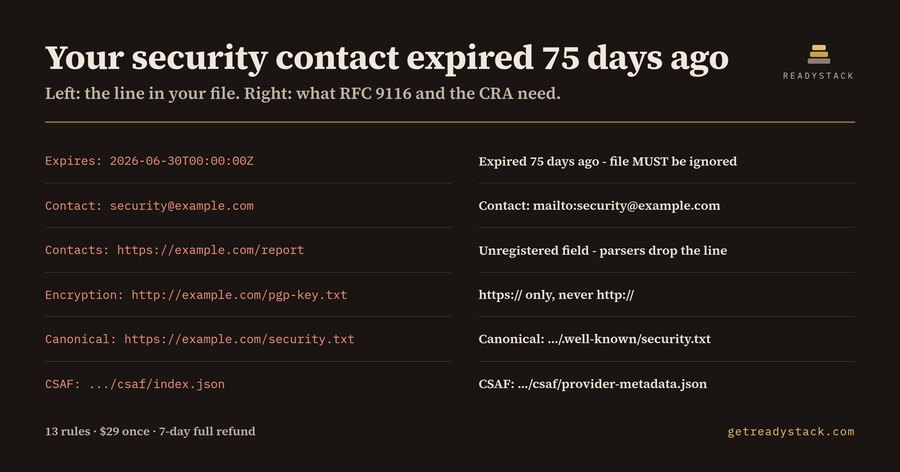
Your /.well-known/security.txt is the address a stranger uses to tell you that your product is
being exploited. Since 11 September 2026 the EU Cyber Resilience Act (Regulation (EU) 2024/2847,
Article 14) has run three clocks from the moment you learn about an actively exploited vulnerability:
an early warning within 24 hours, a vulnerability notification within 72 hours, and a final
report within 14 days. Those clocks start when the report reaches you. A security.txt with an
expired Expires: line is, in the words of RFC 9116, a file that MUST be ignored — the reporter
sees nothing, and your first clock is already running before anyone in your company knows.
This extension lints security.txt the way a scanner and a reporter read it, with 13 rules from
RFC 9116 and the CRA coordinated-vulnerability-disclosure expectation (Annex I, Part II(5)).
What it checks
| Rule |
Why it breaks |
contact_missing, contact_not_uri |
Contact is mandatory and must be a URI — security@example.com is not one, mailto:security@example.com is |
expires_missing, expires_invalid, expires_past, expires_over_year |
Expires is mandatory, must be a full RFC 3339 timestamp, must be in the future, should be under a year out |
field_duplicate |
Expires, Canonical and Preferred-Languages may appear only once |
insecure_url |
every web URI must be https:// |
canonical_wellknown |
Canonical must be the /.well-known/security.txt URI that scanners actually fetch |
policy_missing |
no published disclosure policy for the reporter to follow |
csaf_not_provider |
CSAF must be a provider-metadata.json URI, not an advisory index |
unknown_field |
Contacts: or Policy-URL: are dropped silently by every parser |
malformed_line |
a line without a colon is not parsed at all |
Run it
Open a security.txt and run security.txt Lint: Check this file from the Command Palette.
Findings arrive as diagnostics on the exact line, with the rule reference and, for dates, the
computed number of days.
On the 10-line sample file shipped in _fixtures/dirty.txt it returns 9 findings — 5 errors and
4 warnings — including an Expires value that ran out 75 days before the file was linted.
The clean sample returns 0.
Free and full
Linting the file you have open is free and finishes the job: every rule, every line, no key.
The full version scans every security.txt in the workspace in one pass and writes a dated JSON
report you keep for the audit file. Reviewing a disclosure policy with a security consultant starts
around $150 an hour; this reads the file in under a second.
Full version: workspace sweep + dated JSON report - $29 once, one licence key
per person or team seat, 7-day full refund.
Why not a chatbot
A general model will happily write you a security.txt. It will also leave out Expires (the one
field RFC 9116 added and made mandatory), write Contact: security@example.com without the
mailto: scheme, and it cannot know today's date — so it cannot tell you that the file on your
server went stale 75 days ago. Those are exactly the lines this tool counts.
More tools: https://getreadystack.com/tools/security-txt-cra-lint
MIT licensed. Findings are computed locally; nothing leaves your machine.

