PQC Deprecation Lint — RSA/ECC after 2030Finds quantum-vulnerable crypto (RSA, ECDSA, ECDH, DH, SHA-1, 3DES) in your code and config and dates each one against the NIST IR 8547 clock: deprecated after 2030, disallowed after 2035. Installation Launch VS Code Quick Open ( Ctrl+P), paste the following command, and press enter.Copied to clipboard |

PQC Deprecation Lint — RSA/ECC after 2030
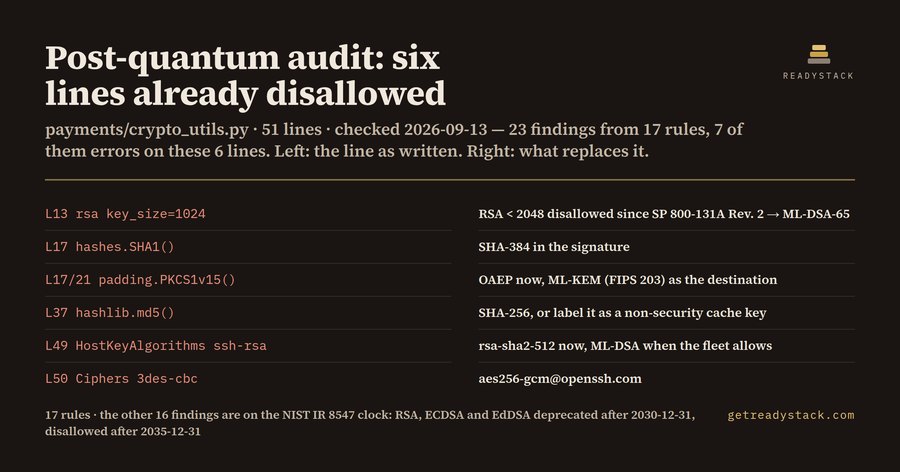
Your AI assistant writes It also catches the part that is not a 2030 problem at all. In the 51-line sample file shipped
with this extension, 23 findings come back on 2026-09-13, and 7 of them are errors on 6
lines — RSA-1024, SHA-1 in a signature, PKCS#1 v1.5 padding, MD5, What it checks — 17 rules
Each finding carries the line number, the standard it comes from (NIST IR 8547, SP 800-131A
Rev. 2, FIPS 186-5, FIPS 203/204/205, NSA CNSA 2.0), and the concrete replacement — not "consider
migrating", but The date is an input, not a decorationSet the date and the answer changes, because the standard changes. On the sample file:
That is the number you actually need in a migration plan: not "RSA is bad", but how many working days are left before the algorithm in front of you stops being acceptable. Commands
Free and paidFree finishes a job on its own: open a file, run the check, see every quantum-vulnerable algorithm in it with line numbers and dates. There is no watermark, no trial counter and no withheld answer. The paid part is a different axis — scope and ownership. The workspace sweep crosses every file at once and writes a dated report file you keep: the artifact you paste into a customer security questionnaire, attach to a migration ticket, or diff next quarter. $29 once, one licence key per person or CI seat, 7-day full refund. Get the full version Yardstick: a security consultant doing the same cryptographic inventory by hand bills $150–$250 an hour, and the first pass over one repository is a day. Free web versionThe same engine, byte for byte, runs in your browser with nothing uploaded: https://getreadystack.com/tools/pqc-deprecation-lint NotesResults are advisory and are not legal or certification advice. The rule set is regex-based and
deliberately noisy on the side of showing you the line: a linter that silently skips your
|