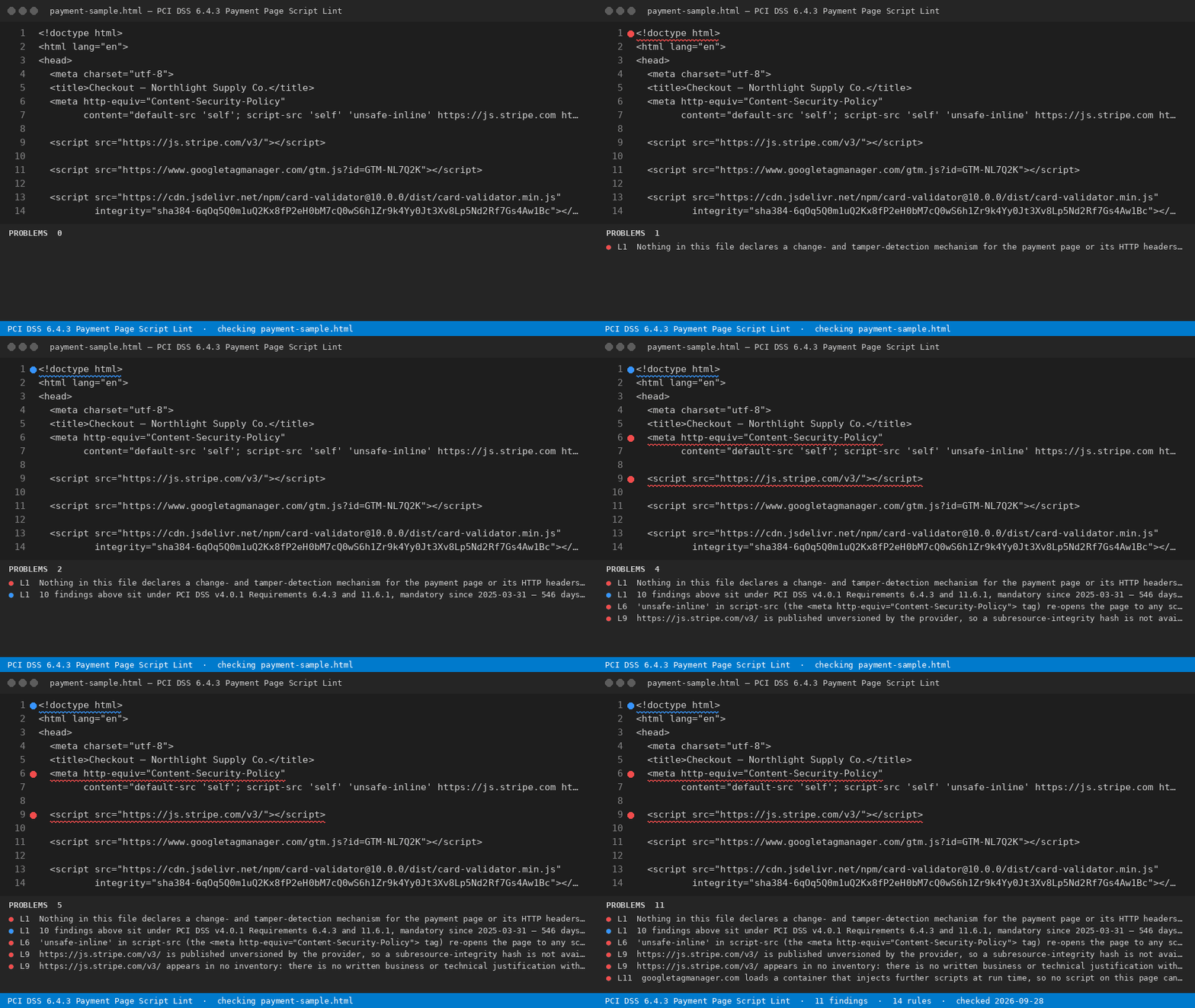
PCI DSS 6.4.3 Payment Page Script LintLints checkout and payment pages against PCI DSS v4.0.1 Requirements 6.4.3 and 11.6.1 — script authorization, SRI integrity, written justification and tamper detection. Mandatory since 2025-03-31. Installation Launch VS Code Quick Open ( Ctrl+P), paste the following command, and press enter.Copied to clipboard |

PCI DSS 6.4.3 Payment Page Script Lint
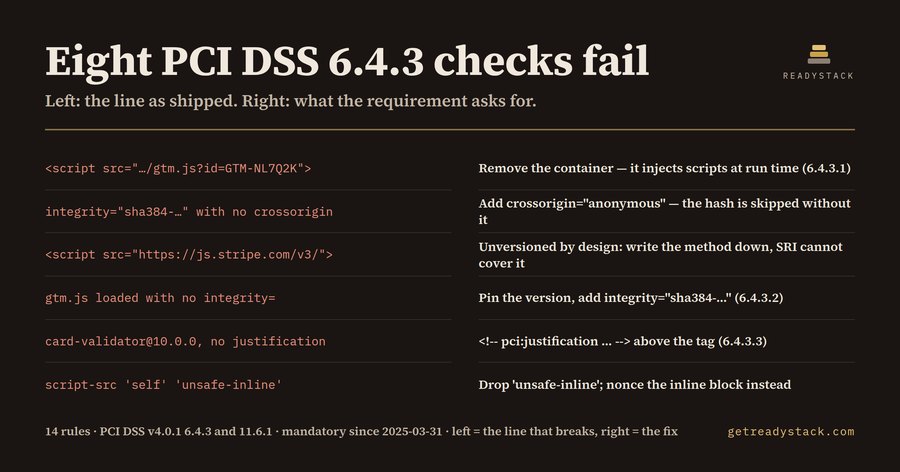
Reads a payment page and reports it against PCI DSS v4.0.1 Requirements 6.4.3 and 11.6.1 — the two requirements that stopped being "best practice" and became mandatory on 2025-03-31. Online, free, nothing uploaded: https://getreadystack.com/tools/pci-dss-6-4-3-payment-script-lint Why these two requirements catch people out6.4.3 asks for three things about every script that runs in the buyer's browser on a payment page: a method that confirms the script is authorized, a method that assures its integrity, and an inventory with a written business or technical justification for each one. 11.6.1 asks for a change- and tamper-detection mechanism on the payment page and its HTTP headers as the consumer browser receives them. Both were future-dated in PCI DSS v4.0, which is why so much still-circulating guidance — and most code an assistant writes for you — treats them as optional. As of 2026-09-11 that date is 529 days past. The mistakes are mechanical, and that is what this checks:
What it does14 checks. It works on A file is only treated as a payment page if it loads a known payment provider script, declares a card-number field, carries a Findings land in the Problems panel with the requirement number attached, and in an output channel as text. Commands
Free and paidFree: check the payment page open in your editor against all 14 checks. Every finding, every requirement number, every suggested fix. No key, no limit, no watermark, no counter. Paid ($29 once): sweep the whole workspace and write the dated script inventory to The line between them is scope and ownership, not capability. One file is a complete job; a repo-wide dated inventory is a different job. QSA assessment time bills at roughly $200 an hour. How to record a justificationOr LimitsStatic analysis of source text. It cannot see scripts injected at run time, headers set by your CDN, or a CSP delivered by a server you did not check in. Findings are advisory and are not legal advice or an assessment. |