Skip to content
| Marketplace
Sign in
Visual Studio Code>Linters>OpenAPI Security Contract LintNew to Visual Studio Code? Get it now.
OpenAPI Security Contract Lint

OpenAPI Security Contract Lint

ReadyStack

| (0) | Free
Finds the lines in an OpenAPI file that publish an endpoint with no authentication, an API key in the query string, or an OAuth grant that RFC 9700 forbids.
Installation
Launch VS Code Quick Open (Ctrl+P), paste the following command, and press enter.
Copied to clipboard
More Info

OpenAPI Security Contract Lint

OpenAPI Security Contract Lint

Hub page: https://getreadystack.com/tools/openapi-security-contract-lint

An OpenAPI document is not documentation. It is the file your API gateway imports, the file your SDK generator reads, and the file an auditor asks for first. Whatever it declares becomes the contract — including the parts nobody meant to declare.

This extension reads that file the way a reviewer does: line by line, against 18 rules drawn from the OWASP API Security Top 10 (2023), RFC 9700 (BCP 240, January 2025) and RFC 8594.

Why the file matters right now

Since 11 September 2026 the EU Cyber Resilience Act's reporting clock runs: an actively exploited vulnerability in a product with digital elements sold into the EU is reported within 24 hours, with a follow-up at 72 hours and a final report at 14 days. The OpenAPI document is the written description of the interface being reported on.

What it reads

Any .yaml, .yml or .json OpenAPI document in your workspace. It is a text pass — no network call, no schema resolution, no upload. The file never leaves the machine.

The 18 rules

Authentication declared away

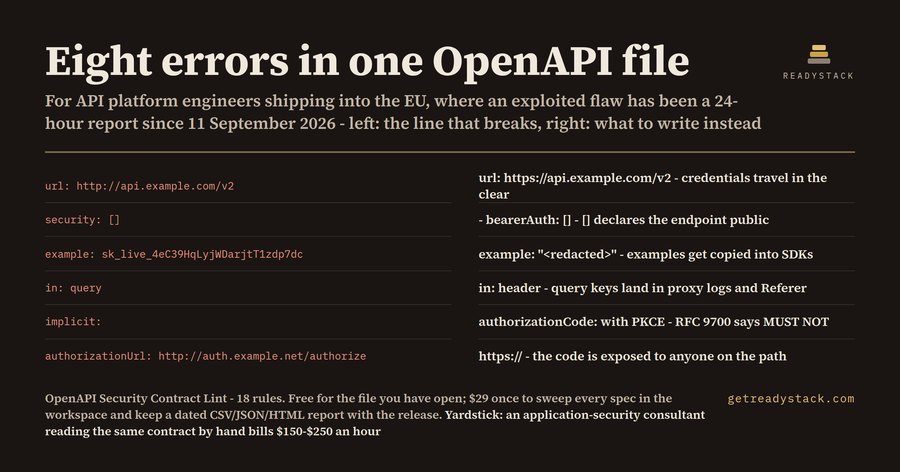
  • security: [] on an operation — the spec says "no authentication required"
  • security: [] at document level — the whole API declared public
  • paths present with no top-level security block — auth becomes opt-in per operation
  • A security scheme defined under components but never referenced anywhere

Credentials in the wrong place

  • apiKey with in: query — the key lands in proxy logs, browser history and Referer
  • scheme: basic — a static credential replayed on every call
  • An example: or default: carrying a live-looking token (sk_live_, ghp_, AKIA…, a JWT, a PEM private key)

OAuth grants RFC 9700 forbids

  • implicit — the token comes back in the URL fragment; RFC 9700 §2.1.2 says MUST NOT
  • password — the resource owner password credentials grant; RFC 9700 §2.4 says MUST NOT
  • authorizationUrl / tokenUrl / refreshUrl on http://
  • An OAuth flow with an empty scopes map — one all-or-nothing token
  • A wildcard or catch-all scope

Transport and surface

  • A servers entry on http:// (localhost excepted)
  • No https:// server anywhere in the document
  • A /debug, /trace, /actuator or /internal path published in the same document you hand to external callers

Contract holes

  • An operation with no 429 response documented
  • additionalProperties: true on a request schema — the mass-assignment route
  • deprecated: true with no sunset date named anywhere in the document

Measured on the fixture that ships with this extension

_fixtures/dirty.yaml is 59 lines and declares 2 paths and 3 operations. The engine returns 21 findings — 8 errors and 13 warnings — touching 17 of the 18 rules. _fixtures/clean.yaml is 63 lines and returns 0. The same engine file runs in the extension and on the free web page, so both give the same answer for the same bytes.

Free

Audit the OpenAPI file open in the editor, top to bottom. Every finding, every line number, every rule reference. Nothing is withheld, redacted or counted down. That job finishes on its own.

With a licence — $29 once

  • Sweep every OpenAPI document in the workspace, not only the open tab — versioned copies under docs/, per-environment overlays, the generated spec in build/
  • Write a dated report (CSV, JSON or HTML) you keep next to the release as evidence the check was run against this commit
  • The JSON output is shaped for a CI step, so a pipeline can fail a branch that reintroduced security: []

One licence key per person or CI seat.

What it costs to do by hand

An application-security consultant reading the same contract bills $150–$250 an hour, and the OAuth grant and scope questions are the slow part.

Commands

  • OpenAPI Security: Check this file
  • OpenAPI Security: Sweep the workspace (licence)
  • OpenAPI Security: List the rules
  • OpenAPI Security: Enter licence key

Licence and privacy

MIT for the extension source. No telemetry. The licence check is a single HTTPS call to the vendor's key-validation endpoint and sends only the key you typed.

  • Contact us
  • Jobs
  • Privacy
  • Manage cookies
  • Terms of use
  • Trademarks
  • Your Privacy Choices
  • Consumer Health Privacy
© 2026 Microsoft