MySQL 8.4 Upgrade Lint (RDS MySQL 8.0)
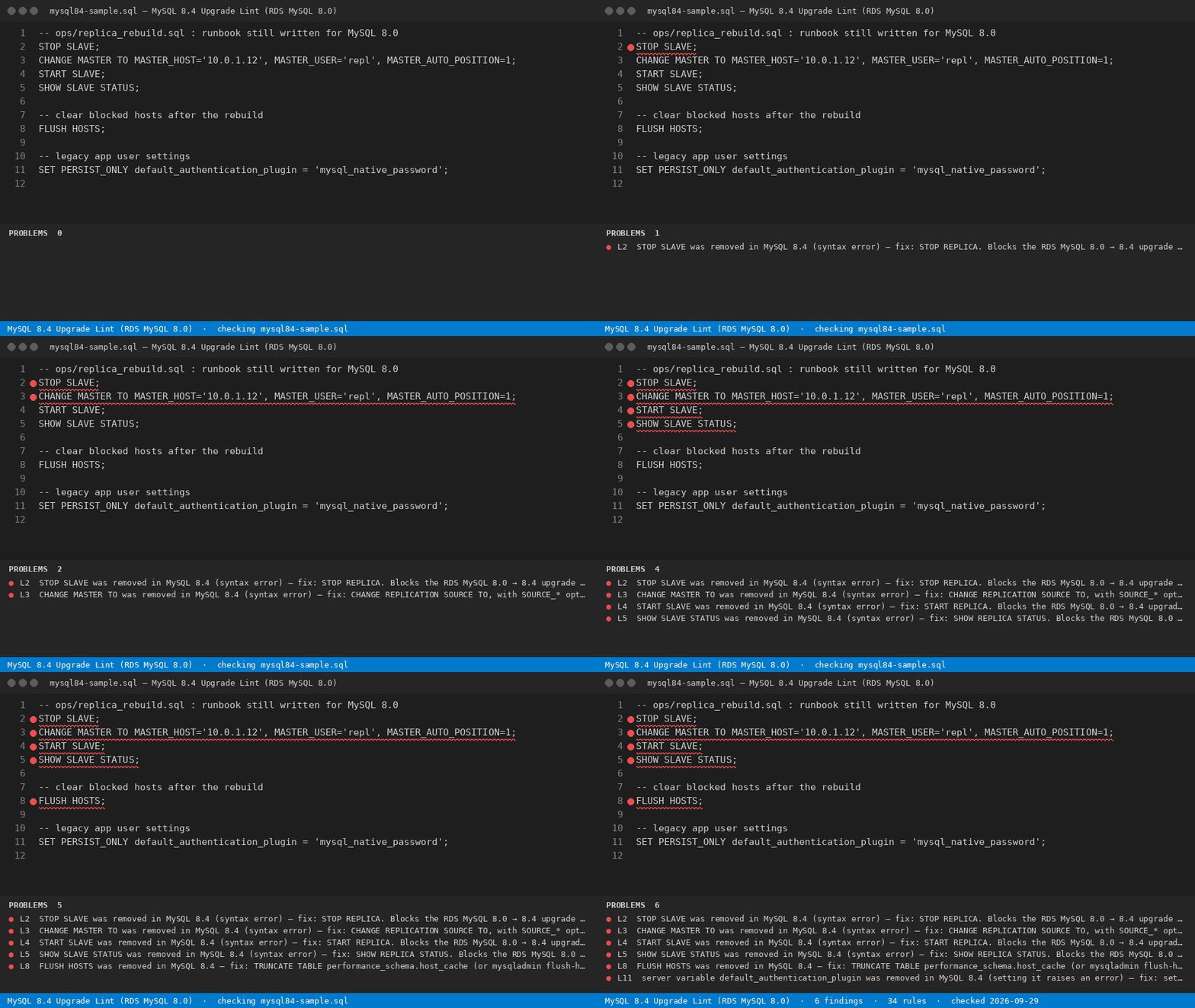
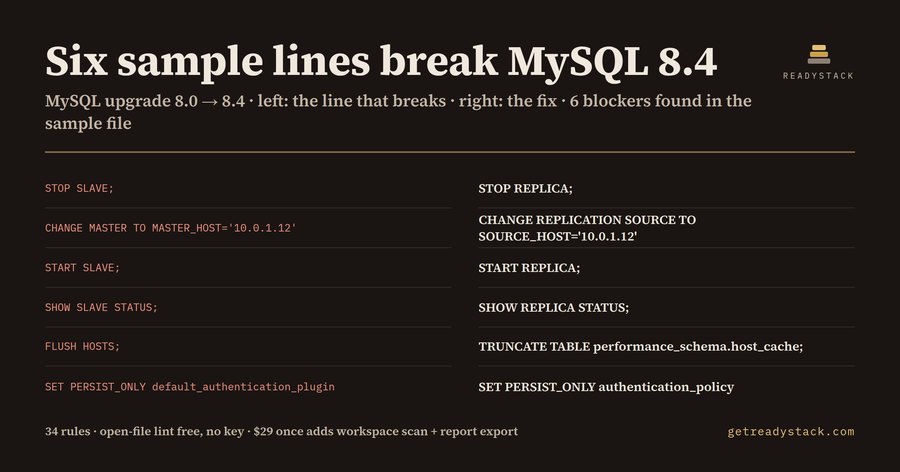
Six lines in the bundled sample runbook break a MySQL 8.0 → 8.4 upgrade: STOP SLAVE, CHANGE MASTER TO, START SLAVE, SHOW SLAVE STATUS, FLUSH HOSTS and SET PERSIST_ONLY default_authentication_plugin. This extension finds lines like them in your .sql, my.cnf, .ini and Terraform parameter-group files with 34 rules taken from the MySQL 8.4 reference manual, and prints the replacement on every line.
Tool page: https://getreadystack.com/tools/mysql84-upgrade-blocker-lint
Why now
Amazon RDS for MySQL 8.0 reached the end of standard support on 31 July 2026 (AWS RDS for MySQL release calendar). Every RDS MySQL 8.0 instance still running has been enrolled in RDS Extended Support since 1 August 2026. Year 3 pricing starts on 1 August 2028 and Extended Support ends on 31 July 2029.
Yardstick: AWS's own pricing example for RDS for MySQL is $0.100 per vCPU-hour in US East (Ohio) for years 1 and 2. One 8-vCPU instance running 8,760 hours a year: 8 × $0.100 × 8,760 = $7,008 a year, on top of the instance price.
What it checks
MySQL 8.4 LTS removed, not just deprecated, a long list of statements, options and variables. Attempting to use them now raises a syntax error or refuses to start the server. The rules cover:
- Replication statements:
START SLAVE, STOP SLAVE, RESET SLAVE, SHOW SLAVE STATUS, SHOW SLAVE HOSTS, CHANGE MASTER TO, RESET MASTER, SHOW MASTER STATUS, SHOW MASTER LOGS, PURGE MASTER LOGS
MASTER_* options such as MASTER_HOST, MASTER_AUTO_POSITION, MASTER_LOG_POS and GET_MASTER_PUBLIC_KEY (use the SOURCE_* names)FLUSH HOSTS (use TRUNCATE TABLE performance_schema.host_cache)- Server variables and options:
default_authentication_plugin, binlog_transaction_dependency_tracking, transaction_write_set_extraction, skip-host-cache, ssl / have_ssl / have_openssl, slave_rows_search_algorithms, log_bin_use_v1_events, master_info_repository, relay_log_info_repository, avoid_temporal_upgrade, show_old_temporals, --old, --new, --language, --skip-innodb, --no-dd-upgrade
- Group Replication:
group_replication_ip_whitelist, group_replication_primary_member, group_replication_recovery_complete_at
- Removed plugins:
keyring_file, keyring_encrypted_file, keyring_oci, authentication_fido
- Removed
Com_slave_* / Com_show_master_status status variables that monitoring queries still read
- Warnings:
IDENTIFIED WITH mysql_native_password (no longer enabled by default in 8.4) and DISABLE ON SLAVE (deprecated)
Lines inside -- comments, /* */ openers and # / ; config comments are skipped.
How to use
- Open a
.sql, .cnf, .ini or .tf file.
- Findings appear in the Problems panel with the line number, what 8.4 removed and the line to write instead.
- Run MySQL 8.4 Upgrade Lint (RDS MySQL 8.0): Check this file from the command palette at any time.
Nothing leaves your machine. The same engine runs in the free web page on the tool page above.
Why the built-in checks miss these
The RDS pre-upgrade check and util.checkForServerUpgrade() read the objects inside the running database. They do not read the runbooks, cron scripts, Ansible templates, my.cnf files and Terraform parameter groups in your Git repository. A SHOW SLAVE STATUS in a monitoring script upgrades without a complaint and fails the first time it runs on 8.4. Chatbots trained on years of MySQL 5.7 and 8.0 examples still write CHANGE MASTER TO.
Free and full version
Free, no key: lint the open file, every rule, every fix. The full version (one licence key, $29 once) scans every migration, my.cnf and parameter group in the workspace at once and exports one upgrade-blocker report as Markdown and CSV for the upgrade ticket: https://getreadystack.com/api/buy/cl/polar_cl_pDhhhYZlkALQMCGNQVCneKjQVhPTdXCo63mRO2H3r2E
Sources
- MySQL 8.4 Reference Manual, "What Is New in MySQL 8.4 since MySQL 8.0", section "Features Removed in MySQL 8.4"
- Amazon RDS for MySQL User Guide, "MySQL versions" release calendar (8.0: end of standard support 31 July 2026, Extended Support year 1 from 1 August 2026)
- Amazon RDS for MySQL pricing, "RDS Extended Support pricing example" ($0.100 per vCPU-hr, US East (Ohio))
| |